Unit 7: Short Fiction III – Nuance and Complication in Narrative Strategy
Advanced Analysis: Complexity in Short Fiction
In Unit 7, we move beyond the basics of plot and character identification into the sophisticated mechanics of storytelling. Advanced analysis requires you to dissect how a story is told—specifically looking at the "lens" through which we view the events. This section focuses on the manipulation of narrative voice and structure to create ambiguity, irony, and deep psychological realism.
Narrator Reliability
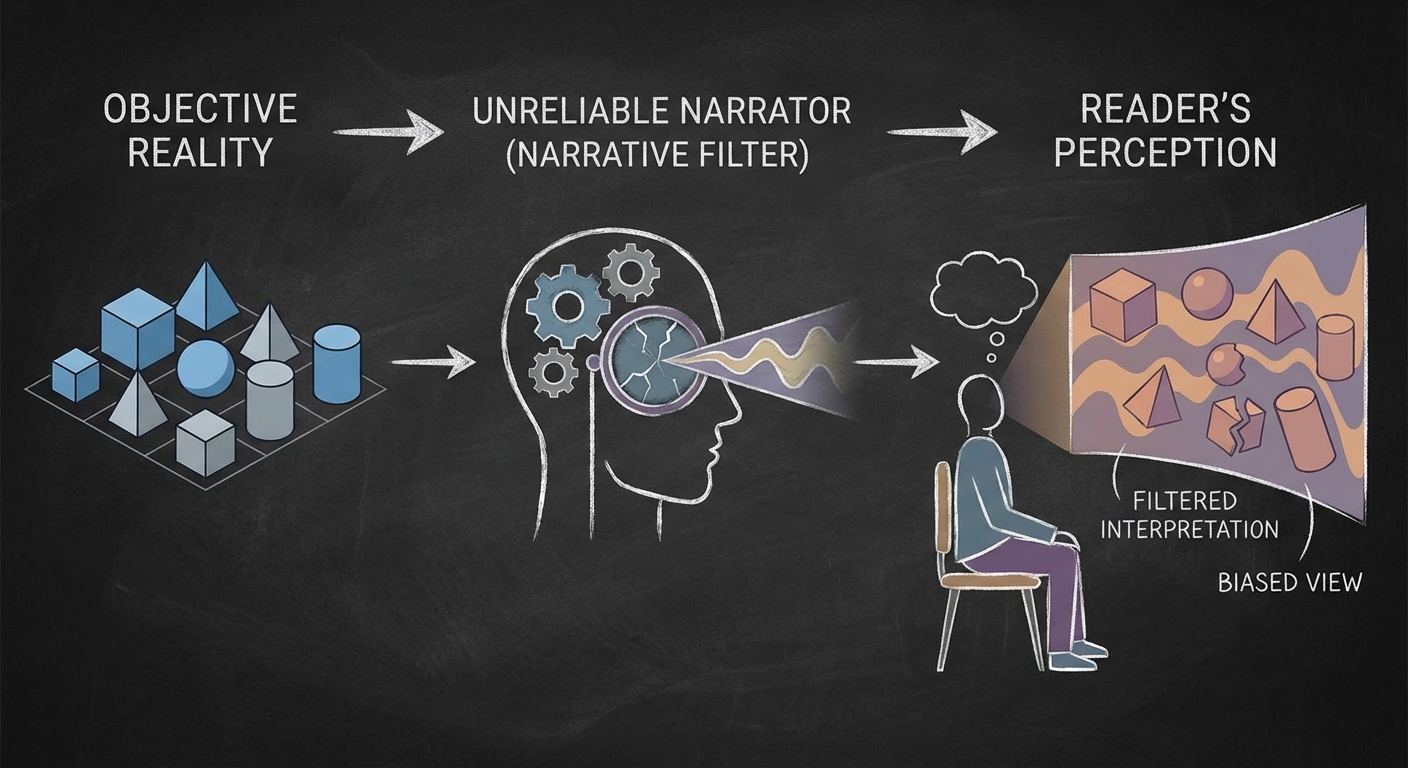
The narrator is not a neutral reporter; they are a filter. In advanced fiction, authors often utilize an Unreliable Narrator—a storyteller whose credibility has been seriously compromised.
Defining Unreliability
An Unreliable Narrator provides a distorted view of the events, misleading the reader either intentionally or unintentionally. The presence of such a narrator forces the reader to look past the text to find the "truth" of the story.
Categories of Unreliability
While not every narrator falls neatly into a box, most unreliable narrators exhibit one of the following traits:
- The Naïf (innocent/immature): A narrator whose perception is limited by their age or lack of experience. They report events accurately but misunderstand their significance.
- Example: A child describing a violent argument as a "loud game."
- The Madman (mental instability): A narrator whose psychological state distorts reality. They may hallucinate, exhibit paranoia, or dissociate.
- Example: The narrator in Charlotte Perkins Gilman’s The Yellow Wallpaper.
- The Liar (moral/ethical defiance): A narrator who deliberately deceives the reader to hide a crime, preserve their reputation, or manipulate the audience.
- Example: The narrator in Poe's The Tell-Tale Heart insisting heavily on their own sanity.
The Role of Irony
Unreliable narration creates Dramatic Irony. This occurs when there is a gap between what the narrator perceives and what the reader understands.
To analyze this in an essay:
- Identify the specific bias or limitation.
- Point out the discrepancy between the narrator's account and the likely reality.
- Explain why the author chose this perspective (e.g., to generate sympathy, to study a specific pathology, or to critique social norms).
Stream of Consciousness and Interior Monologue
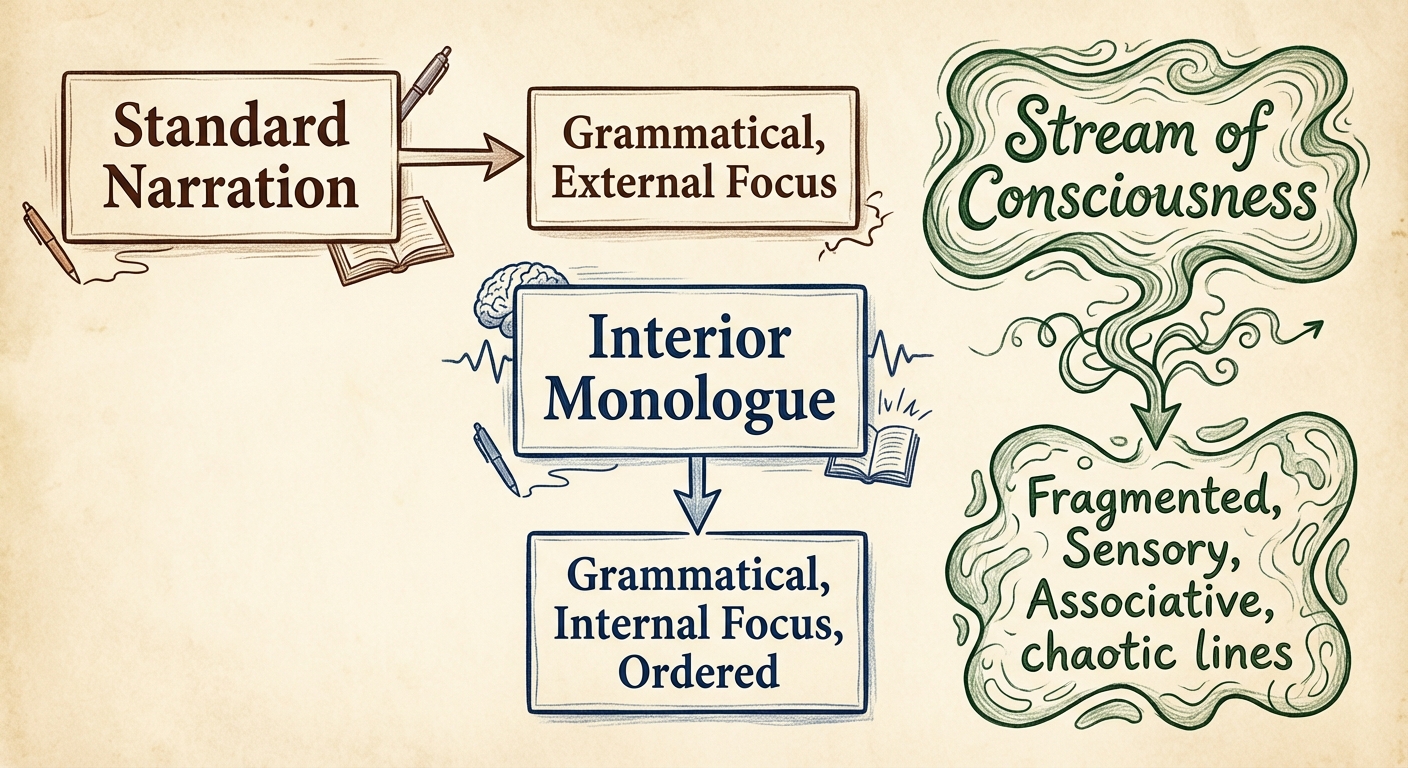
Authors use specific narrative modes to replicate the chaos of the human mind. While often used interchangeably, there are nuance differences between these techniques.
Interior Monologue
Interior Monologue is a representation of a character's internal thoughts. It tends to be somewhat coherent and grammatical, resembling a silent speech the character is making to themselves.
- Characteristics:
- Follows a logical progression of thought.
- Usually maintains standard syntax (sentence structure).
- Focuses on specific decisions or reflections.
Stream of Consciousness
Stream of Consciousness attempts to replicate the raw, unpolished flow of the mind. It includes sensory impressions, incomplete thoughts, and rapid associations.
- Characteristics:
- Associative Leaps: Moving from one thought to another based on sensory triggers rather than logic.
- Fragmented Syntax: Run-on sentences, lack of punctuation, or incomplete phrases.
- Sensory Overload: Blending external stimuli (sounds, sights) with internal memories.
Example: Analyzing Syntax
When you see a long, unpunctuated sentence in a short story (like in Katherine Anne Porter’s The Jilting of Granny Weatherall), ask yourself:
"Is this confusion meant to show the character's deteriorating mental state, or is it capturing the overwhelming speed of their thoughts?"
Complex Narrative Structures
Unit 7 emphasizes that stories are not always linear lines moving from A to B. Authors manipulate Pacing and Sequence to control tension and thematic revelation.
Non-Linear Narratives
Authors may disrupt the chronology of a story to change how we process information.
- In Media Res: Starting "in the midst of things." This creates immediate tension and forces the reader to piece together the backstory later.
- Flashback (Analepsis): Interrupting the present action to show past events.
- Analysis Note: Do not just say "there is a flashback." Explain how placing the past event at this specific moment changes our understanding of the current conflict.
Frame Narratives
A Frame Narrative (or embedded narrative) is a "story within a story." It typically involves an introductory narrator who sets the scene, then introduces a second narrator who tells the main story.

- Function within Short Fiction:
- Distance: It creates emotional distance between the reader and the main events.
- Reliability Check: The outer narrator can cast doubt on the inner narrator's story.
- Context: It provides a specific setting in which the story is being told (e.g., a campfire, a ship deck), which colors the meaning of the tale.
Epistolary Format
Stories told through documents, such as letters, diary entries, or emails.
- Key Effect: This creates a sense of immediacy and intimacy (identifying with the