AP Calculus AB Unit 3 Study Guide: Implicit Differentiation, Tangent Lines, and Higher-Order Implicit Derivatives
Implicit Differentiation
Explicit vs. implicit relationships (what “implicit” means)
In many early calculus problems, you’re given a function in explicit form, where the dependent variable is isolated and written directly in terms of the independent variable. Examples include:
y = x^2 - 4x + 7
y = x^2 + 3x
y = \sqrt{25 - x^2}
However, many important relationships in geometry and physics are implicit: the equation mixes the variables together rather than isolating one of them. These relations often define curves that are not functions (they can fail the vertical line test) or are simply unpleasant or impossible to solve for the dependent variable.
Examples of implicit equations:
x^2 + y^2 = 25
y^3 + x^3 = 6xy
The first equation is a circle, and the second is the Folium of Descartes. Even if you haven’t solved for the dependent variable, the key idea is still true: on the curve, the dependent variable changes when the independent variable changes.
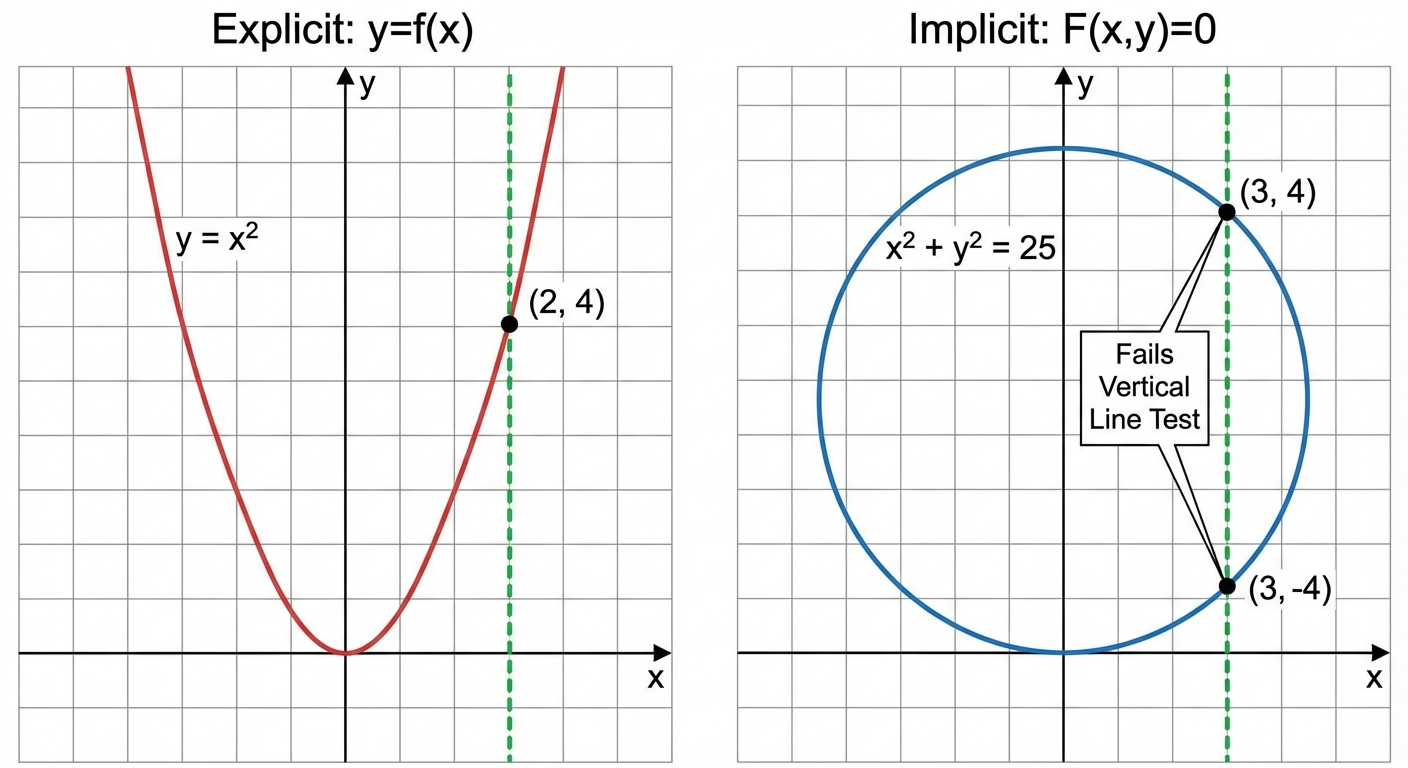
Implicit differentiation is the technique used to find the derivative (the slope of the tangent line) without isolating the dependent variable first.
Why this matters in AP Calculus AB: it lets you find slopes of curves that aren’t functions (like circles or sideways parabolas), it’s a common path to a tangent line equation when solving explicitly would be messy, and it directly tests your Chain Rule instincts.
The central idea: treat the dependent variable as a function
When you see an implicit equation, mentally treat the dependent variable as a function of the independent variable. That’s why differentiating it with respect to the independent variable produces:
\frac{d}{dx}(y) = \frac{dy}{dx}
and, for a power,
\frac{d}{dx}(y^2) = 2y\frac{dy}{dx}
That extra factor is the single most common thing students forget.
The Chain Rule connection (rule of thumb)
The most critical concept in implicit differentiation is remembering that the dependent variable is a function, even if you don’t know the explicit formula. So whenever you differentiate something that contains the dependent variable, you must use the Chain Rule.
Rule of thumb:
\frac{d}{dx}[f(y)] = f'(y)\frac{dy}{dx}
Common derivatives you should recognize quickly:
| Expression | Derivative with respect to the independent variable | Explanation |
|---|---|---|
| x^3 | 3x^2 | Standard power rule. |
| y^3 | 3y^2\frac{dy}{dx} | Outer power rule times derivative of the inside. |
| x + y | 1 + \frac{dy}{dx} | Sum rule. |
| xy | y + x\frac{dy}{dx} | Product Rule (a very common trap). |
Notation you must be comfortable with
AP problems use multiple notations for derivatives. You should be fluent translating between them.
| Meaning | Common notations |
|---|---|
| First derivative | %%LATEX16%% and %%LATEX17%% |
| Second derivative | %%LATEX18%% and %%LATEX19%% |
In implicit work, the fraction form is often clearer because it constantly reminds you what you’re differentiating with respect to.
Standard procedure (a reliable process)
To find the first derivative from an implicit equation, use this workflow:
- Differentiate both sides with respect to the independent variable.
- Apply the Chain Rule whenever you differentiate a term containing the dependent variable (attach a factor of the first derivative).
- Collect all terms containing the first derivative on one side.
- Factor out the first derivative.
- Divide to solve for the first derivative.
- If needed, evaluate at a point by substituting coordinates into the final derivative.
A lot of mistakes here are algebra mistakes, not calculus mistakes, so take the “collect and factor” step seriously.
Worked Example 1: A circle (and why the derivative depends on both variables)
Find the first derivative for:
x^2 + y^2 = 25
Differentiate both sides:
2x + 2y\frac{dy}{dx} = 0
Solve for the first derivative:
2y\frac{dy}{dx} = -2x
\frac{dy}{dx} = -\frac{x}{y}
This depends on both coordinates, which matches the geometry: for a single independent-variable value on a circle, there can be two points (top and bottom) with different tangent slopes.
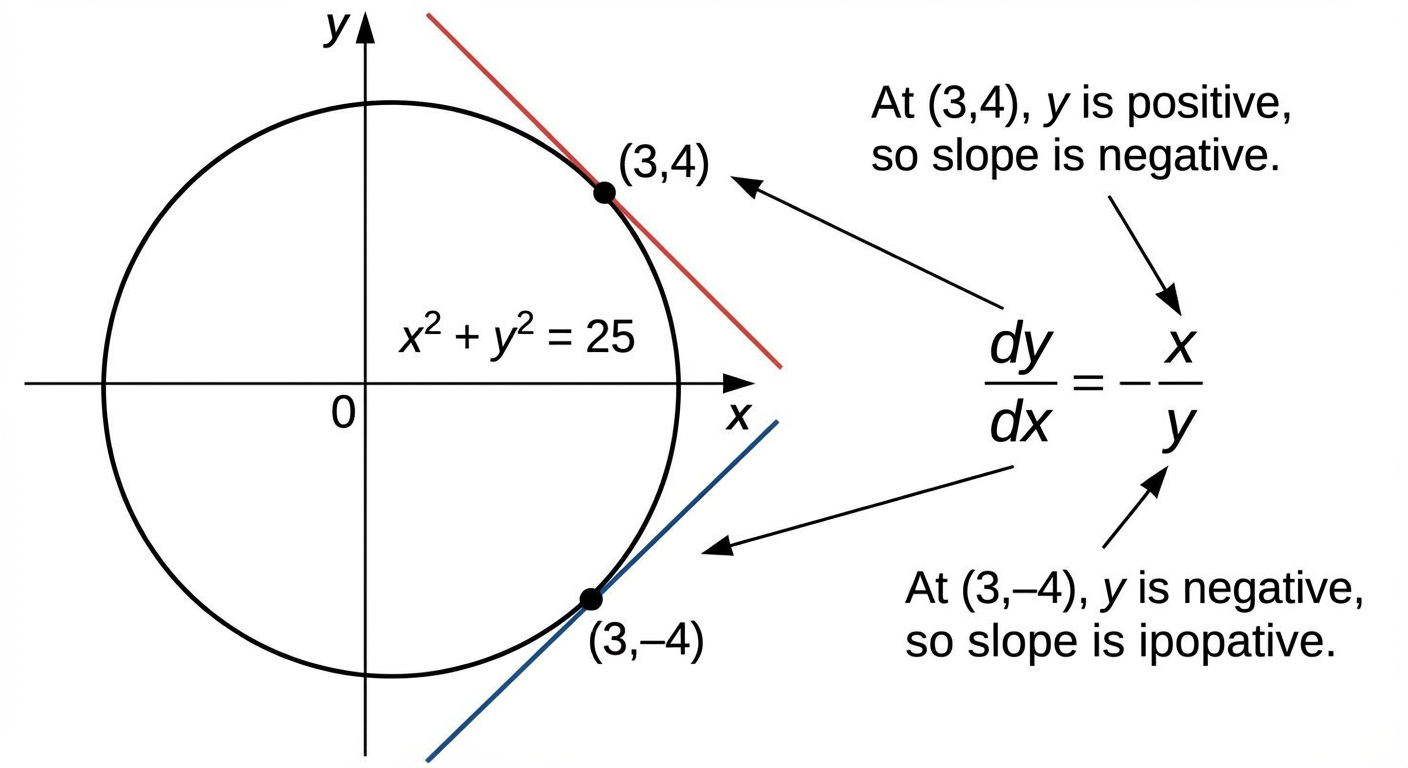
Evaluate the slope at a specific point such as:
\left(3,4\right)
Substitute into the derivative:
\frac{dy}{dx} = -\frac{3}{4}
A common misconception is trying to plug an independent-variable value into the original equation to “find the dependent variable” without thinking about sign. On a circle, the same independent-variable value can correspond to two different dependent-variable values, so you must choose the correct point (or use the point you’re given).
Tangent lines and normal lines (why implicit derivatives are useful)
Once you have the first derivative, you can write a tangent line even when the curve is not a function.
If the tangent slope at a point is the value of the first derivative and the point is:
\left(x_0,y_0\right)
then the tangent line is:
y - y_0 = m(x - x_0)
A normal line is perpendicular to the tangent line. If the tangent slope is nonzero:
m_{\text{normal}} = -\frac{1}{m}
On circles, the normal line often aims toward or away from the center, which can be a useful geometric check.
Worked Example 2: The Product Rule trap (classic AP-style)
Find the slope of the curve at the point:
\left(2,2\right)
given:
x^3 + y^3 = 4xy
Differentiate both sides. The right side requires the Product Rule; treat the constant multiple as outside and differentiate the product inside:
3x^2 + 3y^2\frac{dy}{dx} = 4\left(y + x\frac{dy}{dx}\right)
Expand the right side:
3x^2 + 3y^2\frac{dy}{dx} = 4y + 4x\frac{dy}{dx}
Group first-derivative terms:
3y^2\frac{dy}{dx} - 4x\frac{dy}{dx} = 4y - 3x^2
Factor and solve:
\frac{dy}{dx}\left(3y^2 - 4x\right) = 4y - 3x^2
\frac{dy}{dx} = \frac{4y - 3x^2}{3y^2 - 4x}
Evaluate at the point:
\frac{dy}{dx}\bigg|_{\left(2,2\right)} = \frac{4\left(2\right) - 3\left(2\right)^2}{3\left(2\right)^2 - 4\left(2\right)} = -1
Worked Example 3: Product and Chain Rule together (with trig)
Find the first derivative for:
xy + \sin(y) = x^2
Differentiate both sides. The product requires the Product Rule, and the sine term requires the Chain Rule:
x\frac{dy}{dx} + y + \cos(y)\frac{dy}{dx} = 2x
Collect and factor first-derivative terms:
x\frac{dy}{dx} + \cos(y)\frac{dy}{dx} = 2x - y
\frac{dy}{dx}\left(x + \cos(y)\right) = 2x - y
Solve:
\frac{dy}{dx} = \frac{2x - y}{x + \cos(y)}
What commonly goes wrong here is (1) forgetting the Product Rule on the product term and losing the standalone dependent-variable term, (2) differentiating the trig term without multiplying by the first derivative, and (3) solving but leaving first-derivative terms on both sides.
Implicit differentiation with powers of expressions (Chain Rule “layers”)
A frequent AB-style pattern is a power applied to an expression that includes the dependent variable, such as:
\left(x + y\right)^3 = x^2y
Differentiating the left side requires the Chain Rule, and differentiating the inside creates a second “layer” where the first derivative appears:
\frac{d}{dx}\left(\left(x+y\right)^3\right) = 3\left(x+y\right)^2\left(1+\frac{dy}{dx}\right)
Memory aid: when differentiating something involving the dependent variable, pause and ask, “Did I multiply by the first derivative somewhere?” If not, re-check your Chain Rule steps.
Worked Example 4: Tangent line from an implicit curve
Find the equation of the tangent line to:
x^2 + xy + y^2 = 7
at:
\left(1,2\right)
Differentiate implicitly:
2x + \left(x\frac{dy}{dx} + y\right) + 2y\frac{dy}{dx} = 0
Group first-derivative terms and solve:
x\frac{dy}{dx} + 2y\frac{dy}{dx} = -2x - y
\frac{dy}{dx}\left(x + 2y\right) = -2x - y
\frac{dy}{dx} = \frac{-2x - y}{x + 2y}
Evaluate at the point to get the slope:
\frac{dy}{dx}\bigg|_{\left(1,2\right)} = \frac{-2\left(1\right) - 2}{1 + 2\left(2\right)} = -\frac{4}{5}
Write the tangent line:
y - 2 = -\frac{4}{5}(x - 1)
A common mistake is substituting the point into the derivative before you’ve solved for the first derivative. Sometimes it works, but it often makes the algebra harder than it needs to be.
Horizontal and vertical tangents (common exam target)
You are often asked to find coordinates where the tangent line is horizontal or vertical. If your first derivative can be written as a fraction:
\frac{dy}{dx} = \frac{\text{Numerator}}{\text{Denominator}}
then:
- Horizontal tangent means slope is zero, so set the numerator equal to zero and confirm the denominator is not zero.
- Vertical tangent means the slope is undefined, so set the denominator equal to zero and confirm the numerator is not zero.
Important note: after you get a relationship from setting the numerator or denominator to zero, you usually must substitute back into the original implicit equation to find the actual coordinate point(s).
Exam Focus
- Typical question patterns
- Find the first derivative given an implicit equation, often including products, quotients, trig, or exponentials.
- Find the slope at a given point, or write the equation of the tangent line.
- Find where the tangent is horizontal or vertical by analyzing where the first derivative is zero or undefined.
- Common mistakes
- Forgetting Chain Rule factors of the first derivative when differentiating terms containing the dependent variable, especially powers and trig/exponential forms.
- Product Rule negligence on terms like products of the variables (or products like a power of the independent variable times the dependent variable), treating the dependent variable as a constant.
- Algebra slips when isolating the first derivative, such as failing to factor before dividing or incorrectly distributing negatives.
- Not checking the “extra condition” for horizontal versus vertical tangents (for example, setting the numerator to zero but accidentally choosing a point where the denominator is also zero).
Higher-Order Derivatives
What a higher-order derivative is
A higher-order derivative is a derivative taken more than once. The most common is the second derivative.
- The first derivative gives slope (rate of change of the dependent variable).
- The second derivative tells how that slope changes. In applications, it often represents acceleration when the dependent variable is position.
In AP Calculus AB, second derivatives are used heavily for concavity and points of inflection. With implicit curves, they also let you study curvature even when you can’t easily solve for the dependent variable.
Higher-order derivatives when the relationship is implicit
Once you have an expression for the first derivative, you can differentiate again to find the second derivative. The crucial idea is that even if you solved:
\frac{dy}{dx} = f(x,y)
the right side still depends on both variables. When differentiating again with respect to the independent variable, anything involving the dependent variable still triggers Chain Rule behavior, and any appearance of the first derivative is itself a function that must be differentiated appropriately.
Workflow for finding the second derivative implicitly
A dependable process looks like this:
- Find the first derivative by implicit differentiation.
- Differentiate again with respect to the independent variable.
- Treat the first derivative as a function when it appears during step 2.
- Solve for the second derivative.
- If you want a value at a point, substitute the coordinates and usually also substitute the first-derivative value at that point.
A classic AP Free Response requirement: if asked for the second derivative in terms of the variables, you typically must substitute the first-derivative expression back in so the final answer does not still contain the first derivative.
Worked Example 1: Second derivative for a circle (Quotient Rule + substitution)
Start with:
x^2 + y^2 = 25
First derivative:
\frac{dy}{dx} = -\frac{x}{y}
Now differentiate again:
\frac{d^2y}{dx^2} = \frac{d}{dx}\left(-\frac{x}{y}\right)
Use the Quotient Rule. Mnemonic form:
\frac{\text{Low}\cdot d\text{High} - \text{High}\cdot d\text{Low}}{\text{Low}^2}
Here the “high” is the numerator and the “low” is the denominator. Derivatives needed are:
\frac{d}{dx}(x) = 1
\frac{d}{dx}(y) = \frac{dy}{dx}
So:
\frac{d}{dx}\left(\frac{x}{y}\right) = \frac{y\cdot 1 - x\cdot \frac{dy}{dx}}{y^2}
Including the negative sign from the original expression:
\frac{d^2y}{dx^2} = -\frac{y - x\frac{dy}{dx}}{y^2}
This can also be written (by distributing the negative) as:
\frac{d^2y}{dx^2} = \frac{-y + x\frac{dy}{dx}}{y^2}
Now substitute the first-derivative expression:
\frac{d^2y}{dx^2} = -\frac{y - x\left(-\frac{x}{y}\right)}{y^2}
Simplify:
\frac{d^2y}{dx^2} = -\frac{x^2 + y^2}{y^3}
Use the original circle equation to replace the sum:
\frac{d^2y}{dx^2} = -\frac{25}{y^3}
Interpretation: the sign depends on the dependent-variable value. On the top half of the circle, the second derivative is negative (concave down), and on the bottom half, it’s positive (concave up), which matches the geometry.
Worked Example 2: Second derivative at a point on an implicit curve (often easiest by differentiating before solving)
Given:
x^2 + xy + y^2 = 7
At the point:
\left(1,2\right)
From implicit differentiation, the first derivative is:
\frac{dy}{dx} = \frac{-2x - y}{x + 2y}
Evaluate the first derivative at the point (you will likely need it):
\frac{dy}{dx}\bigg|_{\left(1,2\right)} = -\frac{4}{5}
To find the second derivative at the point, it is often cleaner to differentiate the unsolved first-derivative equation instead of differentiating a complicated fraction. Start from:
2x + x\frac{dy}{dx} + y + 2y\frac{dy}{dx} = 0
Differentiate again term by term.
- Derivative of the first term:
\frac{d}{dx}(2x) = 2
- Product Rule on the term:
x\frac{dy}{dx}
gives:
\frac{d}{dx}\left(x\frac{dy}{dx}\right) = \frac{dy}{dx} + x\frac{d^2y}{dx^2}
- Derivative of the dependent variable:
\frac{d}{dx}(y) = \frac{dy}{dx}
- For the term:
2y\frac{dy}{dx}
pull out the constant and use Product Rule:
\frac{d}{dx}\left(2y\frac{dy}{dx}\right) = 2\left(\left(\frac{dy}{dx}\right)^2 + y\frac{d^2y}{dx^2}\right)
So the second-derivative equation is:
2 + \left(\frac{dy}{dx} + x\frac{d^2y}{dx^2}\right) + \frac{dy}{dx} + 2\left(\left(\frac{dy}{dx}\right)^2 + y\frac{d^2y}{dx^2}\right) = 0
Substitute the point and the first-derivative value:
2 + \left(-\frac{4}{5} + \frac{d^2y}{dx^2}\right) -\frac{4}{5} + 2\left(\left(-\frac{4}{5}\right)^2 + 2\frac{d^2y}{dx^2}\right) = 0
Compute the square:
\left(-\frac{4}{5}\right)^2 = \frac{16}{25}
Continue simplifying:
2 - \frac{8}{5} + \frac{d^2y}{dx^2} + \frac{32}{25} + 4\frac{d^2y}{dx^2} = 0
Combine constants:
\frac{42}{25} + 5\frac{d^2y}{dx^2} = 0
Solve:
\frac{d^2y}{dx^2} = -\frac{42}{125}
Why this method helps: differentiating the solved fraction formula for the first derivative usually forces a messy Quotient Rule with lots of Chain Rule bookkeeping. Differentiating the earlier implicit form can reduce algebra overload.
Interpreting higher-order derivatives for implicitly defined curves
At a point on an implicit curve, interpretation works the same way as for explicit functions:
- The first derivative gives tangent slope.
- If the second derivative is positive, the curve is concave up at that point (on the local branch where the dependent variable behaves like a function).
- If the second derivative is negative, the curve is concave down at that point.
Just be cautious with language: implicit curves may fail the vertical line test, so concavity is most meaningful on a local piece of the curve where the dependent variable is a function of the independent variable.
Exam Focus
- Typical question patterns
- Find the second derivative at a given point on an implicit curve, usually after finding the first derivative.
- Find the second derivative and determine concavity at a point.
- Differentiate implicitly twice where the first-derivative equation is left unsimplified to make the second derivative more approachable.
- Common mistakes
- Treating the first derivative as a constant when differentiating again; it must be differentiated like any other function.
- Forgetting Product Rule on terms like:
y\frac{dy}{dx}
which produces both a squared-first-derivative term and a second-derivative term.
- Sign errors in the Quotient Rule; parentheses (and distributing negatives slowly) prevent many slips.
- Stopping too early on second derivatives: if asked for the second derivative in terms of the variables, leaving the first derivative in the final answer is usually incorrect, so substitute it back in.
- Plugging in the point too early and losing track of needed values, especially forgetting you often need the first derivative at the point before you can compute the second derivative at the point.