Unit 8 Applications of Integration (AP Calculus BC): Average Value, Net Change & Motion, Area Between Curves, and Volume
Average value of a function
What “average value” means and why integrals are involved
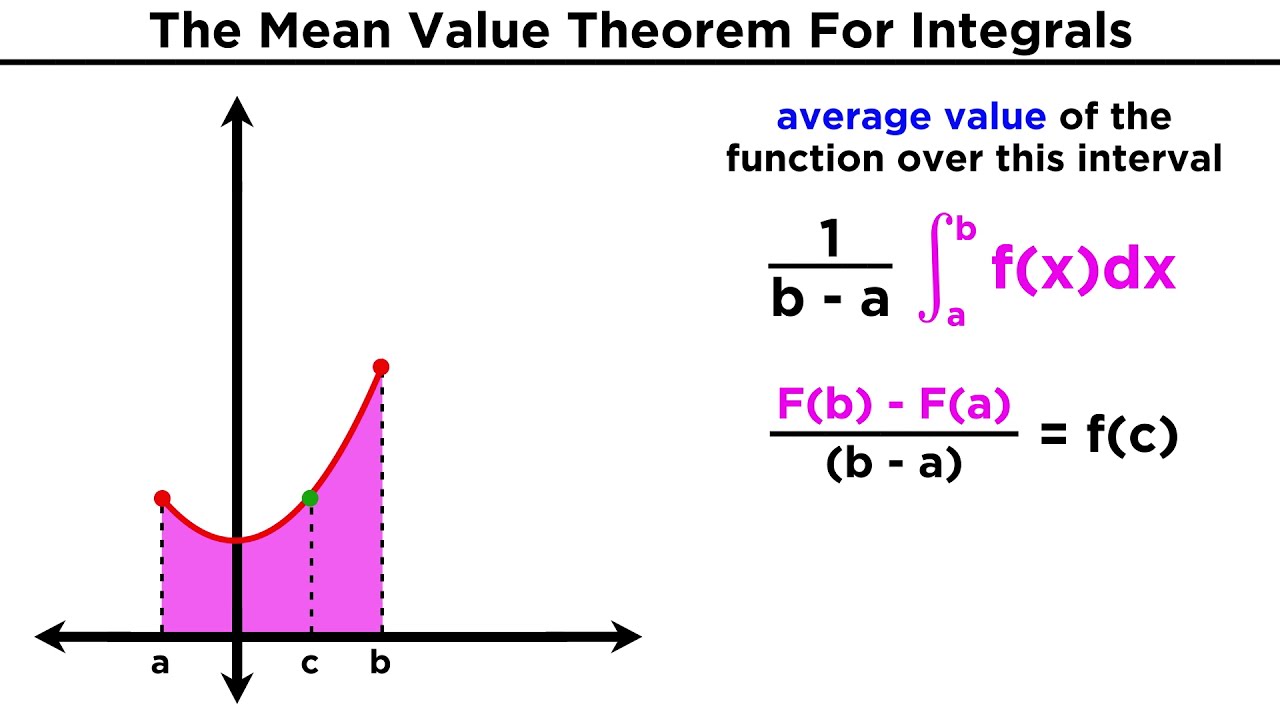
When you hear “average,” you probably think of adding up a bunch of numbers and dividing by how many there are. For discrete data (like equally spaced measurements), you can do exactly that. For a continuous function %%LATEX0%% on an interval %%LATEX1%%, there are infinitely many values, so we use a definite integral as the “add everything up” step.
A helpful geometric picture is this: the definite integral %%LATEX2%% gives the signed area under the curve. If you want a single “typical height” of the graph on %%LATEX3%%, imagine a rectangle spanning the interval with constant height equal to the average value. The rectangle’s area is
Setting that rectangle area equal to the integral area produces the average value formula.
A quick memory cue that matches the usual average idea: “add everything up, then divide.” Here, the integral is the “add everything up,” and dividing by interval length is the “divide.” For example, on an interval from %%LATEX5%% to %%LATEX6%%, you divide by , so the average value is
Reference diagram from the original notes:
The formula and how to interpret it
The average value of %%LATEX9%% on %%LATEX10%% is
Interpretations:
- As a mean height: the height of a constant function that would enclose the same signed area over the interval.
- As a rate: if %%LATEX12%% is a rate (like gallons per minute), then %%LATEX13%% is the total accumulated amount, and dividing by elapsed time gives the average rate.
A common misconception is that the average value must match an endpoint like %%LATEX15%% or %%LATEX16%%. It doesn’t. It depends on the whole interval.
Connecting average value to the Mean Value Theorem for Integrals
If %%LATEX17%% is continuous on %%LATEX18%%, then there exists at least one number %%LATEX19%% in %%LATEX20%% such that
This says that somewhere on the interval, the function actually attains its average value. AP questions may ask you to find such a %%LATEX22%% or to set up an equation whose solution is %%LATEX23%%.
Worked example: average value and “find ”
Let
Find the average value of %%LATEX26%% on %%LATEX27%% and find a value %%LATEX28%% such that %%LATEX29%%.
1) Compute the average value:
So
2) Solve :
So a value that works is
Only %%LATEX36%% lies in %%LATEX37%%, so that is the relevant solution.
Exam Focus
Typical question patterns include finding %%LATEX38%% on %%LATEX39%%, finding %%LATEX40%% such that %%LATEX41%%, and interpreting the average value in context (average temperature, average rate, etc.). Common mistakes include forgetting the factor %%LATEX42%%, using absolute area instead of signed area, and solving for %%LATEX43%% but giving a value outside the interval.
Accumulation, net change, and motion along a line
Net change: why integrals model “how much changed”
A core idea in calculus is that integrals reverse derivatives. If a quantity changes at a rate, integrating that rate over time gives the total change.
If , then
In words: the integral of a rate from %%LATEX46%% to %%LATEX47%% equals the net change in the original quantity.
Motion vocabulary and derivative relationships
Let be position along a line.
- Velocity is the derivative of position:
- Acceleration is the derivative of velocity:
These relationships also work backwards using integrals:
- Change in velocity:
- Change in position (displacement):
This is also a direct application of the FTC: for example, integrating acceleration from %%LATEX53%% to %%LATEX54%% gives
A compact summary (and a common source of confusion) is:
| Quantity you want | Integral to use | What it represents |
|---|---|---|
| Displacement | Net change in position | |
| Total distance traveled | Total movement regardless of direction | |
| Change in velocity | Net change in velocity |
Some students mistakenly label %%LATEX59%% as “position.” It is not position by itself; it is total distance traveled. Position requires an initial value such as %%LATEX60%%.
Displacement vs total distance (a classic exam trap)
Displacement is net change in position:
Total distance counts movement regardless of direction:
To compute total distance, you usually find where %%LATEX63%% (direction changes) and split the integral. A common misconception is to compute distance using %%LATEX64%% without absolute value; that gives displacement, not distance.
Interpreting integrals of rates in context (not just motion)
The same accumulation idea appears in many applications. If %%LATEX65%% is a flow rate (liters per minute), then %%LATEX66%% is total volume. Units are a strong hint on AP problems: “per second” integrated over seconds becomes a plain amount.
Worked example: displacement and total distance
A particle has velocity
on . Find displacement and total distance.
1) Displacement:
An antiderivative is
Evaluate:
So displacement is
2) Total distance: find where velocity changes sign.
So %%LATEX75%% and %%LATEX76%%. The velocity is positive on %%LATEX77%%, negative on %%LATEX78%%, and positive on , so
Using the same antiderivative:
Therefore
Exam Focus
Typical question patterns include finding displacement and total distance from a velocity function, finding velocity/position change from acceleration with an initial condition, and interpreting %%LATEX85%% from units. Common mistakes include forgetting absolute value for total distance, not splitting at every time when %%LATEX86%%, and losing track of initial conditions when integrating.
Area between curves
From “area under a curve” to “area between two curves”
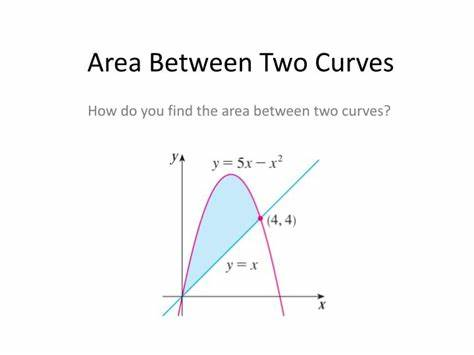
You already know %%LATEX87%% measures signed area between %%LATEX88%% and the -axis. To find area between two curves, use thin slices: each vertical slice has height “top minus bottom,” and adding up all slices becomes an integral.
Reference diagram from the original notes:
The standard setup (vertical slices)
If the region is bounded by %%LATEX90%% on top and %%LATEX91%% on bottom from %%LATEX92%% to %%LATEX93%%, then
The “top” function is the one with larger -value on that interval.
Where the bounds come from (and why intersections matter)
In many AP problems, you integrate from where the region starts to where the curves intersect. Often one boundary is a convenient value like %%LATEX96%%, but you should always verify by solving %%LATEX97%% for intersection points.
When you must split the integral
If the curves cross inside the interval, “top minus bottom” changes and you must split the integral. If you don’t, you compute net signed area and parts can cancel.
Horizontal slices (integrating with respect to )
If vertical slices are difficult, slice horizontally. If the right boundary is %%LATEX99%% and the left boundary is %%LATEX100%% for %%LATEX101%% to %%LATEX102%%, then
Worked example: area between curves with intersections
Find the area enclosed by
and
Intersections:
So %%LATEX108%% and %%LATEX109%%. On %%LATEX110%%, %%LATEX111%% is on top, so
Worked example: matching an “integrate top minus bottom” setup from the original notes
In the original notes, a typical setup was described using the top function %%LATEX114%% and the bottom function %%LATEX115%% on . One correct way to express the area is as a single integral:
The same idea was also written as subtracting two integrals:
These are equivalent, and both reflect the “integrate the top curve and subtract the bottom curve” idea.
Worked example: choosing horizontal slices
Consider the region bounded by
and
Solve for %%LATEX121%% in terms of %%LATEX122%%:
Intersection in comes from
Because %%LATEX128%% implies %%LATEX129%%, the relevant range is %%LATEX130%%. Right boundary is %%LATEX131%% and left boundary is , so
Exam Focus
Typical question patterns include finding area between two curves, setting up (not necessarily evaluating) an area integral possibly using %%LATEX135%%, and finding area enclosed by multiple curves (which forces intersections and splitting). Common mistakes include not checking which function is on top, forgetting to split when the curves cross, and mixing up left vs right when integrating with respect to %%LATEX136%%.
Volumes of solids using cross-sections (general slicing idea)
Why volume can be an integral
The key volume idea is the same accumulation idea as area: if you know the area of a cross-section at each position, you can add up infinitely many thin slices.
If a solid extends from %%LATEX137%% to %%LATEX138%% and the cross-sectional area perpendicular to the %%LATEX139%%-axis is %%LATEX140%%, then
One way students remember why this makes sense is: cross-sectional area times thickness gives a tiny volume. For instance, for a “rectangular slice,” the slice volume would be approximately length times width times thickness, and the integral adds them up. A common template that appears in introductory explanations is
This is not limited to rectangles, but it reinforces the idea that you need an area formula inside the integral.
Cross-sections you see a lot on AP problems
AP questions often describe a base region in the -plane and specify that cross-sections perpendicular to an axis are shapes like squares, rectangles with a fixed ratio, semicircles, or equilateral triangles.
The procedure is consistent:
1) Draw the base region and decide the slicing direction.
2) Express the slice width (often top minus bottom, or right minus left).
3) Use geometry to convert that width into a cross-sectional area formula.
4) Integrate.
A frequent error is to write the correct shape area formula but use the wrong slice width (for example, using %%LATEX144%% when the width should be %%LATEX145%%).
Worked example: squares on a base region
The base in the -plane is bounded by
and
from %%LATEX149%% to %%LATEX150%%. Cross-sections perpendicular to the -axis are squares.
Side length:
Area:
Volume:
Worked example: semicircles (watch the radius)
Base region bounded by
and
on %%LATEX157%%. Cross-sections perpendicular to the %%LATEX158%%-axis are semicircles whose diameters lie in the base.
Diameter:
Radius:
Semicircle area:
So
Volume setup:
Exam Focus
Typical question patterns include solids with a base region and specified cross-sections (squares/semicircles/triangles), “set up the integral” prompts, and choosing %%LATEX164%% vs %%LATEX165%% based on cross-section orientation. Common mistakes include confusing diameter and radius, using the wrong slice length (top-bottom vs right-left), and forgetting that “perpendicular to the %%LATEX166%%-axis” means thickness %%LATEX167%%.
Volumes of revolution: disk and washer methods
Solids of revolution: rotating a region around an axis
When you rotate a 2D region around a line (axis of rotation), you form a 3D solid. Disk/washer methods use slices perpendicular to the axis of rotation. Each slice becomes a disk (no hole) or a washer (hole).
A common student intuition is: “We get a 2D shape from area under a curve; if we rotate this shape, we get a 3D object.” That’s a useful mental model for revolution problems, but remember that not all volume problems involve rotation (cross-section problems may not rotate anything).
Disk method (no hole)
If the radius is , then
Because circles show up so often, some students default to the disk method as a first thought. That heuristic can be helpful, but always check whether there is a hole (washer) or whether shells are easier.
Washer method (hole in the middle)
If outer radius is %%LATEX170%% and inner radius is %%LATEX171%%, then
You subtract areas, not radii.
A common setup you may also see written (and that matches the original notes) is the idea of “outer disk minus inner disk,” expressed as
This is equivalent to the single-integral washer formula when the bounds match.
Reference diagram from the original notes:
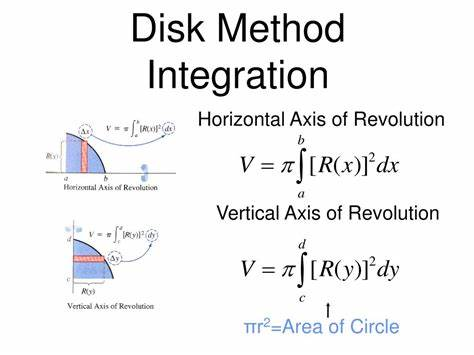
Choosing %%LATEX174%% vs %%LATEX175%% for disks/washers
The disk/washer method always means slices perpendicular to the axis.
- Rotate about a horizontal line: vertical slices often lead to .
- Rotate about a vertical line: horizontal slices often lead to .
Worked example: disks around the -axis
Rotate the region between
and
from %%LATEX181%% to %%LATEX182%% about the -axis.
Worked example: washers about
Rotate the region bounded by
and
on %%LATEX190%% about %%LATEX191%%.
Outer radius is distance from to the lower curve:
Inner radius is distance from to the upper curve:
Volume setup:
Exam Focus
Typical question patterns include rotating around coordinate axes or shifted lines %%LATEX197%% or %%LATEX198%%, deciding whether to use %%LATEX199%% or %%LATEX200%%, and setting up integrals even when not asked to evaluate. Common mistakes include forgetting axis shifts in radii, writing %%LATEX201%% instead of %%LATEX202%%, and swapping inner/outer radius.
Volumes of revolution: cylindrical shell method
Why shells exist (and when they’re easier than washers)
The shell method uses slices parallel to the axis of rotation. Rotating a thin strip produces a cylindrical shell with radius, height, and thickness.
Shells are especially useful when rotating around the %%LATEX203%%-axis (or a vertical line) and the region is naturally written with %%LATEX204%%, because washers might require solving for %%LATEX205%% as a function of %%LATEX206%%.
Shell volume formula and meaning of each factor
A shell has
- radius: distance to the axis of rotation
- height: top minus bottom
- thickness:
So
A common mistake is mixing washer and shell logic. Always check: shells use slices parallel to the axis.
Worked example: rotate around the -axis using shells
Rotate the region bounded by
and
on %%LATEX212%% about the %%LATEX213%%-axis.
Worked example: rotation about (absolute value and splitting)
Rotate the region under
above %%LATEX220%% on %%LATEX221%% about .
Radius is distance to :
Because the expression changes at , split:
Exam Focus
Typical question patterns include using shells around the %%LATEX227%%-axis or about shifted vertical lines %%LATEX228%%, and choosing shells because washers would require messy algebra. Common mistakes include forgetting the factor , confusing shell height with radius, and ignoring absolute-value distance to shifted axes.
Choosing methods and building correct integral setups
A decision framework that matches the geometry
Many application problems are difficult because of modeling rather than calculus. A reliable workflow is:
1) Identify what is being accumulated (area, volume, net change, distance).
2) Choose a slicing direction that makes slice measurements simplest.
3) Write the slice measurement (height, radius, cross-sectional area) as a function of the integration variable.
4) Determine correct bounds.
5) Integrate, or leave as setup if asked.
If you jump straight to memorized formulas, it’s easy to confuse radii, heights, and bounds.
Notation reference (common in Unit 8)
| Idea | Typical notation | Meaning |
|---|---|---|
| Average value | Mean height or mean rate over interval | |
| Displacement | Net change in position | |
| Total distance | Total path length in 1D motion | |
| Area between curves | Geometric area (nonnegative if set up correctly) | |
| Volume by known cross-sections | Sum of cross-sectional areas | |
| Disk/washer | Slices perpendicular to axis | |
| Shells | Slices parallel to axis |
A “set up only” style example (typical AP wording)
“The region enclosed by %%LATEX237%%, %%LATEX238%%, %%LATEX239%%, and %%LATEX240%% is revolved about the -axis. Set up (but do not evaluate) an integral for the volume.”
Because the region touches the axis and we rotate around the -axis, use disks:
Exam Focus
Typical question patterns include “set up an integral expression for…” prompts (often with heavy partial credit for correct setup), explaining method choice in free-response, and modeling with correct units. Common mistakes include correct formulas with incorrect bounds, using shells when slices are perpendicular (or washers when slices are parallel), and not using correct distances to shifted axes like %%LATEX245%% or %%LATEX246%%.