Mastering Non-Syllabus Latin Poetry and Sight Reading
Introduction to Unit 6: Course Project and Teacher's Choice
Unlike the rigid syllabus of Caesar (Units 2 & 4) and Vergil (Units 1, 3, & 5), Unit 6 is designed as a flexible module. The primary goal of this specific unit is to prepare you for the Sight Reading portion of the AP Latin Exam and to broaden your understanding of the Latin literary tradition beyond the Golden Age epic and military commentaries.
While your specific teacher may choose different authors for the "Course Project," the College Board emphasizes that this unit should foster skills in analyzing Latin Poetry from authors such as Catullus, Ovid, Horace, or Martial. Success in this unit relies on mastering poetic mechanics, recognizing diverse literary styles, and applying rigorous translation strategies to unseen texts.
Key Authors in Latin Poetry (Beyond Vergil)
To handle sight reading passages effectively, you must be familiar with the style and themes of the major Latin poets likely to appear on the exam.
1. Catullus (The Neoterics)
Catullus is known for his emotional intensity and versatility. He belonged to a group called the Neoterics (New Poets), who rejected heavy, rapid epics in favor of polished, personal, and shorter poems.
- Key Themes: A tortured love affair with "Lesbia," invective (insults) against rivals, brotherly grief, and mythological diversions (epyllion).
- Style: Conversational, sometimes vulgar, highly emotional, and grammatically complex despite simple vocabulary.
2. Ovid (The Storyteller)
Ovid is the most common author for sight poetry passages due to his narrative clarity.
- Key Works: Metamorphoses (mythological transformations), Amores (love elegy).
- Key Themes: Love as a game, mythology, change.
- Style: Witty, fluid, and clever. He frequently uses rhetoric to argue a point playfully.
3. Horace (The Philosopher)
Horace wrote during the reign of Augustus (like Vergil) but focused on lyric poetry.
- Key Works: Odes and Satires.
- Key Themes: Carpe Diem (seize the day), the "Golden Mean" (moderation), philosophical reflection, praise of country life.
- Style: Highly polished (callida iunctura or "clever arrangement"), word placement is often more important than grammar complexity.
4. Martial (The Satirist)
Martial wrote Epigrams—short, punchy poems with a twist ending.
- Key Themes: Daily life in Rome, satire of social climbers, dining, squalor, and patronage.
- Style: Brief, witty, and often containing a "sting" in the final line.
Poetic Meter and Scansion
While you have mastered Dactylic Hexameter for Vergil, Unit 6 and the Sight Reading section require familiarity with other meters, particularly the Elegiac Couplet and Hendecasyllabic.
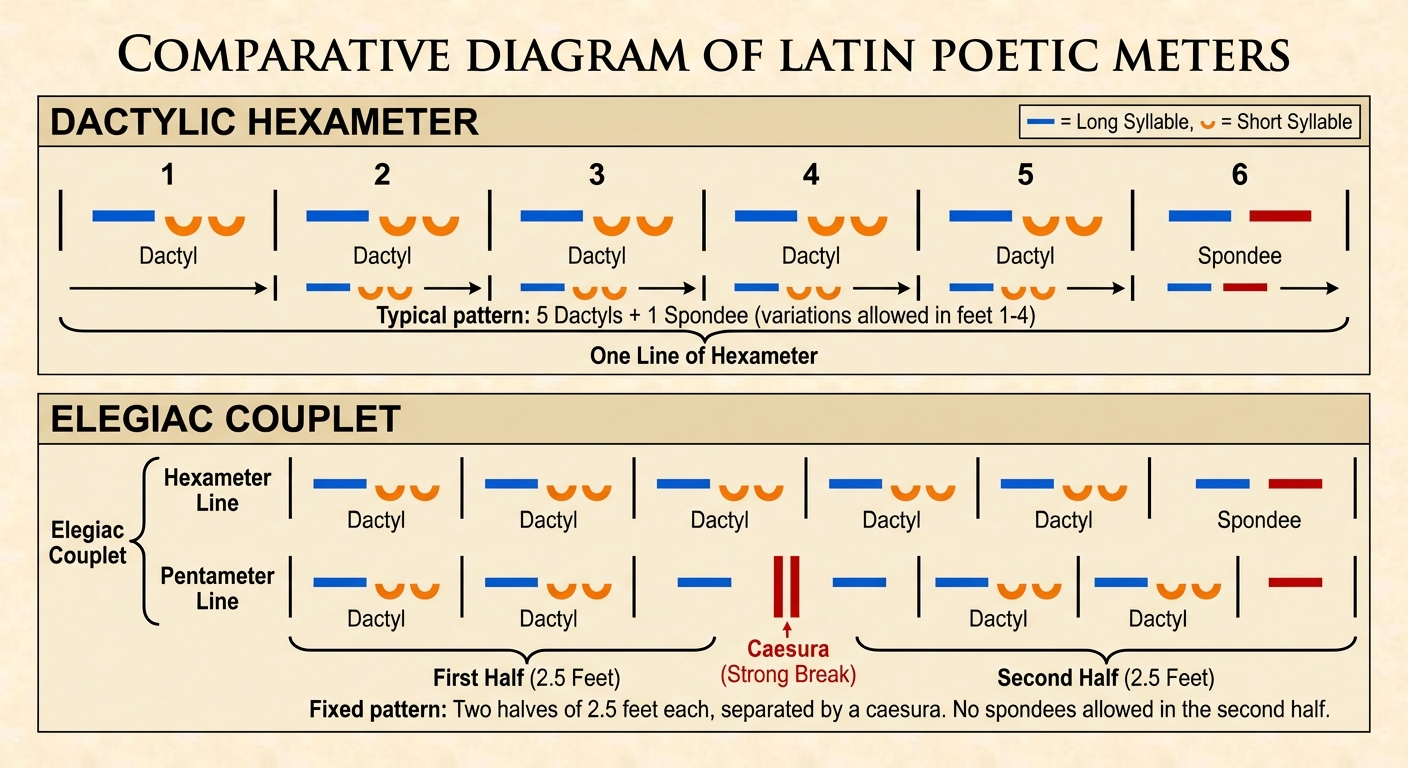
Dactylic Hexameter (Review)
The standard meter for Epic poetry (Vergil, Ovid’s Metamorphoses).
- Structure: Six feet per line.
- Pattern: $-\cup\cup$ (dactyl) or $--$ (spondee). The 5th foot is almost always a dactyl; the 6th is a spondee or trochee.
Elegiac Couplet
The meter of love poetry (Ovid’s Amores, Catullus, Martial). It consists of alternating lines: one line of Dactylic Hexameter followed by one line of Pentameter.
The Pentameter Line Formula:
- Characteristics:
- It has a strong caesura (pause) exactly in the middle.
- The first half contains two feet (dactyls or spondees) and a lone long syllable.
- The second half contains two dactyls only and a lone long syllable.
- Note: The indentations in a text usually indicate the pentameter line (the second line of the pair).
Hendecasyllabic (11-Syllable)
Common in Catullus and Martial.
- Memory Trick: Think of it as the "beat" of a specific rhythm: "Who ate the dōnūt? Why dīd yōu ēāt īt?"
Rhetorical Devices and Textual Analysis
In the sight reading multiple-choice section (MCQ), you will be asked to identify literary devices. Beyond the standard Alliteration and Anaphora, you must master these complex devices often found in lyric poetry.
| Device | Definition | Example | Purpose/Effect |
|---|---|---|---|
| Chiasmus | ABBA word order arrangement (Noun A, Adj B, Adj B, Noun A). | Magnas (A) urbanas (B) impiger (B) urbes (A) | Encapsulation; surrounding one idea with another. |
| Synchysis | ABAB (Interlocked) word order. | Saeva (A) memorem (B) Iunonis (A) ob iram (B) | Creates confusion or tight geometric connection between words. |
| Litotes | Affirming something by denying its opposite (Double Negative). | Non indecoro (Not unbecoming = very beautiful). | Understatement or irony. |
| Hyperbaton | Violent separation of words that belong together. | Tantae molis erat Romanam condere gentem. | Creates suspense; emphasizes the separated words. |
| Polysyndeton | Use of excessive conjunctions (et… et… et). | Et cupit et instat et precatur. | Creates a sense of overwhelming abundance or speed. |
| Asyndeton | Omission of conjunctions. | Veni, vidi, vici. | Creates speed, urgency, or punchiness. |
Grammar in Poetry: Poetic Licenses
Latin poets often alter standard grammar to fit the strict requirements of meter. Recognizing these is crucial for accurate translation.
1. Syncopation
Shortening verb forms to save syllables.
- Dixerunt (3rd pl. perfect) $\rightarrow$ Dixere.
- Audiverunt $\rightarrow$ Audiere.
- Novisse $\rightarrow$ Nosse.
2. Greek Accusatives
Since Roman poets imitated Greeks, they often kept Greek endings for names.
- Ending in -a or -an (singular) or -as (plural) typically indicates a direct object (Accusative).
- Example: Aenean, Hectora, Delphin.
3. The Poetic Plural
Using a plural noun to mean a singular object, often for grandeur or metric convenience.
- Tecta (roofs) $\rightarrow$ meaning a single house.
- Ora (mouths/faces) $\rightarrow$ meaning a single face.
4. Accusative of Respect (Greek Accusative)
Used to specify the part of the body affected by an action/adjective.
- Nudus membra (Bare with respect to his limbs = Bare-limbed).
- Tremit artus (He trembles regarding his limbs).
Strategies for Sight Reading
The most difficult part of Unit 6 is applying knowledge to a text you have never seen. Follow this systematic approach.
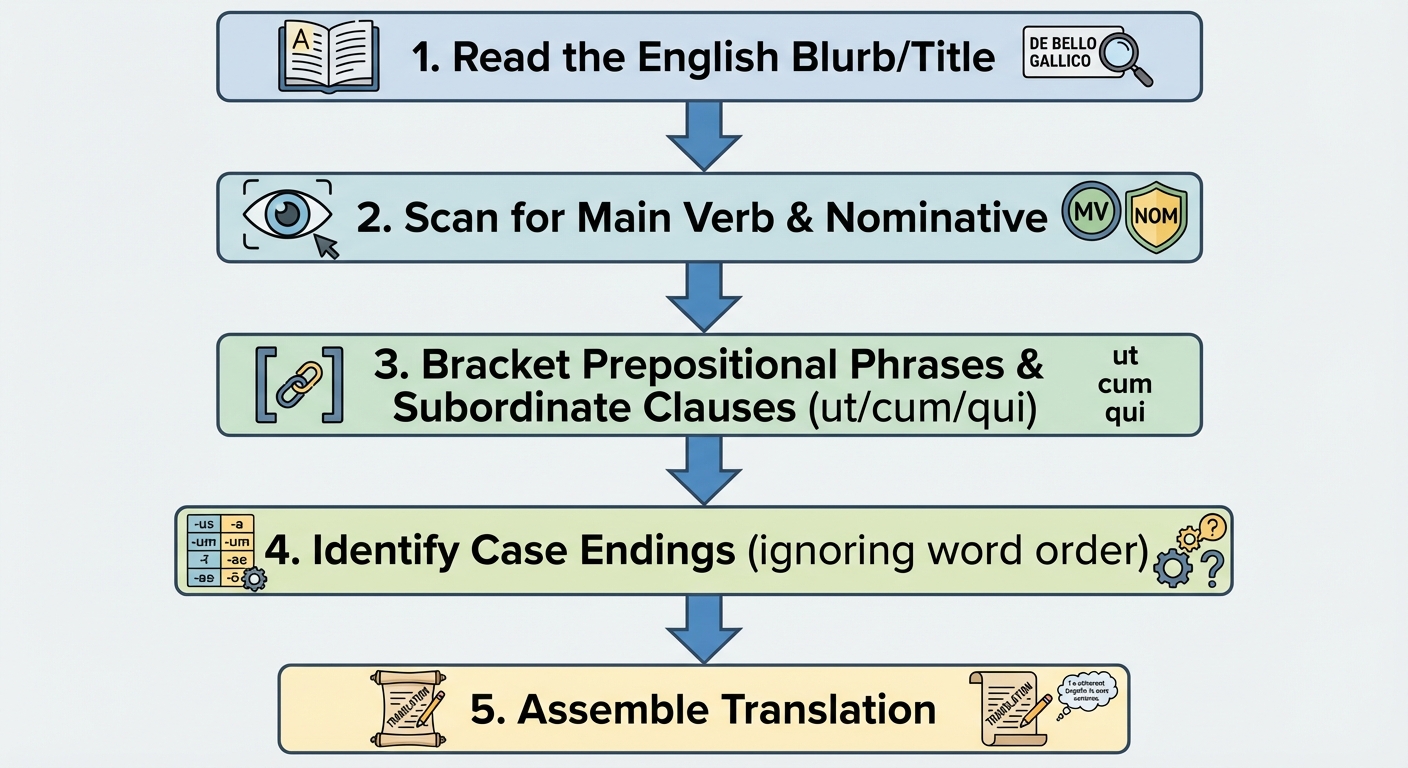
Step 1: The Contextual "Blurb"
Never skip the English introduction. The College Board provides a title and a brief summary above the Latin text.
- This provides the names of characters (so you don't confuse a Proper Noun for a vocabulary word).
- It sets the scene (Who is speaking? Are they angry? Sad?).
Step 2: Bracket and Chunk
Do not read left-to-right like English. Your brain must process the syntax.
- Put brackets
[ ]around prepositional phrases (e.g., [in nova fert animus]). - Underline the Main Verb immediately.
- Find the Nominative subject that agrees with that verb.
Step 3: Vocabulary Analysis
If you don't know a word:
- Look at the root: Does it look like a Spanish/French/Italian word or an English derivative? (e.g., vulnus $\rightarrow$ vulnerable $\rightarrow$ wound).
- Context: If the poem is about a battle, ensis probably means "sword."
- Synonyms: Poets hate repeating words. If line 1 uses gladius (sword), line 3 might use ferrum (iron/sword) to mean the same thing.
Common Mistakes & Pitfalls
1. Confusing "-a" Endings
In poetry, an ending of -a is ambiguous. It could be:
- Nominative Singular (1st Declension).
- Ablative Singular (1st Declension - look for a macron or scan the meter; it will be long).
- Nominative/Accusative Plural (Neuter nouns).
- Mistake: Assuming every -a is a female subject.
2. The "Jigsaw Puzzle" Error
Students often pick words they know and try to arrange them into a sentence that makes sense in English, ignoring the Latin case endings.
- Correction: Trust the endings over word order. If puellam is accusative, she is not doing the action, even if she is the first word in the sentence.
3. Misidentifying the Speaker
In Ovid or Horace, the poet often includes dialogue without clear quotation marks.
- Correction: Watch for verbs of speaking (dixit, ait, fatur) and changes in pronouns (ego vs. tu) to track who is talking.
4. Ignoring the Subjunctive
Sight readings involve complex sentence structures.
- If you see ut + subjunctive, determine if it is a Purpose clause (to…), Result clause (so that…), or Indirect Command (ordered to…).
- Translating a subjunctive as a simple indicative fact (e.g., "he went" instead of "so that he might go") is a frequent error in translation questions.