Complete Guide to Acing the ACT Mathematics Section
Fundamentals of Number and Quantity
The ACT Math section consists of 60 questions to be answered in 60 minutes. Unlike the SAT, the ACT does not provide a formula sheet, so memorization is crucial. This section covers the essential arithmetic and algebraic properties that form the foundation of the exam.
Real and Complex Numbers
Real Numbers include all rational and irrational numbers found on the number line. Complex Numbers involve the imaginary unit $i$, defined as $i = \sqrt{-1}$.
- Imaginary Unit Rules:
- $i^1 = i$
- $i^2 = -1$
- $i^3 = -i$
- $i^4 = 1$
- The cycle repeats every 4 powers.
- Complex Form: $a + bi$, where $a$ is the real part and $b$ is the imaginary part.
- Conjugates: To divide complex numbers, multiply the numerator and denominator by the conjugate of the denominator ($a - bi$).
Matrices
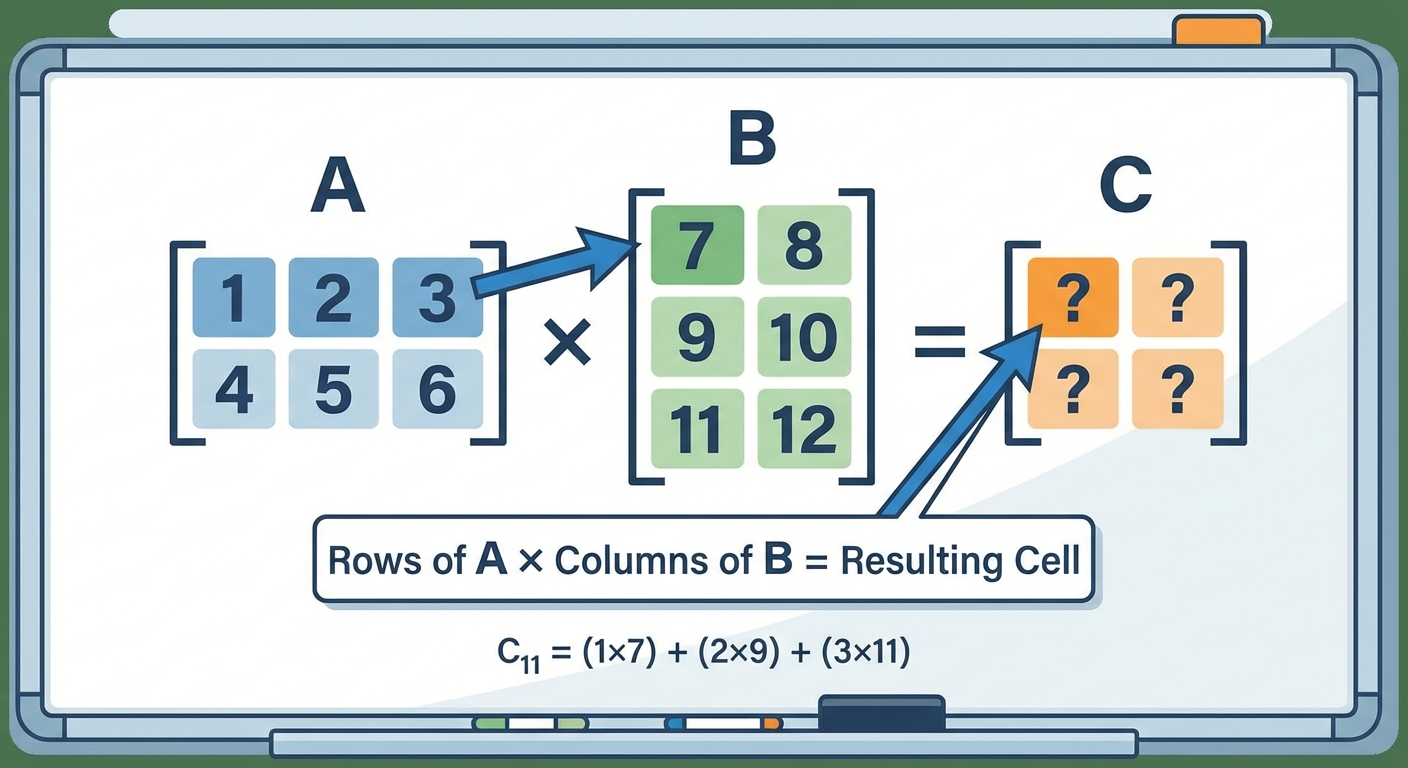
A Matrix is a rectangular array of numbers. The ACT tests addition, subtraction, scalar multiplication, and matrix multiplication.
- Addition/Subtraction: You can only add or subtract matrices with the same dimensions. Add corresponding distinct elements.
- Multiplication: To multiply Matrix $A$ ($m \times n$) by Matrix $B$ ($n \times p$), the inner dimensions ($n$) must match. The result will be size $m \times p$.
Vectors
Vectors possess both magnitude and direction. They are often represented as $\langle a, b \rangle$ or $ai + bj$.
- Component Form: $\langle x2-x1, y2-y1 \rangle$
- Magnitude: $||v|| = \sqrt{a^2 + b^2}$ (essentially the Pythagorean theorem).
- Vector Addition: Add the $x$-components and the $y$-components separately.
Common Mistakes: Number & Quantity
- Forgetting $i^2 = -1$: Students often leave $i^2$ in the final answer instead of simplifying it to $-1$.
- Matrix Dimensions: Attempting to multiply matrices where the columns of the first do not equal the rows of the second.
Algebra and Functions
This area comprises about 40% of the test, moving from pre-algebra concepts to advanced function modeling.
Linear Equations and Inequalities
The most tested concept is the interplay between equations and their graphs.
- Slope-Intercept Form:
- $m$ = slope ($\frac{\text{rise}}{\text{run}}$)
- $b$ = y-intercept
- Standard Form: $Ax + By = C$
- Point-Slope Form: $y - y1 = m(x - x1)$
Inequalities: When multiplying or dividing by a negative number, you MUST flip the inequality sign ($
Systems of Equations
You will often need to find the intersection of two lines.
- Substitution: Isolate a variable in one equation and plug it into the other.
- Elimination: Add or subtract equations to cancel out a variable.
- Graphical Interpretation: The solution is the point $(x, y)$ where the lines intersect. Parallel lines have no solution; identical lines have infinite solutions.
Polynomials and Quadratics
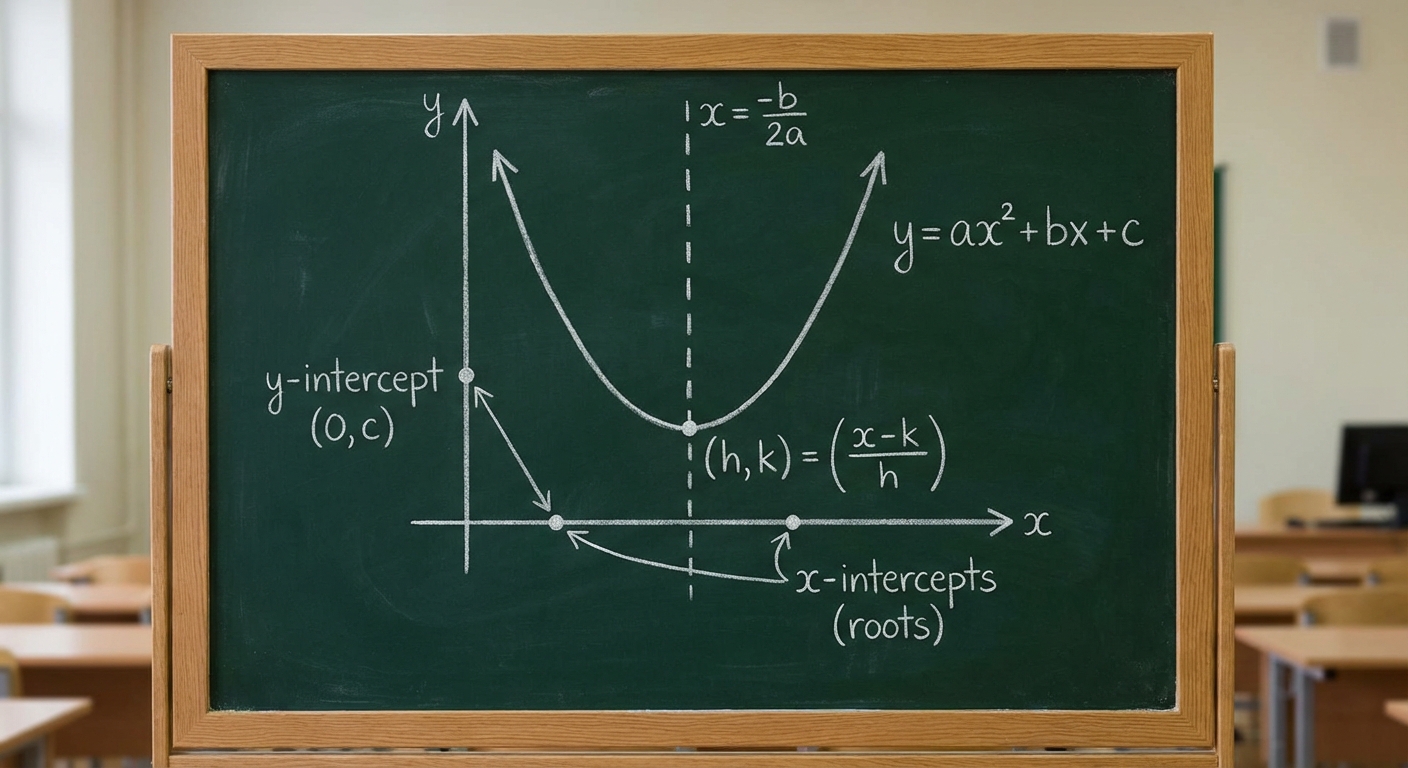
Quadratics generally appear as parabolas.
- Factoring: Finding what multiplies to the constant term and adds to the linear coefficient.
- The Quadratic Formula: Use this when factoring is difficult.
- The Discriminant: $\Delta = b^2 - 4ac$
- If $\Delta > 0$: 2 real roots.
- If $\Delta = 0$: 1 real repeated root.
- If $\Delta < 0$: 2 complex (imaginary) roots.
Logarithms
Logarithms are the inverse of exponents. If $b^x = y$, then $\log_b(y) = x$.
Key Properties:
- Product Rule: $\logb(xy) = \logb(x) + \log_b(y)$
- Quotient Rule: $\logb(\frac{x}{y}) = \logb(x) - \log_b(y)$
- Power Rule: $\logb(x^n) = n \cdot \logb(x)$
- Change of Base: $\log_b(x) = \frac{\log(x)}{\log(b)}$
Common Mistakes: Algebra
- Distributing the Negative: In expressions like $3x - (2x + 5)$, students often write $3x - 2x + 5$ instead of the correct $3x - 2x - 5$.
- Undefined slopes vs. Zero slope: A horizontal line has a slope of 0. A vertical line has an undefined slope.
- Illegal Cancellation: canceling terms instead of factors (e.g., simplifying $\frac{x^2+1}{x}$ to $x+1$ is WRONG).
Geometry
Geometry accounts for roughly 30-35% of the test. Problems deal with properties of shapes rather than proofs.
Plane Geometry: Triangles
Angles in a triangle sum to $180^{\circ}$. The area is $A = \frac{1}{2}bh$.
Pythagorean Theorem (Right Triangles only): $a^2 + b^2 = c^2$, where $c$ is the hypotenuse.
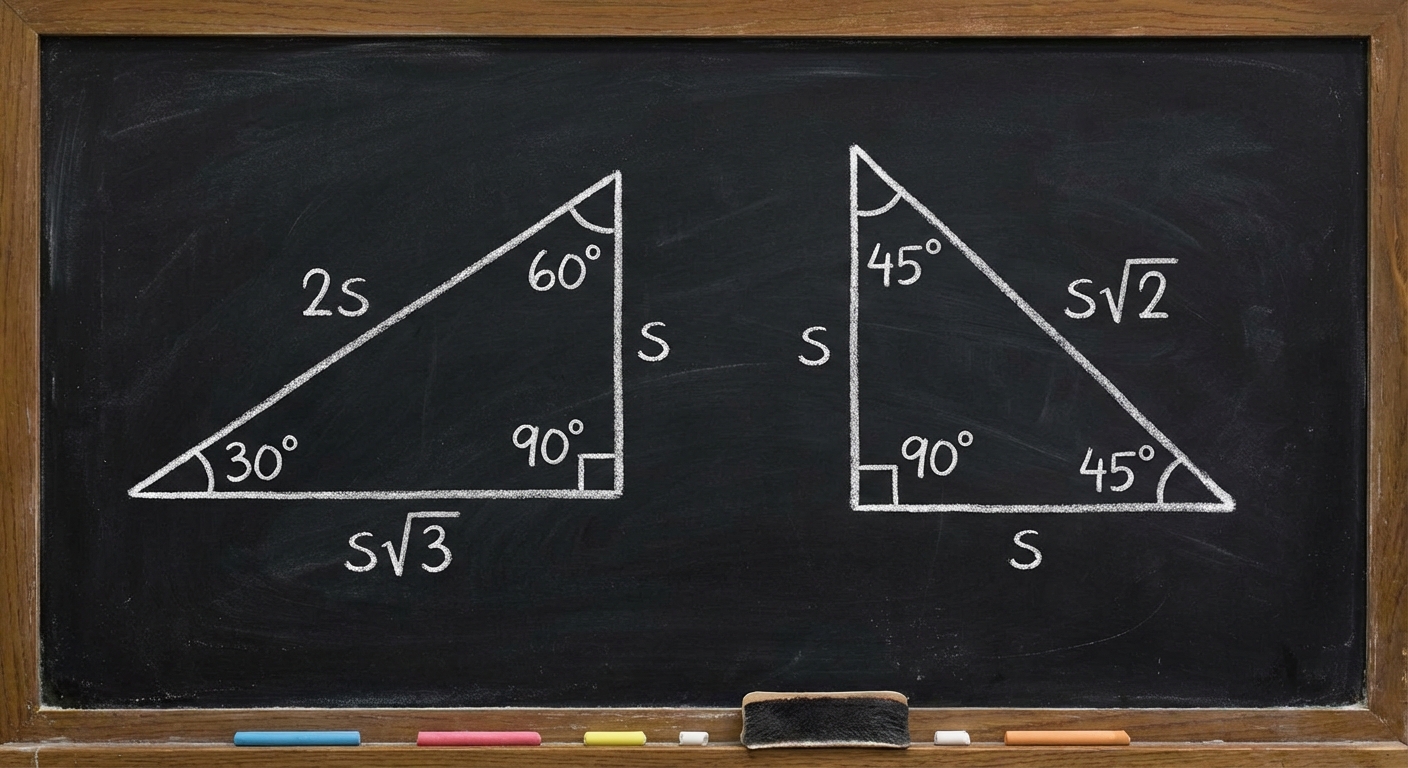
Special Right Triangles (Memorize these!):
- 30-60-90: Sides are $x, x\sqrt{3}, 2x$ (hypotenuse).
- 45-45-90: Sides are $x, x, x\sqrt{2}$ (hypotenuse).
Coordinate Geometry
- Distance Formula:
- Midpoint Formula:
- Equation of a Circle:
- Center: $(h, k)$
- Radius: $r$ (Don't forget to take the square root of the right side!)
Solid Geometry
Understanding Volume ($V$) and Surface Area ($SA$).
- Rectangular Prisms: $V = l \cdot w \cdot h$
- Cylinders: $V = \pi r^2 h$
- Spheres: $V = \frac{4}{3}\pi r^3$
Common Mistakes: Geometry
- Radius vs. Diameter: Questions often give the diameter but the formula requires the radius.
- Unit Confusion: Calculating area in square feet when dimensions were given in inches.
- Assuming diagrams are to scale: Never assume an angle is $90^{\circ}$ or lines are parallel unless explicitly stated.
Trigonometry
Expected to contribute 4-7 questions.
SOH CAH TOA
For a right triangle with an angle $\theta$:
- Sine = $\frac{\text{Opposite}}{\text{Hypotenuse}}$
- Cosine = $\frac{\text{Adjacent}}{\text{Hypotenuse}}$
- Tangent = $\frac{\text{Opposite}}{\text{Adjacent}}$
Reciprocal Functions:
- Cosecant ($\csc$) is $1/\sin$
- Secant ($\sec$) is $1/\cos$
- Cotangent ($\cot$) is $1/\tan$
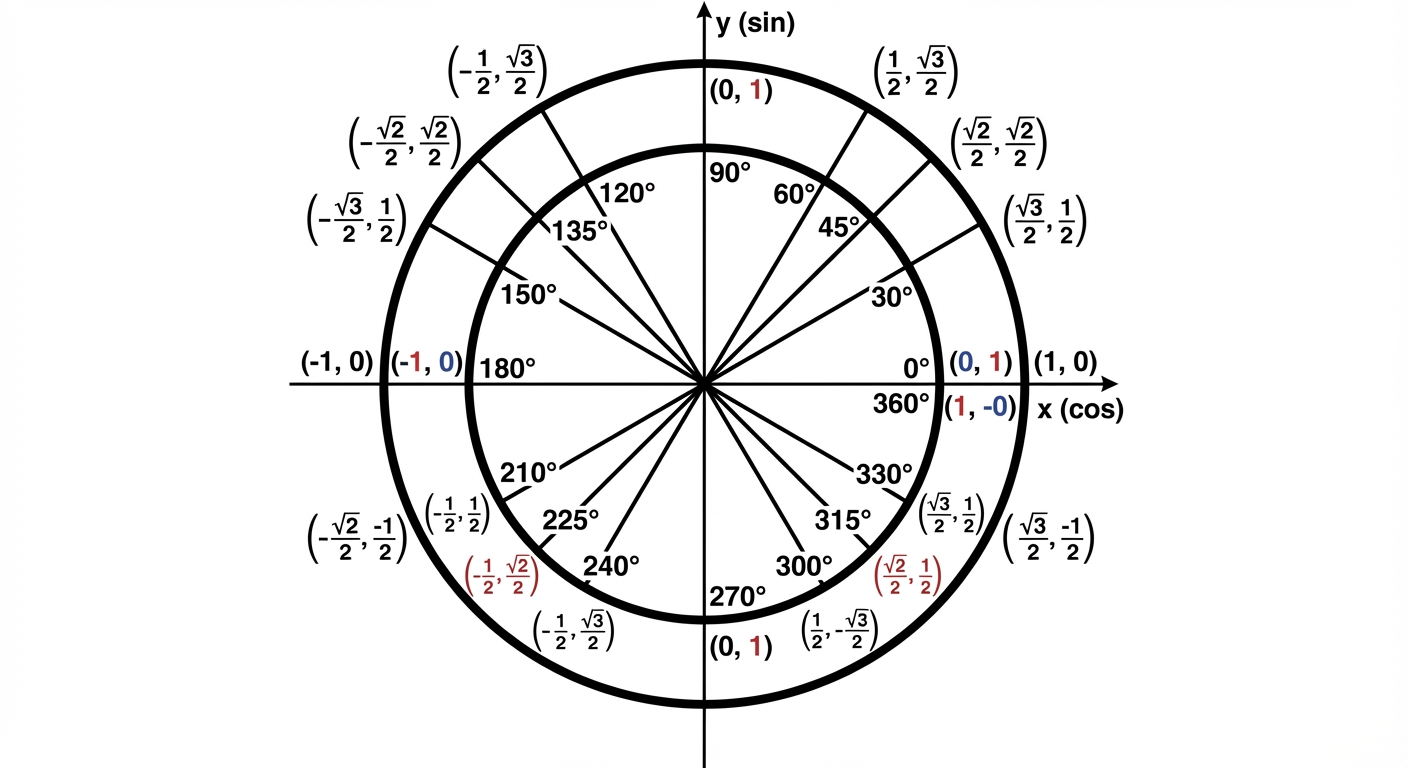
The Unit Circle & Identities
You must know the basic Pythagorean Identity:
Radians vs. Degrees:
- Conversion: Multiply degrees by $\frac{\pi}{180}$ to get radians.
- $\pi \text{ radians} = 180^{\circ}$
Law of Sines and Cosines
Used for non-right triangles.
- Law of Sines: $\frac{\sin A}{a} = \frac{\sin B}{b} = \frac{\sin C}{c}$
- Law of Cosines: $c^2 = a^2 + b^2 - 2ab\cos(C)$ (Essential for finding a side when given SAS).
Statistics, Probability, and Sequences
Statistics: Measures of Center and Spread
- Mean (Average): $\frac{\text{Sum of terms}}{\text{Number of terms}}$
- Tip: If you know the mean is $m$ for $n$ items, the Total Sum is $m \times n$.
- Median: The middle number when ordered from least to greatest. If there are two middle numbers, average them.
- Mode: The most frequently occurring number.
- Range: $\text{Max Value} - \text{Min Value}$.
Probability
- Basic Probability: $P(A) = \frac{\text{Desired Outcomes}}{\text{Total Possible Outcomes}}$
- Independent Events: $P(A \text{ and } B) = P(A) \times P(B)$
- Mutually Exclusive Events: $P(A \text{ or } B) = P(A) + P(B)$
- Counting Principle: If you have 3 shirts and 4 pants, you have $3 \times 4 = 12$ outfits.
Sequences
- Arithmetic Sequences (Adding a constant $d$):
- $an = a1 + (n-1)d$
- Geometric Sequences (Multiplying by a ratio $r$):
- $an = a1 \cdot r^{n-1}$
Common Mistakes: Stats & Probability
- Weighted Averages: Averaging the averages rather than summing the totals.
- Permutations vs. Combinations: Permutations (order matters) vs. Combinations (order doesn't matter). The ACT calculator usually has functions for ${n}P{r}$ and ${n}C{r}$.
Final Strategy Tips for ACT Math
- Plug in Numbers: If a problem contains variables in the question and answer choices (e.g., "for all $x > 0$"), pick a simple number like $x=2$, solve, and check the choices.
- Back-Solving: If you are stuck on an algebra problem, plug the answer choices (starting with the middle value, usually C or H) back into the equation to see which one works.
- Draw It Out: If a geometry problem describes a shape but provides no picture, draw one immediately.
- Calculator Literacy: Be proficient with your TI-84 (or allowed graphing calculator). Know how to graph a function to find intercepts and how to use the fraction conversion button.