Period 6: The Broken System and the Fight for Change (1865–1898)
Gilded Age Politics and Populism
The Nature of Gilded Age Politics
The term Gilded Age, coined by Mark Twain, satirized the era as having a glittering, golden exterior that hid a rotting core of corruption and poverty. Between 1865 and 1900, American politics was characterized by intense partisanship, high voter turnout (nearly 80%), and a laissez-faire approach to the economy, despite widespread political corruption.
The Political Stalemate
During this period, the Democratic and Republican parties were evenly matched, leading to a series of "forgettable presidents" (Hayes, Garfield, Arthur, Cleveland, Harrison). The parties were divided less by substantive ideology and more by regional, religious, and ethnic differences.
- Republicans: Strong in the North and West; supported by big business, African Americans, and middle-class Protestants. They championed high tariffs and the "bloody shirt" (reminding voters of Civil War sacrifices).
- Democrats: Strong in the Solid South and urban industrial cities; supported by white southerners, Catholics, and recent immigrants. They favored lower tariffs and states' rights.
Political Machines and Corruption
In rapidly growing cities, politics was dominated by Political Machines—organized groups that controlled the activities of a political party in a city. They offered services to voters and businesses in exchange for political and financial support.
- The Boss: The top politician who controlled jobs, business licenses, and influenced the courts.
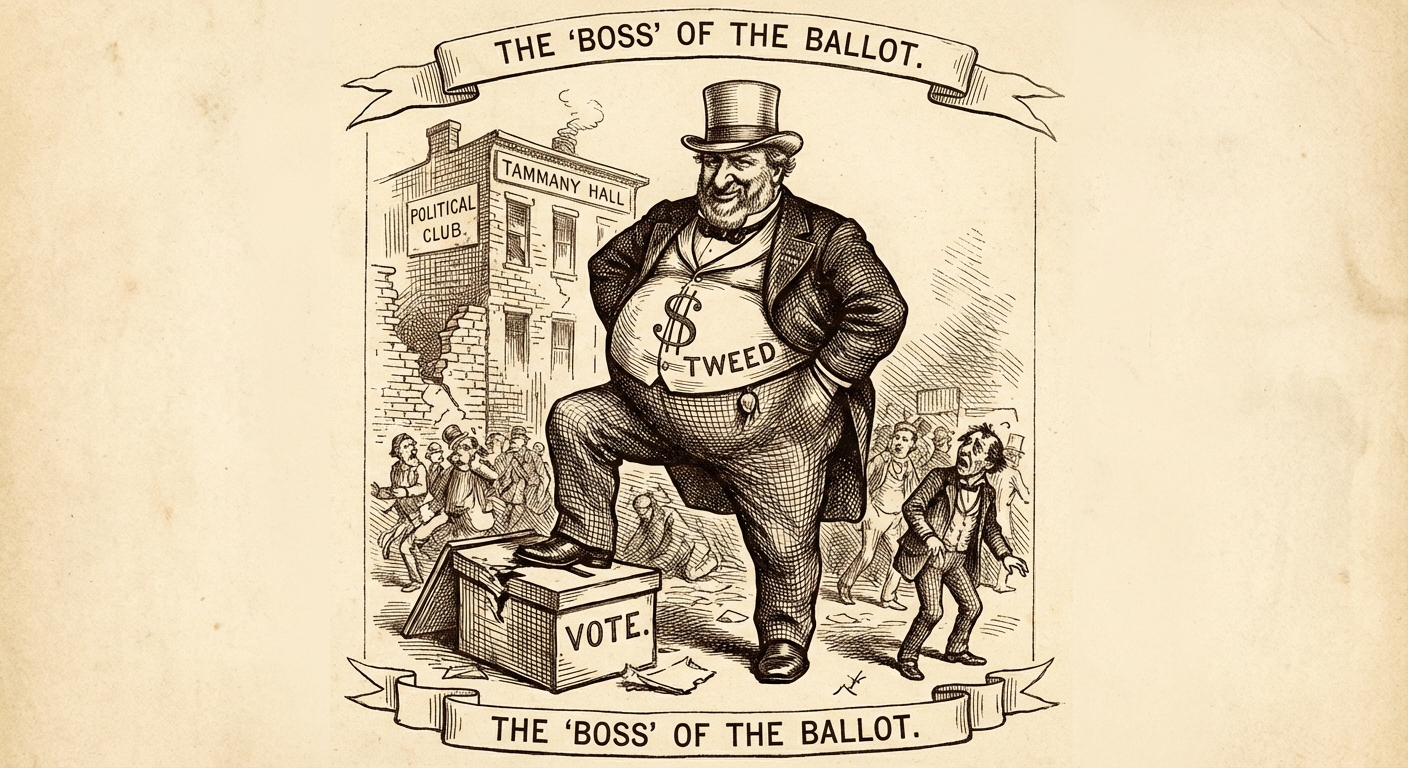
- Tammany Hall: The most infamous machine in New York City, led by William M. "Boss" Tweed. The "Tweed Ring" defrauded NYC of millions through graft and kickbacks.
- Thomas Nast: A political cartoonist whose scathing illustrations of Tweed helped bring down Tammany Hall. Nast is credited with creating the elephant and donkey symbols for the major parties.
Civil Service Reform
For decades, the Spoils System (patronage) allowed winning candidates to give government jobs to loyal supporters, regardless of qualification. The turning point came with the assassination of President James A. Garfield in 1881 by a disgruntled office-seeker.
- Pendleton Civil Service Act (1883): This landmark law created a bipartisan Civil Service Commission to appoint federal jobs based on merit through examination. While it reduced patronage, it unintentionally forced politicians to rely more heavily on donations from big business rather than party workers.
The Money Question and Economic Debates
Economic policy in the Gilded Age revolved around two major issues: Tariffs and Currency.
- The Tariff Issue: Republicans generally favored the McKinley Tariff (high protective tax on imports) to protect industry. Democrats and farmers opposed it, arguing it raised consumer prices.
- The Currency Debate: This was a class struggle between debtors (farmers) and creditors (bankers).
- "Hard Money" (Gold Standard): Supported by bankers and industrialists. They wanted currency backed only by gold to limit inflation.
- "Soft Money" (Silver/Greenbacks): Supported by farmers and debtors. They wanted to print paper money or coin silver to create inflation, which would make paying back debts easier.
The Rise of Populism
Farmers in the West and South suffered from falling crop prices, high railroad shipping rates, and tight money policies. Their discontent coalesced into an agrarian political movement.
Evolution of the Movement
- The Grange (1860s): Originally a social organization, it turned political to fight distinct railroad monopolies (Granger Laws).
- Farmers' Alliances (1870s-80s): More organized local groups that educated farmers on loans and government control of railroads.
- The Populist Party (People's Party) (1892): The culmination of agrarian protest.
The Omaha Platform (1892)
The Populists met in Omaha, Nebraska, to draft their political platform. It was considered radical at the time but paved the way for future Progressive reforms. Key demands included:
- Direct election of Senators (to bypass corrupt state legislatures).
- Graduated income tax (tax rate increases as income increases).
- Government ownership of railroads, telegraphs, and telephones.
- Free and unlimited coinage of silver (at a ratio of 16:1 to gold).
The Election of 1896
This election marked the end of the Gilded Age political stalemate and the demise of the Populist Party.
- William Jennings Bryan (Democrat/Populist): Famous for his "Cross of Gold" speech, he championed the free silver cause. He toured the country giving energized speeches.
- William McKinley (Republican): Supported by business titan Mark Hanna, he ran a "front porch campaign" backed by massive fundraising and the gold standard.
Result: McKinley won. The victory cemented the dominance of the Republican Party and big business, urban centers over agrarian interests, and the Gold Standard.

Reform Movements in the Gilded Age
While politics remained corrupt, various movements emerged to address the social problems caused by rapid industrialization and urbanization.
The Social Gospel Movement
Different from the earlier "Second Great Awakening," the Social Gospel was a Protestant intellectual movement that applied Christian ethics to social problems like poverty, alcoholism, and inequality. Leaders like Walter Rauschenbusch argued that true salvation required distinct social reform, helping the poor directly rather than just preaching to them.
Settlement Houses
Upper-middle-class educated women moved into poor immigrant neighborhoods to provide social services.
- Hull House (1889): Founded by Jane Addams in Chicago. It provided English lessons, counseling, childcare, and cultural activities for immigrants.
- Impact: Settlement houses became centers for women's activism and social reform lobbying, challenging the Victorian notion that women belonged only in the domestic sphere.
Women's Suffrage and Rights
The movement revitalized in 1890 with the formation of the National American Woman Suffrage Association (NAWSA), led by Elizabeth Cady Stanton and Susan B. Anthony. They shifted tactics, arguing that women needed the vote to better fulfill their roles as "homemakers" in the public sphere (municipal housekeeping).
- Ida B. Wells: An African American journalist who launched a fierce international crusade against lynching. She exposed that lynching was often used to punish black economic success rather than to punish crimes.
African American Reformers
With the rise of Jim Crow laws and the Supreme Court decision in Plessy v. Ferguson (1896) (establishing "separate but equal"), black leaders debated the best path forward.
| Feature | Booker T. Washington | W.E.B. Du Bois |
|---|---|---|
| Background | Born into slavery in the South. | Harvard-educated Northerner. |
| Institution | Founded Tuskegee Institute. | Helped found the NAACP (later, 1909). |
| Philosophy | Accommodation / Gradualism. Black people should focus on vocational training and economic self-sufficiency before seeking political equality. | Immediate Equality. Argued for the "Talented Tenth" to lead the black community to full political and social rights immediately. |
| Key Text | Atlanta Compromise Speech (1895). | The Souls of Black Folk (1903). |
Common Mistakes & Pitfalls
- Confusing Populists and Progressives:
- Correction: Populists (1890s) were mostly rural farmers focusing on economic distress (silver). Progressives (1900–1920) were mostly urban middle-class reformers focusing on a wider range of social and political ills.
- Overlooking the "Forgotten Presidents":
- Correction: Students often assume nothing happened politically. However, the precedent for Civil Service Reform (Pendleton Act) and the Interstate Commerce Act (regulating railroads) occurred under them.
- Misinterpreting "Laissez-Faire":
- Correction: While the government generally stayed out of business regulation, they did intervene to help business via high tariffs and land grants to railroads. It was selective laissez-faire.
- Washington vs. Du Bois Chronology:
- Correction: Washington was the dominant figure during the Gilded Age (1895 Atlanta Compromise). Du Bois rose to prominence closer to the turn of the century; don't assume the NAACP existed in 1880.