Mastering Inquiry: The Art of Questioning and Exploration
Welcome to AP Seminar. If you are reading this, you are stepping away from the traditional "memorize and regurgitate" style of learning. AP Seminar is about process—specifically, the QUEST framework.
Big Idea 1: Question and Explore is the foundation of this framework. It is the "Q" in QUEST. Before you can argue, analyze, or propose solutions, you must learn to ask the right questions and navigate the ocean of information available to you. This unit prepares you for the Individual Research Report (IRR) and the Team Multimedia Presentation (TMP) by teaching you how to turn a spark of curiosity into a rigorous academic investigation.
The Anatomy of Inquiry: From Topic to Research Question
The most critical skill in detailed research is narrowing your scope. A common mistake students make is trying to research a "topic" rather than answering a "question."
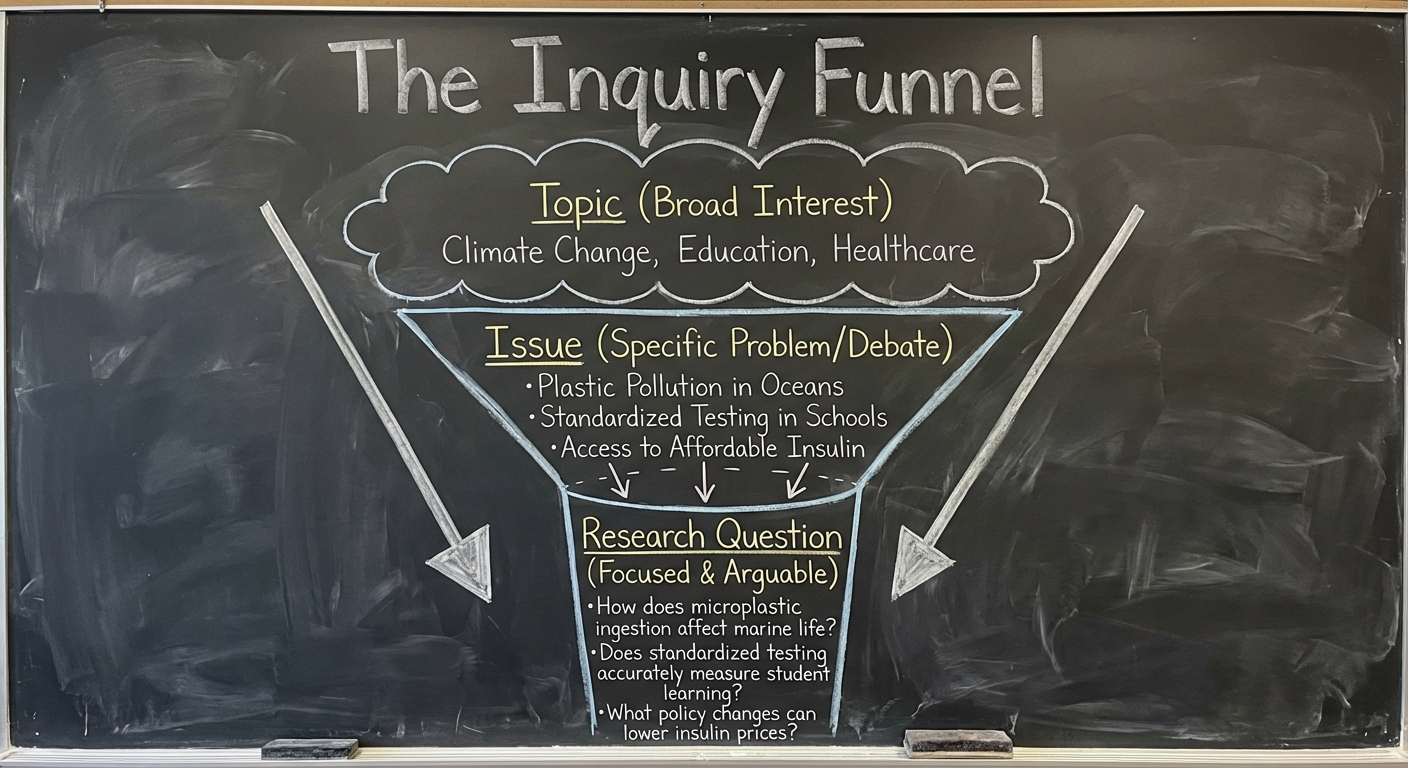
1. The Funnel Method
Your journey should look like a funnel, moving from broad to specific:
- Topic: A general subject area (e.g., Artificial Intelligence).
- Issue/Problem: A specific tension, debate, or concern within that topic (e.g., AI displacing creative jobs).
- Research Question (RQ): A precise, open-ended question that guides the investigation (e.g., To what extent does the use of generative AI in graphic design impact the copyright protections of human artists in the United States?).
2. Characteristics of a Strong Research Question
In AP Seminar, not all questions are created equal. A strong RQ must be researchable, complex, and open-ended. We often use criteria to ensure the question is not a simple "Google search" question.
- Require Judgment: It cannot be answered with a simple "Yes" or "No." It requires weighing evidence.
- Debate/Tension: There must be multiple plausible viewpoints.
- Scope (The Goldilocks Rule):
- Too Broad: "How does technology change society?" (This is a book, not a paper.)
- Too Narrow: "How many Copyright Act lawsuits were filed in 2023?" (This is a statistic, not an argument.)
- Just Right: Focuses on a specific location, population, or time period.
3. Types of Research Questions
Different disciplines ask different types of questions. Understanding these can help you frame your inquiry:
- Fact-Based/Definitions: What is X? (Usually a starting point, not the final RQ).
- Value-Based: How strictly should we regulate X? (Focuses on ethics/morals).
- Policy-Based: What should be done about X? (Focuses on solutions/laws).
- Problem-Based: Why is X happening? (Focuses on causes and effects).
Context (The "Where" and "When")
No problem exists in a vacuum. To understand an issue, you must understand its Context—the circumstances that form the setting for an event, statement, or idea.
Why Context Matters
Imagine seeing a photo of a person crying.
- Context A: They are at a funeral. (Interpretation: Grief)
- Context B: They just won a gold medal. (Interpretation: Joy)
In AP Seminar, you must ask:
- Historical Context: How has this issue developed over time? Have we tried to solve this before?
- Geographic Context: Does this issue affect the Global South differently than the West?
- Social Context: How does society view this issue right now?
Key Concept: Failing to address context is a major error in the Individual Research Report (IRR). You cannot explain a problem without explaining the environment in which the problem exists.
Perspectives vs. Lenses
This is perhaps the single most important conceptual distinction in Big Idea 1. Students often confuse "Lenses" with "Perspectives."
1. Lenses (The Filter)
A Lens is a way of looking at a problem. It filters the information you see. The College Board suggests specific lenses, though you can use others:
- Cultural and Social
- Artistic and Philosophical
- Ethical
- Political and Historical
- Futuristic
- Environmental
- Economic
- Scientific and Mathematical
2. Perspectives (The Voices)
A Perspective is a specific point of view, position, or argument within a lens. It is "who is talking" and "what are they saying."
Example Breakdown:
- Topic: School Uniforms.
- Lens: Economic.
- Perspective A: A single parent arguing that uniforms save money on clothing.
- Perspective B: A textile manufacturer arguing that uniforms increase costs for schools.
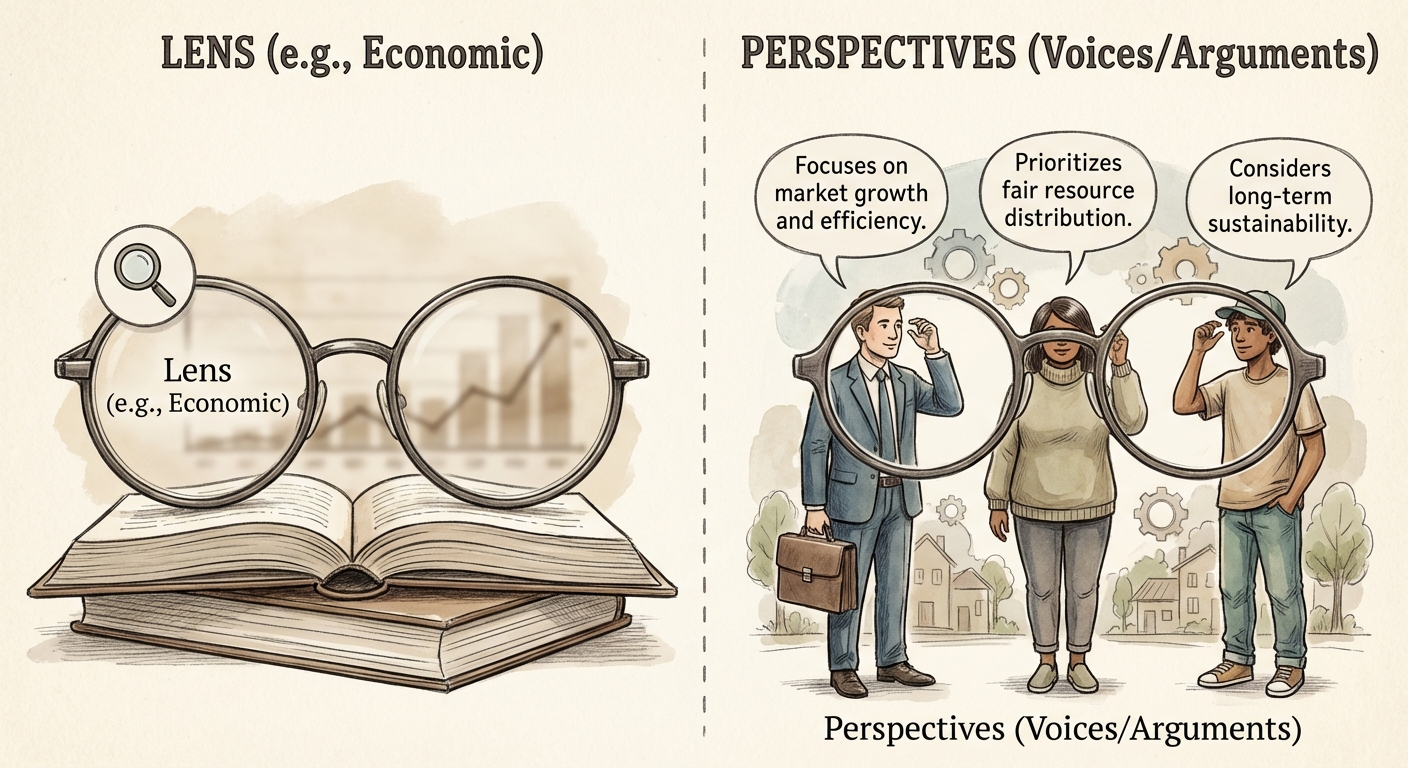
Tip: A lens is how you look; a perspective is what you see (or who is speaking). You use lenses to find diverse perspectives.
Search Strategies and Information Literacy
Once you have a question, you need data. Big Idea 1 requires you to move beyond basic Google searches into academic databases (like EBSCO, JSTOR, or Google Scholar).
1. Boolean Operators
Database search engines use logic to filter results. Mastering Boolean Operators is essential for efficiency.
- AND: Narrows results.
- returns only sources containing both terms.
- OR: Broadens results.
- returns sources containing either term. Useful for synonyms.
- NOT: Excludes results.
- insures you get results about the animal, not the luxury vehicle.
2. Database vs. General Web
| Feature | Academic Database | General Web (Google) |
|---|---|---|
| Credibility | High (Peer-reviewed, Vetted) | Variable (Anyone can publish) |
| Cost | Often paid (Libraries pay for access) | Free (Ad-supported) |
| Stability | Citations are permanent (DOIs) | Link rot (404 errors) |
| Depth | Specialized, technical | Broad, often superficial |
3. RAVEN: Evaluating Sources
Before using a source, you must evaluate its credibility. While Big Idea 2 focuses on analysis, Big Idea 1 requires you to select credible sources initially using tools like RAVEN:
- R - Reputation: What is the track record of the author/publisher?
- A - Ability to See: Was the author in a position to know the truth? (Primary vs. Secondary sources).
- V - Vested Interest: Does the author gain anything (money, status) by persuading you?
- E - Expertise: Does the author have relevant credentials (PhD, experience)?
- N - Neutrality: Is the language objective or emotionally charged?
Reflecting on Inquiry
Research is iterative (a cycle), not linear (a straight line). Big Idea 1 emphasizes that your question should change as you learn more.
- Refining the Question: If you find 10,000 results, your question is too broad. If you find 3 results, it is too narrow. Adjust accordingly.
- Addressing Blind Spots: Continuously ask: "whose voice is missing?" If you are researching a medical issue, have you only looked at doctors (Scientific Lens)? What about patients (Social/Ethical Lens)?
Common Mistakes & Pitfalls
1. The "Google Question" Mistake
- Mistake: Choosing a research question that can be answered with a fact check.
- Bad: "What is the GDP of China?"
- Correction: Ensure the question requires argumentation.
- Good: "To what extent does China's GDP growth influence its diplomatic relations with Southeast Asia?"
2. Lens/Perspective Confusion
- Mistake: Stating "My perspective is Scientific."
- Correction: Science is the lens. The perspective is the specific scientific consensus or a specific scientist's theory.
3. Confirmation Bias
- Mistake: Only searching for articles that agree with your initial opinion.
- Correction: Actively search for the opposing view using Boolean operators suitable for the counter-argument.
4. Ignoring the "So What?"
- Mistake: Picking a topic that is obscure or irrelevant to the real world.
- Correction: A good inquiry must have real-world stakes. Who is harmed? Who benefits? Why does this matter now?
5. Broad Concept Overload (The Encyclopedia Error)
- Mistake: Trying to cover the entire history of a topic.
- Correction: Narrow your bounds. Focus on a specific decade, a specific country, or a specific demographic.
Key Terms Summary
- Inquiry: The process of asking questions and seeking answers.
- Scope: The extent of the area or subject matter that something deals with.
- Primary Source: Original materials (diaries, raw data, interviews).
- Secondary Source: Interpretation of primary sources (textbooks, analyses).
- Recursive: Characterized by recurrence or repetition; the research process loops back on itself.
Remember, in AP Seminar, the answer is often less important than the quality of the question and the thoroughness of the search. Stay curious!