Mastering the ACT English Section: A Comprehensive Review
Note: The ACT English section consists of 75 questions to be answered in 45 minutes. The questions cover two broad categories: Usage/Mechanics and Rhetorical Skills. This guide covers the essential rules and strategies required to achieve a top score.
Usage and Mechanics: Punctuation
Punctuation on the ACT is not about "pausing" or how the sentence sounds; it is about logical syntax. The test relies on objective rules, particularly concerning how clauses are connected.
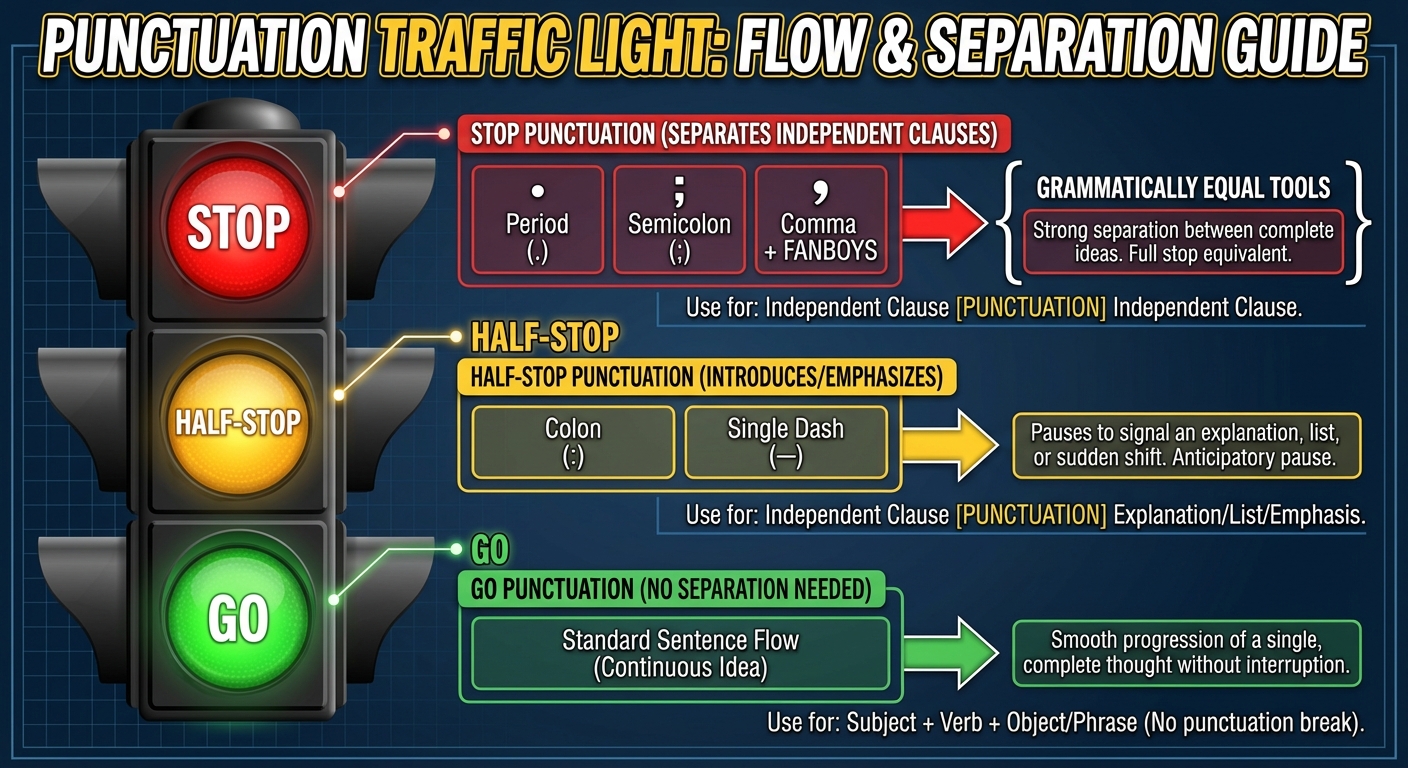
The "Stop" Punctuation
Stop punctuation connects two Independent Clauses (complete sentences). If you use a Stop mark, the text on both sides must be arguably able to stand alone as a sentence.
The three forms of Stop punctuation are:
- Period (.)
- Semicolon (;)
- Comma + FANBOYS (For, And, Nor, But, Or, Yet, So)
Common Mistake: Using a comma alone to separate two independent sentences results in a comma splice. You must add a conjunction or change the punctuation.
The Colon and The Dash
These marks act similarly but have nuances.
- The Colon (:): Must follow an Independent Clause. What follows can be a list, a quote, or an explanation. Think of the colon as an equals sign ($=$) or the phrase "such as."
- Correct: I have only one goal: to pass this test.
- Incorrect: The ingredients are: flour, sugar, and milk. (The part before the colon is not a complete sentence).
- The Dash (—): Dashes have two main functions:
- Single Dash: Functions like a colon or a strong pause for emphasis.
- Pair of Dashes: Functions like parentheses, surrounding non-essential information.
Commas
Commas are the most frequently tested punctuation mark. On the ACT, if you are unsure whether a comma is needed, lean toward omitting it.
Four Mandatory Comma Uses:
- Separating Items in a List: "I bought apples, bananas, and pears."
- Separating Independent Clauses with FANBOYS: See "Stop Punctuation" above.
- Surrounding Non-Essential Clauses (Appositives): If you can remove the phrase without changing the core meaning of the sentence, surround it with commas.
- Example: "My brother, an accountant, lives in Ohio."
- After an Introductory Phrase: "After the game, we went home."
The "No Comma" Zones:
- Between a Subject and a Verb.
- Between an Adjective and the Noun it modifies.
- Before a preposition (usually).
Apostrophes
Apostrophes indicate Possession or Contraction.
| Concept | Rule | Example |
|---|---|---|
| Singular Possession | Add 's | The dog's toy (one dog) |
| Plural Possession | Add s' | The dogs' toy (multiple dogs) |
| Irregular Plural | Add 's | The men's room |
| Contraction | Replaces letters | Can't (cannot) |
Common Mistake: Confusing It's vs. Its.
- It's = It is.
- Its = Possessive form of "it" (like "his" or "her").
- Tip: If you can replace it with "it is" in the sentence, use the apostrophe.
Grammar and Usage
Subject-Verb Agreement
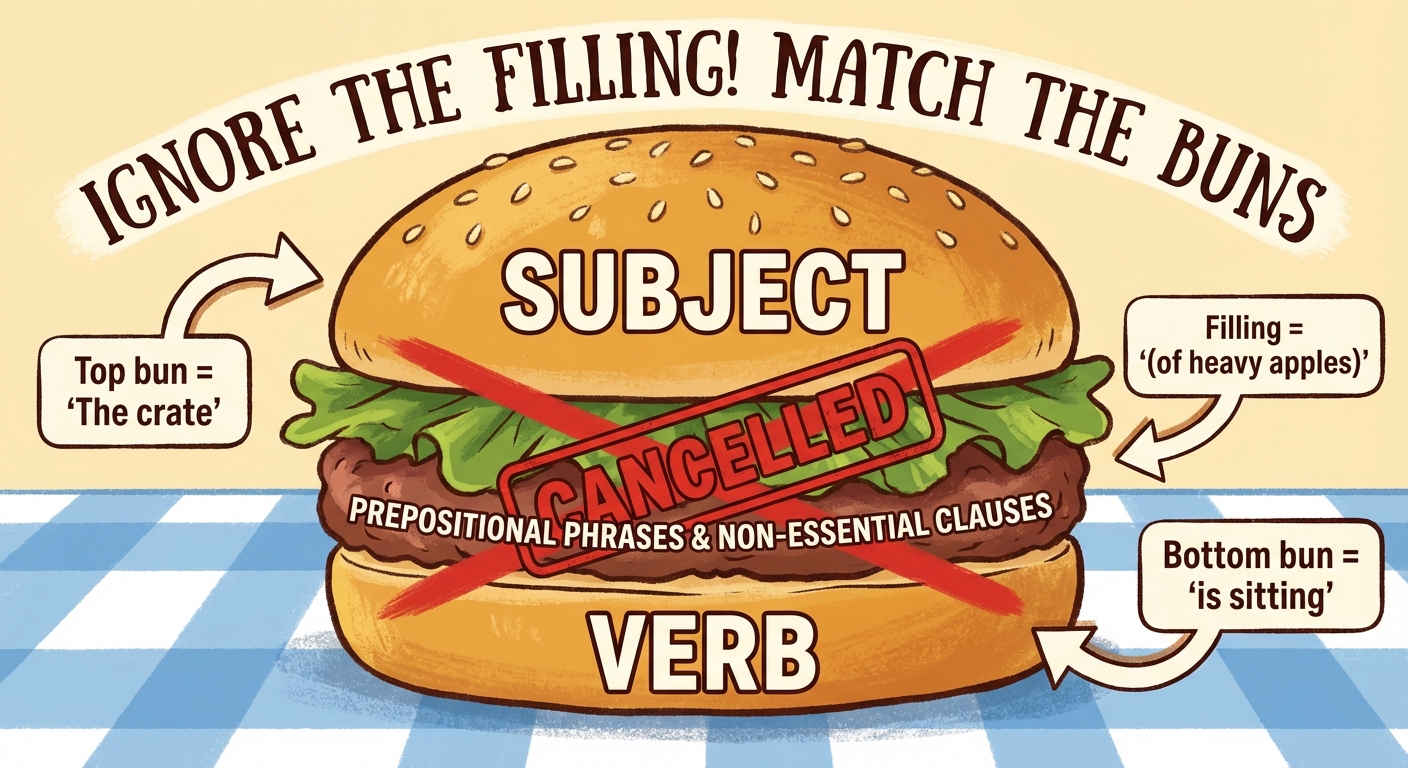
The specific rule is that singular subjects take singular verbs (usually ending in s) and plural subjects take plural verbs. However, the ACT hides the subject behind a wall of distractions.
The Prepositional Trap
The subject of a sentence will never be inside a prepositional phrase. Cross out the prepositional phrase to find the real subject.
- Trick Sentence: "The box [of nails] is heavy."
- The subject is "box" (singular), not "nails" (plural). Therefore, the verb is "is," not "are."
Pronoun Agreement and Case
Pronouns must agree with their antecedent (the noun they replace) in number and gender. They also must be in the correct "case."
- Subject Case (I, He, She, We, Type, They, Who): Used when the pronoun is doing the action.
- Object Case (Me, Him, Her, Us, Them, Whom): Used when the pronoun receives the action or follows a preposition.
The "Who vs. Whom" Mnemonic
- Replace "Who/Whom" with "He" or "Him."
- If He works $\rightarrow$ Use Who.
- If HiM works $\rightarrow$ Use WhoM.
Adjectives vs. Adverbs
- Adjectives modify nouns. (The quick fox)
- Adverbs modify verbs, adjectives, or other adverbs. They often end in -ly. (The fox ran quickly)
Common Mistake: "I did good on the test."
- Correction: "I did well on the test." ("Good" is an adjective; "Well" is the adverb explaining how you did).
Sentence Structure
Misplaced Modifiers
A modifier is a descriptive phrase. The golden rule: A modifier must be placed immediately next to the noun it describes.
- Incorrect: "Covered in pepperconi, the waiter brought the pizza."
- Implication: The waiter is covered in pepperoni.
- Correct: "The waiter brought the pizza, covered in pepperoni."
Parallelism
In a list or a comparison, items must share the same grammatical form.
- Incorrect: "I like swimming, hiking, and to ride horses."
- Correct: "I like swimming, hiking, and riding horses."
Rhetorical Skills
These questions (approx. 47% of the test) ask about the author's meaning, the organization of text, and style rather than just grammar.
Transitions
Transition words act as logic bridges between ideas. To solve these, you must read the previous sentence and the current sentence to determine the relationship.
| Relationship | Key Words |
|---|---|
| Continuation | Also, Furthermore, Moreover, Additionally, In fact |
| Contrast | However, But, Yet, Despite, On the other hand |
| Causation | Therefore, As a result, Consequently, Because, Thus |
| Sequence/Time | First, Later, Meanwhile, Subsequently |
Strategy: Adding and Deleting Information
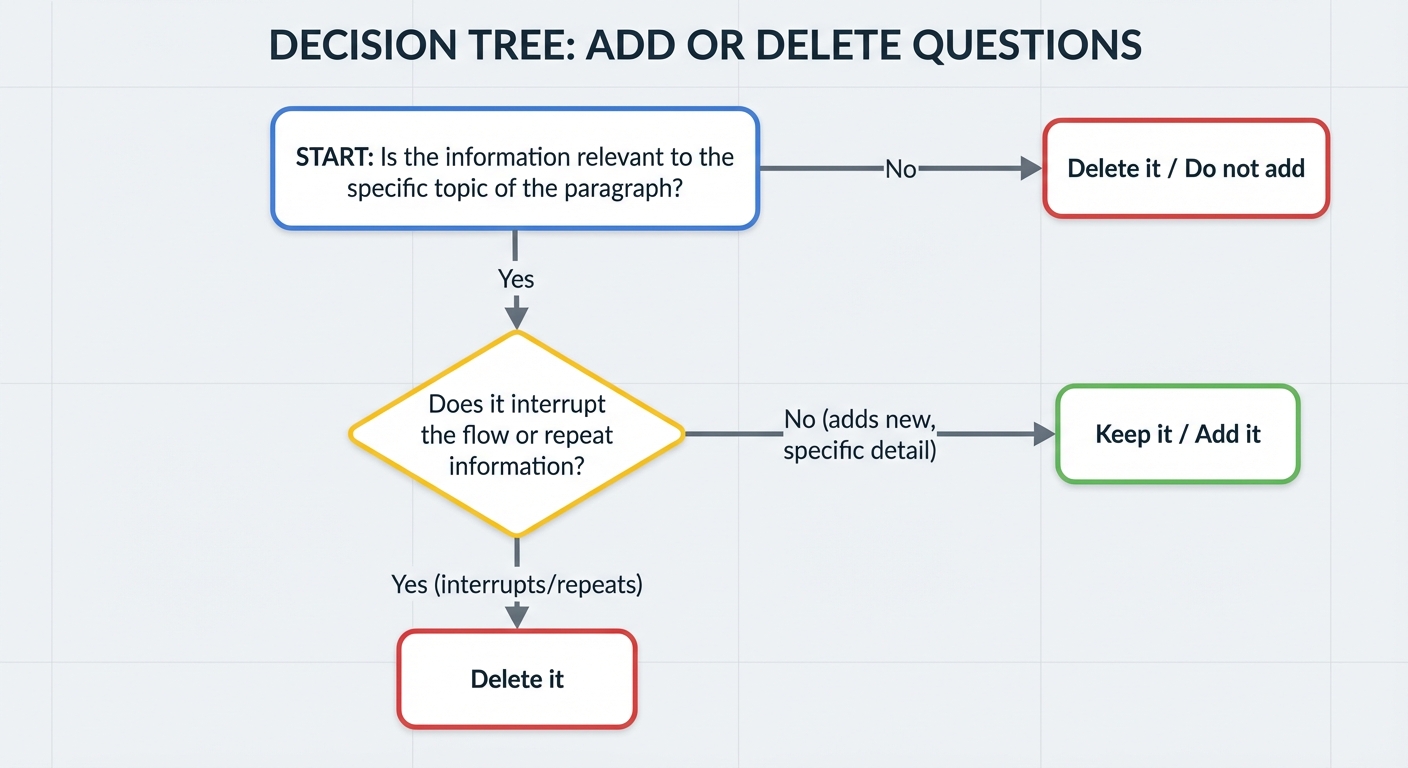
Questions often ask: "Should the writer add this sentence?" or "Should the writer delete this sentence?"
- Relevance Check: Does the new information directly support the main topic of the paragraph? If it is off-topic, delete it or do not add it.
- Yes/No Logic: Often, two answer choices are "Yes" and two are "No." Decide Yes/No first based on relevance, then check the reasoning provided in the answer choice.
Conciseness and Redundancy
The ACT demands concise writing. If three answer choices say the same thing but have different lengths, the shortest one is usually correct (provided it is grammatically sound).
Avoid Redundancy: Do not state the same idea twice.
- Redundant: "The annual marathon happens every year."
- Correct: "The annual marathon."
- Redundant: "It was blue in color."
- Correct: "It was blue."
Final Tips and Common Pitfalls
1. Read the Context
Do not just read the underlined portion. You must read the whole sentence (and often the previous sentence) to understand context, tense, and flow.
2. OMIT the Underlined Portion
If "OMIT the underlined portion" or "DELETE the underlined portion" is an option, check it carefully. It has a high probability of being correct because the ACT hates wordiness.
3. Vocabulary in Context
You may see questions asking for the "most appropriate" word. These are about tone and precision.
- Tone: If the passage is formal (scientific, historical), avoid slang or overly casual words.
- Precision: Look for the word that has the specific definition fitting the scenario.
4. Frequent Mistakes Checklist
- Accept vs. Except: Accept = to receive; Except = excluding.
- Then vs. Than: Then = time; Than = comparison.
- Affect vs. Effect:
- Affect = Action (verb).
- Effect = End Result (noun).
- Could of / Should of: This is grammatically impossible. The correct forms are "Could have" (Could've) and "Should have" (Should've).
Summary Checklist
Before you take the test, ensure you can answer these questions:
- Can you identify the subject of the sentence even if it is far from the verb?
- Do you know the difference between a colon and a semicolon?
- Can you identify the 7 FANBOYS?
- Do you know when not to use a comma?
Mastering these mechanical rules will guarantee you points on the Usage/Mechanics section, leaving you more mental energy to tackle the Rhetorical Skills questions.