AP Calculus AB Unit 5: First and Second Derivative Analysis (Monotonicity, Extrema, Concavity, Inflection Points)
Determining Intervals of Increase and Decrease
When you look at a graph and say “this function is going up” or “this function is going down,” you’re describing increasing and decreasing behavior. In AP Calculus, you’re expected to determine this behavior analytically using derivatives, often without graphing the original function.
What it means (definitions)
A function %%LATEX0%% is increasing on an interval %%LATEX1%% if whenever %%LATEX2%% (both in %%LATEX3%%), then %%LATEX4%%. A function %%LATEX5%% is decreasing on %%LATEX6%% if %%LATEX7%% implies .
Why derivatives decide increasing vs. decreasing
The first derivative %%LATEX9%% measures the instantaneous rate of change (the slope of the tangent line). If the slopes are positive on an interval, the graph rises as %%LATEX10%% increases; if the slopes are negative, the graph falls.
The core test is:
- If %%LATEX11%% on an interval, then %%LATEX12%% is increasing on that interval.
- If %%LATEX13%% on an interval, then %%LATEX14%% is decreasing on that interval.
- If %%LATEX15%% for all %%LATEX16%% in an interval, then is constant on that interval.
This works because the derivative is the limit of average rates of change, so it captures the function’s local “direction.”
Critical numbers (where behavior can change)
Before identifying intervals, find critical numbers. A critical number of a function %%LATEX18%% is a number %%LATEX19%% in the domain of such that either:
- is undefined
These (along with any domain breaks where %%LATEX23%% itself is not defined) are the only places where the sign of %%LATEX24%% can change, so they are the only places where increasing can switch to decreasing or vice versa.
How to find intervals of increase/decrease (process)
You typically do this with a sign analysis of .
- Compute .
- Find critical numbers (solve %%LATEX27%% and where %%LATEX28%% does not exist), and also mark any places where is not defined.
- Use these values to split the domain into test intervals.
- Pick a test point in each interval and determine the sign of there.
- State where %%LATEX31%% (increasing), %%LATEX32%% (decreasing), and, if it occurs, where for an entire interval (constant).
A common misconception is that solving %%LATEX34%% automatically tells you where the function changes behavior. Those solutions only give candidates; you must still confirm the sign of %%LATEX35%% on each interval.
Notation you may see
Derivatives appear in multiple equivalent notations.
| Meaning | Common notations |
|---|---|
| derivative of %%LATEX36%% with respect to %%LATEX37%% | |
| derivative of | %%LATEX40%%, %%LATEX41%% |
| second derivative | %%LATEX42%%, %%LATEX43%% |
Visual intuition (tangent slopes)
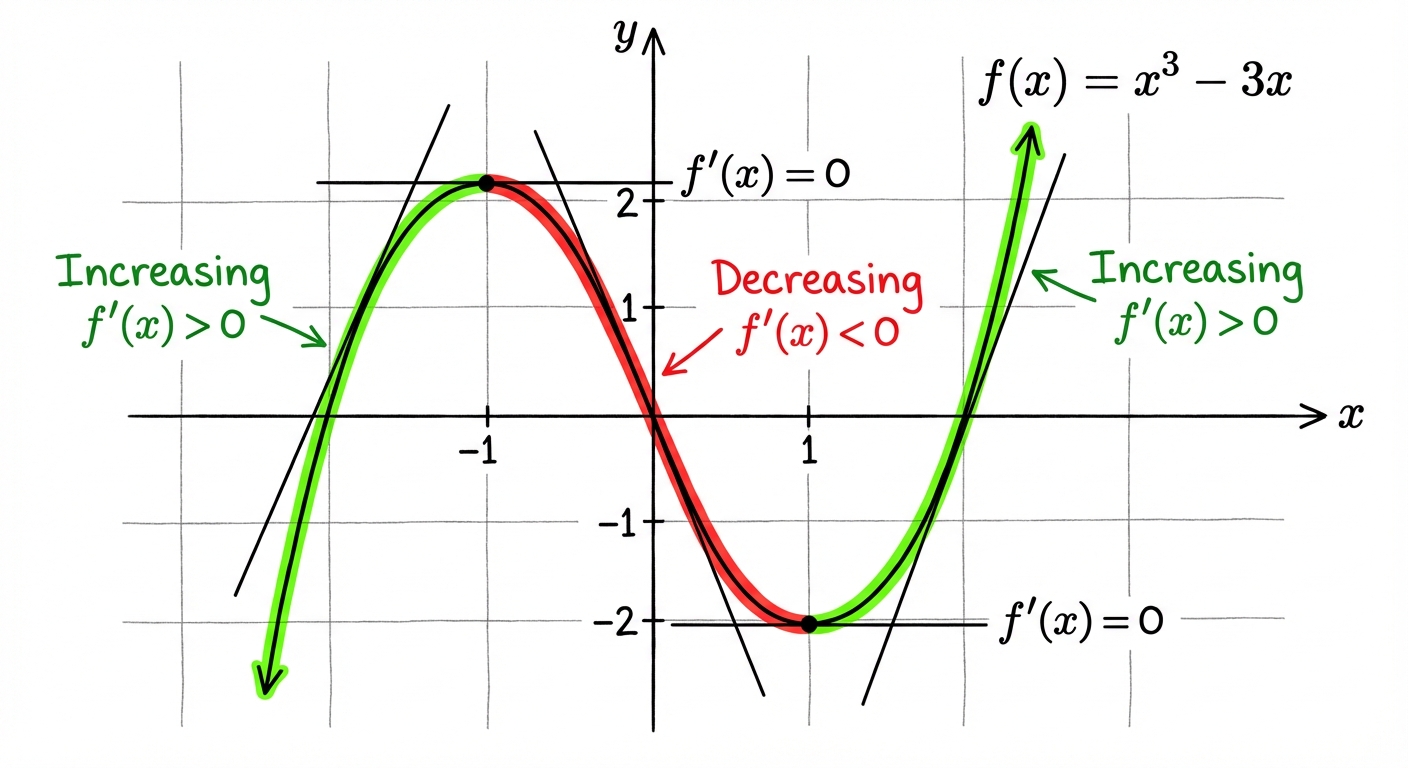
Worked Example 1: Increasing/decreasing for a polynomial
Let
Differentiate:
Find critical numbers by solving %%LATEX46%%:
%%LATEX47%%
%%LATEX48%%
So %%LATEX49%% at
%%LATEX50%%
%%LATEX51%%
Make test intervals and test points:
- On %%LATEX52%%, test %%LATEX53%%: so increasing.
- On %%LATEX55%%, test %%LATEX56%%: so decreasing.
- On %%LATEX58%%, test %%LATEX59%%: so increasing.
Conclusion:
- Increasing on
- Decreasing on
Worked Example 2: Sign-chart table (another polynomial)
Problem: Find the open intervals on which
is increasing or decreasing.
Differentiate:
Critical numbers from %%LATEX65%%:
%%LATEX66%%
So
%%LATEX67%%
%%LATEX68%%
Sign chart (testing one value in each interval):
| Interval | Test value | Sign computation for | Sign of | Behavior of |
|---|---|---|---|---|
| positive | Increasing | |||
| negative | Decreasing | |||
| positive | Increasing |
Conclusion: %%LATEX81%% is increasing on %%LATEX82%% and %%LATEX83%% and decreasing on %%LATEX84%%.
Worked Example 3: Don’t forget the domain (rational function)
Let
Domain: .
Differentiate:
%%LATEX87%%
Simplify:
%%LATEX88%%
Since %%LATEX89%% for all %%LATEX90%%, we have %%LATEX91%% everywhere in the domain. Therefore %%LATEX92%% is decreasing on both domain intervals:
- Decreasing on
- Decreasing on
A common mistake is to claim “decreasing on %%LATEX95%%” even though the function is not defined at %%LATEX96%%. Intervals of increase/decrease must be intervals where the function actually exists.
Exam Focus
- Typical question patterns:
- “Find the intervals on which %%LATEX97%% is increasing/decreasing” given a formula for %%LATEX98%%.
- “Given the graph of %%LATEX99%%, determine where %%LATEX100%% increases/decreases.”
- “Given a table/sign information for , justify monotonicity on intervals.”
- Common mistakes:
- Forgetting to exclude values not in the domain of (vertical asymptotes, holes, etc.).
- Listing critical numbers as intervals (critical numbers are points; answers must be intervals).
- Assuming automatically means a maximum or minimum without sign testing.
- Forgetting that a function can also be constant on an interval when throughout that interval.
First Derivative Test
Intervals of increase/decrease don’t just tell you “up” and “down.” They also let you locate and classify local (relative) extrema, meaning points where the function is higher or lower than nearby points.
What it is
The First Derivative Test classifies a critical number %%LATEX105%% by checking how %%LATEX106%% changes sign around .
- If %%LATEX108%% changes from positive to negative at %%LATEX109%%, then %%LATEX110%% changes from increasing to decreasing, so %%LATEX111%% is a local maximum.
- If %%LATEX112%% changes from negative to positive at %%LATEX113%%, then %%LATEX114%% changes from decreasing to increasing, so %%LATEX115%% is a local minimum.
- If %%LATEX116%% does not change sign at %%LATEX117%% (positive on both sides or negative on both sides), then is neither a local max nor a local min. This is often called a terrace point (a “flat spot”), and it can also occur at some inflection points.
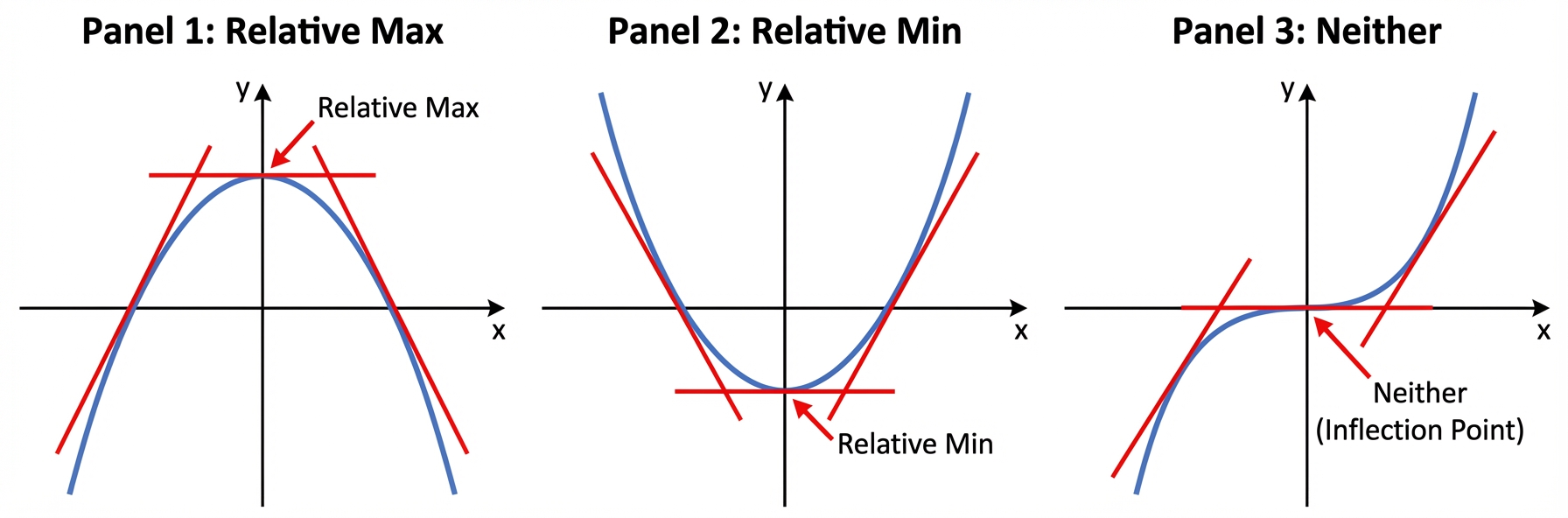
Why it matters (including AP justification)
On many AP questions, you’re asked to justify maxima/minima without graphing. The First Derivative Test is powerful because it works even when the second derivative test fails or is messy.
When you justify on the AP Exam, avoid vague phrases like “the slope changes” or “it goes up then down.” Be specific about the derivative’s sign:
Function %%LATEX119%% has a relative maximum at %%LATEX120%% because changes from positive to negative at this point.
How it works (step-by-step)
- Find critical numbers of %%LATEX122%%: solve %%LATEX123%% and find where %%LATEX124%% does not exist, provided %%LATEX125%% is defined there.
- Choose test points on each side of each critical number.
- Determine the sign of on each side.
- Use the sign change rule to classify the critical number.
A subtle but important point: a critical number where %%LATEX127%% does not exist can still be a local extremum (corners, cusps, vertical tangents). For example, sharp points can occur in functions like
%%LATEX128%%
or
%%LATEX129%%
The first derivative test still works because it relies on the sign of %%LATEX130%% around %%LATEX131%%, not on whether %%LATEX132%% exists.
Example 1: Classifying critical points from a sign chart
Suppose for a function you know:
- %%LATEX134%% on %%LATEX135%%
- %%LATEX136%% on %%LATEX137%%
- %%LATEX138%% on %%LATEX139%%
Then:
- At %%LATEX140%%, %%LATEX141%% changes from positive to negative, so is a local maximum.
- At %%LATEX143%%, %%LATEX144%% changes from negative to positive, so is a local minimum.
You didn’t need the formula for %%LATEX146%%, only the sign behavior of %%LATEX147%%.
Example 2: A critical point that is not an extremum
Let
%%LATEX148%%
Then
%%LATEX149%%
Critical number: %%LATEX150%% at %%LATEX151%%.
But %%LATEX152%% for all %%LATEX153%%, and it is positive on both sides of %%LATEX154%%. So %%LATEX155%% does not change sign at .
Conclusion: %%LATEX157%% has no local max/min at %%LATEX158%% even though is a critical number. This prevents the classic mistake “critical point equals extremum.”
Real-world connection: velocity and turning points
If %%LATEX160%% is position, then %%LATEX161%% is velocity. When velocity changes from positive to negative, the object turns around and position reaches a local maximum. When velocity changes from negative to positive, position reaches a local minimum. That is the First Derivative Test in a physical context.
Exam Focus
- Typical question patterns:
- “Find and classify all local extrema of .”
- “Given a graph of %%LATEX163%%, determine where %%LATEX164%% has local maxima/minima and justify.”
- “Use the first derivative test to classify critical points” (often requiring a sign chart).
- Common mistakes:
- Declaring a max/min just because without checking sign change.
- Forgetting that critical numbers can occur where is undefined (corners, cusps, vertical tangents), and extrema can still occur there.
- Mixing up local vs. absolute extrema (local depends on nearby behavior; absolute compares the entire interval).
- Endpoint errors: derivative tests classify relative extrema in open intervals. Absolute extrema can occur at endpoints, so optimization problems require checking endpoints separately.
Determining Concavity and Points of Inflection
Increasing/decreasing describes whether a function moves up or down. Concavity describes the shape of the graph (whether it “bends upward” or “bends downward”). Concavity is controlled by the second derivative.
What concavity means (and how to visualize it)
A function is:
- Concave up on an interval if the graph bends upward like a cup and tangent lines tend to lie below the curve.
- Concave down on an interval if the graph bends downward like a cap and tangent lines tend to lie above the curve.
A very useful interpretation connects concavity to slopes:
- Concave up means slopes are increasing as increases.
- Concave down means slopes are decreasing as increases.
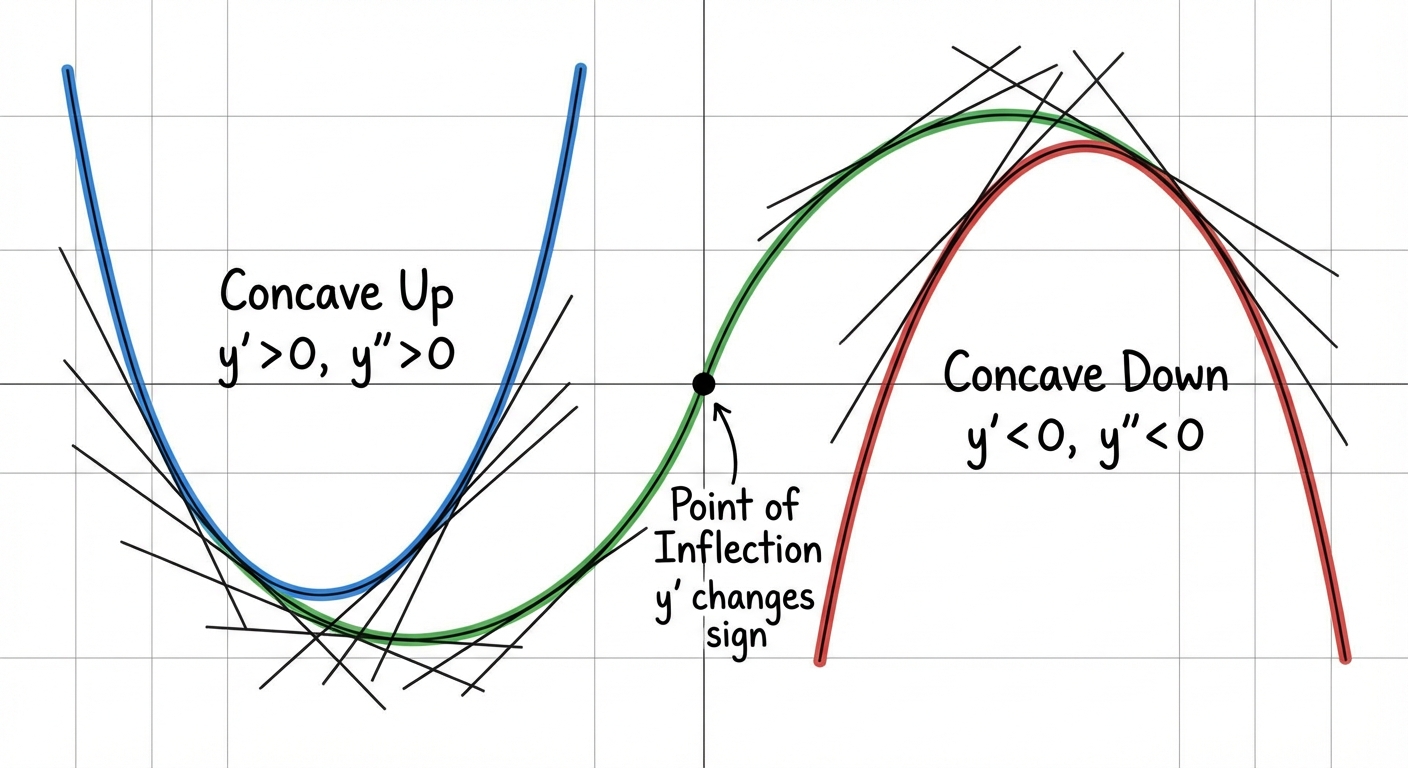
Why the second derivative controls concavity
The first derivative %%LATEX170%% is slope. The second derivative %%LATEX171%% is the rate of change of slope. Therefore:
- If %%LATEX172%%, slopes are increasing and %%LATEX173%% is concave up.
- If %%LATEX174%%, slopes are decreasing and %%LATEX175%% is concave down.
Physics connection: if %%LATEX176%% is position, then %%LATEX177%% is acceleration. Positive acceleration tends to increase velocity (slope), giving concave up position graphs; negative acceleration tends to decrease velocity, giving concave down position graphs.
Testing for concavity (procedure)
- Compute .
- Find possible concavity-change inputs where either:
- , or
- does not exist.
- Split the domain into intervals using these values (and any domain breaks).
- Use a sign chart for .
- State concavity on each interval.
Points of inflection (what they are, and what they are not)
A point of inflection is a point where the graph changes concavity (concave up to concave down, or vice versa). A helpful geometric description is that it is a point where the curve intersects its tangent line and the concavity changes.
To confirm a point of inflection at , you need all of the following ideas working together:
- %%LATEX184%% must correspond to a point on the graph, meaning %%LATEX185%% must be defined there, and in typical AP contexts you assume the graph has to be continuous at .
- %%LATEX187%% or %%LATEX188%% is undefined gives a candidate.
- The crucial test: %%LATEX189%% must change sign at %%LATEX190%%.
A point where is not automatically an inflection point. It is only a candidate.
Memory Aid: the “ladder”
This relationship hierarchy is a frequent source of AP questions.
| behavior | behavior | behavior |
|---|---|---|
| Increasing (upward trend) | Positive | |
| Decreasing (downward trend) | Negative | |
| Concave up (cup shape) | Increasing | Positive |
| Concave down (cap shape) | Decreasing | Negative |
| Point of inflection | Relative extremum of (often) | Change of sign |
Example 1: Concavity and inflection for a polynomial
Let
Differentiate:
%%LATEX198%%
%%LATEX199%%
Candidate from %%LATEX200%%:
%%LATEX201%%
Sign of :
- For %%LATEX204%%, %%LATEX205%% so concave down on .
- For %%LATEX207%%, %%LATEX208%% so concave up on .
Concavity changes at %%LATEX210%% and %%LATEX211%% is continuous there, so there is an inflection point at %%LATEX212%%. The point is:
%%LATEX213%%
So the inflection point is .
Example 2: A candidate that is not an inflection point
Let
%%LATEX215%%
Then
%%LATEX216%%
Candidate: .
But %%LATEX219%% for all %%LATEX220%% and does not become negative, so concavity does not change.
Conclusion: no inflection point at .
Example 3: Inflection requires a point on the graph
Let
%%LATEX222%%
Then
%%LATEX223%%
Although %%LATEX225%% changes sign at %%LATEX226%% (negative for %%LATEX227%% and positive for %%LATEX228%%), %%LATEX229%% is not defined at %%LATEX230%%. There is no point , so there is no inflection point.
You can still state concavity:
- Concave down on
- Concave up on
Exam Focus
- Typical question patterns:
- “Find intervals where is concave up/down and find points of inflection.”
- “Given a graph of %%LATEX235%%, determine concavity of %%LATEX236%%” (since concavity depends on whether is increasing or decreasing).
- “Given a table of values/signs for %%LATEX238%%, decide where %%LATEX239%% is concave up/down.”
- Common mistakes:
- Saying “point of inflection at %%LATEX240%% because %%LATEX241%%” without verifying a sign change.
- Forgetting an inflection point must be on the graph (requires to be defined there, and typically continuous there).
- Confusing “concave up” with “increasing” (a function can be decreasing and concave up at the same time).
Second Derivative Test
Once you can find critical points (often from %%LATEX243%%) and understand concavity (from %%LATEX244%%), you can combine them to classify local extrema quickly. The Second Derivative Test uses concavity at a critical point to decide whether that point is a local max or min.
The rules
Let %%LATEX245%% be a critical number with
%%LATEX246%%
and assume %%LATEX247%% exists on an open interval containing %%LATEX248%%.
- If %%LATEX249%%, the graph is concave up at %%LATEX250%%, so is a local minimum.
- If %%LATEX252%%, the graph is concave down at %%LATEX253%%, so is a local maximum.
- If , the test is inconclusive, and you must use another method (typically the First Derivative Test).
Why it makes sense (the “bowl vs. hill” idea)
At a critical point with , the tangent line is horizontal. If the curve is shaped like a bowl (concave up), a horizontal tangent tends to occur at the bottom (a local minimum). If it’s shaped like a hill (concave down), a horizontal tangent tends to occur at the top (a local maximum).
This can be faster than the First Derivative Test because you evaluate a single number , but the tradeoff is that sometimes it gives no answer.
Reliable procedure
- Compute %%LATEX258%% and solve %%LATEX259%% to find critical numbers.
- Compute .
- For each critical number %%LATEX261%%, evaluate %%LATEX262%%.
- Classify using the sign of .
- If the test is inconclusive, fall back on the First Derivative Test.
“Inconclusive” does not mean “neither max nor min.” It only means the second derivative test can’t decide.
Example 1: Second derivative test works cleanly
Let
Differentiate:
%%LATEX265%%
Solve %%LATEX266%%:
%%LATEX267%%
Critical numbers:
%%LATEX268%%
Second derivative:
Evaluate:
%%LATEX271%%
So %%LATEX272%% is a local maximum.
%%LATEX273%% So %%LATEX274%% is a local minimum.
If you need the coordinate points:
%%LATEX275%%
%%LATEX276%%
So local max at %%LATEX277%% and local min at %%LATEX278%%.
Example 2: Inconclusive case (must use first derivative test)
Let
%%LATEX279%%
Then
%%LATEX280%%
Critical number: .
Second derivative:
%%LATEX282%%
Evaluate:
%%LATEX283%%
Inconclusive.
Now use the First Derivative Test: %%LATEX284%% is negative for %%LATEX285%% and positive for %%LATEX286%%, so %%LATEX287%% decreases then increases. Therefore is a local minimum.
Example 3: Second-derivative test with multiple critical points (including “neither”)
Problem: Classify the critical points of
using the Second Derivative Test.
First derivative and critical numbers:
%%LATEX290%%
%%LATEX291%%
So %%LATEX292%% at
%%LATEX293%%
Second derivative:
Apply the test:
At %%LATEX296%%: %%LATEX297%%
Since %%LATEX298%%, %%LATEX299%% is concave up there, so is a relative minimum.At %%LATEX301%%: %%LATEX302%%
Inconclusive. Use the First Derivative Test (sign chart idea): %%LATEX303%% is negative just left of %%LATEX304%% and negative just right of %%LATEX305%%, so there is no sign change. Therefore %%LATEX306%% is neither a relative maximum nor a relative minimum.
Connection to graph interpretation of
Sometimes you’re given a graph of %%LATEX308%%, not %%LATEX309%%. You can still use the second-derivative idea conceptually:
- If %%LATEX310%% and %%LATEX311%% is increasing at %%LATEX312%%, then %%LATEX313%%, suggesting a local minimum.
- If %%LATEX314%% and %%LATEX315%% is decreasing at %%LATEX316%%, then %%LATEX317%%, suggesting a local maximum.
Exam Focus
- Typical question patterns:
- “Use the second derivative test to classify each critical point of .”
- “Given that %%LATEX319%% and %%LATEX320%% (or ), what can you conclude?”
- “Second derivative test is inconclusive; use the first derivative test to finish classification.”
- Common mistakes:
- Applying the test when (you need a critical point with a horizontal tangent).
- Treating as meaning “inflection point” or “no extremum” (it only means inconclusive).
- Forgetting to check that %%LATEX324%% exists in an open interval around %%LATEX325%% before using its sign.
- Confusing the tests: the First Derivative Test uses sign change of %%LATEX326%% around %%LATEX327%%, while the Second Derivative Test uses the sign of at the point.
- Endpoint errors in optimization: derivative tests don’t automatically “find” endpoints, but absolute extrema can occur there, so endpoints must be checked separately.