Deconstructing Arguments and Examining Evidence within Texts
Identifying Arguments, Claims, and Evidence
To succeed in AP Seminar, particularly for End-of-Course Exam Part A, you must be able to surgically dissect a text. An argument is not merely a contradiction or a dispute; in academic terms, an Argument is a cohesive explanation consisting of a main claim, the reasons that support it, and the evidence used to prove those reasons.
The Anatomy of an Argument
Think of an argument like the architecture of a building. If the structure is weak, the roof collapses.
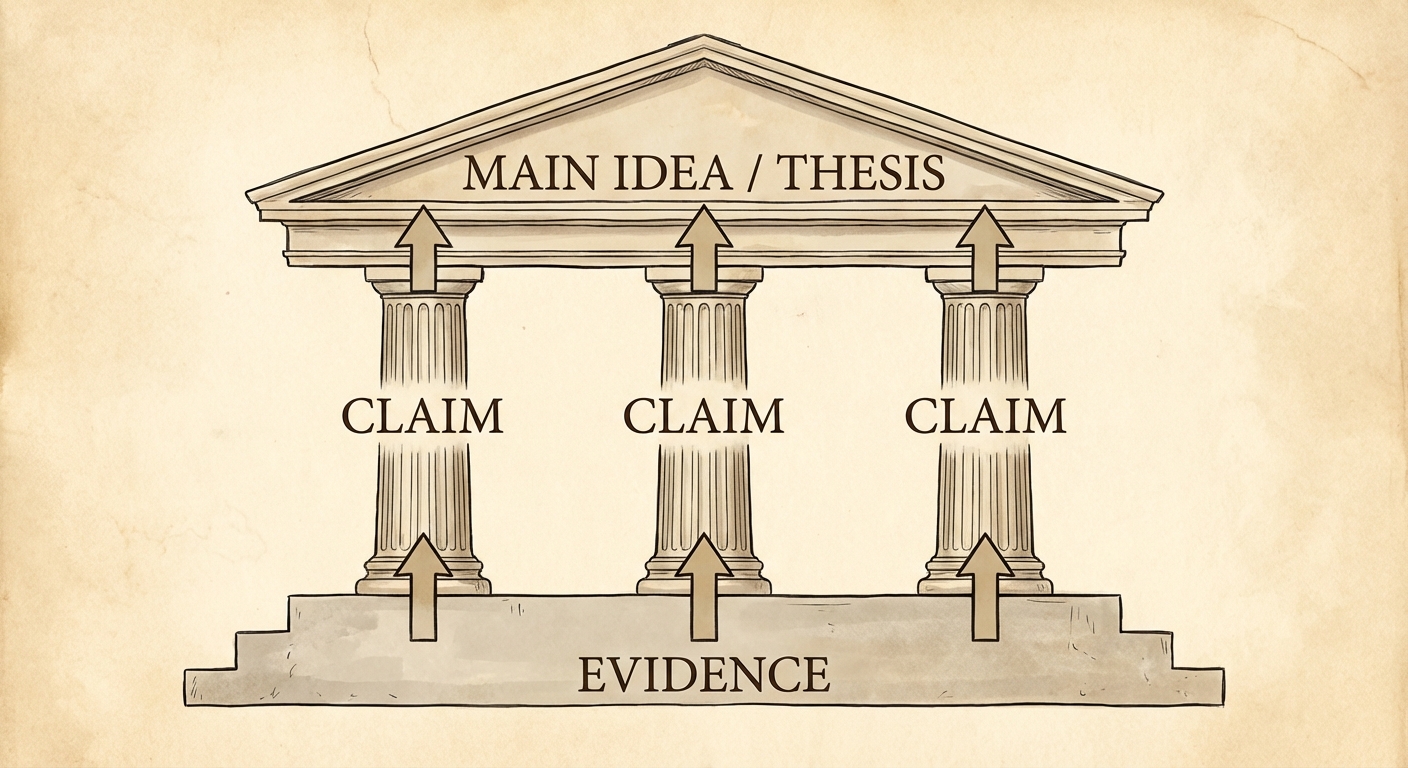
- Main Idea / Thesis (The Roof): This is the overarching conclusion the author wants you to believe or accept. It is the destination where the author is taking the reader.
- Claims (The Pillars): These are the sub-conclusions or reasons that support the main idea. A claim answers the question: "Why should I believe the thesis?"
- Evidence (The Foundation): These are the specific facts, data, statistics, or expert opinions that support the claims. Evidence answers the question: "How do I know this claim is true?"
Distinguishing Claims from Evidence
One of the most frequent hurdles is distinguishing between a claim (an assertion) and evidence (proof).
- Claim: *"High school start times should be delayed because teenagers face a chronic sleep deficit."
- Evidence: *"A 2022 study by the CDC found that 73% of high school students get less than 8 hours of sleep."
Note: A claim is debatable; a piece of evidence is verifiable data used to settle the debate.
Evaluating the Quality of Sources
Once you have identified the evidence, you must assess its credibility. Not all "facts" are created equal. The College Board expects you to determine if a source is trustworthy using specific criteria.
The RAVEN Method
Use the mnemonic RAVEN to evaluate the credibility of a source or author:
- R — Reputation: Does the author or publication have a history of accuracy? Is it a peer-reviewed journal (high credibility) or a personal blog (low credibility)?
- A — Ability to Observe: Was the source in a position to know the truth? Primary sources (eyewitnesses) often have higher ability to observe than secondary sources, though they may lack objectivity.
- V — Vested Interest: Does the author have something to gain (usually money, status, or political influence) by persuading you? If an oil company releases a study claiming climate change is a myth, they have a vested interest.
- E — Expertise: Does the author have specialized knowledge or credentials (PhD, years of experience) relevant to the specific topic?
- N — Neutrality: Is the source objective, or is it emotionally charged and biased?
Validity vs. Reliability
While often used interchangeably, these terms have distinct meanings in research:
| Term | Definition | Key Question |
|---|---|---|
| Validity | The accuracy of the measure; does it measure what it is supposed to? | Is the data relevant and accurate to the claim? |
| Reliability | The consistency of the measure; can the result be replicated? | If I repeated this study, would I get the same results? |
Analyzing Reasoning and Logic
Understanding what the author says is step one; understanding how they connect their ideas is step two. This involves analyzing the Line of Reasoning and the type of logic employed.
The Line of Reasoning (LOR)
The Line of Reasoning is the logical arrangement of claims and evidence that leads to a conclusion. It is the "path" the author forces the reader to walk. When analyzing LOR, look for:
- Sequencing: Does the author build the argument chronologically?
- Juxtaposition: Does the author place two contrasting ideas side-by-side to highlight differences?
- Cause and Effect: Does the author establish a clear link between an action and a consequence?
Inductive vs. Deductive Reasoning
Arguments generally follow one of two logical flows:
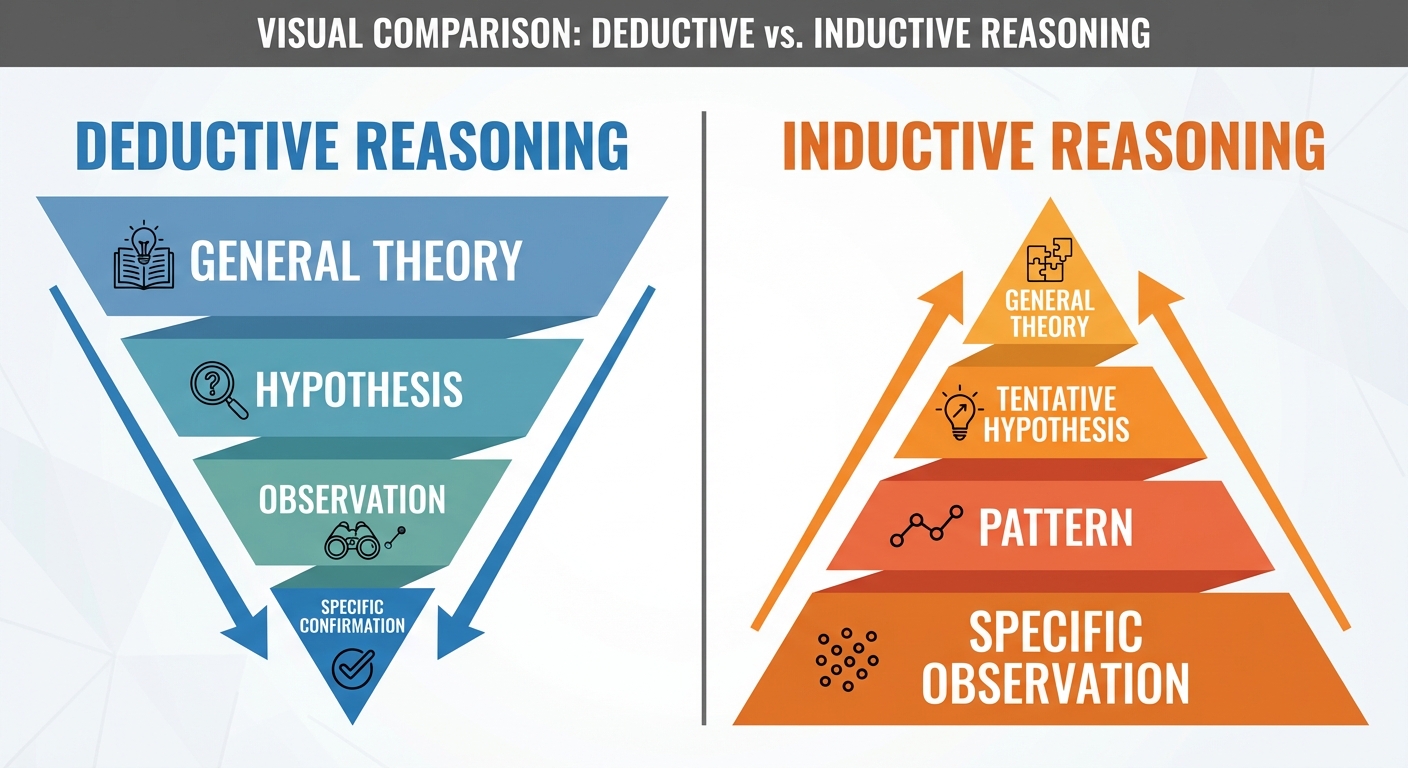
Deductive Reasoning (Top-Down):
- Starts with a general rule (premise) and applies it to a specific case to reach a certain conclusion.
- Formula:
- Example: All AP students are hardworking. You are an AP student. Therefore, you are hardworking.
Inductive Reasoning (Bottom-Up):
- Starts with specific observations and moves to a general probability or theory.
- Example: Every quiz I have taken in this class has been on a Friday. Therefore, the next quiz will likely be on a Friday.
Logical Fallacies
A "flaw" in the line of reasoning is a Logical Fallacy. Identifying these allows you to critique the author's effectiveness.
- Hasty Generalization: Drawing a broad conclusion from a small sample size. (e.g., "My Toyota broke down, so all Japanese cars are unreliable.")
- Ad Hominem: Attacking the person rather than the argument. (e.g., "You can't trust his policy on education; he's never been a teacher.")
- Straw Man: Misrepresenting an opponent's argument to make it easier to attack.
- Post Hoc Ergo Propter Hoc: Assuming that because B followed A, A caused B. (Correlation $\neq$ Causation).
Common Mistakes & Pitfalls
- Listing instead of Analyzing: Do not just list the evidence the author used. Explain how that evidence supports the specific claim and why it is (or isn't) credible.
- Confusing "Reasoning" with "Evidence": Students often quote a statistic when asked for the line of reasoning. Remember: Reasoning is the structure or the link; Evidence is the data.
- Ignoring the Counterargument: A strong analysis notes whether the author acknowledged opposing views. If they didn't, their line of reasoning might be weak or one-sided.
- Vague Credibility Checks: Avoid saying "The source is credible because it is from 2023." Recency does not equal accuracy. Use RAVEN criteria (e.g., "The source lacks credibility despite being current, as the author has a clear vested interest…").