Mastering ACT English: Conventions of Standard English
Sentence Structure and Formation
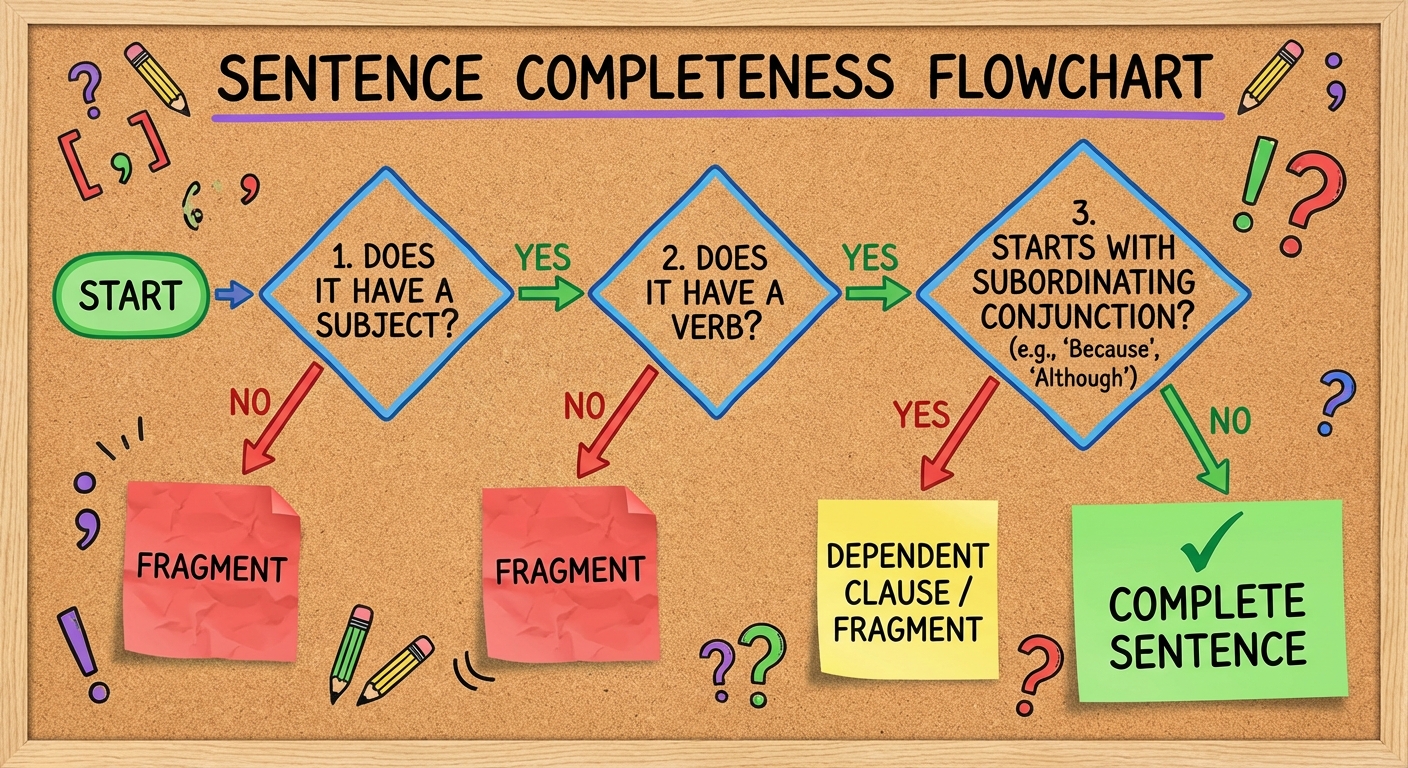
The foundation of the ACT English test lies in understanding what constitutes a complete sentence. The test frequently attempts to trick you into accepting fragments or run-ons as correct sentences.
The Anatomy of a Sentence
A complete sentence requires three components:
- Subject: Who or what performs the action.
- Predicate (Verb): The action or state of being.
- Complete Thought: The clause must stand alone logically.
If a group of words contains subject and a verb but starts with a subordinating conjunction (e.g., because, although, while), it is a Dependent Clause and cannot stand alone.
Run-On Sentences and Comma Splices
These are the most common sentence boundary errors on the ACT.
- Run-On Sentence: Two independent clauses (complete sentences) joined with no punctuation at all.
- Incorrect: The test was difficult I studied all night.
- Comma Splice: Two independent clauses joined only by a comma. (A comma is too weak to hold two sentences together).
- Incorrect: The test was difficult, I studied all night.
How to Fix Them:
- Use a Period: The test was difficult. I studied all night.
- Use a Semicolon: The test was difficult; I studied all night.
- Use a Comma + FANBOYS: The test was difficult, so I studied all night.
- Make one clause dependent: Because the test was difficult, I studied all night.
Sentence Fragments
A fragment is an incomplete sentence masquerading as a whole one. It often lacks a main verb or begins with a dependent word without finishing the thought.
- Incorrect: Which is why I stayed home.
- Correct: That is why I stayed home. (Or attach it to the previous sentence).
Coordination and Subordination
Coordination (FANBOYS)
Coordination connects two ideas of equal importance. We use Coordinating Conjunctions, remembered by the mnemonic FANBOYS:
- For
- And
- Nor
- But
- Or
- Yet
- So
The Rule: Comma + FANBOYS = Period. Use this combination only when connecting two independent clauses.
Subordination
Subordination makes one idea less important (dependent) than the other. This creates complex sentences and clarifies cause-and-effect relationships.
- Common Subordinators: Because, Although, Since, While, When, If.
- The Rule: If the sentence starts with a subordinator, use a comma after the introductory clause.
- Example: Although it rained, we played soccer.
Parallel Structure
Parallelism requires that items in a list or compound structures share the same grammatical form. If you start with a noun, continue with nouns. If you start with an -ing verb, continue with -ing verbs.
- Incorrect: I enjoy running, hiking, and to swim.
- Correct: I enjoy running, hiking, and swimming.
This rule also applies to correlative pairs (not only/but also, neither/nor).
- Incorrect: He is not only smart but also has kindness.
- Correct: He is not only smart but also kind.
Punctuation Rules
Commas
The comma is the most tested punctuation mark. Use it for:
- Lists: Separating three or more items (the Oxford comma is preferred on the ACT).
- Introductory phrases: In the beginning,
- Compound Sentences: Before a FANBOYS conjunction.
- Non-Essential Information (Appositives): If you can remove a phrase without changing the core meaning of the sentence, surround it with commas.
- Example: My brother, who is a dentist, lives in Ohio.
Semicolons and Colons
These are "Stop" punctuation marks, similar to a period.
- Semicolon (;): Connects two closely related independent clauses. It is grammatically identical to a period.
- Usage: Clause 1 ; Clause 2.
- Colon (:): Used after an independent clause to introduce a list, an explanation, or a quotation.
- Usage: Independent Clause : List/Explanation.
- Test: You must have a full sentence before the colon.

Dashes and Parentheses
- Dashes (—): Used for emphasis or an abrupt break in thought. Two dashes can function like a pair of commas (for non-essential info). One dash can function like a colon.
- Parentheses ( ): Used for de-emphasizing information or adding a whispered aside. They always come in pairs.
Apostrophes and Possessives
There are two steps to getting apostrophes right on the ACT:
- Determine Possession: Does something belong to something else?
- Determine Number: Is the owner singular or plural?
| Type | Rule | Example |
|---|---|---|
| Singular | Add 's | The dog's bone |
| Plural (ending in s) | Add ' only | The dogs' bones |
| Plural (irregular) | Add 's | The men's room |
Common Pitfall: Possessive Pronouns never use apostrophes.
- Its = Possessive (The dog wagged its tail).
- It's = Contraction for "It is" (It's sunny).
- Their (Possessive) vs. They're (They are) vs. There (Location).
Verbs and Agreement
Subject-Verb Agreement
Singular subjects require singular verbs; plural subjects require plural verbs. The trick is that the ACT often puts a "distraction phrase" (usually a prepositional phrase) between the subject and the verb.
- The Trap: The box of chocolates are empty. (Incorrect)
- The Fix: Ignore the prepositional phrase (of chocolates). The subject is box (singular).
- Correct: The box [of chocolates] is empty.
Verb Tense and Consistency
Start by checking the surrounding text. If the paragraph is narrating a past event, stay in the past tense unless there is a specific time shift mentioned.
- Perfect Tenses: Used to show sequence.
- Past Perfect (Had + V3): An action completed before another past action.
- Example: By the time I arrived, he had left.
Pronouns
Pronoun-Antecedent Agreement
A pronoun must match the noun it replaces (the antecedent) in number and gender.
- Incorrect: If a student wants to succeed, they must study. (Historically incorrect on ACT, though changing in modern usage. ACT prefers: he or she must study, or changing subject to students).
- Collective Nouns: Teams, committees, and groups are usually singular "it," not plural "they."
- Correct: The team won its game.
Pronoun Case
- Subject Case: I, He, She, We, They, Who (Do the action).
- Object Case: Me, Him, Her, Us, Them, Whom (Receive the action).
The Compound Subject Trick: If a sentence says "Jim and me went to the store," remove "Jim and." Would you say "Me went to the store"? No. You would say "I went." Therefore: "Jim and I went to the store."
Adjectives, Adverbs, and Modifiers
Adjective vs. Adverb
- Adjectives modify nouns (The quick fox).
- Adverbs modify verbs, adjectives, or other adverbs (The fox ran quickly).
Modifier Placement (Dangling Modifiers)
A descriptive phrase at the start of a sentence must be immediately followed by the noun it describes. If not, the modifier is "dangling."
- Incorrect: Walking down the street, the trees looked beautiful.
- Why? Trees cannot walk.
- Correct: Walking down the street, I thought the trees looked beautiful.
Idiomatic Expressions
Idioms are phrases where the meaning relies on convention rather than strict grammar rules. These usually involve Prepositions. There are no specific rules to memorize, only patterns to recognize.
- Examples:
- Curious about (not for)
- Consistent with (not to)
- Preoccupied with
Common Mistakes & Pitfalls
- Redundancy: The ACT hates repetition. If a sentence says "The annual yearly report," it is wrong. Choose the shortest, most concise option that preserves meaning.
- The "Could Of" Trap: It is never "could of," "should of," or "would of." It is always "could have."
- Who vs. Whom: Use the "he/him" substitution test. If you can answer the question with "him," use whom. If you answer with "he," use who.
- Example: "(Who/Whom) did you invite?" -> "I invited him." -> Therefore, "Whom did you invite?"
- Misidentifying Subjects: Watch out for inverted sentences where the verb comes before the subject. "There is a cat and a dog" (Incorrect) -> "There are a cat and a dog."