Unit 5: The Media as a Political Force
The Role of Media in Politics
The mass media is broadly defined as Linkage Institution—a structure within a society that connects the people to the government. In the AP US Government and Politics curriculum, the media is often referred to as the "fourth branch of government" due to its immense influence on public opinion and policy making.
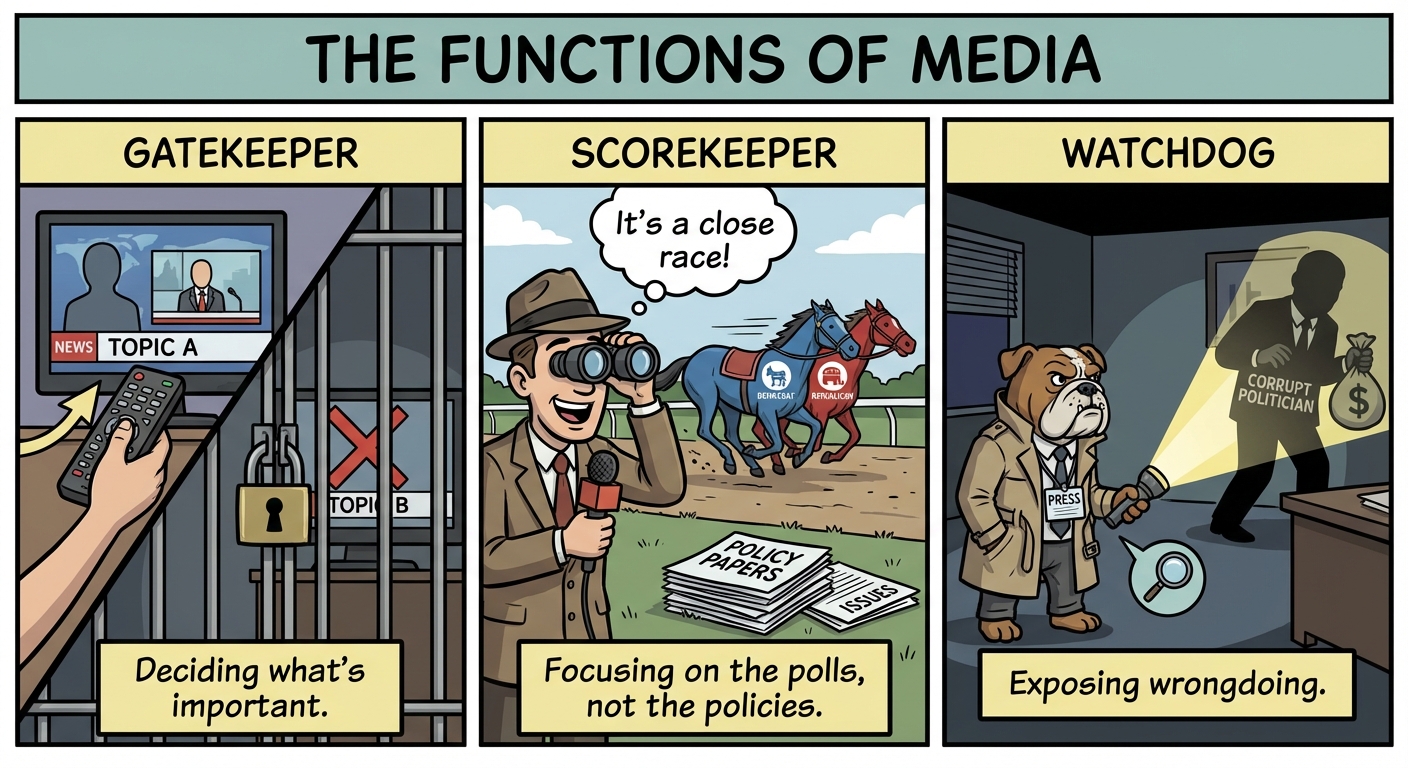
The Three Main Functions of the Media
Political scientists generally categorize the media's influence into three distinct roles. Understanding the nuance between these roles is crucial for the AP exam.
1. The Gatekeeper (Agenda Setting)
As a gatekeeper, the media decides which issues are important enough to receive public attention and which are not. By highlighting specific stories and ignoring others, the media influences the policy agenda—the set of issues that policymakers consider important.
- Agenda Setting: The media doesn't tell people what to think, but it tells them what to think about.
- Example: If every major news outlet runs a headline story about inflation for a week, the public will perceive inflation as the diversity's most critical problem, pressuring the government to act.
2. The Scorekeeper (Horse-Race Journalism)
As a scorekeeper, the media tracks political reputations and candidacies. This is most prominent during election cycles.
- Horse-Race Journalism: This is news coverage that focuses on who is ahead or behind in the polls rather than the nuances of the candidates' policy platforms.
- Consequence: Voters often become informed about poll numbers and campaign tactics but remain uninformed about the candidates' actual stances on issues.
- Bandwagon Effect: Constant reporting on high poll numbers can lead undecided voters to support the frontrunner simply because they are winning.
3. The Watchdog (Investigative Journalism)
As a watchdog, the media scrutinizes the government and exposes corruption, scandal, or inefficiency. This role is fundamental to a free press in a democracy.
- Investigative Journalism: Deep, often long-term reporting used to unearth lies or corruption.
- Historical Example: The Watergate Scandal, exposed by Washington Post reporters Woodward and Bernstein, led to the resignation of President Nixon.
- Legal Context: The Supreme Court case New York Times Co. v. United States (1971) bolster's this role by ruling against prior restraint (government censorship before publication), allowing the press to publish classified documents (Pentagon Papers) if they do not compromise immediate national security.
The Changing Media Landscape
The way citizens consume information has shifted dramatically from the mid-20th century to today. The College Board focuses heavily on the shift from broad appeal to niche marketing.
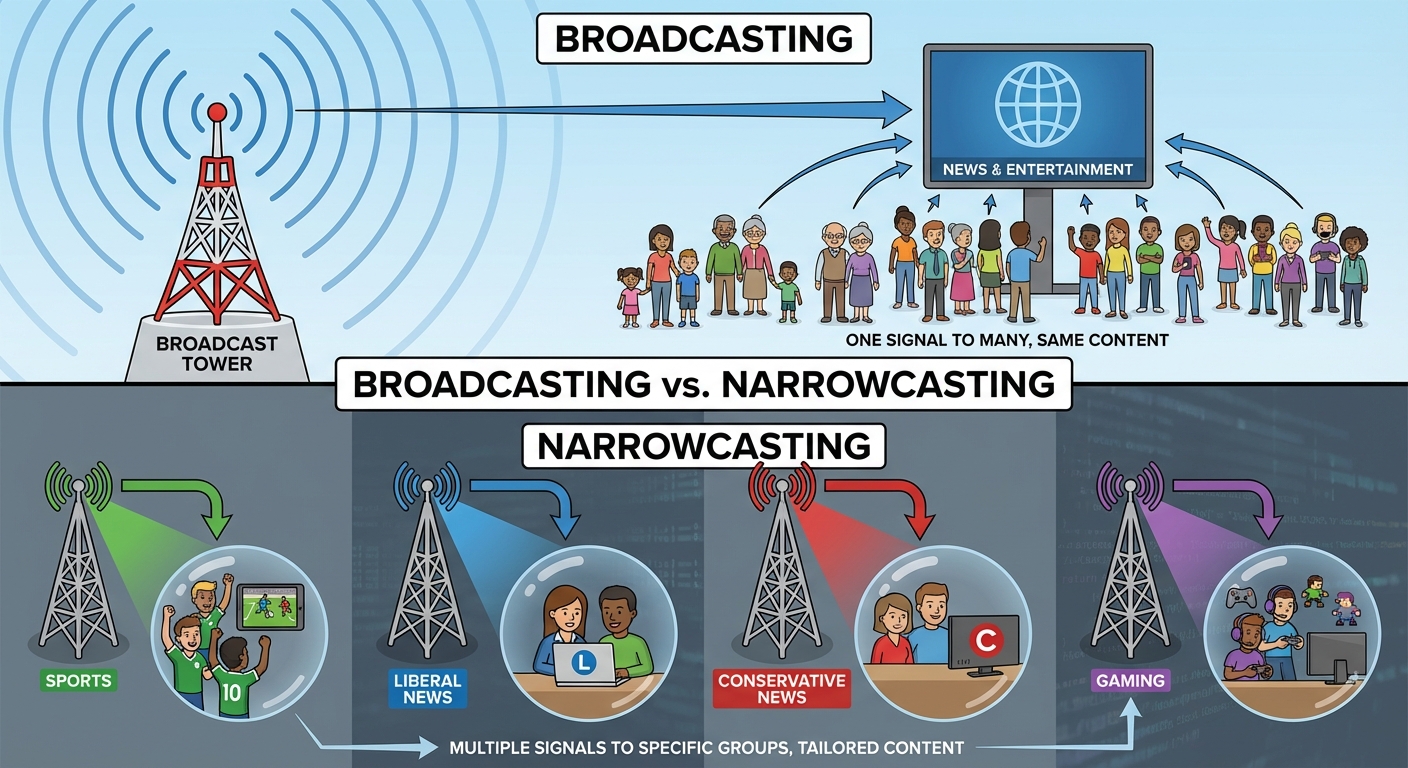
From Broadcasting to Narrowcasting
- Broadcasting: Media programming intended for a general, broad audience.
- Era: 1950s–1980s (ABC, NBC, CBS).
- Effect: Created a shared national culture and consensus on facts.
- Narrowcasting: Media programming on cable TV or the internet that is focused on a particular interest or aimed at a particular audience.
- Era: 1990s–Present (Fox News, MSNBC, Podcasts, Subreddits).
- Effect: Reinforces political polarization.
| Feature | Broadcasting | Narrowcasting |
|---|---|---|
| Target Audience | The general public (Middle America) | Specific ideologies or demographics |
| Goal | Appeal to the widest base; maximize scale | Appeal to loyalty; maximize engagement |
| Political Impact | Moderate, centrist coverage | Ideological, polarized coverage |
| Example | NBC Nightly News | Fox News (Conservative) or MSNBC (Liberal) |
The Rise of Social Media & Consumer-Driven Media
Modern news is often consumer-driven, meaning media outlets produce content based on what will get the most clicks, views, or shares (ad revenue), rather than strictly what is most educational.
- Ideologically Oriented Programming: To keep viewers watching, cable news channels often feed audiences information that confirms their existing beliefs (Confirmation Bias).
- Citizen Journalism: Social media allows anyone to capture and report news. While this democratizes information (e.g., videos of police brutality), it lacks the editorial oversight and fact-checking of traditional journalism.
- The Echo Chamber: Algorithms on platforms like Facebook, X (Twitter), and TikTok are designed to show users content they agree with. This isolates citizens from opposing viewpoints, making compromise difficult.
Uncertainty Over Credibility
With the explosion of digital sources, distinguishing between legitimate journalism, satire, and intentional disinformation (fake news) has become a major challenge for the electorate.
- Sound Bites: Short video clips of approximately 10 seconds. Politicians speak in catchy phrases knowing the media will only air a snippet. This reduces complex policy debates to catchy slogans.
Interactions with the Branches of Government
While the media covers all branches, the focus is unequal.
The Presidency and the Media
The President receives the most coverage of any political figure.
- The Bully Pulpit: A term coined by Teddy Roosevelt. The President uses the prestige and visibility of the office to speak directly to the American people to persuade them to support specific policies, thereby pressuring Congress to act.
- Press Secretary: The President's spokesperson who handles daily briefings with the White House press corps to manage the narrative.
Congress and the Media
Congress struggles to get unified media attention because there are 535 members.
- Leadership (Speaker of the House, Majority Leaders) gets the most attention.
- Committee hearings are occasionally televised, especially during scandals or high-profile confirmations.
The Judiciary and the Media
The Supreme Court receives the least coverage.
- No Cameras: Cameras are not allowed in the Supreme Court during oral arguments (only audio is released).
- Complexity: Rulings are complex legal documents that are difficult to turn into sound bites.
Common Mistakes & Pitfalls
Confusing "Gatekeeper" with "Censorship":
- Correction: When the media acts as a Gatekeeper, they aren't banning topics (censorship); they are simply choosing to prioritize other topics. If the news ignores a story, it is "agenda setting," not government censorship.
Assuming all Media Bias is Ideological:
- Correction: Students often write that the media is "Liberal" or "Conservative." While true for narrowcasting, the strongest bias in mainstream media is actually Commercial Bias (bias toward conflict, drama, and whatever generates ratings).
The "Fairness Doctrine" Fallacy:
- Correction: The FCC's Fairness Doctrine (which required broadcasters to present opposing views) was repealed in 1987. Media outlets are not legally required to be neutral or