Module 7.1: Mechanisms of Oscillatory Motion
Oscillations and Simple Harmonic Motion
Fundamentals of Simple Harmonic Motion (SHM)
Not all back-and-forth motion is considered Simple Harmonic Motion. While many objects oscillate (vibrate about a fixed point), SHM is a specific, idealized type of periodic motion defined by a very strict dynamic relationship between force and position.
Defining Characteristics
To classify a motion as SHM, it must satisfy two central conditions:
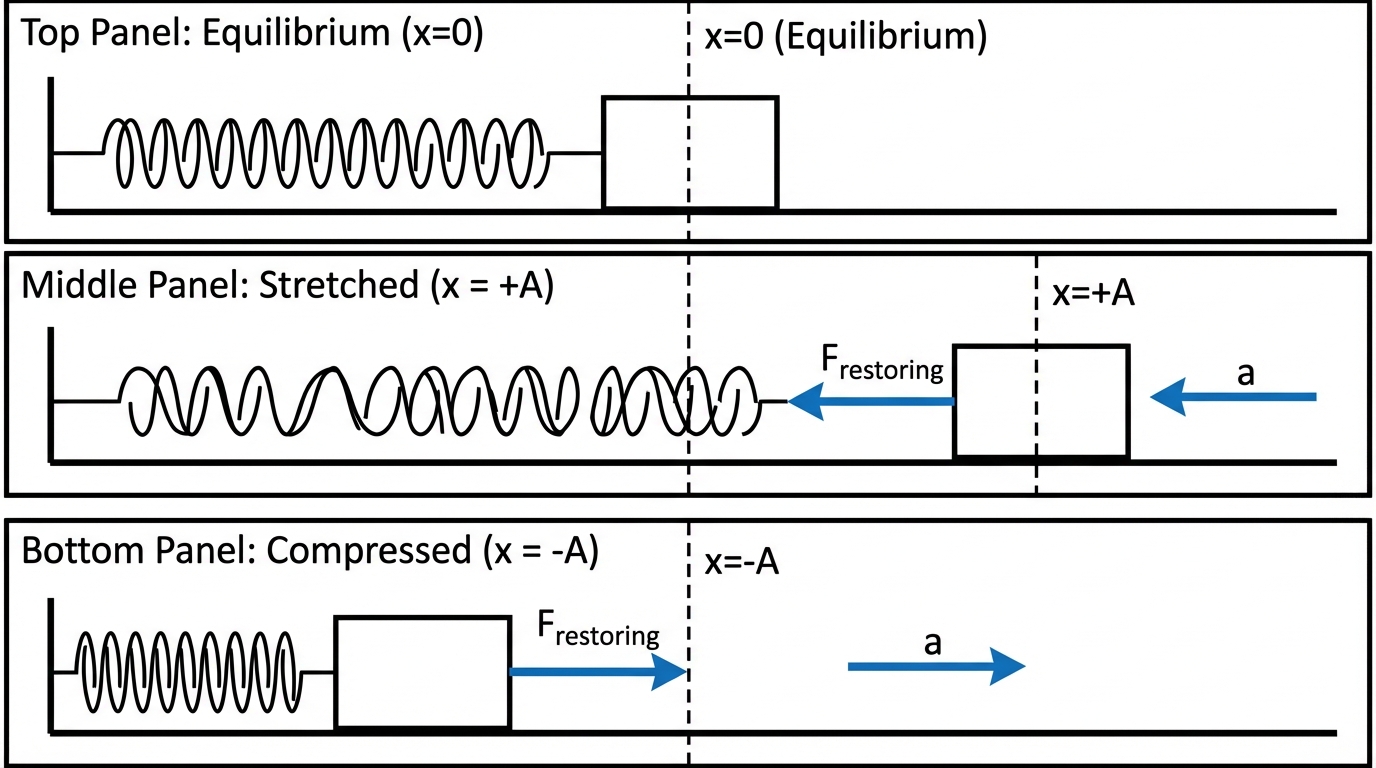
- Restoring Force: There must be a net force that acts to restore the object to its equilibrium position. This force is always directed opposite to the displacement.
- Proportionality: The magnitude of the restoring force is directly proportional to the magnitude of the displacement from equilibrium.
Mathematically, this describes Hooke's Law:
Where:
- $F_{restoring}$ is the net force towards equilibrium.
- $k$ is the force constant (or stiffness of the system).
- $x$ is the displacement from the equilibrium position.
- The negative sign indicates the force acts opposite to the direction of displacement.
Key Concepts in SHM Kinematics
Understanding the relationship between position ($x$), velocity ($v$), and acceleration ($a$) is critical for the AP exam. The motion is not constant; these values change continuously.
| Position | Displacement ($x$) | Velocity ($v$) | Acceleration ($a$) | Net Force ($F_{net}$) |
|---|---|---|---|---|
| Equilibrium ($x=0$) | Zero | Maximum | Zero | Zero |
| Amplitude ($x=\pm A$) | Maximum | Zero | Maximum | Maximum |
This table highlights a crucial concept: Acceleration is greatest when the object is momentarily stopped (at the turning points), and acceleration is zero when the object is moving fastest (at the center).
Amplitude ($A$)
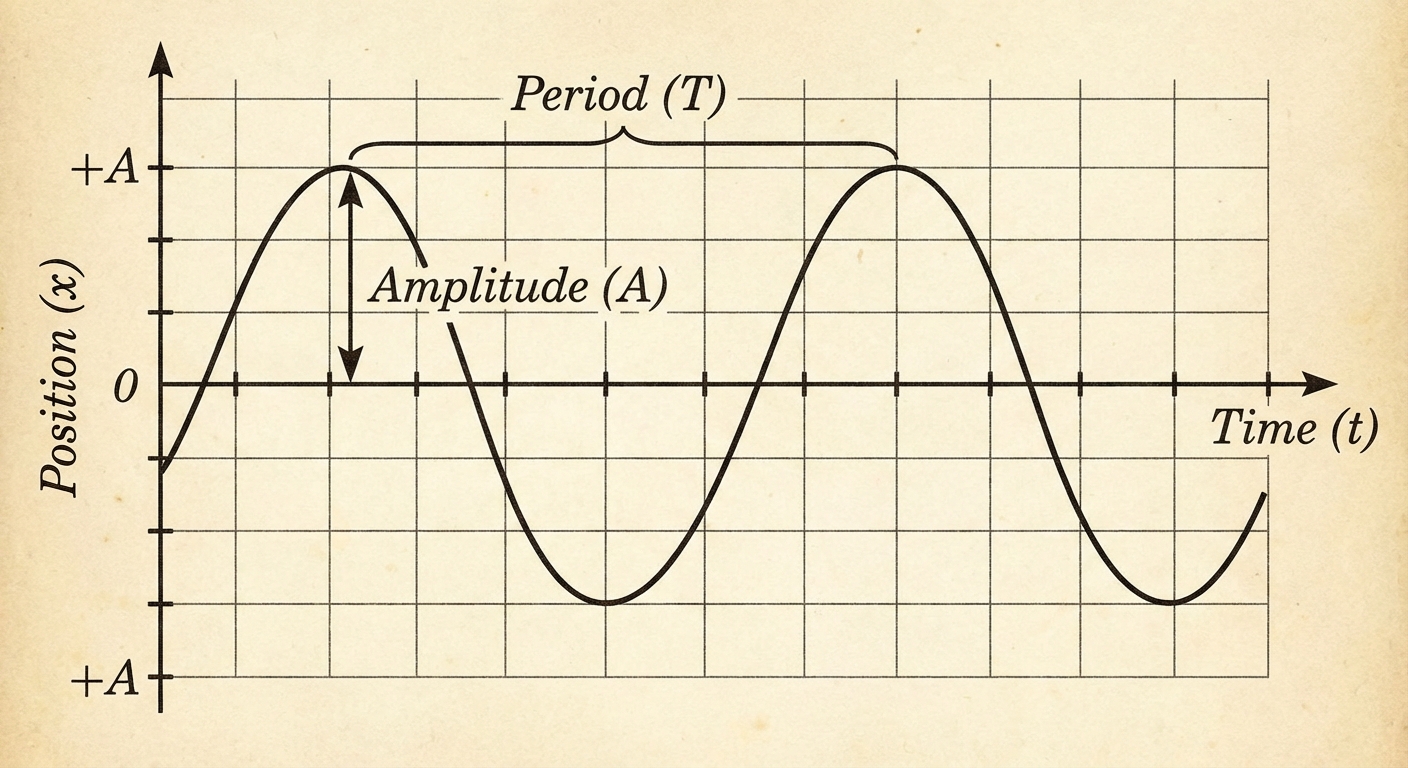
Amplitude is the maximum displacement from the equilibrium position.
- It is a scalar value (always positive) representing magnitude.
- In ideal SHM (no friction/damping), the amplitude remains constant over time.
- Crucially: For simple pendulums and ideal springs, amplitude does not affect the period (provided the angle is small for pendulums).
Frequency and Period of SHM
While kinematics describes where the object is, Period and Frequency describe when the motion occurs.
Period ($T$)
Period is the time it takes to complete one full cycle of motion (e.g., from max extension, to max compression, back to max extension).
- Symbol: $T$
- SI Unit: Seconds ($s$)
Frequency ($f$)
Frequency is the number of cycles completed per unit of time.
- Symbol: $f$
- SI Unit: Hertz ($Hz$), where $1 Hz = 1 \text{ cycle}/s$ or $s^{-1}$
The Mathematical Relationship
Period and frequency are inversely related. If an object vibrates faster (high frequency), it takes less time to finish a cycle (low period).
Calculating Period for Specific Systems
The AP Physics 1 exam focuses on two specific SHM systems. You must know what physical properties change the period for each.
1. The Spring-Mass System
The period depends on the mass of the block and the stiffness of the spring.
- $m$ (Mass): More mass $\rightarrow$ more inertia $\rightarrow$ slower oscillation $\rightarrow$ Larger $T$.
- $k$ (Spring Constant): Stiffer spring $\rightarrow$ greater restoring force $\rightarrow$ faster acceleration $\rightarrow$ Smaller $T$.
- Gravity: Gravity does not appear in this equation. A horizontal spring on Earth has the same period as a vertical spring on the Moon (assuming the same $m$ and $k$).
2. The Simple Pendulum
The period depends on the length of the string and the gravitational field strength.
- $\ell$ (Length): Longer string $\rightarrow$ Larger $T$ (slower swing).
- $g$ (Gravity): Stronger gravity $\rightarrow$ stronger restoring force $\rightarrow$ Smaller $T$ (faster swing).
- Mass Independence: The mass of the bob does not affect the period of a simple pendulum.
Examples & Applications
Worked Example: Quantifying Oscillation
Problem: A 0.5 kg block attached to a spring oscillates back and forth. It makes 10 complete oscillations in 5.0 seconds. Determine the period, frequency, and spring constant ($k$).
Solution:
Find Frequency: $f = \frac{\text{# cycles}}{\text{time}}$
Find Period: $T = \frac{1}{f}$
Find Spring Constant: Rearrange $T_s = 2\pi \sqrt{\frac{m}{k}}$
Common Mistakes & Pitfalls
Confusing Acceleration and Velocity:
- Mistake: Thinking acceleration is zero at the endpoints because velocity is zero.
- Correction: At the endpoints (amplitude), the restoring force is at its maximum, so acceleration is maximum, even though the object is momentarily stopped.
The "Mass on a Pendulum" Trap:
- Mistake: Thinking that adding a heavier weight to a pendulum makes it swing faster or slower.
- Correction: Mass cancels out in the pendulum derivation. A 1kg bob and a 10kg bob on the same string have the same period ($T_p = 2\pi \sqrt{\frac{\ell}{g}}$).
Amplitude and Period:
- Mistake: Thinking that pulling a spring back further (increasing $A$) increases the time it takes to return ($T$).
- Correction: For ideal SHM, Period is independent of Amplitude. If you pull it back further, the restoring force is larger, causing it to accelerate faster, exactly compensating for the extra distance.