Mastering Synthesis and Argumentative Relationships
Identifying and Comparing Arguments
Before you can write your own complex arguments, you must understand how existing arguments interact with one another. In AP English Language, no text exists in a vacuum. Every speech, essay, or article is part of a larger, ongoing conversation regarding a specific subject.
The "Conversation" Metaphor
To succeed in Unit 3, visualize the topic as a dinner party. When you arrive, people (the authors/sources) are already talking. Some agree, some are shouting matches, and some are finding a middle ground. Your job is to listen to them, understand their relationships, and then enter the conversation with your own perspective.
Mapping Relationships Between Texts
When analyzing two or more texts on the same subject, you are looking for intertextuality—how the texts reference, support, or contradict one another.
There are three primary ways arguments relate:
- Support/Extend: Source A presents an idea, and Source B provides additional evidence, a new context, or a stronger theoretical basis for that same idea. They are allies.
- Refute/Challenge: Source A presents an idea, and Source B argues it is incorrect, unethical, or illogical. They are opponents.
- Qualify/Complicate: Source A makes a broad claim. Source B argues that the claim is true but only in specific circumstances, or adds nuance that makes the original claim less black-and-white. This is often the most sophisticated relationship to analyze.
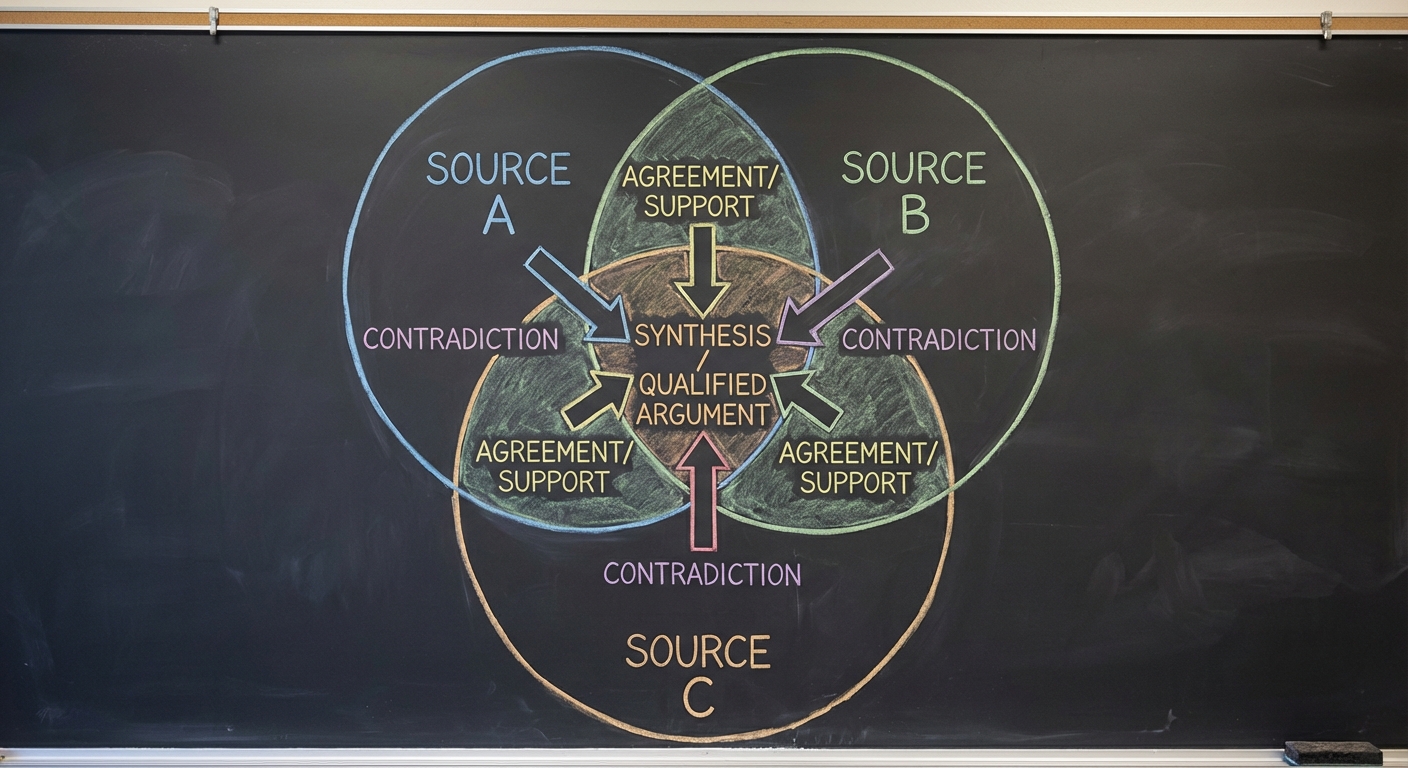
Worked Example: The AI in Schools Debate
Imagine three sources discussing Artificial Intelligence in classrooms:
- Source A (The Optimist): Argues AI will democratize tutoring and personalize learning for every student.
- Source B (The Skeptic): Argues AI promotes plagiarism and the erosion of critical thinking skills.
- Source C (The Realist): Acknowledges the plagiarism risk (agreeing with B) but argues that with strict regulation, the personalization benefits (agreeing with A) outweigh the risks.
Analysis: Source C isn't just summarizing; it is synthesizing the views of A and B to create a qualified argument.
Synthesizing Multiple Sources
Synthesis is often misunderstood as "stacking summaries." However, true synthesis is not a list; it is a chemical reaction. You are combining elements to create something new.
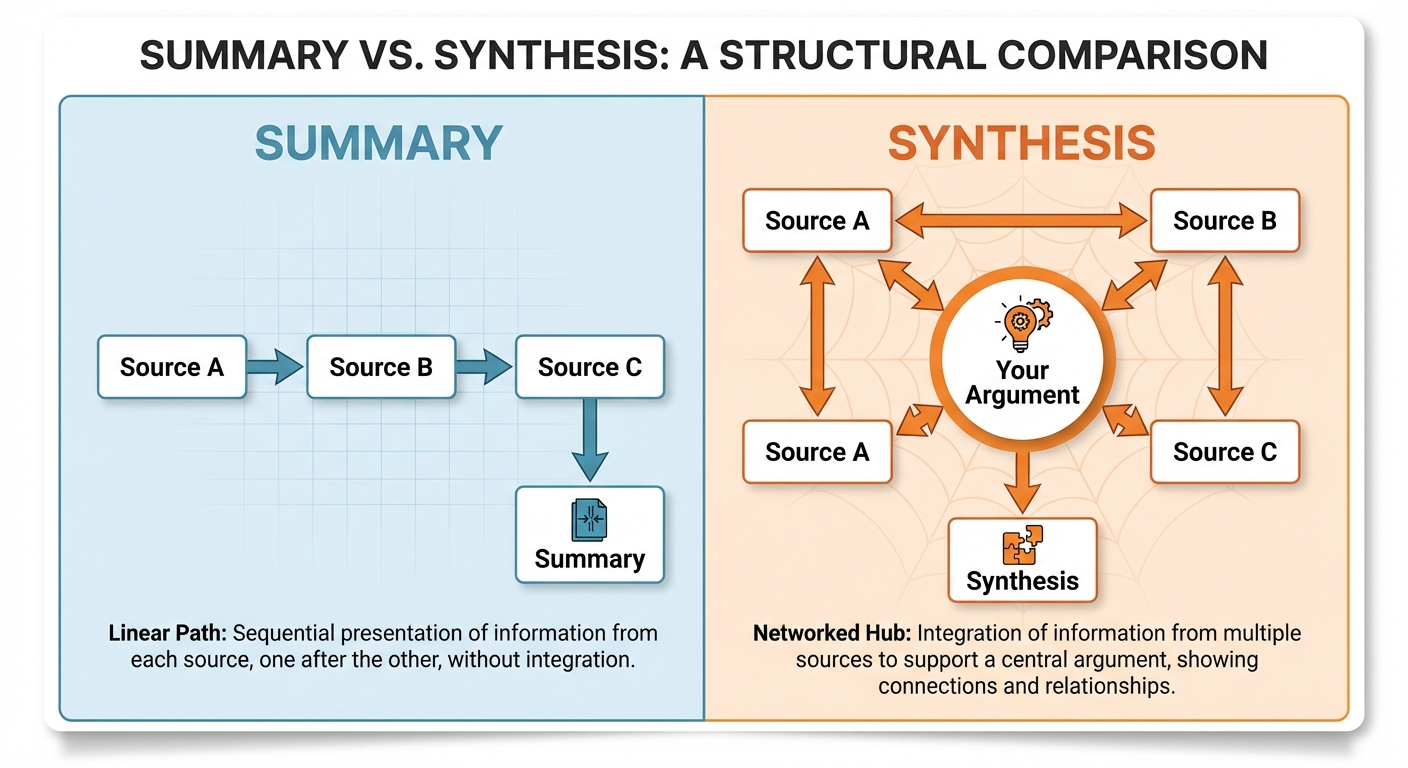
Definition: Synthesis vs. Summary
- Summary: Reporting what sources say, one by one. (e.g., "Source A says X. Then, Source B says Y.")
- Synthesis: Using sources to support your unique argument. The sources talk to each other within your paragraphs. (e.g., "While Source A argues X, Source B reveals that this approach overlooks Y.")
To conceptualize this, think of the following relationship:
Strategies for Integration
When you write a synthesis essay (or a research paper), you should group sources by concept, not by author.
- Identify Sub-claims: Break the prompt down. If the topic is "Space Exploration," sub-claims might be Cost, Scientific Value, and Ethics.
- Cluster Sources: Which sources talk about Cost? Put them in the same paragraph.
- Create Dialogue: Use transitions to show how they interact.
The "Burke's Parlor" Approach
Kenneth Burke, a famous rhetorician, described academic writing as entering a parlor where a heated discussion is taking place. You don't just repeat what everyone else said; you listen, then add your voice.
Example of Synthesis Phraseology:
"Although Source A claims that urban gardening is too expensive to maintain, Source C provides economic data suggesting that the long-term health savings for the community offset these initial costs."
In this sentence, the writer controls the conversation. Source A and Source C are used effectively to prove the writer's point about economic viability.
Concession and Rebuttal
Arguments are rarely 100% right or 100% wrong. Identifying the validity in an opposing view is not a sign of weakness; it is a sign of intellectual maturity. This is key to building Ethos (credibility).
The Counterargument Structure
To argue effectively, you must anticipate what a skeptic would say.
- Concession (The "Yes, but…"): You acknowledge a valid point made by the opposition. This shows you are fair-minded and have considered multiple perspectives.
- Rebuttal (The "However…"): You immediately pivot back to your stance, explaining why your argument is still superior or why the opposing point, while valid, is less important than your main claim.
Why Use Concession?
- Disarms the Audience: If you ignore obvious counterpoints, the audience assumes you are ignorant of them or hiding something.
- Qualifies the Argument: It moves your argument from an absolute (which is easy to prove wrong) to a probability (which is harder to attack).
Drafting the Concession/Rebuttal
Common structures include:
- "Admittedly, [Counterargument] is true regarding [Specific Minor Point]; however, looking at the big picture, [Your Claim]…"
- "While proponents of X correctly note that [Valid Point], they fail to consider [Your Rebuttal]…"
- "It is true that [Concession]. Nevertheless, [Rebuttal]…"
Example:
Thesis: High schools should start later in the day.
Concession: Critics argue that starting later disrupts bus schedules and sports practice.
Rebuttal: While logistical challenges exist, the mental health benefits and increased academic performance linked to adequate sleep are more critical to the school's primary educational mission.
Common Mistakes & Pitfalls
"The Tour Guide" Method: This is when a student writes one paragraph entirely about Source A, the next entirely about Source B, and the next about Source C. This is summary, not synthesis. Fix: Organize paragraphs by idea, using multiple sources in a single paragraph.
The "Straw Man" Fallacy: When rebutting an argument, students often oversimplify the opposing view to make it easier to attack. Fix: Represent the opposing view accurately and fairly before rebutting it. Your argument will look stronger for having defeated a strong opponent.
Letting Sources Drown Your Voice: Students often use so many direct quotes that their own argument disappears. Fix: Use short, embedded quotes (fragments) rather than full sentences. Your voice should carry the melody; the sources provide the harmony.
Absolute Claims: Avoid words like always, never, everyone, or undeniably. These open you up to easy rebuttal. Fix: Use qualifying language like frequently, often, in many cases, or typically.