Comprehensive Guide: Families and Communities in Japan
Unit 1: Families in Different Societies
This unit focuses on the fundamental structure of Japanese society: the family (kazoku). It covers the linguistic nuances of referring to family members, the physical spaces families inhabit, traditional customs, and the modern demographic challenges reshaping Japan.
1.1 The Pillars of the Language
Before discussing family structures, it is crucial to recognize how the writing system interacts with names and terminology. Japanese uses three scripts simultaneously.
The Three Writing Systems
Hiragana (ひらがな):
- Function: The grammatical backbone. Used for verb endings, particles, and native Japanese words not covered by Kanji.
- Characteristics: Curvilinear strokes. There are 46 basic characters.
- Relevance to Unit: Used for furigana (reading aids) next to difficult Kanji names.
Katakana (カタカナ):
- Function: Used for foreign loanwords (gairaigo), emphasis, and onomatopoeia.
- Characteristics: Angular, straight strokes. Parallel to Hiragana sounds.
- Relevance to Unit: Non-Japanese names (e.g., "Smith") are written here.
- Example: Ice cream = Aisukurīmu (アイスクリーム).
Kanji (漢字):
- Function: Logographic characters borrowed from Chinese representing meaning.
- Values: Most Kanji have an On-yomi (Chinese reading) and Kun-yomi (Native Japanese reading).
- Example:
- 家 (Ie = House)
- 族 (Zoku = Tribe/Group)
- Combined: 家族 (Kazoku = Family)
1.2 The Concept of Uchi-Soto and Family Terminology
One of the most frequent mistakes students make is using the wrong terms for family members. Japanese culture relies heavily on the Uchi-Soto (Inside-Outside) concept.
- Uchi (内): Your in-group (My family/My company). You must be humble about them.
- Soto (外): The out-group (Someone else's family). You must be respectful towards them.
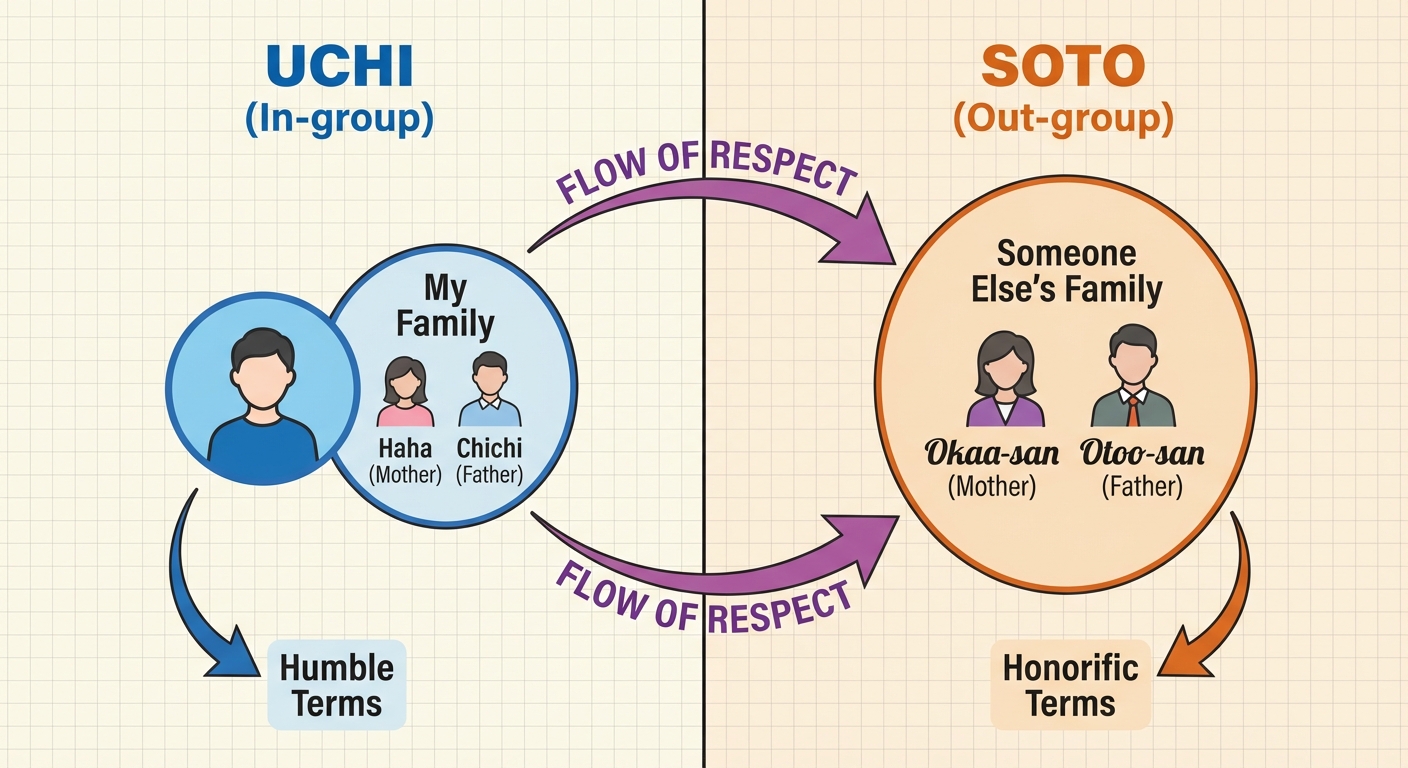
Family Terminology Reference Table
| Person | Referring to your own family (Humble/Uchi) | Addressing someone else's family (Respectful/Soto) |
|---|---|---|
| Family | Kazoku (家族) | Gokazoku (ご家族) |
| Mother | Haha (母) | Okāsan (お母さん) |
| Father | Chichi (父) | Otōsan (お父さん) |
| Older Sister | Ane (姉) | Onēsan (お姉さん) |
| Older Brother | Ani (兄) | Oniisan (お兄さん) |
| Younger Sister | Imōto (妹) | Imōtosan (妹さん) |
| Younger Brother | Otōto (弟) | Otōtosan (弟さん) |
| Husband | Shujin (主人) / Otto (夫) | Goshujin (ご主人) |
| Wife | Kanai (家内) / Tsuma (妻) | Okusan (奥さん) |
Critical Rule: Never call your own mother "Okāsan" when talking to someone outside your family. It sounds childish and arrogant. Use "Haha."
1.3 Housing and Daily Life
The physical environment of the Japanese home dictates family interactions.
The Japanese Home
Japanese housing blends traditional and Western styles.
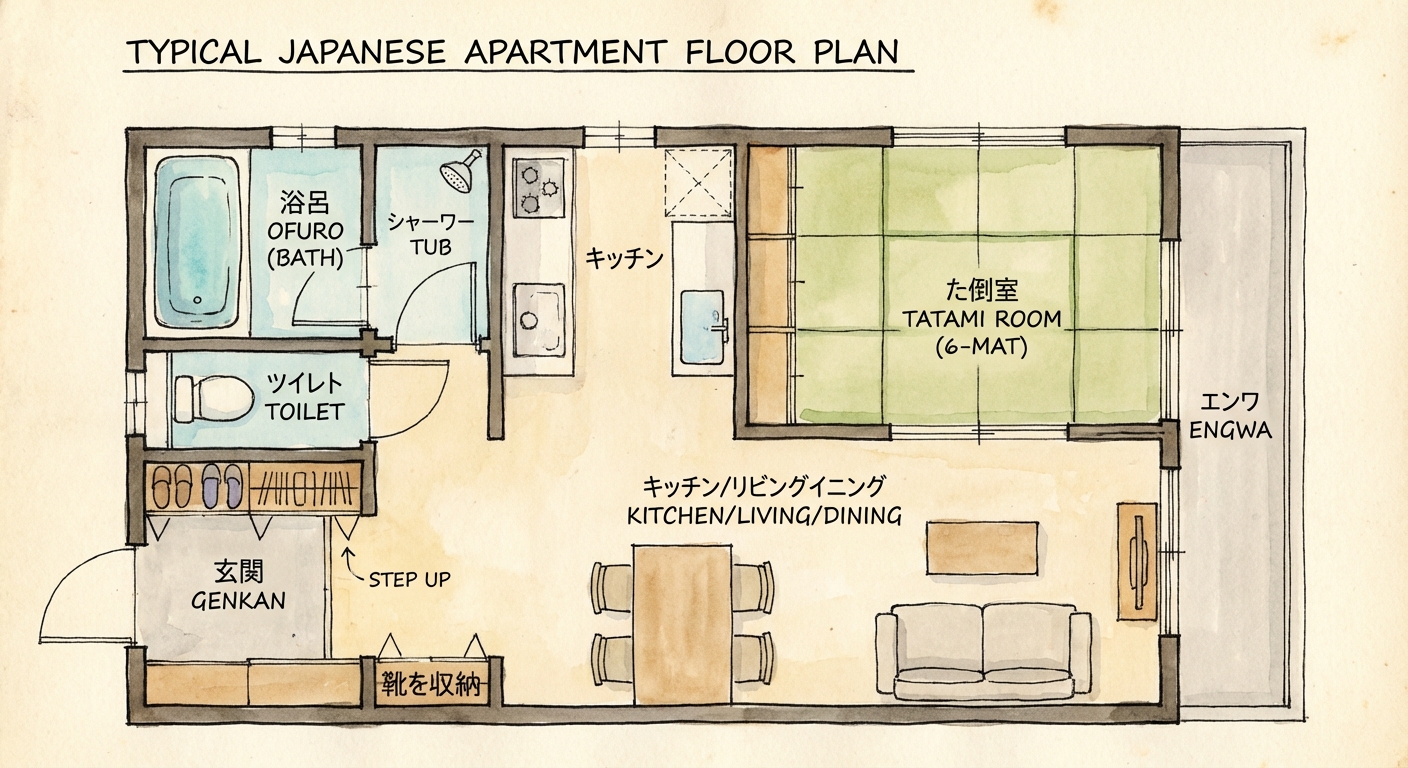
- Genkan (玄関): The entryway where shoes must be removed.
- Significance: Separates the "dirty" outside world from the "clean" inside sanctuary.
- Etiquette: Shoes are pointed towards the door (ready to leave).
- Tatami (畳): Straw mats used as flooring in traditional rooms. Rooms are measured by the number of mats (e.g., a "6-mat room").
- Butsudan (仏壇): A Buddhist alter found in many traditional homes to honor ancestors.
- Ofuro (お風呂): The bath. Japanese people wash outside the tub (using a shower/bucket) and only soak in the tub to relax. The bathwater is shared by the family (cleanest person goes first, usually the father or guest).
Urban vs. Rural Living
Urban Families (Tokyo, Osaka)
- Housing: Often live in "Mansions" (concrete condominiums) or small apartments (apāto).
- Structure: Nuclear families (parents + 1-2 children) due to lack of space.
- Lynchpin: The "Bedtown" phenomenon—fathers commute long hours from suburbs, returning late, leaving education and household management primarily to mothers.
Rural Families (Inaka)
- Housing: Larger, traditional detached houses.
- Structure: Multi-generational households (Grandparents + Parents + Children) are more common.
- Community: High emphasis on neighborhood cooperation in farming or fishing.
1.4 Changing Family Roles & Social Issues
The traditional concept of the Japanese family is undergoing rapid transformation.
Gender Roles
- Traditional View: Otoko wa soto, onna wa uchi (Men outside, women inside). The husband is the breadwinner (daikokubashira), and the wife manages the home and finances.
- Modern Reality:
- Dual-Income: More women are working (tomobataraki), though many still carry the burden of housework.
- Ikumen (イクメン): A modern slang term for fathers who actively participate in child-rearing (derived from "iku" to raise + "men").
The Demographic Crisis: Shoushikoureika (少子高齢化)
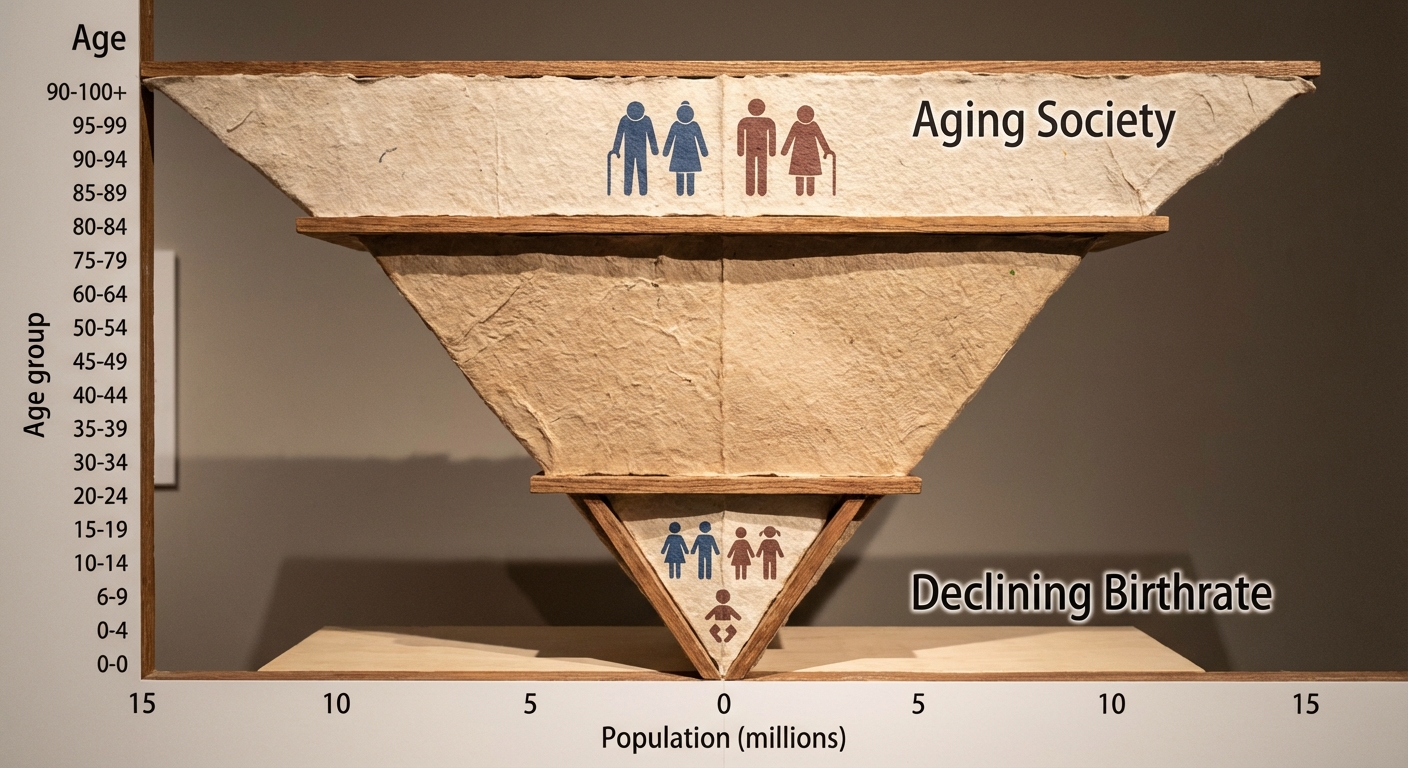
This is a key keyword for AP Japanese. It means "Declining birthrate and aging population."
- Low Birth Rate (Shoushika):
- Causes: High cost of education, late marriage (bankonka), and difficulty balancing career/childcare.
- Aging Population (Koureika):
- Japan has the highest life expectancy in the world.
- Impact: Fewer young workers to support the pension system.
Care for the Elderly
- Filial Piety (Oyakōkō - 親孝行): The Confucian duty to care for parents.
- Modern Challenge: Traditionally, the eldest son's wife cared for aging authorities. Now, nursing homes and visiting care services are increasingly necessary, causing cultural tension.
1.5 Traditions and Etiquette
Mealtime Manners
- Greetings:
- Start: Itadakimasu (I humbly receive).
- End: Gochisōsama deshita (It was a feast/Thank you for the meal).
- Chopsticks (Hashi): Never pass food from chopstick to chopstick (resembles funeral rites).
- Slurping: Acceptable for noodles (soba, ramen, udon) to cool them and show enjoyment.
Gift Giving (Zōtō)
- Omiyage (お土産): Souvenirs brought home from a trip for family/coworkers. Usually food (individually wrapped).
- Oseibo/Chūgen: Seasonal gifts given to people you are indebted to (bosses, teachers) in winter and summer.
- Otoshidama (お年玉): Money given to children in envelopes (pochibukuro) on New Year's Day. Key for teaching financial literacy.
1.6 Grammar Corner: Existence
In Unit 1, describing family members and housing relies on "Existence Verbs."
Formula:
- Imasu (います): Used for living/animate things (People, Animals).
- Example: Imōto ga imasu. (I have a younger sister / There is a younger sister.)
- Arimasu (あります): Used for inanimate things (Houses, Furniture, Plants).
- Example: Ōkii ie ga arimasu. (There is a big house.)
Common Mistake: Saying Neko ga arimasu (A cat exists [like an object]).
Correction: Neko ga imasu (A cat is there).
Common Mistakes & Pitfalls
- Mixing Up Keigo (Honorifics): Calling your own father Otōsan implies you are a guest in your own family or talking to him directly. Use Chichi when talking about him to others.
- San-zuke (Adding -San): Never add "-san" to your own name. (e.g., "I am Smith-san" is incorrect).
- Shoe Etiquette: Stepping on the Genkan floor (the lower area) in socks, then stepping up into the house, brings dirt inside. Step directly from the shoe onto the raised floor.
- Bath Water: Draining the bathtub after using it. Unless you are the last person or live alone, do not drain the water; others will use it.