AP Language Unit 5: Coherence, Sequencing, and Argument Construction
Unit 5: How a Writer Brings an Argument Together
In previous units, you learned how to identify rhetoric and structure specific claims. Unit 5 focuses on the macro-level skill of argumentation: Coherence and the Line of Reasoning. It is not enough to have good evidence; that evidence must be arranged in a sequence that logically leads the reader to an unavoidable conclusion. This unit bridges the gap between isolated rhetorical choices and a unified, persuasive essay.
The Foundations of Argument Construction
Crafting a strong argument isn’t just about making a claim—it’s about building a well-supported, logical, and compelling case. A persuasive argument acknowledges the complexity of an issue while maintaining a steady course toward a conclusion.
Key Components of an Argument
Every strong argument includes these critical elements. In AP Lang, you must be able to identify these in texts and produce them in your own writing (especially for the Synthesis and Argument essays):
- A Clear Claim (Thesis Statement): This presents the writer’s position on a debatable issue. It is not a statement of fact.
- Reasons: These act as the sub-claims that explain why the main thesis is valid.
- Evidence: The specific data, quotes, or examples that support the reasons.
- Commentary (Analysis): The connective tissue that explains how the evidence proves the reason and links back to the thesis.
- Counterarguments: Acknowledging opposing viewpoints to demonstrate fairness and complexity.
- Rebuttals: Providing evidence and reasoning to refute opposing views, thereby strengthening your original claim.
The Line of Reasoning
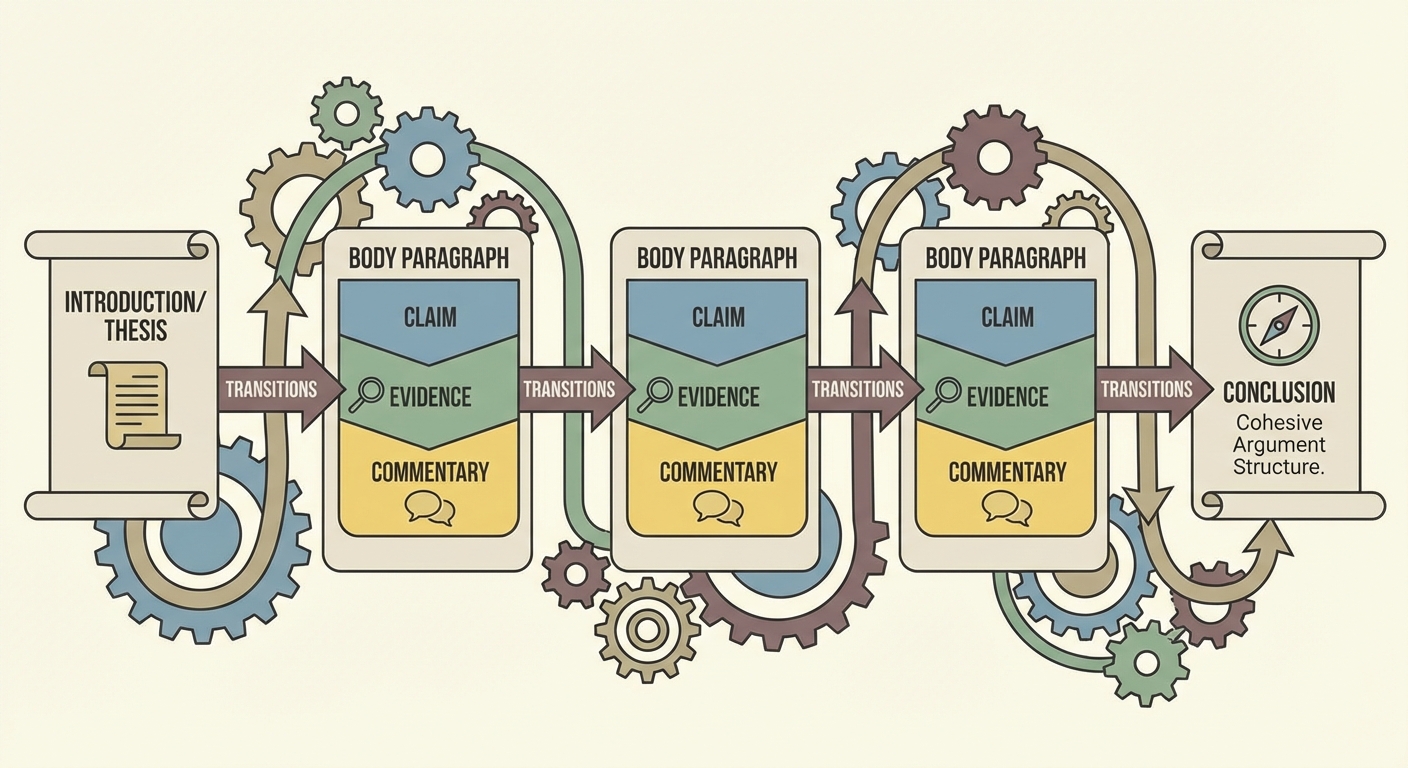
The most important concept in Unit 5 is the Line of Reasoning. This is the logical arrangement of claims and evidence that leads to a conclusion. Think of it as the path the writer clears for the reader to follow.
Characteristics of a Strong Line of Reasoning
- Progression: The argument moves forward; it does not circle back or repeat points unnecessarily.
- Unity: Every paragraph and every sentence relates back to the central thesis.
- Connectivity: Transitions act as signposts, showing the relationship between the previous idea and the next.
If a reader finishes a paragraph and asks, "Why is this here?" or "How does this relate to what I just read?", the line of reasoning is broken.
Developing a Strong Thesis Statement
A thesis statement is the creative blueprint of your argument. In Unit 5, we look at the thesis not just as a claim, but as a structural guide.
The Thesis as a Roadmap
A thesis should suggest the structure of the essay. It can be:
- Open: "The internet has fundamentally altered society by changing how we communicate and learn."
- Structure implied: One section on communication, one on learning.
- Closed: "The internet harms society by spreading misinformation, decreasing attention spans, and eroding privacy."
- Structure implied: Three distinct body paragraphs matching the three listed points.
Rules for a Strong Thesis
- Be Specific and Debatable: A strong thesis isn’t too broad or too narrow. It must be arguable.
- Too Broad: "Technology has changed the world." (Vague, obvious).
- Better: "Social media has reshaped human communication by increasing global connectivity while simultaneously reducing the quality of face-to-face interactions."
- Be Concise: Usually one or two sentences located at the end of the introduction.
- Evolving Thesis: Writers should always consider their purpose, audience, and context. As you draft and discover new evidence, your thesis may need to be refined to reflect the nuance of your argument.
Strategic Organization and Transitions
Organization is the physical manifestation of the line of reasoning. How you group information determines impacts how persuasive you are.
Organizational Patterns
Writers choose specific patterns based on their goal:
- Chronological: Effective for histories or cause-and-effect arguments.
- General to Specific: Starts with broad concepts and narrows down to a case study (Deductive).
- Specific to General: Starts with an anecdote and expands to a societal issue (Inductive).
- Order of Importance: Placing the strongest argument last (for impact) or first (to hook the audience).
Mastering Transitions
Transitions are not just words like "however" or "furthermore." They are bridges between ideas. Effect transitions in Unit 5 can include:
- Transitional Words: Therefore, consequently, similarly, conversely.
- Repetition of Key Terms: Repeating key words (or their synonyms) from the previous sentence to maintain focus.
- Referential Framing: Using a sentence to summarize the previous paragraph before introducing the new one.
- Example: "While the economic benefits of space travel are clear (Reference back), the moral implications of colonizing other planets remain unresolved (Look forward)."
Using Evidence and Support Effectively
Solid evidence convinces the audience, but Commentary brings the argument home. In AP Lang, common feedback is "more commentary needed." You must explain the relevance of your evidence.
Types of Evidence
- Facts and Statistics: Logos-based data that provides objective support.
- Expert Opinions: Ethos-based statements from credible authorities.
- Anecdotes: Pathos-based narratives that make abstract arguments relatable.
- Analogies: Comparisons that explain complex ideas by relating them to familiar ones.
The Commentary Sandwich
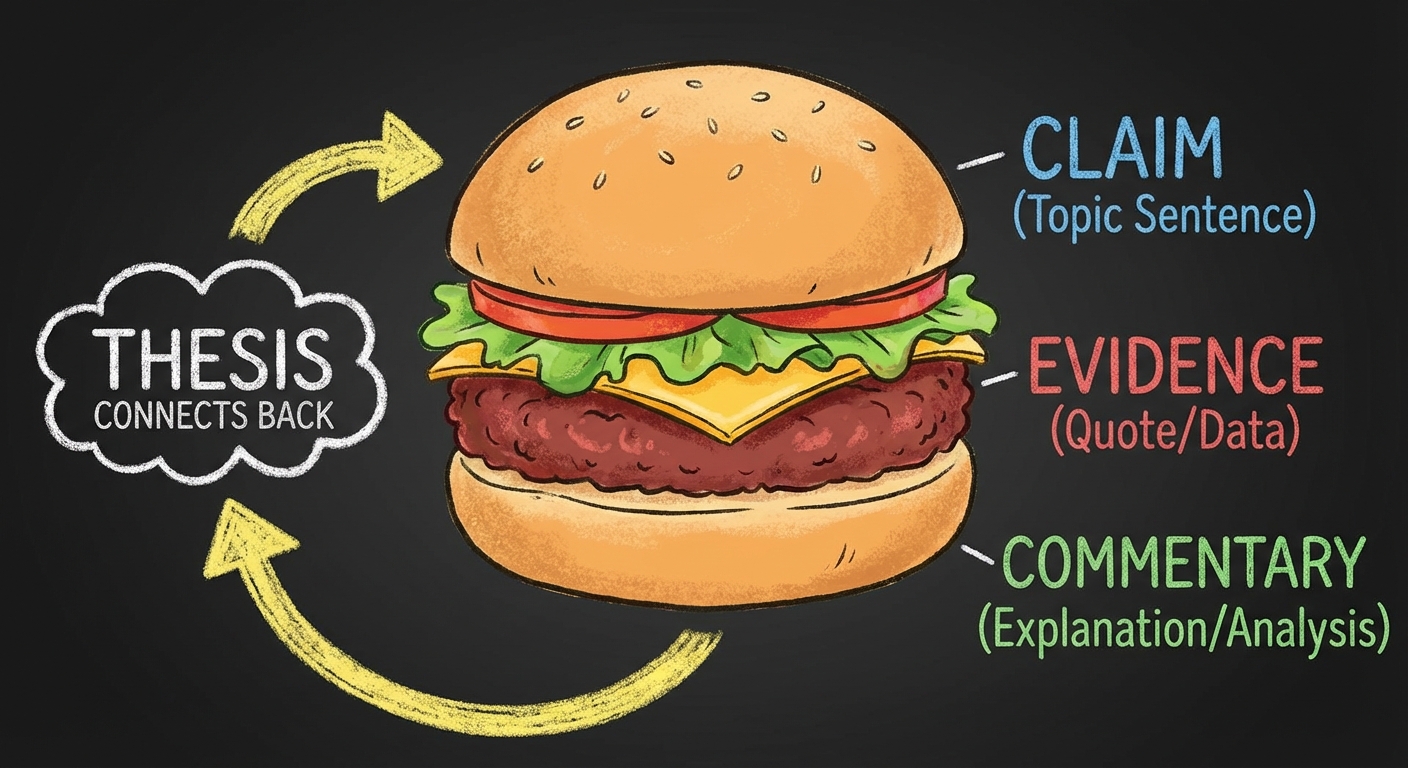
Do not leave evidence "naked" (unexplained). Use the sandwich method:
- Top Bun (Claim): State your point.
- Meat (Evidence): Quote or cite the data.
- Bottom Bun (Commentary): Explain why this evidence proves the claim and how it connects to the thesis.
Nuance: Qualifiers and Counterarguments
Sophisticated arguments (the kind that score high on the AP exam) avoid absolute language. They embrace nuance.
Using Qualifiers
Avoid words like always, never, everyone, or nobody. These are easy to disprove. Instead, use qualifiers to make your argument defensible:
- Instead of: "Video games cause violence."
- Use: "Excessive exposure to certain types of violent video games can desensitize players to aggression."
Counterarguments and Rebuttals
Acknowledging the other side doesn't weaken your argument; it protects it.
Why include them?
- It demonstrates an understanding of the complexity of the issue (Ethos).
- It preemptively answers the reader's doubts.
How to execute:
- Concession: Admit where the opposing side has a valid point. ("Admittedly, standardized testing provides a uniform metric for comparison…")
- Refutation/Rebuttal: Pivot back to your stance using logic or stronger evidence. ("…however, this metric often reflects socioeconomic status rather than intellectual ability.")
Rhetorical Strategies and Style
How you phrase your argument is as important as the argument itself. Rhetorical choices should align with your purpose.
The Rhetorical Triangle in Action
- Ethos (Credibility): Build trust by citing reliable sources, acknowledging limitations, and using a professional tone.
- Pathos (Emotion): meaningful anecdotes or vivid imagery to appeal to the audience's values. Example: Sharing a story about a struggling student to humanize a policy paper on education reform.
- Logos (Logic): Using "if/then" statements, syllogisms, and hard data.
Syntax and Tone
- Sentence Length: Short sentences create impact or urgency. Long, complex sentences imply sophistication or contemplation.
- Diction: Developing a precise vocabulary enhances clarity. Using "catastrophic" instead of "bad" changes the intensity of the argument.
Crafting a Powerful Conclusion
A conclusion is not just a summary; it is the "so what?" of the essay. It should reinforce the argument's validity and extend its significance.
Strategies for memorable conclusions:
- The Broader Context: Connect your specific topic to a larger societal theme or universal truth.
- Call to Action: Urge the audience to change their behavior or thinking.
- The Circular Ending: Reference an image or idea from the introduction to give the piece a sense of closure.
Avoid:
- Simply restating the thesis word-for-word.
- Introducing brand new evidence that wasn't analyzed in the body.
Revision and Refinement
Great arguments are rewritten, not just written. Writing is a process of refinement.
- Check for Clarity: Are the thesis and reasons immediately understandable?
- Check for Coherence: Read only the first and last sentence of each paragraph. Does this outline make sense? If not, your transitions or topic sentences are weak.
- Check for Commentary: Highlight your evidence in one color and your analysis in another. If you have more evidence than analysis, you are listing facts, not arguing a point.
Common Mistakes to Avoid in Unit 5
| Mistake | Why it fails | Correction |
|---|---|---|
| The "Data Dump" | Listing fact after fact without explanation confuses the reader. | Ensure every piece of evidence is followed by at least two sentences of commentary. |
| The "Island" Paragraph | A paragraph that makes a good point but creates a tangent unconnected to the thesis. | Rewrite the topic sentence to explicitly link the paragraph's main idea to the thesis statement. |
| Absolute Claims | Using words like "all," "always," or "never" makes the argument easy to disprove. | Use qualifiers like "typically," "often," or "many" to nuance the claim. |
| Logical Fallacies | Ad hominem attacks, hasty generalizations, or false dichotomies destroy credibility. | Focus on addressing the argument, not the person, and ensure your sample size for generalizations is sufficient. |