Unit 3 Master Notes: Evolution of Sacred Space and Image in Medieval Europe
Late Antiquity and Early Christian Art (c. 200–500 CE)
This period marks a massive conceptual shift away from the classical realism of Greece and Rome toward a focus on spiritual symbolism. As Christianity moved from a persecuted cult to the official religion of the Empire, art transformed to serve the liturgy and instruct the faithful.
Form and Function in Christian Architecture
Early Christians needed large interior spaces for congregations (unlike pagan cults which worshiped outside temples). They adopted and adapted the Roman civil law court structure known as the Basilica.
- Basilica Plan: A longitudinal axis focused on the altar.
- Nave: The central aisle where the congregation stands.
- Apse: The semi-circular niche at the east end (holding the altar).
- Transept: An aisle crossing the nave aimed at creating a cross shape (cruciform).
- Spolia: The reuse of architectural or decorative elements from earlier monuments (e.g., Roman columns used in Santa Sabina).
Key Work: Santa Sabina (Rome). It exemplifies the unadorned exterior (representing the physical body) contrasting with a spiritually rich, light-filled interior (representing the soul).
Shift in Figural Representation
In the Catacomb of Priscilla, we see the transition of Roman imagery into Christian context.
- Orant Figures: Figures with arms raised in prayer; a standard pose of piety.
- The Good Shepherd: Originally a motif for Apollo or Hermes, adapted to represent Jesus. The style is sketchy and immediate, not monumental.
Byzantine Art and Architecture (c. 330–1453 CE)
While the Western Roman Empire crumbled, the Eastern Empire (Byzantium) flourished in Constantinople. Byzantine art is characterized by distinct formality, frontality, and a lack of depth to emphasize a spiritual, timeless reality.
The Golden Age of Justinian
Emperor Justinian I sought to revive the empire's glory. Architecture moved away from the timber-roofed basilica toward massive domed structures using central plans.
Key Innovation: The Pendentive
To place a round dome over a square base, architects developed the pendentive—a triangular segment of a sphere that tapers to a point at the bottom and spreads at the top to establish the continuous circular base for the dome.
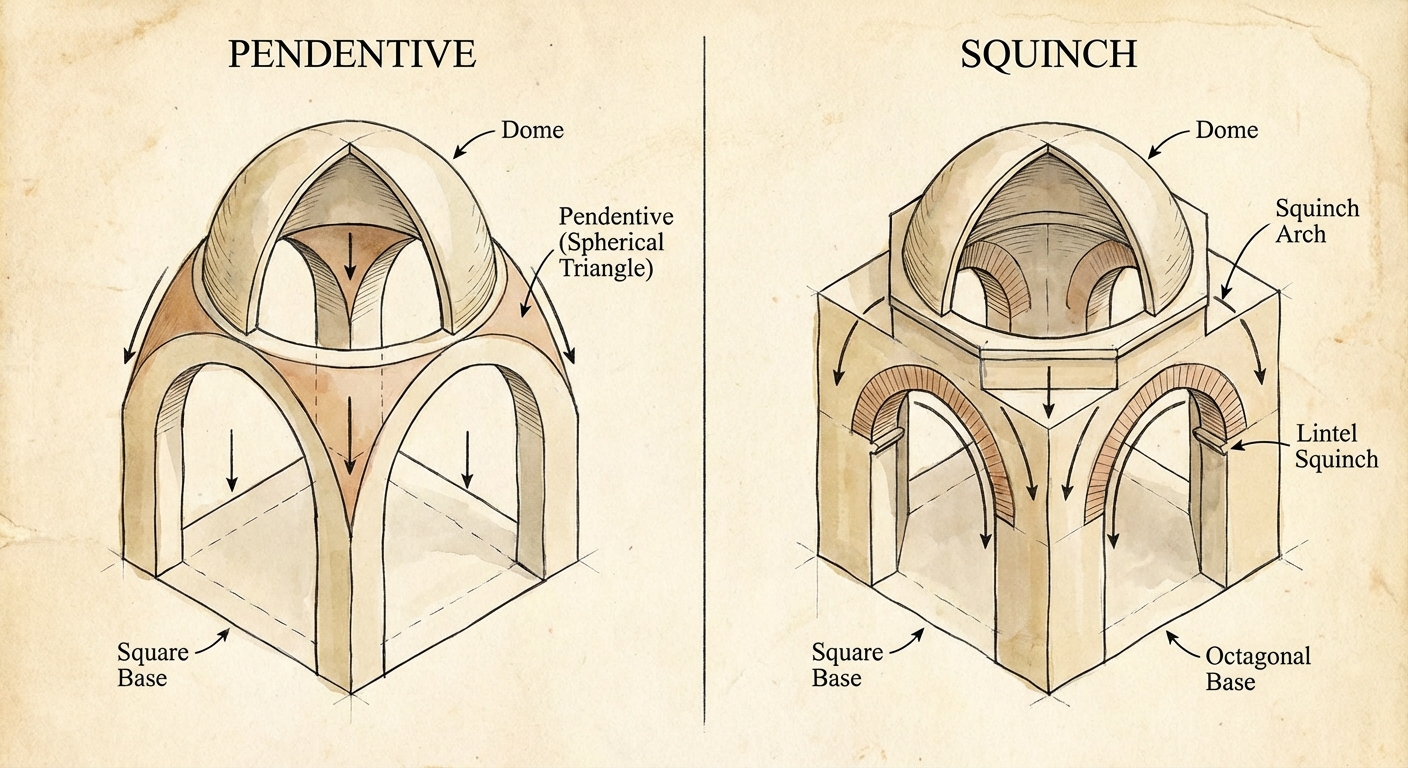
Key Work: Hagia Sophia (Constantinople/Istanbul). Famous for its row of windows at the base of the dome, creating a "ring of light" that makes the dome appear to float, dematerializing the heavy stone.
Key Work: San Vitale (Ravenna). An octagonal central-plan church. The famous mosaics of Justinian and Theodora show the union of political and spiritual power. Note the Isocephalism (heads aligned at the same height) and dangling feet, rejecting earthly space.
Icons and Iconoclasm
- Icon: A sacred image used as a focal point for prayer/meditation.
- Theotokos: "Bearer of God," a title for the Virgin Mary.
- Encaustic: A painting technique using pigment mixed with hot wax (e.g., Virgin (Theotokos) and Child between Saints Theodore and George).
Historical Context: The Iconoclasm (726–843 CE) was a period where icons were destroyed due to fears of idolatry. Few early Byzantine icons survived, mostly at the remote monastery of St. Catherine’s in Sinai.
Illuminated Manuscripts
Before the printing press, books were handmade luxury objects created in a Scriptorium (monastic writing workshop). They were essential for preserving knowledge and evangelizing.
Materials and Techniques
- Parchment/Vellum: Animal skin prepared for writing. Vellum is the highest quality (calfskin).
- Codex: A bound book with pages (replacing the scroll).
Regional Styles
- Early Byzantine: Vienna Genesis. Written in silver ink on purple-dyed vellum (indicating imperial patronage). Illustrations use continuous narrative.
- Hiberno-Saxon (Insular Art): Art produced in the British Isles (e.g., Lindisfarne Gospels).
- Characterized by Interlace patterns (complex, knotwork lines).
- Cross-carpet pages: Full pages of decorative design resembling textiles.
- Incipit pages: The opening words of a Gospel, heavily decorated.
Romanesque Architecture (c. 1000–1150 CE)
This era is defined by the explosion of Pilgrimage. Faithful travelers moved across Europe to visit Relics (holy objects/body parts of saints). Churches had to expand to accommodate these crowds.
Architectural Features
- Stone Vaulting: Replaced wooden roofs to prevent fire and improve acoustics for chanting.
- Barrel Vaults: Continuous arched ceilings. They are heavy and require thick walls and small windows, resulting in dark interiors.
- Ambulatory: A walkway around the apse allowing pilgrims to view relics in radiating chapels without disturbing the main service.
Key Work: Church of Sainte-Foy. Located on the route to Santiago de Compostela. It features a massive Tympanum depicting the Last Judgment—a visual warning to pilgrims about the consequences of sin.
The Romanesque Portal
The entrance to the church was a "billboard" for religious education.
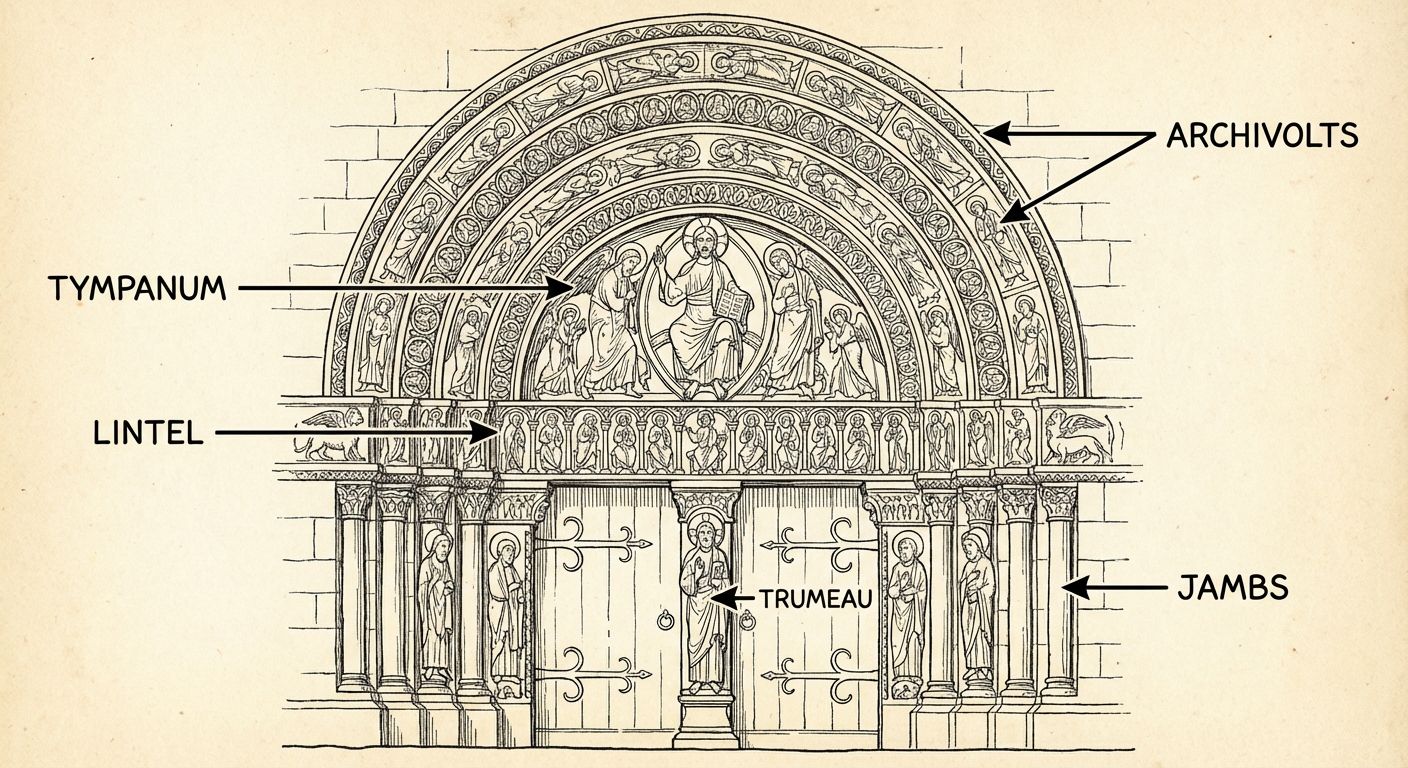
- Tympanum: The semi-circular area over the door (usually strictly symmetrical).
- Trumeau: The central pillar supporting the lintel.
Gothic Architecture (c. 1140–1400 CE)
Originating in the Ile-de-France (area around Paris), Gothic architecture solved the problem of dark Romanesque churches by aiming for height and light.
The Philosophy of Light
Abbot Suger (patron of Saint-Denis) coined the term Lux Nova (New Light). He believed colored light entering the church was the physical manifestation of the Divine.
Structural Innovations
To achieve taller walls with massive stained glass windows, three innovations were combined:
- Pointed Arch: Channels weight more directly downward than a round arch.
- Rib Vault: A skeleton of crossed arches that supports the ceiling, reducing weight.
- Flying Buttress: An exterior arch that transfers the lateral thrust of the roof/walls to an outer pier.
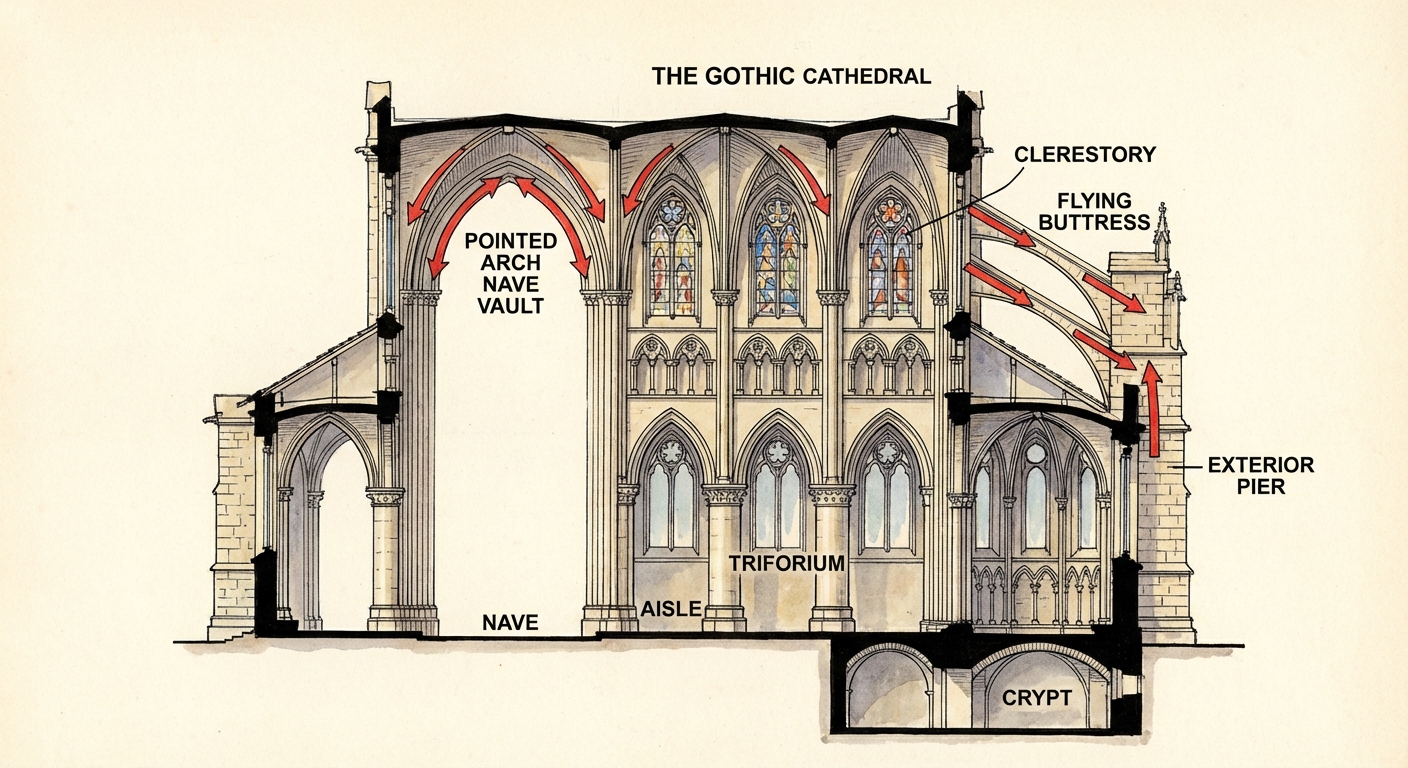
Key Work: Chartres Cathedral.
- Shows the transition from Early to High Gothic.
- Holds the relic of the Sancta Camisa (Mary’s tunic).
- Famous for its Royal Portal (Old Testament kings/queens on jambs) and distinct stained glass ("Chartres Blue").
Late Gothic Emotion
As the period progressed, art became more humanized and emotional. The Röttgen Pietà leads this shift. Unlike the stoic Early Christian figures, this painted wood sculpture depicts a horrific, emaciated Christ and a Mary exploding with grief, intended to evoke empathy in the viewer.
Common Mistakes & Pitfalls
- Mistaking the Pantocrator: Students often confuse the Theotokos (Mary and Child) with the Christ Pantocrator (Christ as Ruler/Judge). Look for the book in one hand and blessing gesture in the other for Pantocrator.
- Buttress vs. Flying Buttress: A regular buttress is a solid mass against a wall (common in Romanesque). A flying buttress is a free-standing arch usually found in Gothic architecture. Do not use the terms interchangeably.
- Timeline Confusion: Don't assume all "Dark Ages" art was crude. The Lindisfarne Gospels show incredible mathematical precision in their design, just a different (non-narrative) aesthetic goal.
- Concrete in Medieval Art: The recipe for Roman concrete was lost. Medieval architects used stone and mortar. If you mention concrete for Chartres or Sainte-Foy, you will lose points.
- Function of the Bayeux Tapestry: While it looks like a decoration, it functions as a historical document (propaganda) justifying the Norman Conquest. Also, technically it is an embroidery, not a tapestry (woven).