Unit 6: Harmony and Voice Leading III — Embellishments, Motives, and Melodic Devices
Fundamentals of Non-Chord Tones
Non-Chord Tones (NCTs), also known as non-harmonic tones or embellishments, are notes played or sung that do not belong to the chord sounding at that moment. They are typically dissonant against the prevailing harmony and create tension that requires resolution to a chord tone (consonance).
Mastery of NCTs is essential for AP Music Theory, particularly for Harmonic Dictation, Part Writing (FR 5 & 6), and Harmonic Analysis.
Classification Criteria
To correctly identify an NCT, you must analyze three specific events:
- Preparation: How the voice approaches the NCT (step, leap, or same tone).
- Dissonance: The NCT itself (accented vs. unaccented).
- Resolution: How the voice leaves the NCT (step, leap, or same tone).
Accented vs. Unaccented
- Unaccented Non-Chord Tone: Occurs on a weak beat or a weak part of a beat (e.g., the "and" of a count).
- Accented Non-Chord Tone: Occurs on a strong beat or the strong part of a beat. These are more expressive and create a stronger dissonance.
Stepwise Embellishments
These are the most common embellishments, connecting chord tones via scale steps.
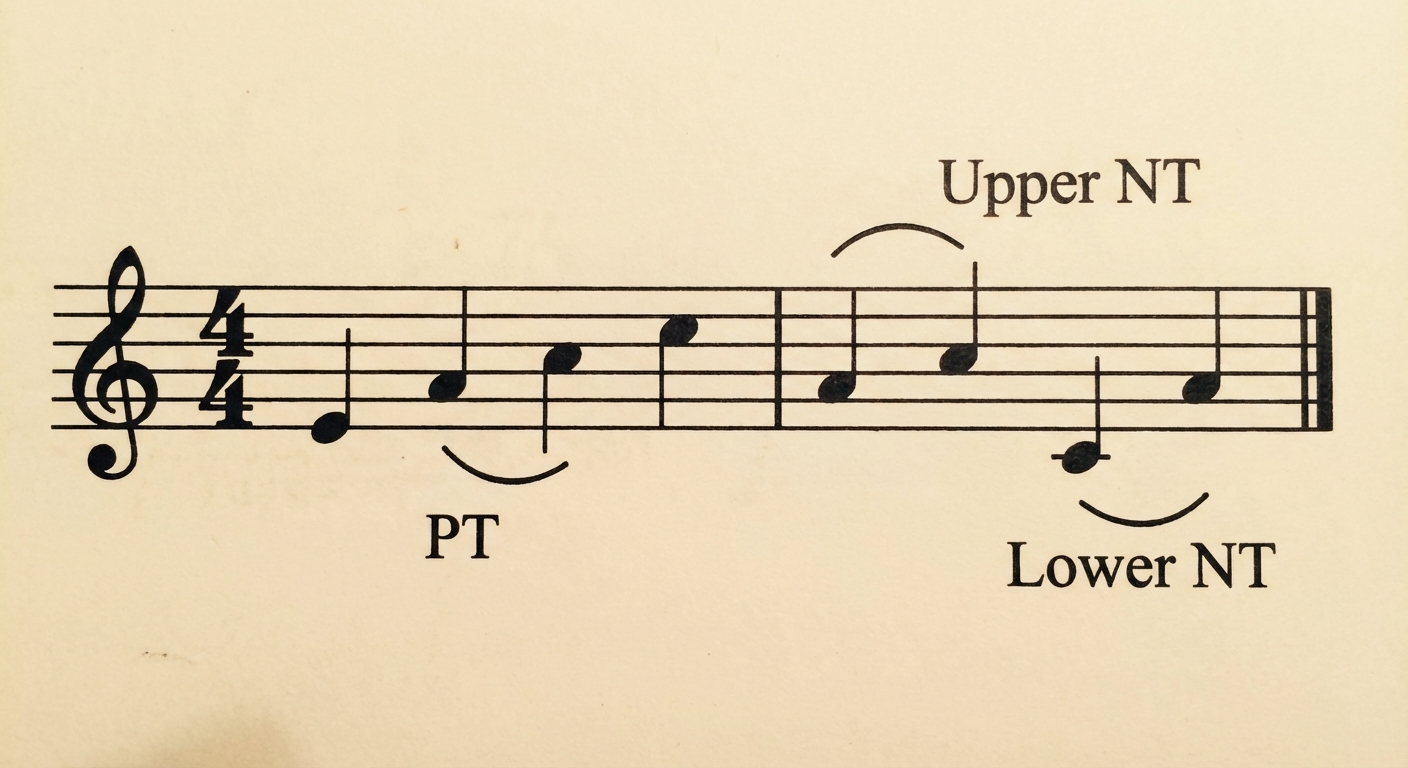
Passing Tone (P or PT)
Fills the space between two different chord tones that are a third apart.
- Approach: Step
- Departure: Step (in the same direction)
- Types:
- Diatonic Passing Tone: Uses notes within the key signature.
- Chromatic Passing Tone: Uses accidentals to fill a whole step with semitones.
- Accented Passing Tone: The passing tone lands on the beat.
Neighbor Tone (N or NT)
Decorates a single chord tone by moving to an adjacent pitch and returning.
- Approach: Step
- Departure: Step (in the opposite direction, returning to the original note)
- Types:
- Upper Neighbor: Steps up, then down ($C \to D \to C$).
- Lower Neighbor: Steps down, then up ($C \to B \to C$).
Rhythmic Displacements: Suspensions and Retardations
These NCTs involve rhythmically holding a note over from a previous chord while the harmony changes beneath it.
The Suspension (SUS)
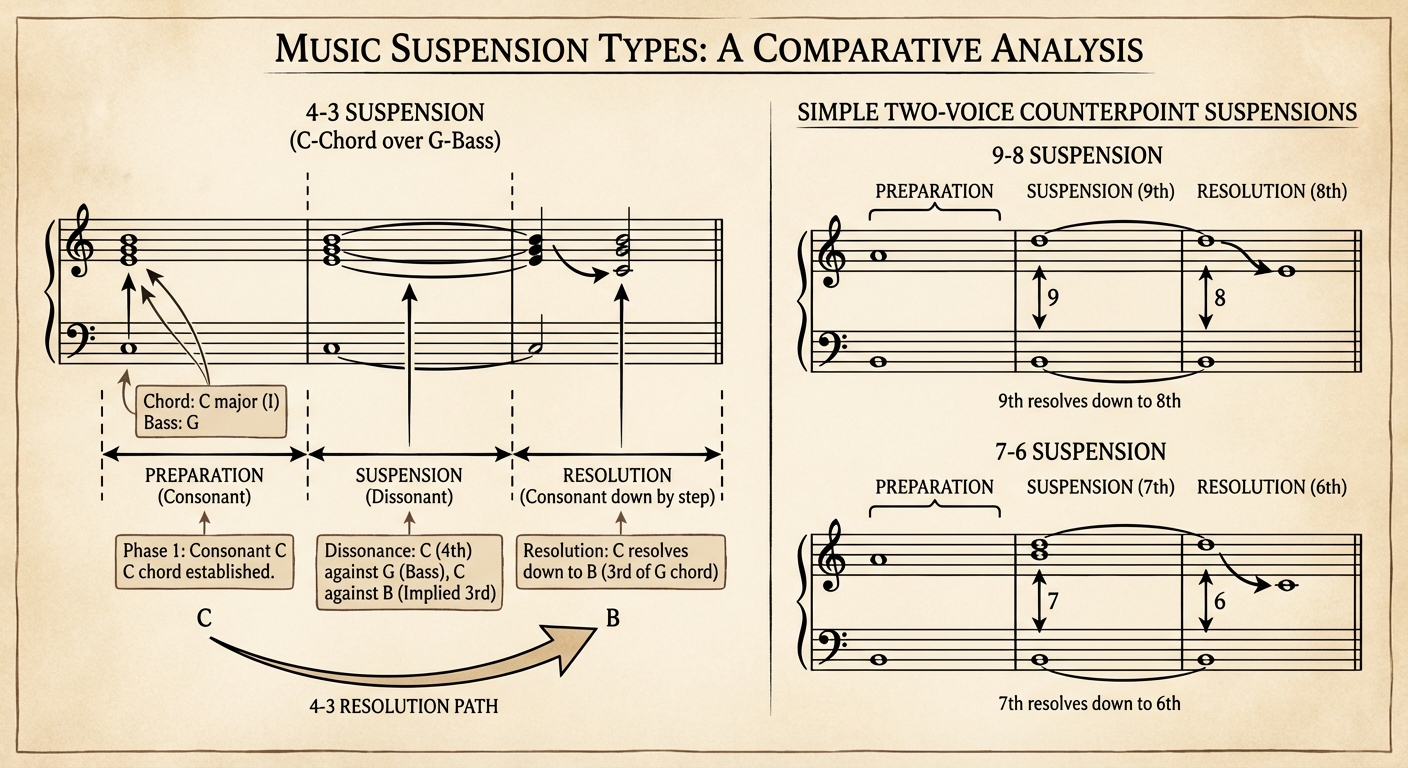
A suspension keeps a note from the previous chord sounding while the harmony changes, creating a dissonance on the beat that resolves downward.
It consists of three mandatory phases:
- Preparation: A consonant tone in the previous chord (usually on a weak beat).
- Suspension: The preparation note is sustained (tied or re-articulated) into the new chord change, creating a dissonance (on a strong beat).
- Resolution: The suspended note moves down by step to a chord tone.
Standard Suspension Types
In AP Music Theory, suspensions are labeled by the generic intervals formed between the bass and the suspended voice (even if the suspension is in an inner voice).
| Type | Description | Common Usage |
|---|---|---|
| 9-8 | Suspended note is a 9th (2nd) above bass; resolves to octave. | Soprano/Tenor |
| 7-6 | Suspended note is a 7th above bass; resolves to 6th. | Soprano/Alto |
| 4-3 | Suspended note is a 4th above bass; resolves to 3rd. | Soprano/Alto |
| 2-3 | Bass Suspension. The Bass holds a note (dissonant 2nd) and resolves down, creating a 3rd with the upper voice. | Only in Bass |
Note: For the $9-8, 7-6,$ and $4-3$, the bass moves while the upper voice stays. For the $2-3$, the upper voices change while the bass stays.
The Retardation (RET)
Similar to a suspension, but it resolves upward.
- Approach: Same note (sustained or re-articulated)
- Departure: Step UP
- Common Use: A $7-8$ retardation at a cadence in the soprano line.
Leaping Embellishments
These involve skips or leaps (intervals larger than a 2nd) in the approach or departure. These are distinct for their expressive quality.
Appoggiatura (APP)
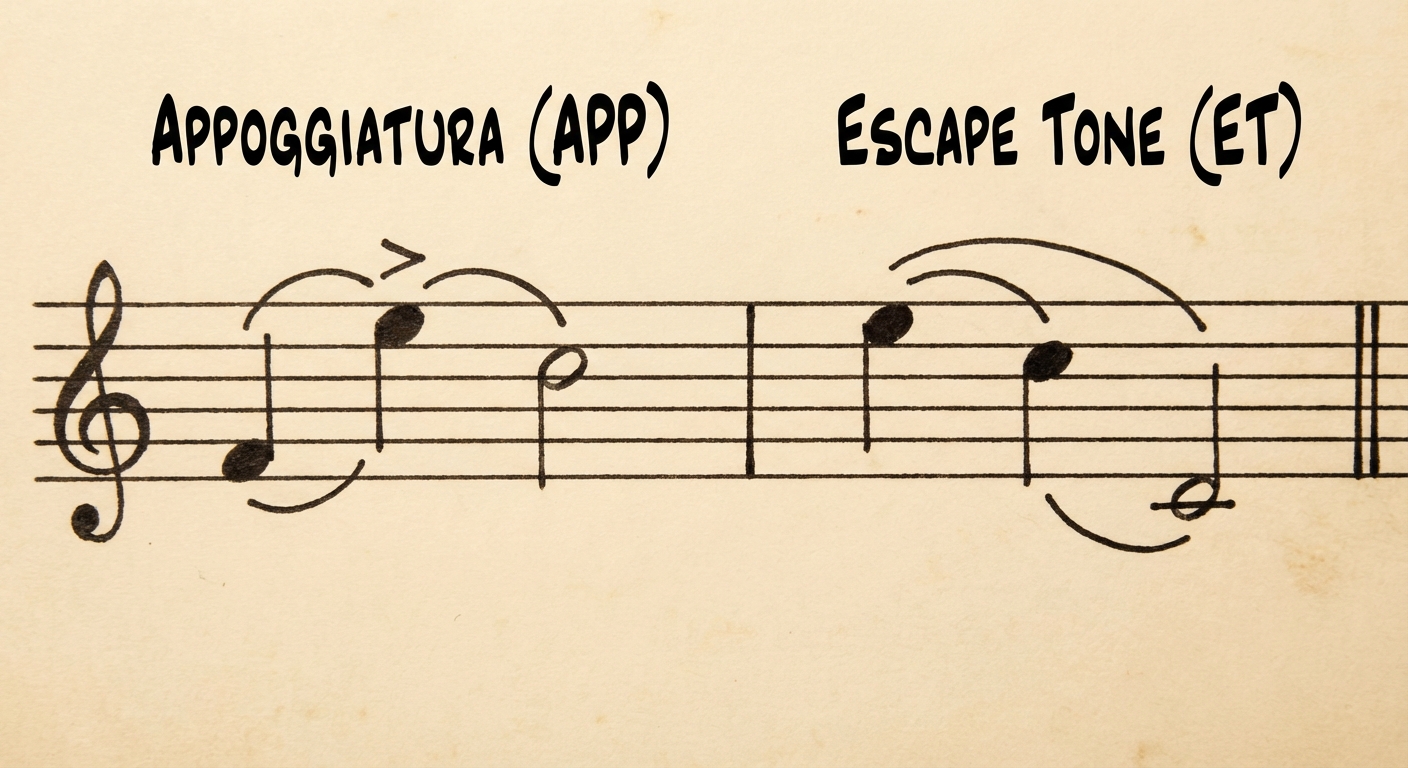
An accented embellishment that lands on the beat, emphasizing the dissonance.
- Approach: Leap (usually upward)
- Departure: Step (usually downward, opposite to the leap)
- Memory Aid: Think of the Appoggiatura as "leaning" heavily on the dissonance before relaxing into the resolution.
Escape Tone (ET) / Échappée
Usually unaccented, occurring away from the beat.
- Approach: Step
- Departure: Leap (in the opposite direction)
- Common Context: Often found at cadences in the soprano ($Scale\ Degree\ 2 \to 1$, ornamented as $2 \to 3 \to 1$).
Neighbor Group / Cambiata (Double Neighbor)
A combination of two NCTs (one upper, one lower) surrounding the main chord tone.
- Structure: Chord Tone $\to$ NCT $\to$ NCT $\to$ Chord Tone
- Example: $C \to D \to B \to C$
Other Harmonic Devices
Anticipation (ANT)
A note that arrives "early." It belongs to the next chord but is played before the harmonic change occurs.
- Approach: Step or Leap
- Departure: Same Note (as the harmony changes to match it)
- Rhythm: Usually very short value; common at authentic cadences.
Pedal Point (PED)
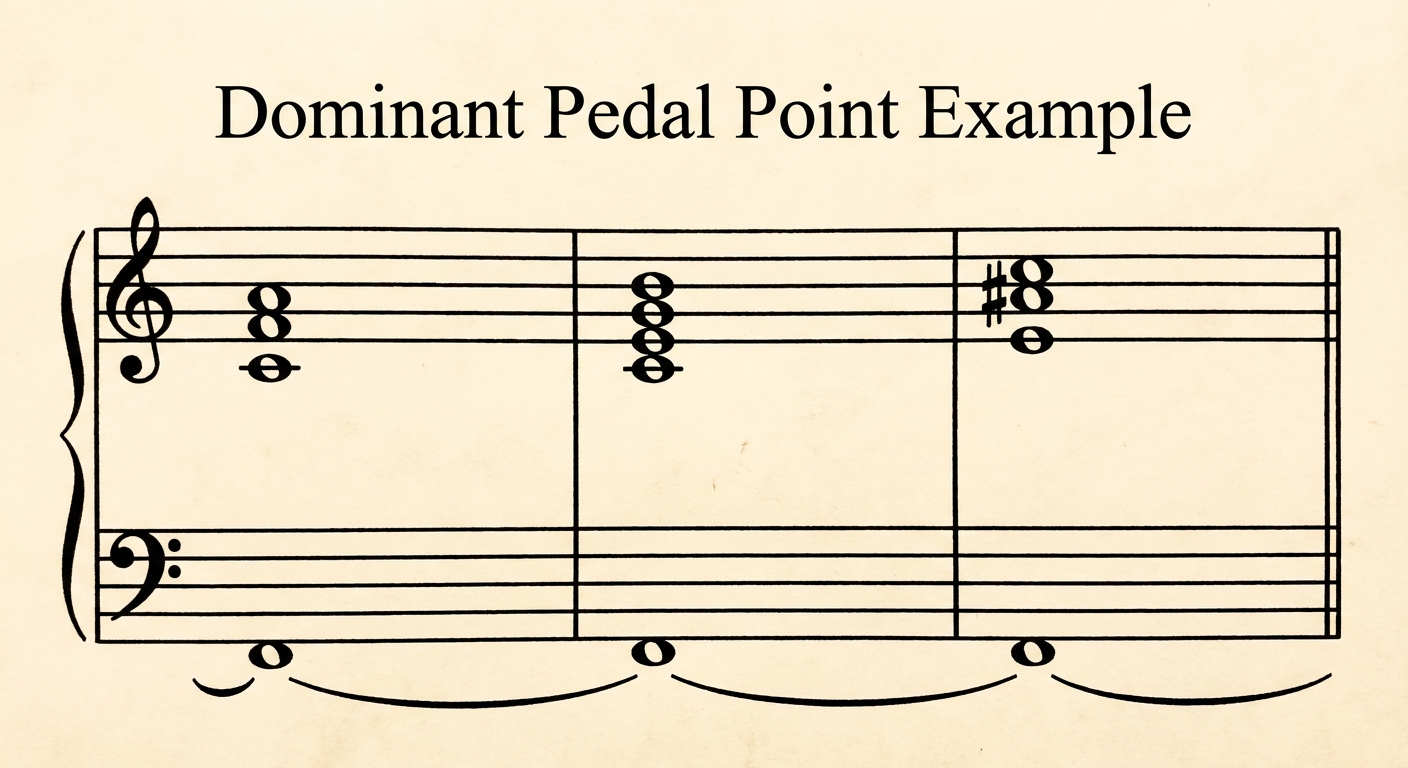
A sustained or repeated note, usually in the bass, that sounds against changing harmonies.
- Consonance/Dissonance: It begins as a chord tone, becomes dissonant as harmonies change above it, and ends as a chord tone.
- Types:
- Dominant Pedal: Sustains Scale Degree 5 (leads to tension/expectation).
- Tonic Pedal: Sustains Scale Degree 1 (reinforces finality).
Summary Table: Identifying NCTs
| NCT Name | Approach | Dissonance | Departure |
|---|---|---|---|
| Passing Tone | Step | Unaccented (usually) | Step (Same Direction) |
| Neighbor Tone | Step | Unaccented | Step (Opposite Direction) |
| Suspension | Same Tone | Accented | Step Down |
| Retardation | Same Tone | Accented | Step Up |
| Appoggiatura | Leap | Accented | Step (Opposite) |
| Escape Tone | Step | Unaccented | Leap (Opposite) |
| Anticipation | Step/Leap | Unaccented | Same Tone |
Common Mistakes & Pitfalls
1. The "Parallel Intervals" Excuse
The Mistake: Thinking that adding an NCT allows you to break voice-leading rules.
The Reality: You cannot use an NCT to mask parallel 5ths or 8ves. If the structural notes (the chord tones vs chord tones) create parallels, the part writing is incorrect, even if you insert a passing tone between them. Conversely, be careful that your NCT itself does not create a parallel 5th/8ve with another voice.
2. Confusing Appoggiatura and Escape Tone
The Mistake: Mixing up which one leaps and which one steps.
Correction: Use the mnemonic: A.L.S. (Appoggiatura: Leaps, then Steps). By process of elimination, the Escape Tone does the reverse (Steps, then Leaps).
3. Mislabeling Suspensions
The Mistake: Labeling the interval based on the root of the chord rather than the bass note, or forgetting the 2-3 rule.
Correction:
- Always measure specific intervals against the bass.
- If the dissonance is in the bass voice itself, it is likely a 2-3 suspension (the bass is the "2", the upper voice is the "3").
- Remember only the upper number is the dissonance ($4, 7, 9$). The resolution number is the consonance ($3, 6, 8$).
4. Forgetting Resolution Direction
The Mistake: Resolving a suspension upward.
Correction: Suspensions must resolve down. If it resolves up, you must label it as a Retardation (RET).