APUSH Unit 3: The Revolutionary Era (1775–1783)
Military Victory and Social Transformation (1775–1783)
The American Revolution was not just a military conflict between Great Britain and the colonies; it was a political and ideological upheaval that fundamentally transformed American society and influenced the world. This note covers APUSH Topics 3.5 (The American Revolution) and 3.6 (The Influence of Revolutionary Ideals).
The American Revolution (The War Effort)
Despite Britain's overwhelming military and economic superiority, the colonists achieved independence through resilient leadership, foreign aid, and ideological commitment.
Comparison of Forces
To understand the outcome, early war assessments must be analyzed. The victory was an upset because the balance of power heavily favored the British Empire.
| Factor | British Empire (Great Britain) | Continental Army (Patriots) |
|---|---|---|
| Military | Professional standing army (Redcoats), world's best navy, Hessian mercenaries. | Undisciplined militias, short-term enlistments, severe supply shortages. |
| Economic | Strong manufacturing base, ability to fund war through debt. | Worthless paper currency (Continentals), rampant inflation, reliance on smuggling. |
| Political | Strong central government (Parliament/King). | Weak central government (Continental Congress), unable to tax. |
| Advantages | Loyalist support (Torries), Native American alliances. | Home turf advantage, defensive strategy, ideological motivation, French alliance. |
Key turning Points of the War
While there were many skirmishes, three specific phases define the military history for the AP exam.
1. The Survival Phase (1776–1777)
Under General George Washington, the strategy was often merely to keep the army intact. Washington understood that as long as the Continental Army existed, the rebellion survived.
- Trenton & Princeton (Winter 1776): Washington crossed the Delaware to ambush Hessians. It was a morale booster that encouraged re-enlistment.
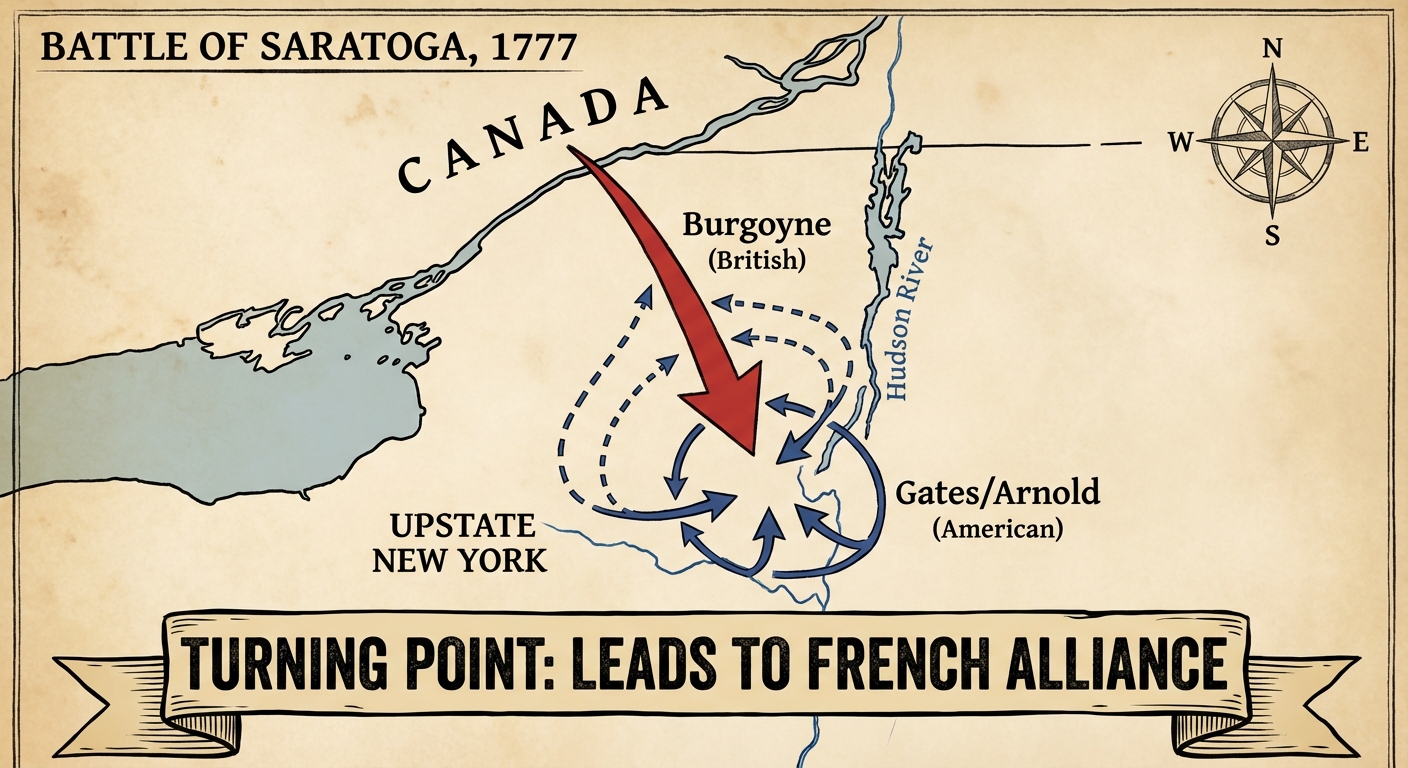
2. The Turning Point: Battle of Saratoga (1777)
This is the most frequently tested battle on the AP exam.
- The Event: British General Burgoyne attempted to sever New England from the rest of the colonies but was trapped and forced to surrender.
- The Consequence: This victory proved to France that the Americans could actually fight. It led directly to the Franco-American Alliance of 1778.
- Diplomatic Key: Benjamin Franklin utilized this victory to negotiate money, troops, arms, and naval support from King Louis XVI.
3. The End Game: Battle of Yorktown (1781)
- Washington, aided by French General Rochambeau and the French Navy (under de Grasse), surrounded British General Cornwallis on a peninsula in Virginia.
- Cornwallis surrendered, effectively ending major combat operations.
The Treaty of Paris (1783)
The war officially ended with this treaty. Key provisions:
- Britain recognized the United States as an independent nation.
- The U.S. boundary was established at the Mississippi River (a massive land grab).
- Americans retained fishing rights off Newfoundland.
- American Concession: The U.S. agreed to stop persecuting Loyalists and recommended that states restore confiscated Loyalist property (this was largely ignored, leading to future tension).
The Influence of Revolutionary Ideals
The Revolution was driven by the Enlightenment. These abstract ideas had concrete consequences for society, government, and global history.
Ideological Foundations
Enlightenment Roots
The movement relied heavily on John Locke’s concept of the Social Contract:
- Government is formed by the consent of the governed.
- Natural Rights: Life, Liberty, and Property (modified by Jefferson to "Pursuit of Happiness").
- Right to Rebellion: If the government violates these rights, the people have a duty to overthrow it.
Thomas Paine’s Common Sense (1776)
While the elite read Locke, the masses read Paine.
- Argument: Large continents should not be ruled by small islands; kings are not divine; America should be a republic.
- Impact: Shifted public opinion from "reconciliation with the King" to "total independence."
The Declaration of Independence (1776)
Authored primarily by Thomas Jefferson, this document served two purposes:
- Propaganda: To unite the colonies and convince foreign powers (France) to help.
- Statement of Intent: It listed specific grievances against King George III to justify the break.
Social Impacts (“The Revolution Within”)
The egalitarian rhetoric of the Revolution (“all men are created equal”) clashed with the reality of American social hierarchy.
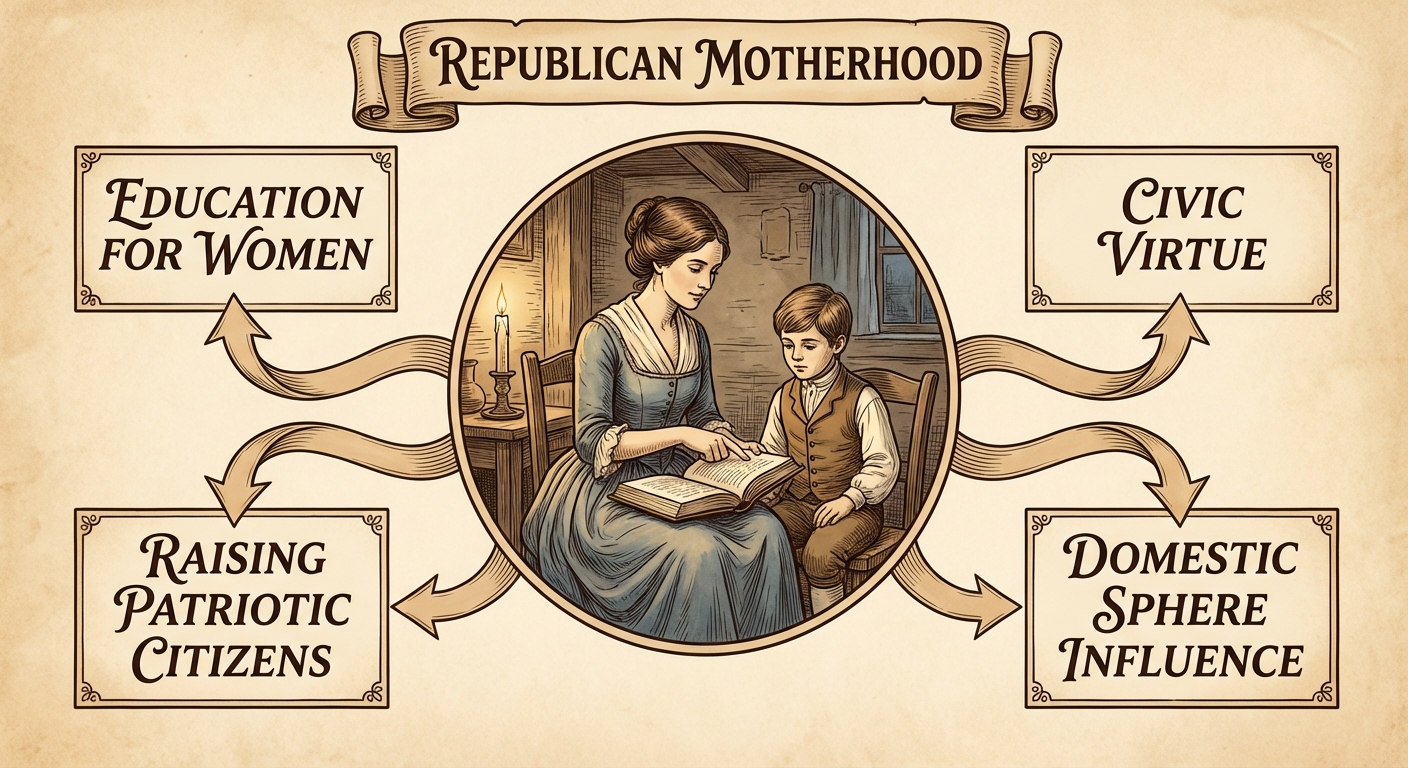
1. Women and "Republican Motherhood"
Example of limited progress. Women did not gain the right to vote or hold office. However, their status changed.
- Definition: The idea that women were responsible for raising the next generation of virtuous, civic-minded male citizens.
- Result: It elevated women’s role in the domestic sphere and led to increased educational opportunities for women (so they could teach their sons), but confined them to the home.
2. The Issue of Slavery
The Revolution highlighted the hypocrisy of fighting for liberty while holding slaves.
- Northern Emancipation: Many northern states (e.g., Pennsylvania, Massachusetts) began gradual emancipation processes or abolished slavery in their state constitutions.
- The Divide: The South largely maintained the institution, claiming it was an economic necessity. This set the stage for the sectional crisis of the 19th century.
- Free Blacks: The free Black population grew; some slaves were freed for fighting in the Continental Army (though the British also promised freedom to slaves, e.g., Lord Dunmore's Proclamation).
3. Native Americans
Generally, the Revolution was a disaster for Native Americans.
- Most tribes (e.g., Iroquois Confederacy) sided with the British, hoping to stop colonial westward expansion.
- With the American victory, white settlers flooded across the Appalachians, disregarding previous treaties.
Global Impact
The American Revolution was the first in a wave of "Atlantic Revolutions."
- French Revolution (1789): Inspired by the Declaration of Independence and American success.
- Haitian Revolution (1791): Toussaint L'Ouverture led a slave rebellion inspired by revolutionary rhetoric, creating the second republic in the Americas.
- Latin American Revolutions: Leaders like Simon Bolivar used American examples to overthrow Spanish rule.
Common Mistakes & Pitfalls
- Mistake: Believing the Revolution immediately created a democracy.
- Correction: The early U.S. was a Republic, not a direct democracy. Voting was largely restricted to white, land-owning males.
- Mistake: Overlooking the Loyalists.
- Correction: Roughly 20% to 30% of colonists remained loyal to Britain. The war was also a civil war.
- Mistake: Thinking the Treaty of Paris (1783) ended all problems with Britain.
- Correction: Britain kept forts in the American West and continued impressment, leading eventually to the War of 1812.
- Mistake: Confusing the Stamp Act Congress with the Continental Congress.
- Correction: Stamp Act Congress (1765) was a protest; Continental Congress (1774/1775) was a de facto government managing the war.
Memory Aid
To remember why the Colonies won, remember D.I.G.:
- D - Diplomacy: Franklin bringing in the French.
- I - Ideology: The motivation of protecting homes and liberty (Common Sense).
- G - Geography: Fighting a defensive war on home soil vs. British supply lines across the ocean.