Unit 3: Harmony Fundamentals - Triads and Seventh Chords
Triad Anatomy and Qualities
Structure of a Triad
A Triad is a three-note chord consisting of a Root, a Third, and a Fifth. These terms refer to the specific position of the note within the chord structure, regardless of which note is actually in the bass (lowest position).
- Root: The fundamental note upon which the chord is built.
- Third: The note interval of a third above the root. Determines if the chord is Major or Minor.
- Fifth: The note interval of a fifth above the root. Determines if the chord is Augmented or Diminished.
The Four Triad Qualities
There are four distinct qualities of triads found in tonal music. You must memorize their construction based on stacked thirds and intervals from the root.
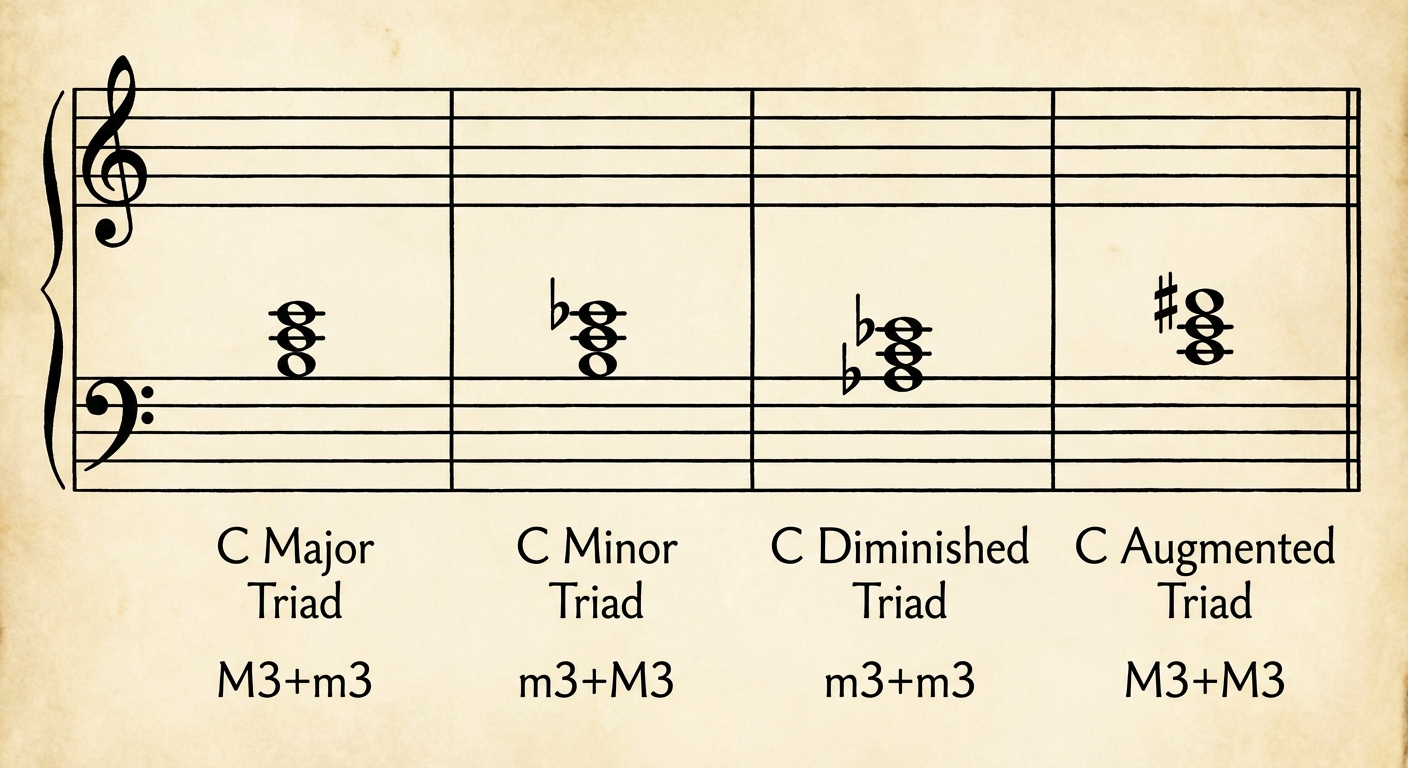
1. Major Triad (M)
- Symbol: Uppercase Roman Numeral (e.g., I, V) or Capital Letter (C).
- Stacked Intervals: Major 3rd (bottom) + Minor 3rd (top).
- From Root: Major 3rd + Perfect 5th.
2. Minor Triad (m)
- Symbol: Lowercase Roman Numeral (e.g., ii, vi) or Letter + 'm' (Cm).
- Stacked Intervals: Minor 3rd (bottom) + Major 3rd (top).
- From Root: Minor 3rd + Perfect 5th.
3. Diminished Triad ($^\circ$)
- Symbol: Lowercase Roman Numeral with degree symbol (vii$^\circ$) or Letter + 'dim' (Cdim).
- Stacked Intervals: Minor 3rd (bottom) + Minor 3rd (top).
- From Root: Minor 3rd + Diminished 5th (tritone).
4. Augmented Triad (+)
- Symbol: Uppercase Roman Numeral with plus sign (III$^+$) or Letter + 'aug' (Caug).
- Stacked Intervals: Major 3rd (bottom) + Major 3rd (top).
- From Root: Major 3rd + Augmented 5th.
Key Concept: The Major and Minor triads contain a imperfect 5th. The Diminished and Augmented triads contain an altered 5th (lowered or raised).
Seventh Chord Qualities
A Seventh Chord is a triad with one additional note stacked a third above the fifth. This creates a four-note chord containing a Root, Third, Fifth, and Seventh.
Because of the interval of the 7th, all seventh chords are considered dissonant and typically require resolution.
The Five Common Seventh Chords
For AP Music Theory, you must identify these five qualities aurally and visually.
1. Major Seventh (MM7 or M7)
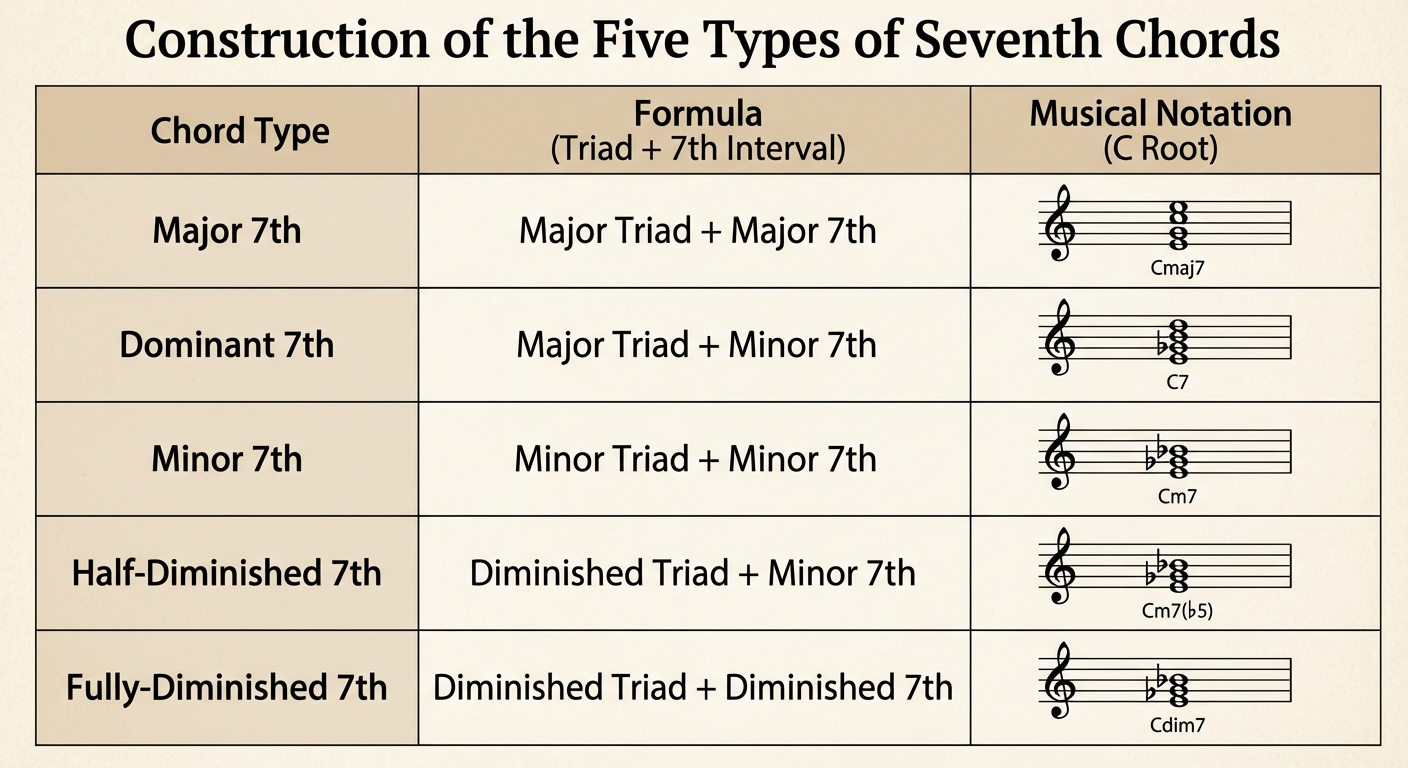
- Construction: Major Triad + Major 7th.
- Symbol: I$^7$, IV$^7$, Cmaj7.
- Sound: Jazzy, bright, nostalgic.
2. Major-Minor Seventh (Mm7) $\rightarrow$ The "Dominant Seventh"
- Construction: Major Triad + Minor 7th.
- Symbol: V$^7$, C7.
- Function: This is the most important active chord in tonal harmony. It defines the key.
3. Minor Seventh (mm7 or m7)
- Construction: Minor Triad + Minor 7th.
- Symbol: ii$^7$, vi$^7$, Cm7.
4. Half-Diminished Seventh ($^\varnothing 7$)
- Construction: Diminished Triad + Minor 7th.
- Symbol: vii$^\varnothing 7$ (in Major), ii$^\varnothing 7$ (in Minor).
- Important: This is the diatonic seventh chord on the leading tone of a Major key.
5. Fully-Diminished Seventh ($^\circ 7$)
- Construction: Diminished Triad + Diminished 7th.
- Symbol: vii$^\circ 7$ (in Harmonic Minor).
- Important: This is the diatonic seventh chord on the leading tone of a Harmonic Minor key.
Comparison Table
| Chord Quality | Triad Base | Interval of 7th (from root) | Symbol (Roman) | Symbol (Lead Sheet) |
|---|---|---|---|---|
| Major 7th | Major | Major 7th | $\text{I}^7$ | $\text{Cmaj7}$ or $\text{C}\Delta$ |
| Dominant 7th | Major | Minor 7th | $\text{V}^7$ | $\text{C}^7$ |
| Minor 7th | Minor | Minor 7th | $\text{ii}^7$ | $\text{Cm}^7$ or $\text{C-}^7$ |
| Half-Dim 7th | Diminished | Minor 7th | $\text{vii}^{\varnothing 7}$ | $\text{Cm}^{7(b5)}$ |
| Fully-Dim 7th | Diminished | Diminished 7th | $\text{vii}^{\circ 7}$ | $\text{Cdim}^7$ or $\text{C}^{\circ 7}$ |
Inversions and Figured Bass
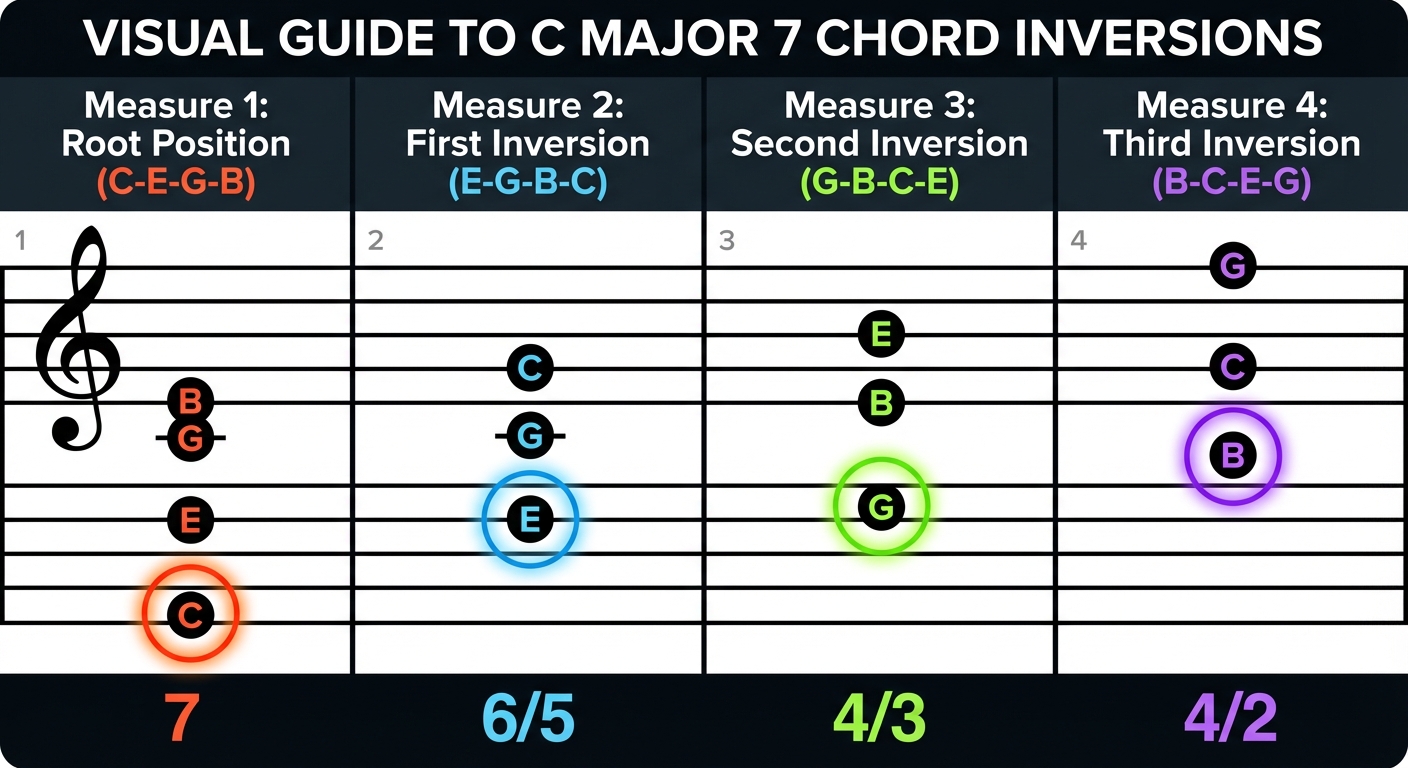
Inversions determine which member of the chord is in the Bass (lowest) voice. We use Figured Bass (Arabic numbers below the staff) to label inversions based on the intervals above the bass note.
The Inversion Hotline: An essential mnemonic for remembering the symbols.
Call: 664 - 765 - 4342
Triad Inversions
Root Position:
- Root is in the bass.
- Figured Bass: (usually left blank).
First Inversion:
- Third is in the bass.
- Root is a 6th above the bass.
- Figured Bass: (short for $6/3$).
Second Inversion:
- Fifth is in the bass.
- Root is a 4th above the bass.
- Figured Bass: . (e.g., the cadential $I^6_4$).
Seventh Chord Inversions
Root Position:
- Root is in the bass.
- Figured Bass: (short for $7/5/3$).
First Inversion:
- Third is in the bass.
- Figured Bass: .
Second Inversion:
- Fifth is in the bass.
- Figured Bass: .
Third Inversion:
- Seventh is in the bass.
- Figured Bass: or just .
Figured Bass Special Rules
Understanding the numbers is only half the battle. You must understand how accidentals interact with the numbers.
- Abbreviated Notation: In figured bass, we rarely write $5/3$. If you see a Roman numeral with no numbers (e.g., V), it is Root Position. If you see just a 6, it is $6/3$.
- Accidentals Floating Alone: An accidental ($\sharp, \flat, \natural$) appearing alone under a bass note applies to the third above the bass.
- Example: In a V chord, a $\sharp$ often appears under the bass to raise the leading tone.
- Slash Notation: A slash or stroke through a number (e.g., a slashed 6) indicates that the note associated with that interval should be raised by a half step.
- Example: A figure of means play the interval of a 6th and a 5th above the bass. If the key signature requires an F$\sharp$, you play F$\sharp$ unless the figure specifically cancels it.
Diatonic Chords in Context
Diatonic chords are built using only the notes of a specific key and scale. You must know the pattern of Major, Minor, and Diminished chords for Major and Minor keys.
Major Key Diatonic Pattern
All Major keys follow this sequence:
- I (Major)
- ii (Minor)
- iii (Minor)
- IV (Major)
- V (Major) - Often V7 (Dominant 7th)
- vi (Minor)
- vii$^\circ$ (Diminished) - Half-Diminished 7th if adding a 7th
Minor Key Diatonic Pattern
Minor keys are more complex due to the variations of the minor scale (Natural vs. Harmonic).
1. Natural Minor (used for i, III, iv, VI)
Includes the Subtonic (flat-7) scale degree.
- i (Minor)
- III (Major)
- iv (Minor)
- VI (Major)
- VII (Major) $\rightarrow$ This is the Subtonic Triad. It is a major triad built on the lowered 7th scale degree (a whole step below tonic).
2. Harmonic Minor (used for V and vii$^\circ$)
To create a functional dominant chord, we raise the leading tone (scale degree 7).
- V (Major) $\rightarrow$ The dominant must be major to pull to the tonic.
- vii$^\circ$ (Diminished) $\rightarrow$ Built on the raised leading tone.
Crucial Distinction:
- VII (Subtonic): Major triad usually found in sequences or modulating to the relative major.
- vii$^\circ$ (Leading Tone): Diminished triad acting as a dominant function chord.
Common Mistakes & Pitfalls
Confusing Half vs. Fully Diminished:
- Mistake: Assuming vii$^\circ 7$ is always fully diminished.
- Correction: In Major keys, the diatonic leading tone chord is Half-Diminished ($^\varnothing 7$). In Minor keys, it is Fully-Diminished ($^\circ 7$).
Figured Bass vs. Root Calculation:
- Mistake: Thinking the figured bass numbers count from the root of the chord.
- Correction: Figured bass numbers explicitly measure intervals from the Bass Note (the bottom note on the paper), regardless of what the root is.
Inversion Counting:
- Mistake: Mixing up 2nd inversion ($6/4$) and 1st inversion ($6$).
- Correction: Use the mnemonic "The bigger number wins." $6/4$ has two numbers (bigger visual footprint), but it corresponds to 2nd inversion? (Wait, that's confusing). Stick to the Hotline: 664-765-4342.
The "Floating" Accidental:
- Mistake: Seeing a $\sharp$ under the staff and assuming it applies to the bass note.
- Correction: If there is no number, the accidental applies to the Third above the bass.