Comprehensive Review: Mechanisms and Impacts of Earth's Changing Climate
The Greenhouse Effect
The Greenhouse Effect is a natural and necessary process that warms the Earth's surface. Without it, Earth's average temperature would be approximately -18°C (0°F), making life as we know it impossible. It is crucial to distinguish between the natural greenhouse effect and the anthropogenic (human-enhanced) greenhouse effect.
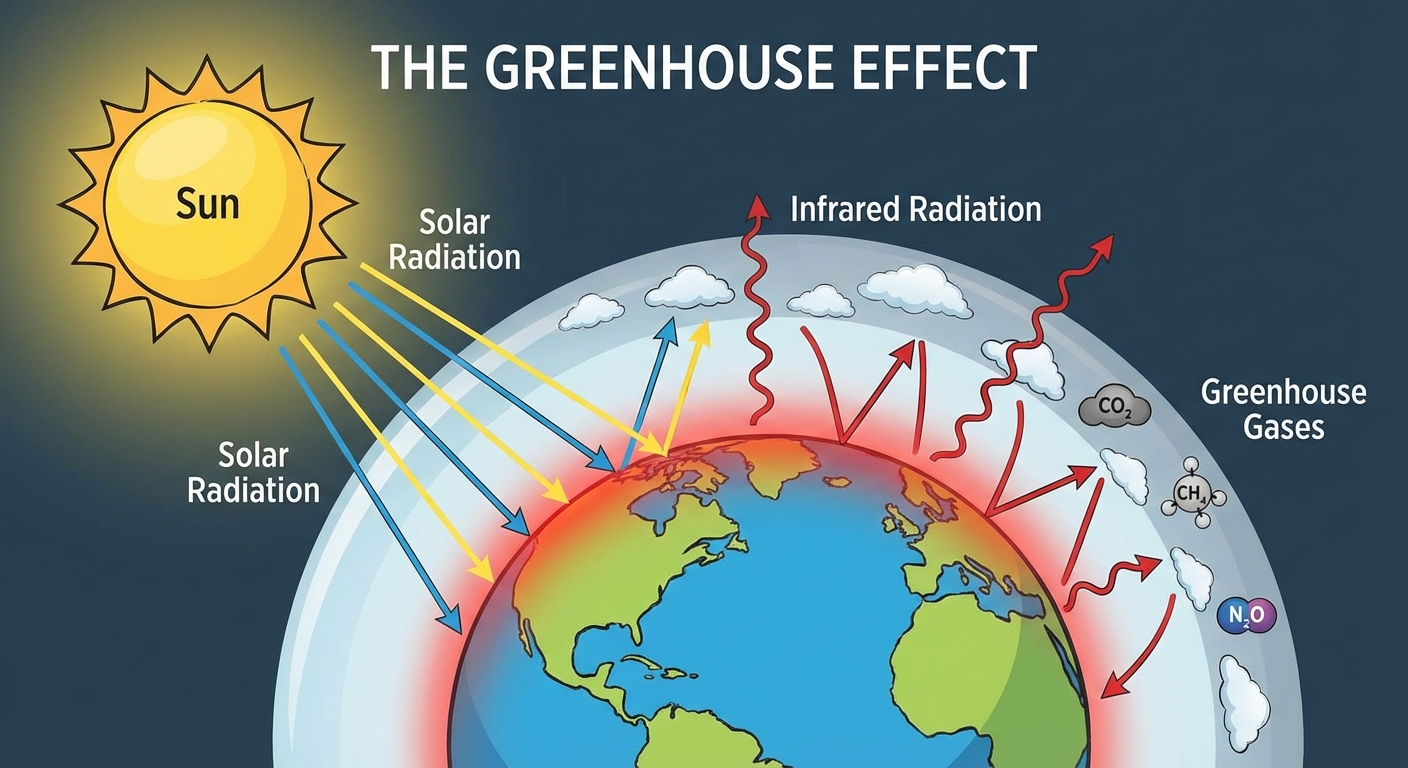
The Mechanism
- Incoming Solar Radiation: The sun emits high-energy radiation (mostly ultraviolet and visible light). This radiation passes easily through the atmosphere and strikes the Earth's surface.
- Absorption and Re-emission: The Earth absorbs this energy and warms up. It then re-radiates this energy back toward space in the form of lower-energy Infrared Radiation (IR) (heat).
- Trapping Heat: Greenhouse gases (GHGs) in the troposphere absorb this outgoing infrared radiation and re-emit it in all directions, warming the lower atmosphere and the surface.
Principal Greenhouse Gases
The gases listed below are the primary drivers of the greenhouse effect. Note that Nitrogen ($N2$) and Oxygen ($O2$), which make up 99% of the atmosphere, are not greenhouse gases because they do not absorb infrared radiation.
- Water Vapor ($H_2O$): The most abundant natural GHG; however, it has a very short residence time in the atmosphere (days).
- Carbon Dioxide ($CO_2$): The primary GHG of concern due to human activity. Long residence time.
- Methane ($CH4$): More potent than $CO2$ but exists in lower concentrations.
- Nitrous Oxide ($N_2O$): highly potent; produced by denitrification and combustion.
- Chlorofluorocarbons (CFCs) & Hydrofluorocarbons (HFCs): Synthetic industrial gases with effectively permanent residence times and immense heat-trapping capabilities.
Increases in the Greenhouse Effect
While the greenhouse effect is natural, human activities have significantly increased the concentration of GHGs, leading to Global Warming. To understand the impact of different gases, scientists use the Global Warming Potential (GWP).
Global Warming Potential (GWP)
GWP is a relative measure of how much heat a specific mass of gas traps in the atmosphere over a specific time horizon (usually 100 years), compared to Carbon Dioxide.
| Greenhouse Gas | Formula | GWP (approx. 100-yr) | Primary Anthropogenic Sources |
|---|---|---|---|
| Carbon Dioxide | 1 (Reference) | Fossil fuel combustion, deforestation, cement production | |
| Methane | 25 - 30 | Livestock (enteric fermentation), landfills, rice paddies, natural gas leaks | |
| Nitrous Oxide | 300 | Agricultural fertilizers, improper manure management, combustion | |
| CFCs / HFCs | Various | 1,000 - 10,000+ | Refrigerants, air conditioning, aerosols (CFCs are banned by the Montreal Protocol) |
Key Trends
- $CO2$ fluctuation: Historically, $CO2$ levels fluctuate with the seasons (decreasing in spring/summer as plants photosynthesize, increasing in fall/winter as vegetation decays). However, the overall trend line is steadily increasing.
- Positive Feedback Loops: Rising temperatures can trigger cycles that cause further warming. For example, melting permafrost releases trapped methane, which causes more warming, melting more permafrost.
Global Climate Change
Global Climate Change refers to the broad range of changes happening to our planet due to the excess heat trapped in the system. It encompasses more than just "global warming."
Impacts on Ice and Water
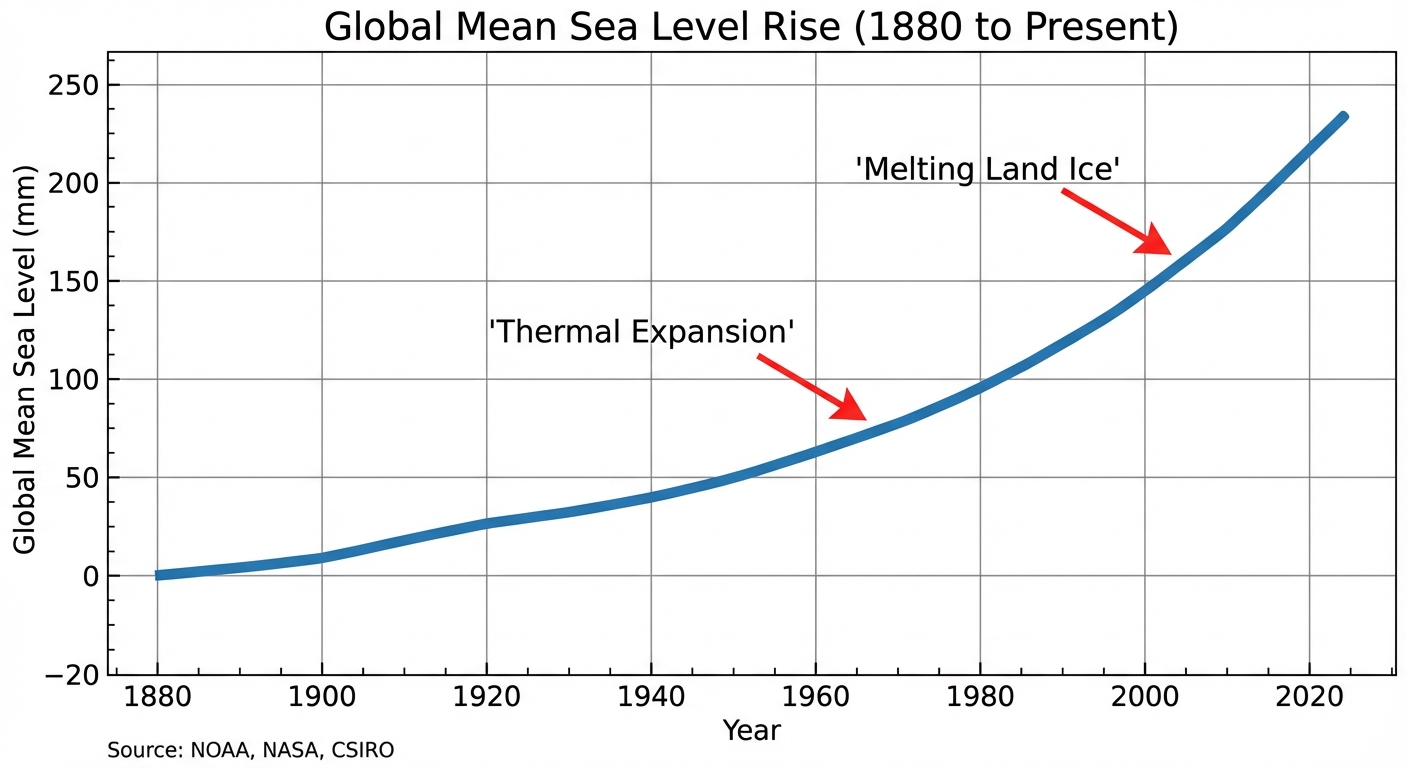
- Melting Ice Sheets and Glaciers: The melting of land-based ice (Greenland and Antarctic ice sheets) contributes directly to sea-level rise.
- Thermal Expansion: As ocean water warms, the molecules move further apart, causing the volume of the ocean to expand. This is a primary driver of current sea-level rise, alongside melting land ice.
- Melting Permafrost: Found in tundra biomes, permafrost thaw destabilizes infrastructure (buildings, pipelines) and releases massive amounts of methane.
Impacts on Ecosystems and Biota
- Range Shifts: Organisms are migrating toward the poles or up mountain slopes to remain in their optimal temperature range. Organisms that cannot migrate (e.g., plants, alpine species) face extinction.
- Changed Migration Patterns: Birds and marine life may migrate earlier or later, leading to mismatches with food availability (phenological mismatch).
- Disease Vectors: Warmer climates expand the habitable range of vectors like mosquitoes and ticks, spreading diseases like Malaria, Zika, and Lyme disease to previously unaffected areas.
Impacts on Weather Patterns
- Increased intensity of storm events due to more energy/heat in the atmosphere and ocean.
- Altered precipitation patterns, leading to severe droughts in some areas and flooding in others.
- Disruption of the Jet Stream/Polar Vortex, causing extreme cold snaps in temperate regions.
Ocean Warming
The oceans absorb approximately 90% of the excess heat generated by the increased greenhouse effect. This buffers the atmosphere from extreme temperatures but devastatingly impacts marine environments.
Ecological Consequences
- Metabolic Changes: Marine organisms generally have narrow thermal tolerance ranges. Increased heat increases metabolic rates, causing organisms to burn energy faster, which can stunt growth or reduce reproductive success.
- Oxygen Depletion: Warm water generally holds less dissolved oxygen ($DO$) than cold water. As oceans warm, zones of hypoxia (low oxygen) expand, leading to fish kills.
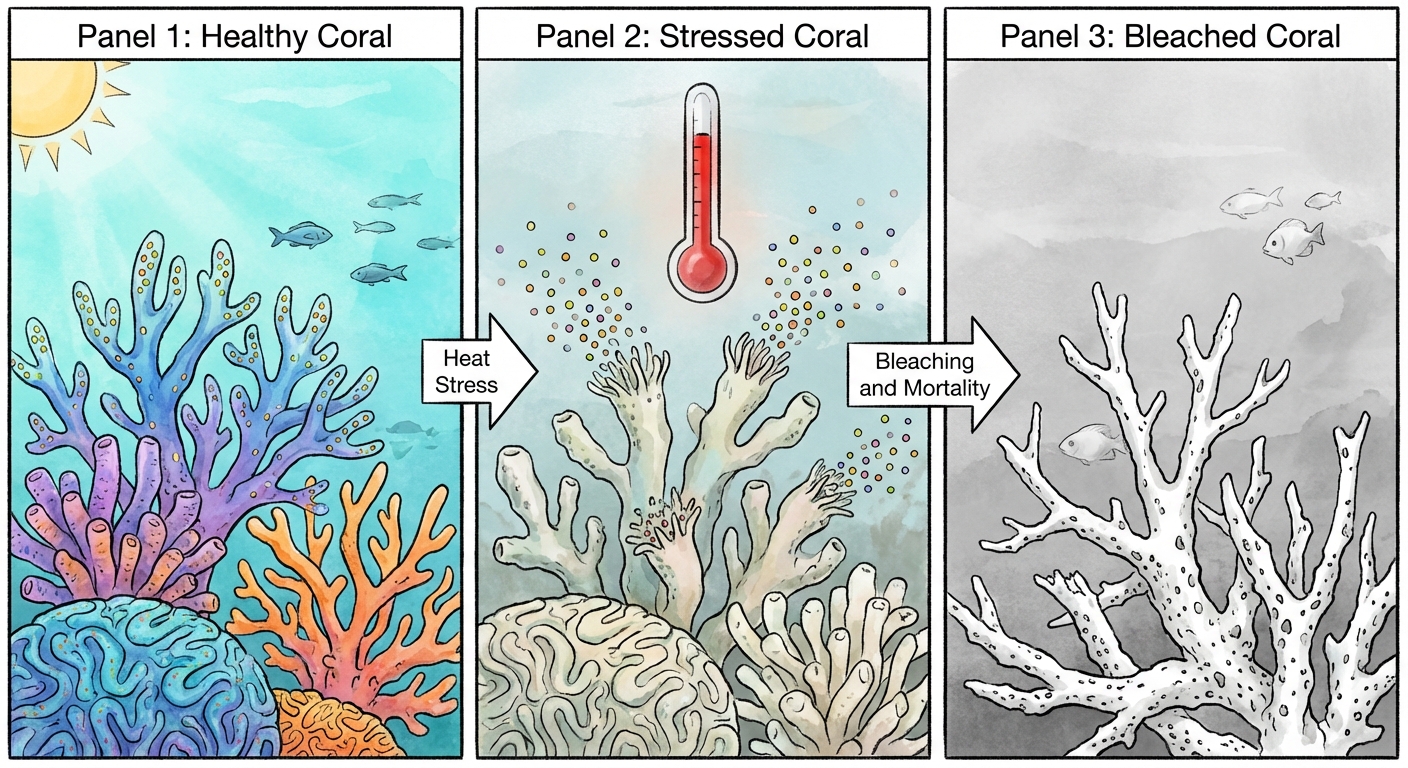
- Coral Bleaching:
- Corals have a symbiotic relationship with algae called zooxanthellae, which provide food and color.
- When water temperatures rise just 1-2°C above average, corals become stressed and expel the algae.
- The coral turns white ("bleaches") and will die of starvation if conditions do not return to normal quickly.
Ocean Acidification
Ocean Acidification is often called the "evil twin" of climate change. It is caused by the chemical absorption of $CO_2$, not directly by the heat.
The Chemistry
When Carbon Dioxide dissolves in seawater, it undergoes a chemical reaction:
- Formation of Carbonic Acid:
- Dissociation:
The increase in Hydrogen ions ($H^+$) is what lowers the pH of the ocean (making it more acidic).
Impact on Calcifying Organisms
Many marine organisms (corals, mollusks, echinoderms, plankton) rely on Calcium Carbonate ($CaCO_3$) to build their shells and skeletons.
- The Problem: The excess $H^+$ ions bond with free carbonate ions ($CO3^{2-}$) to form bicarbonate ($HCO3^-$).
- The Result: This reduces the availability of carbonate ions for organisms to build shells. In severe cases, acidic water can actually dissolve existing shells.
\text{Availability of } CO_3^{2-} \downarrow \implies \text{Weak Shells & Coral Skeletons}
Common Mistakes & Pitfalls
1. The Ozone Hole vs. Global Warming
- Mistake: Thinking the hole in the ozone layer lets in more heat and causes global warming.
- Correction: Stratospheric ozone depletion (caused by CFCs) allows more UV radiation to hit Earth, causing skin cancer and crop damage. It has a negligible effect on thermal warming. The Greenhouse Effect traps Infrared radiation.
2. Sea Ice vs. Land Ice
- Mistake: Claiming that melting sea ice (like the ice at the North Pole) significantly raises sea levels.
- Correction: Sea ice is already floating. When it melts, it does not change the water level (Archimedes' Principle). However, melting land ice (glaciers, ice sheets) adds new water to the ocean, raising sea levels.
3. Weather vs. Climate
- Mistake: Using a single cold day or snowstorm as evidence against warming.
- Correction: Weather is short-term and local. Climate is the long-term average (decades/centuries) of weather patterns. A cold snap is weather; a clear upward trend in average global temperature is climate.
4. Acidification vs. Toxicity
- Mistake: Thinking ocean acidification means the ocean will burn human skin.
- Correction: The pH change is small on a scale perceptible to humans (e.g., 8.2 to 8.1), but because the pH scale is logarithmic, this represents a massive (approx. 30%) increase in acidity chemically, which is devastating to microscopic biological processes.