Unit 7: West and Central Asia — Islamic Visual Culture (500 BCE–1980 CE)
Foundations of Islamic Art
Islamic Art is not a monolithic style but a diverse cultural tradition spanning over 1,400 years and vast geography, united by the Islamic faith and the Arabic language. In AP Art History context, this section focuses heavily on the exchange of ideas between the secular and the sacred, and how art facilitates religious practice.
Core Characteristics
- Aniconism: in sacred contexts (mosques, Qur'ans), imagery of sentient beings (humans, animals) is prohibited to avoid idolatry.
- Dominant Motifs:
- Calligraphy: The highest art form, transmitting the divine word of Allah.
- Vegetal/Arabesque: Intertwining plant motifs representing the paradise garden.
- Geometric Patterns: Complex tessellations symbolizing the infinite nature of God and the order of the universe.
- Patronage: Art was often commissioned by Caliphs and Sultans to legitimize political power through religious piety.
Early Islamic Architecture
Early architecture often repurposed or referenced Byzantine and Sassanian forms, adapting them to new religious requirements.
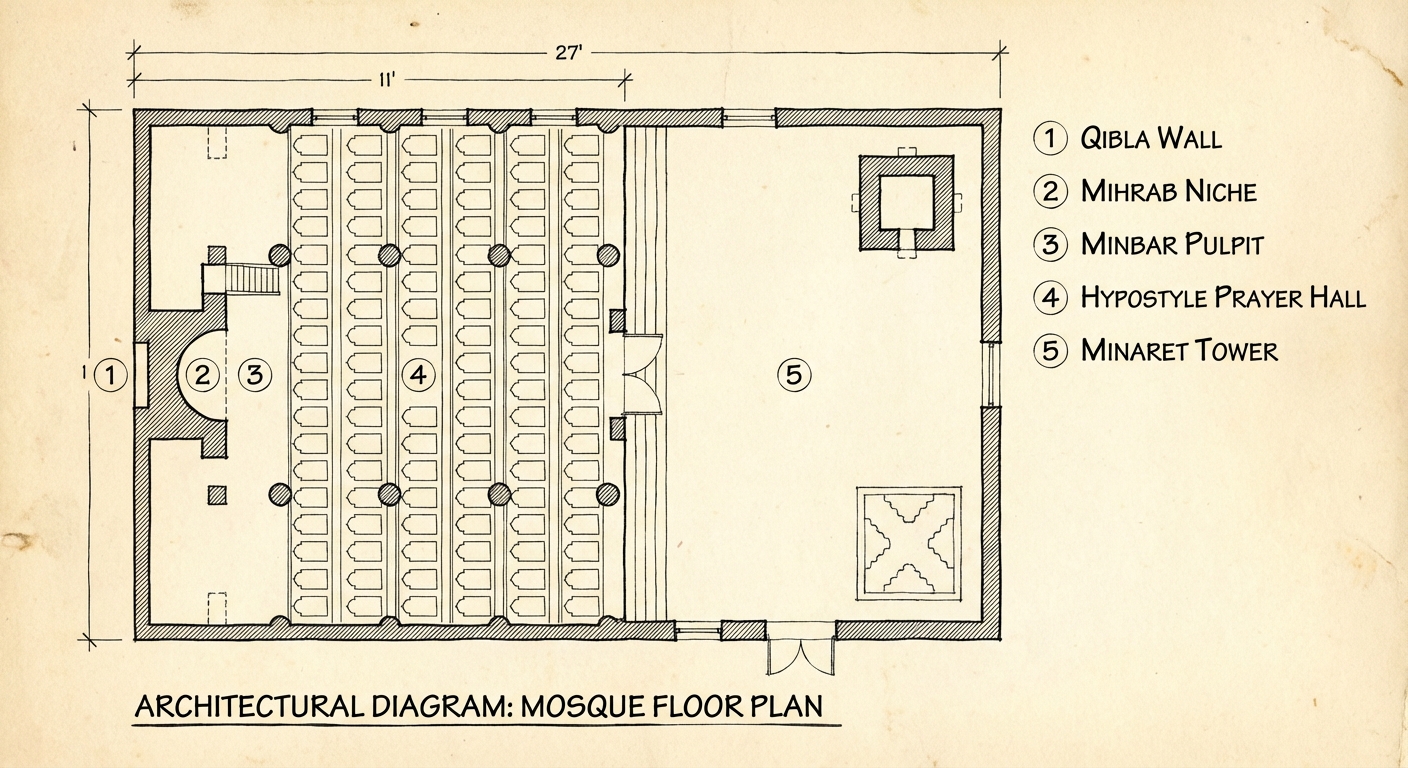
The Mosque (Masjid)
Every mosque must have specific components for prayer (salat):
- Qibla Wall: The wall indicating the direction of Mecca.
- Mihrab: A niche in the Qibla wall; the focal point of prayer.
- Minaret: Tower from which the call to prayer (adhan) is issued.
- Minbar: Pulpit for the Friday sermon.
The Dome of the Rock (691–692 CE)
- Location: Jerusalem (Umayyad Dynasty).
- Function: Not a mosque, but a shrine and political statement. It marks the site of the Night Journey (Miraj) of Muhammad and the sacrifice of Abraham/Ibrahim.
- Form: Octagonal plan with a golden dome.
- Significance:
- Heavily influenced by the Byzantine San Vitale (Ravenna).
- Use of mosaics devoid of human figures; instead, they feature crowns and jewels (symbolizing defeated empires) and Arabic inscriptions challenging the Christian Holy Trinity.
Great Mosque of Córdoba (c. 785–786 CE)
- Location: Córdoba, Spain (Al-Andalus).
- Context: Founded by the Umayyad prince Abd al-Rahman I, who fled to Spain after his dynasty fell in Syria.
- Key Features:
- Hypostyle Hall: A vast prayer hall filled with columns.
- Spolia: Recycled Roman columns were too short for the high ceiling, leading to a unique innovation.
- Double-Tiered Arches: A lower horseshoe arch supports a second upper arch, increasing height and allowing light.
- Voussoirs: Alternating red brick and white stone create a rhythmic visual effect.
- Maqsura: A screened area reserved for the ruler to pray safely.
Later Architectural Developments: Ottoman & Safavid
As Islam spread, regional empires developed distinct architectural vocabularies.
Architectural Typologies Comparison
| Type | Description | Key Example |
|---|---|---|
| Hypostyle | Many columns, flat roof, "forest of trees" effect. | Great Mosque of Córdoba |
| Four-Iwan | Central courtyard featuring four large vaulted halls (iwans) opening onto it. | Great Mosque (Masjid-e Jameh) of Isfahan |
| Centrally Planned | Dominated by a massive central dome; influenced by Hagia Sophia. | Mosque of Selim II |
The Great Mosque (Masjid-e Jameh) of Isfahan
- Location: Iran (Seljuk, Il-Khanid, Timurid, and Safavid contributions).
- Significance: The archetype of the Four-Iwan Plan. It is largely integrated into the city's urban fabric (bazaars connect directly to the mosque).
- Muqarnas: Stucco "honeycomb" vaulting creates a transition from vertical walls to curved domes, catching light and symbolizing the complexity of creation.
Mosque of Selim II (1568–1575 CE)
- Location: Edirne, Turkey (Ottoman Empire).
- Architect: Sinan (the Great).
- Context: Built to surpass the grandeur of the Byzantine Hagia Sophia and prove Islam's architectural triumph.
- Form:
- Massive central dome resting on squinches (structural support).
- Four pencil-thin minarets (tallest in the Ottoman world).
- Interior is flooded with light through hundreds of windows.
Islamic Calligraphy and Luxury Arts
Since the representation of figures was discouraged in religious settings, artists poured creativity into text and decorative objects.
Calligraphy: Folio from a Qur'an
- Medium: Ink, color, and gold on parchment (vellum).
- Script: Kufic script (strong, angular, horizontal orientation). Notable for its clarity and rhythm.
- Significance: Writing the Qur'an was a holy act. The proportions of the letters were strictly calculated.
Luxury Objects: The Ardabil Carpet
- Period: Safavid Dynasty (1539–1540 CE).
- Medium: Silk and wool (allows for higher knot count = 340 knots per sq. inch).
- Design:
- Central golden sunburst medallion represents the inside of a dome.
- Symmetry flaw: Two lamps are depicted; one is larger than the other. This is likely an intentional perspectival trick so they look equal when viewed from the entrance end.
- Function: Prayer carpet for a funerary shrine.
The Basin (Baptistère de Saint Louis)
- Artist: Muhammad ibn al-Zain (Mamluk, Egypt/Syria).
- Medium: Brass inlaid with gold and silver.
- Function: Originally for hand-washing; later captured and used to baptize French royal children.
- Imagery: Unusual because it is figurative. It depicts Mamluk hunters, Mongol enemies, and animals. Being a secular object allowed the artist to break the ban on imagery.
Persian Miniature Painting
Persian manuscripts (miniatures) are a major exception to the "no figures" rule, as they were secular books intended for royal enjoyment, not worship.
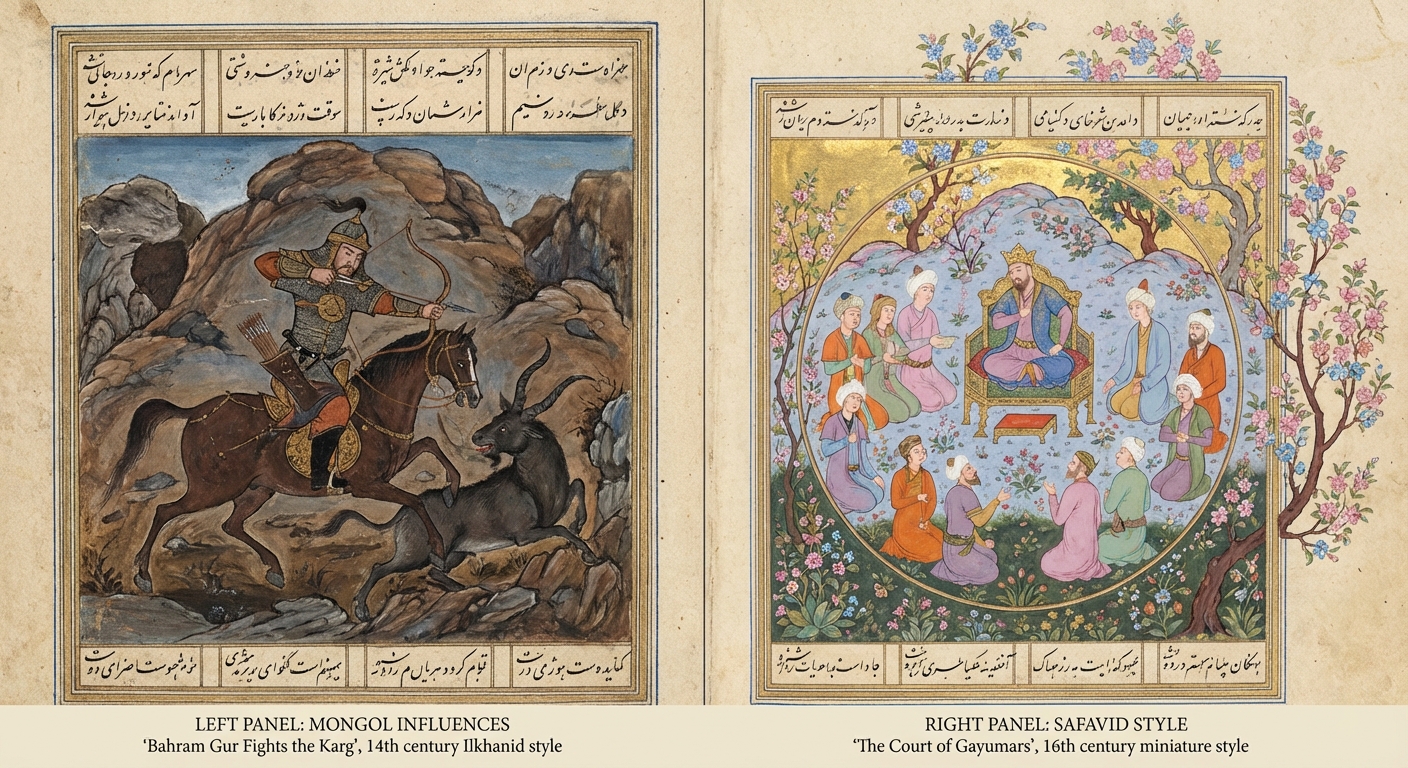
Bahram Gur Fights the Karg
- Source: The Shahnama (Book of Kings), the Persian national epic.
- Style: Il-Khanid (Mongol influence in Persia).
- Visual Analysis:
- Bahram Gur represents the ideal king (brave, skilled).
- Chinese Influence: Landscape elements (gnarled trees, rocky mountains) show trade along the Silk Road.
- Bahram Gur wears European fabric styles, showing the cosmopolitan nature of the Il-Khanids.
The Court of Gayumars
- Source: Examining the Shahnama produced for Shah Tahmasp (Safavid).
- Artist: Sultan Muhammad.
- Visual Analysis:
- Gayumars (legendary first king) sits enthroned on a mountain.
- Composition: Figures float in a high-perspective semicircle.
- Bleeding: The trees and rocks extend past the ruled borders of the page, suggesting a world too lush to be contained.
- Harmony between humans, animals, and nature represents a Golden Age.
Common Mistakes & Pitfalls
Universality of Aniconism:
- Mistake: Thinking Islamic art never has humans or animals.
- Correction: Figures are banned in religious spaces (Mosques, Qur'ans) but are common in secular art (palaces, books, carpets, metalwork).
Confusing Mosques:
- Mistake: Confusing the Cordoba arches (striped/horseshoe) with the Isfahan arches (pointed/muqarnas).
- Tip: Red stripes = Spain/Cordoba. Blue tiles = Iran/Isfahan. Massive central dome = Turkey/Ottoman.
Dome of the Rock vs. The Kaaba:
- The Kaaba is the holiest site (Mecca). The Dome of the Rock is a shrine in Jerusalem. They are not the same building.
"Arab Art" vs. "Islamic Art":
- Do not use these interchangeably. Persians (Iranians), Turks (Ottomans), and Moors (Spain) produced Islamic art but are not Arabs. Use the dynastic name (Umayyad, Safavid, Ottoman) for precision.