Mastering the ACT Reading Section: Strategies and Curriculum
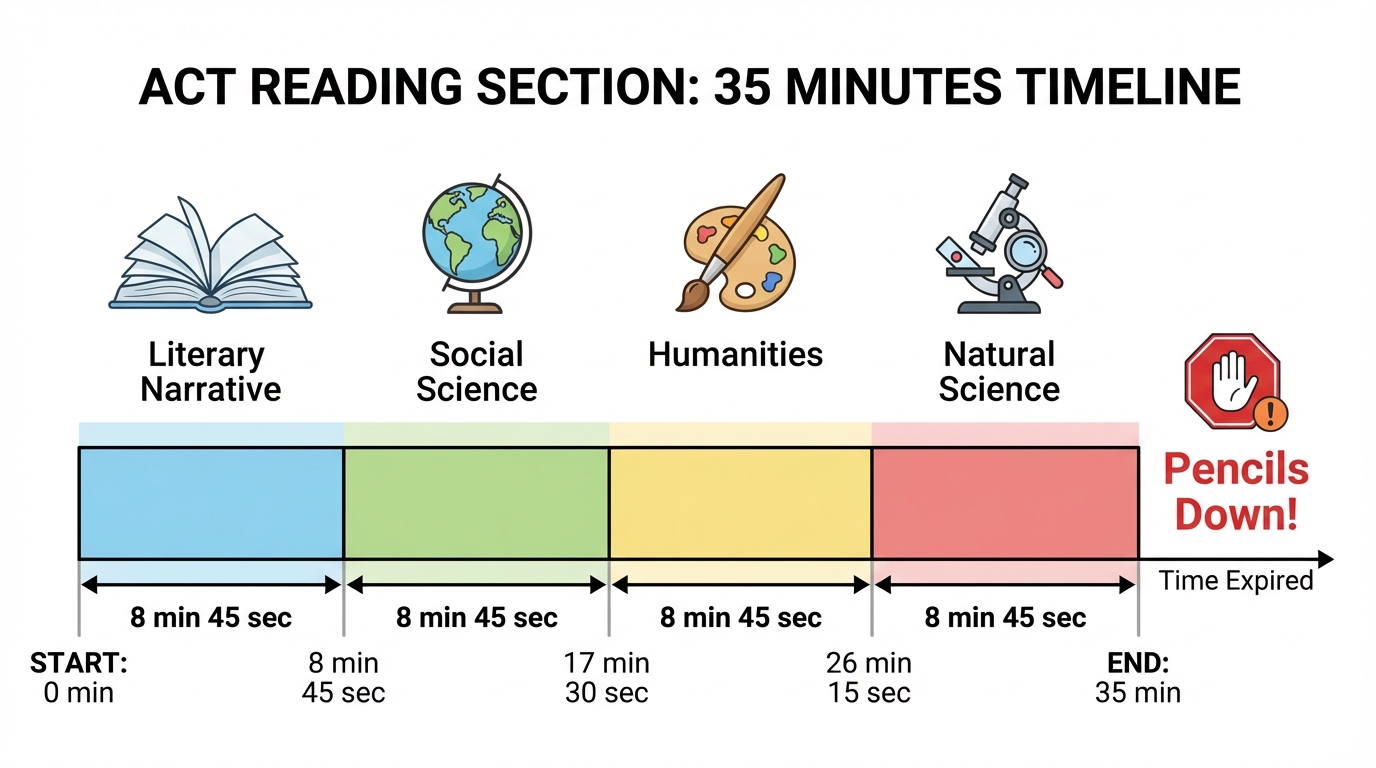
Structure and Pacing of the Reading Test
The ACT Reading Test is fundamentally a test of speed, comprehension, and evidence retrieval. Unlike literature exams in school that may ask for your interpretation or feelings about a text, the ACT requires you to act as an objective investigator finding facts within a strict time limit.
The Logistics
- Total Time: 35 Minutes
- Total Questions: 40 Questions
- Number of Passages: 4 distinct sections (approx. 750-800 words each)
- Time Per Passage: 8 minutes and 45 seconds (including reading and answering)
The Four Passage Genres
The passages always appear in the same fixed order. Understanding the typical content and structure of each genre helps in mental preparation and Personal Order of Difficulty (POOD) strategies.
- Literary Narrative (Prose Fiction):
- Content: Excerpts from novels or short stories. Focuses on characters, relationships, emotional conflicts, and coming-of-age themes.
- Strategy: Read for "voice" and character motivation rather than facts.
- Social Science:
- Content: History, anthropology, psychology, sociology, or economics. These are informational and argumentative.
- Strategy: track the author's thesis and the sequence of events or cause-and-effect relationships.
- Humanities:
- Content: Memoirs, essays on art, music, philosophy, or theatre. Often written in the first person.
- Strategy: Look for the author's perspective or tone regarding the subject matter.
- Natural Science:
- Content: Biology, chemistry, physics, astronomy, or geology. Heavy on facts, data, and scientific phenomena.
- Strategy: Do not memorize the jargon; focus on the relationships between variables and the main scientific theory presented.
Official Reporting Categories (Question Types)
The ACT categorizes its questions into three specific learning objectives (Reporting Categories). Understanding these tells you exactly what the test makers are looking for.
1. Key Ideas and Details (55–60% of the test)
These questions ask you to identify the central themes or locate specific information explicitly stated in the text. They require close reading but minimal interpretation.
- Central Idea: "The main purpose of the third paragraph is to…"
- Detail Retrieval: "According to the passage, the primary reason for the experiment was…"
- Sequential Order: "Which of the following events happened first chronologically?"
Strategy: Use the "Lead Words" in the question stem (proper nouns, dates, unique technical terms) to scan the passage and locate the answer sentence. The answer is almost always a direct paraphrase of the text.
2. Craft and Structure (25–30% of the test)
These questions focus on how the text is written rather than just what it says. You must analyze word choice, text structure, and point of view.
- Vocabulary in Context: "As used in line 45, the word 'check' most nearly means…"
- Note: The most common definition is usually a trap. You must determine the meaning based only on the surrounding sentence.
- Function: "The author mentions the 'blue heron' in line 12 primarily to…"
- Tone/Perspective: "The author's attitude toward the subject can best be described as…"
Strategy for Vocab: Pretend the word is a blank space. Fill in the blank with your own synonym based on context, then find the answer choice that matches your synonym.
3. Integration of Knowledge and Ideas (13–18% of the test)
These are the most complex questions. They require you to connect ideas, evaluate arguments, or compare two different texts.
- Cause and Effect: "The results of the study suggest that X occurs because…"
- Arguments/Claims: "Which of the following claims is NOT supported by the passage?"
- Paired Passage Questions: "Both Passage A and Passage B support the idea that…"
Strategy: The Paired Passages
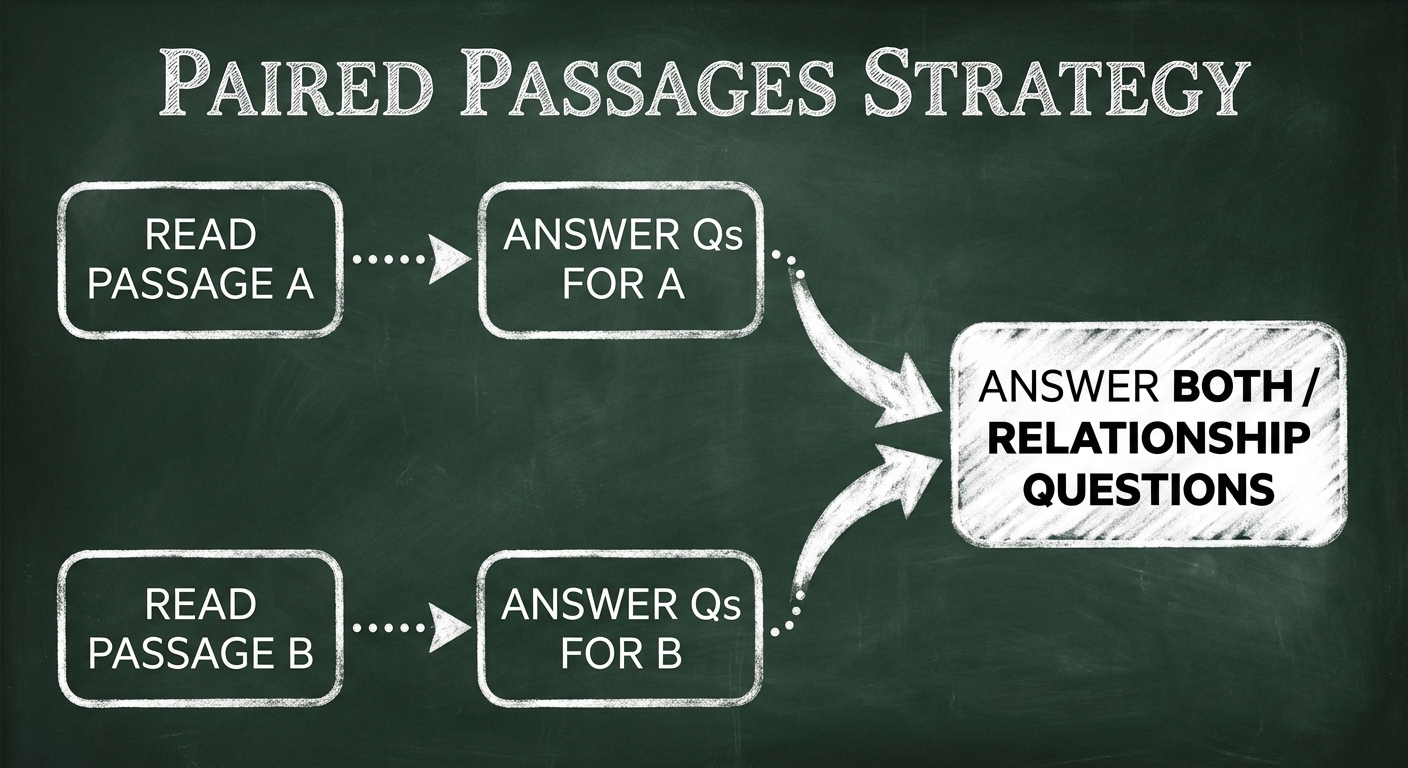
One of the four sections will consist of two shorter passages (Passage A and Passage B) on a related topic. This is often the Social Science or Humanities section.
The A-B-Both Method
Do not read Passage A, then Passage B, then look at the questions. Your memory will fail you. Instead, use this segmented approach:
- Read Passage A completely.
- Answer Passage A questions ONLY. (Skip questions that ask about Passage B or "Both").
- Read Passage B completely.
- Answer Passage B questions ONLY.
- Answer the "Both" questions.
Analyzing Relationships
When answering questions about both passages, determine the relationship between the authors:
- Contradictory: Does B disagree with A?
- Corroborative: Does B support A with new examples?
- Extension: Does B take the topic in a new, more specific direction?
Critical Reading Techniques
To finish on time, you cannot read casually. You must employ active reading strategies.
The 3-Stage Process
- Stage 1: The Preview (30-60 seconds)
- Read the blurb (introductory text usually in italics). It gives context, author, and date.
- Skim the first paragraph, the last paragraph, and the first sentence of body paragraphs.
- Goal: Establish the main idea and structure.
- Stage 2: The Map (3 minutes)
- Read the passage actively. Underline main arguments and circle proper nouns or transition words (e.g., "However," "Therefore").
- Do NOT obsess over details. Know where the details are, not what they are.
- Stage 3: The Attack (5 minutes)
- Go to the questions. Read the stem, predict the answer, find the evidence, and select.
The "Refer Back" Rule
In the ACT, every single correct answer is supported by evidence in the text. There is no room for subjective interpretation. If you think the answer is correct because it "feels right" or "makes sense in the real world" but it isn't in the text, it is wrong.
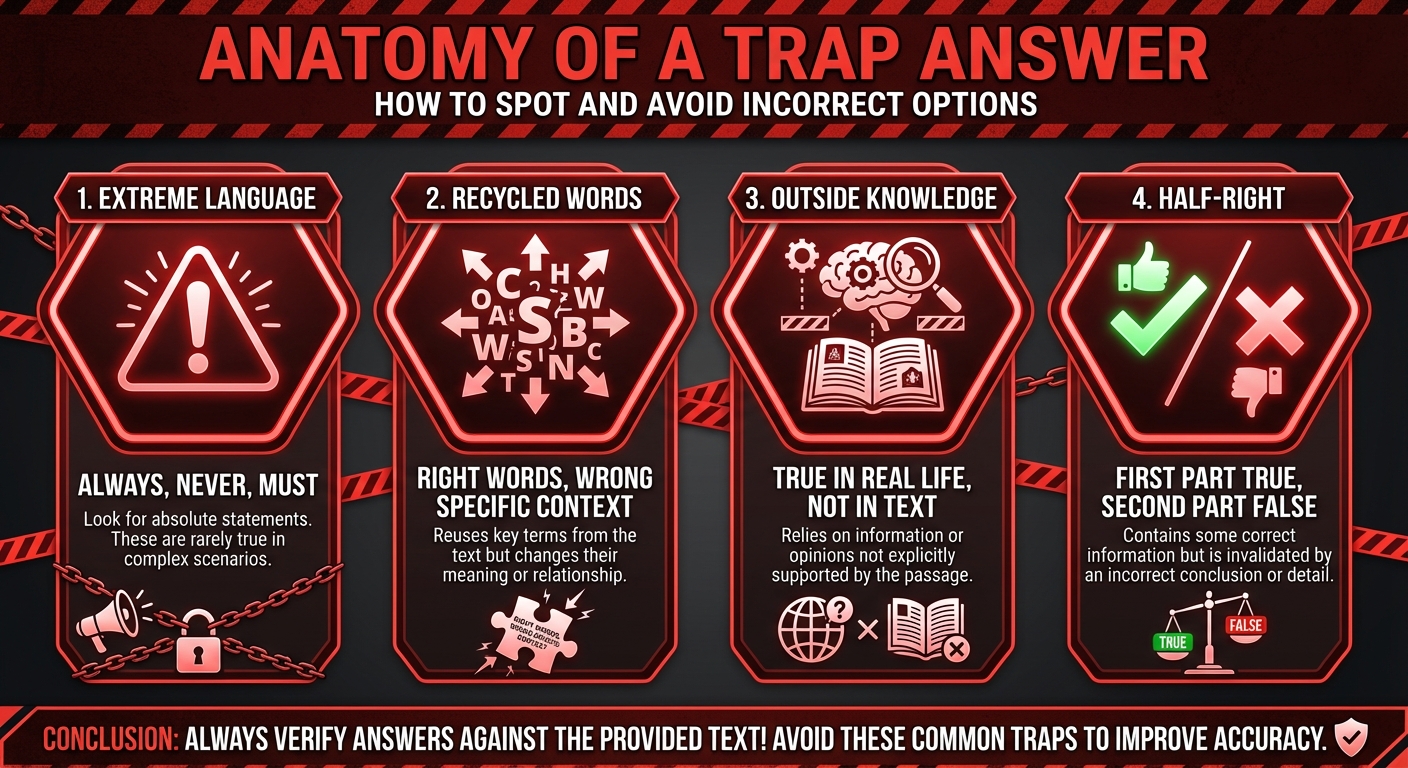
Common Trap Answers and Pitfalls
The ACT designs wrong answers (distractors) to look appealing. Learn to spot these specific patterns.
1. The "Right Words, Wrong Meaning" Trap
The answer choice uses words exactly as they appear in the passage (verbatim), but rearranges them to change the meaning or relationship.
2. The "Extreme Language" Trap
Avoid answers containing absolute words unless the text is also absolute.
- Red Flags: Always, Never, Everyone, Impossible, Must, Best.
- Safer Words: Often, Rarely, Some, Plausible, Suggests.
3. The "Half-Right, Half-Wrong" Trap
The first half of the sentence is perfect, but the second clause is factually incorrect. If any part of an answer is wrong, the entire answer is wrong.
4. The "Misplaced Detail" Trap
The answer statement is actually true according to the passage, but it answers the wrong question. (e.g., The question asks about Passage A, but the answer choice describes a detail from Passage B).
Mnemonics for Success
To remember your strategy during the pressure of the exam, use C.O.A.T.:
- C - Citations: Does the text explicitly cite this? If not, cross it out.
- O - Order: Do the passages in your personal order of difficulty (e.g., if you hate Science, do it last).
- A - Annotate: Underline key terms to stop your eyes from glazing over.
- T - Time: Check the clock after every passage. If you are at 18 minutes, you should be finishing your second passage.
Common Mistakes Breakdown
- Reading too slowly: Attempting to memorize the passage or understand every scientific nuance consumes too much time. You don't get points for understanding the passage; you get points for answering questions.
- Fix: Practice skimming. Read for structure, not depth.
- Using outside knowledge: Answering based on what you learned in Biology class rather than what is written in the Natural Science passage.
- Fix: Assume you know nothing about the topic except what is on the page.
- Leaving blanks: The ACT has no penalty for guessing.
- Fix: Pick a "Letter of the Day" (e.g., B/G) and bubble it in for any question you cannot answer in 45 seconds.
- Neglecting the "NOT" or "EXCEPT" questions: Students often miss the capitalized formatting and select the first true statement they see.
- Fix: Circle the word "NOT" or "EXCEPT" in the question book immediately.