Cosmology and Power: Indigenous Americas (1000 BCE–1980 CE)
Unit Overview: Indigenous Americas
This unit explores the artistic traditions of ancient America before and immediately after European contact. Geographically, it covers North America (including the Puebloan, Plains, and Northwest Coast), Mesoamerica (Maya, Aztec/Mexica), and the Central Andes (Chavín, Inka).
Key Concepts
- Shamanism: Religious practice where a practitioner aids the community by entering a trance state to communicate with the spirit world.
- Axis Mundi: The concept of a "world center" connecting the heavens, the earth, and the underworld.
- Reciprocity: The obligation to give back to the earth or the gods (often through sacrifice or libations) to ensure agricultural fertility and cosmic balance.
- Dualism: A worldview (especially common in Andean art) that sees the universe as divided into two opposing but complementary forces (e.g., male/female, sun/rain).
South America (The Central Andes)
The cultures of the Andes (modern Peru/Bolivia) are renowned for their mastery of textiles, stonemasonry, and metallurgy (gold/silver). Unlike Mesoamerica, they did not use a written hieroglyphic script, relying instead on quipu (knotted cords) for record-keeping.
1. Chavín de Huántar (900–200 B.C.E.)
Culture: Chavín | Location: Northern Highlands, Peru
- Context: A major pilgrimage site strategically located between the arid coast and the Amazonian rainforest. It united people through religion rather than military force.
- Form: The complex includes the Old Temple (U-shaped) and New Temple. It features a sunken court allowing only elite access.
The Lanzón Stela
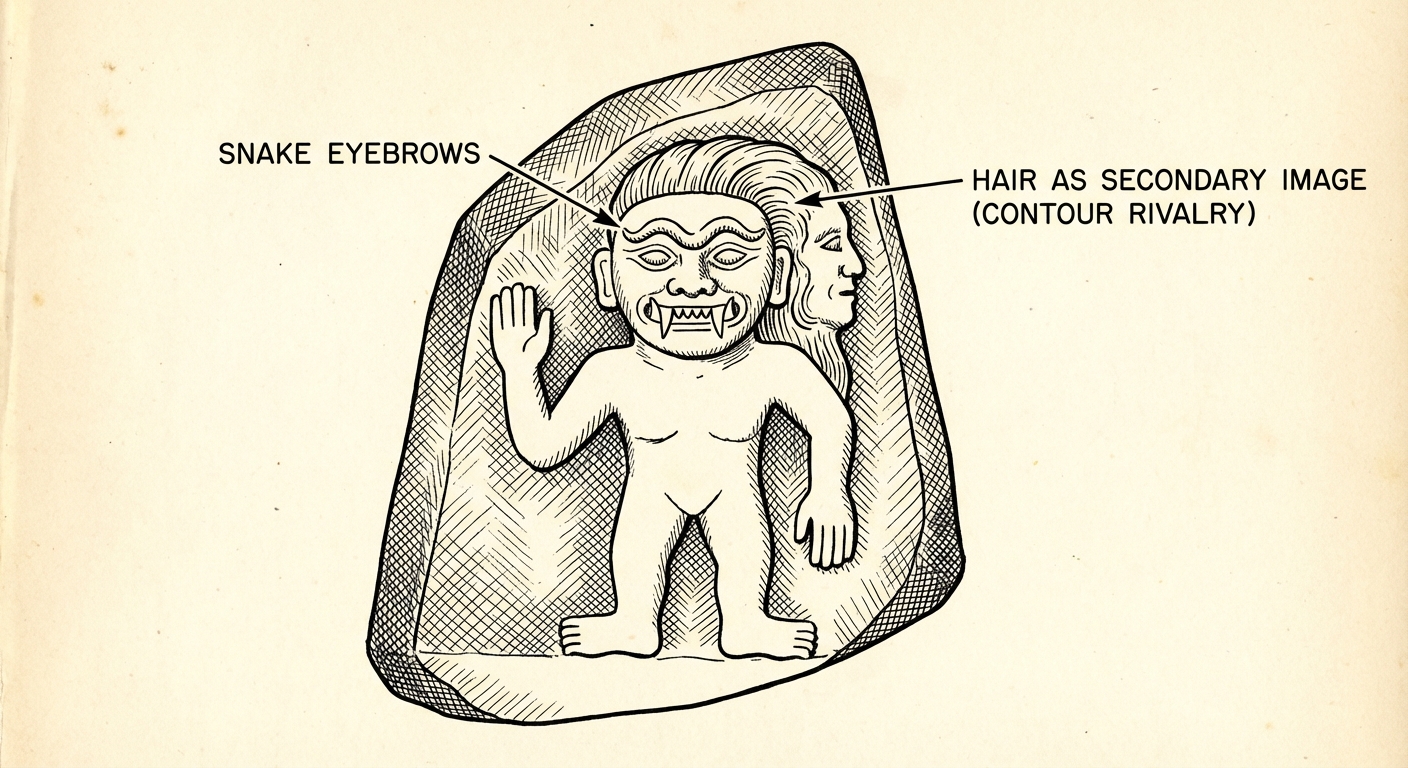
- Form: A 15-foot notched wedge-shaped stone carved with the "Smiling God." It depicts a human-feline hybrid with claws, fangs, and snake eyebrows.
- Technique: Contour Rivalry—an artistic technique where an image can be interpreted multiple ways depending on how it is viewed (promotes confusion/hallucination in rituals).
- Function: An axis mundi connecting the earth and heavens. It served as an oracle.
- Innovation: The gallery acoustics were engineered to project the voice of the oracle (via a hidden priest) to the worshippers outside, mimicking the roar of a jaguar.
Nose Ornament
- Material: Gold alloy.
- Function: Worn by elites to physically transform the wearer into a supernatural being. It showcases early metallurgical sophistication (hammering gold).
2. City of Cusco (c. 1440 C.E.)
Culture: Inka | Location: Central Highlands, Peru
- Concept: The capital city was laid out in the shape of a puma (symbol of royal power). The head was the fortress Saqsa Waman, and the heart was the central plaza.
- Social Structure: Divided into hanan (upper) and hurin (lower) sections, reflecting social dualism.
Qorikancha (Temple of the Sun)
- Form: The most sacred temple, dedicated to Inti (Sun God). Interior walls were originally covered in sheet gold.
- Technique: Ashlar Masonry—stones are carved to fit together perfectly without mortar. This creates stability during earthquakes (stones shift and resettle).
- Colonial History: After the Spanish conquest, the Convent of Santo Domingo was built directly on top of the Inka walls, symbolizing the imposition of Christianity over Indigenous beliefs.
Walls at Saqsa Waman
- Form: Zig-zagging walls using massive stones (up to 70 tons).
- Function: Unfinished fortress; the zig-zag shape may represent lightning.
3. Maize Cobs (c. 1440–1533 C.E.)
Culture: Inka | Material: Sheet metal (gold and silver alloys)
- Technique: Repoussé—metal is hammered from the back to create a relief.
- Context: Displayed in the Qorikancha garden alongside llamas and shepherds made of gold. It represented the vast agricultural resources of the empire.
- Significance: Shows the Inka mastery of metal for symbolic (not just utilitarian) purposes. Realism in the kernels suggests a respect for the specific food source.
4. City of Machu Picchu (1450–1540 C.E.)
Culture: Inka | Location: 8,000 ft altitude
- Function: A royal estate for the emperor Pachacuti. It was a retreat, not a military/administrative capital.
- Adaptation: Used terracing to farm on steep slopes and manage water runoff (preventing erosion).
Intihuatana Stone
- Meaning: "Hitching post of the sun."
- Function: Used to track the sun’s movement, specifically the solstices. It demonstrates the Inka connection between astronomy, agriculture, and religion.
5. All-T’oqapu Tunic (1450–1540 C.E.)
Culture: Inka | Material: Camelid fiber and cotton
- Technique: Woven on a backstrap loom. The thread count is incredibly high (approx. 100 threads/cm).
- Content: Covered in T’oqapu—small, square geometric designs that served as a code indicating status, ethnicity, or lineage.
- Function: Worn by the Sapa Inka (King). By wearing a tunic with all the different T’oqapu, he claimed dominion over all the peoples and lands of the empire.
Mesoamerica
Known for distinct architectural styles (step pyramids), the use of stucco, hieroglyphic writing (Maya), and a calendar system involving a 52-year cycle.
6. Yaxchilán (725 C.E.)
Culture: Maya | Location: Chiapas, Mexico
- Architecture: Features roof combs (stone ornamentation atop temple roofs to increase height) and corbel arches (step-layered stone arches).
Lintel 25, Structure 23
- Significance: Highlights the role of royal women in maya political life.
- Content: Lady Xook performs a bloodletting ritual (running a thorned rope through her tongue). The loss of blood induces a hallucination of the "Vision Serpent," from whose mouth emerges an ancestor.
- Context: Bloodletting was essential to open portals to the Otherworld and maintain royal power.
7. Templo Mayor (Main Temple) (1375–1520 C.E.)
Culture: Aztec (Mexica) | Location: Tenochtitlan (Mexico City)
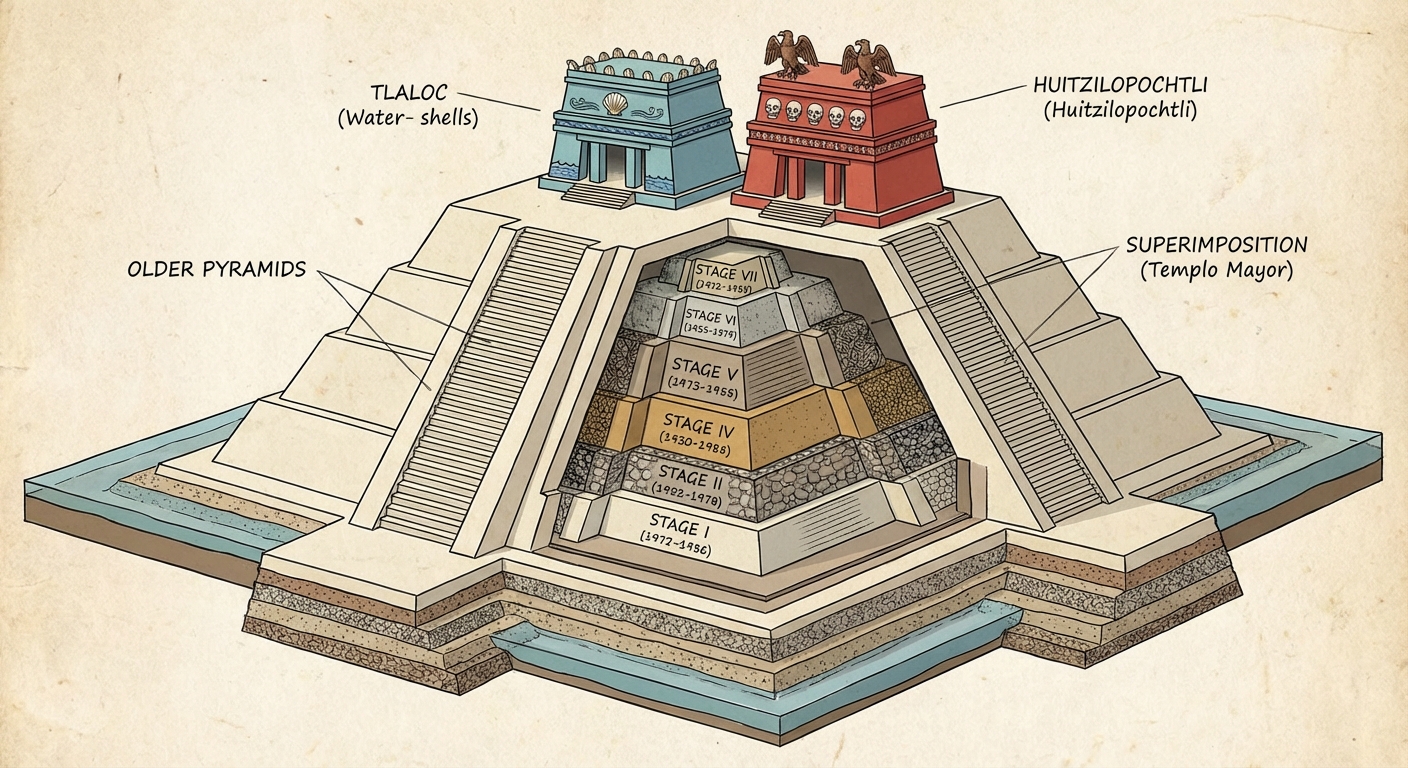
- Form: A twin-towered pyramid located in the Sacred Precinct. It represents the concept of Superimposition (building new layers over old temples every 52 years).
- Dualism:
- Right Side (Red): Dedicated to Huitzilopochtli (God of Sun/War/Fire).
- Left Side (Blue): Dedicated to Tlaloc (God of Rain/Water/Agriculture).
- Together: They represent atl-tlachinolli (burnt water), a metaphor for warfare.
The Coyolxauhqui Stone
- Placement: Found at the base of the Huitzilopochtli side stairs.
- Content: Depicts the naked, dismembered body of the Moon Goddess, Coyolxauhqui.
- Mythology: She tried to kill her mother (Coatlicue), but her brother Huitzilopochtli (Sun) burst from the womb fully grown and dismembered her, throwing her down the mountain.
- Ritual Use: War captives were sacrificed at the top; their bodies were thrown down the stairs, landing on this stone to reenact the myth.
Calendar Stone (Sun Stone)
- Content: Depicts the history of the world through "Five Suns" (eras). The central face represents the current sun, needing human hearts (sacrificial flint knife tongue) to survive.
Olmec-style Mask
- Context: An heirloom found buried in the Aztec temple. It was made 1,000 years earlier by the Olmecs. It shows the Aztec reverence for history and their habit of collecting objects from ancient civilizations.
8. Ruler’s Feather Headdress (1428–1520 C.E.)
Culture: Aztec (Mexica)
- Material: 400 feathers of the Quetzal (green) and Cotinga (blue), gold detailing.
- Symbolism: 400 represented eternity. Quetzal birds were sacred and elusive.
- Production: Made by special feather workers called amanteca.
- History: Likely sent by Moctezuma II to Hernán Cortés. Currently in Vienna (subject of repatriation debates).
North America
Diverse regions (Puebloan, Mississippian, Eastern Woodlands, Northwest Coast, Plains) utilizing varied local materials.
9. Mesa Verde Cliff Dwellings (450–1300 C.E.)
Culture: Ancestral Puebloan (Anasazi) | Location: Colorado
- Environment: Built into a cliff face for thermal regulation (shade in summer, sun in winter) and defense.
- Key Feature: Kivas—circular, subterranean rooms used for spiritual ceremonies and clan gatherings. They represent the origin story of emerging from the earth.
10. Great Serpent Mound (c. 1070 C.E.)
Culture: Mississippian (Fort Ancient Culture) | Location: Ohio
- Form: An effigy mound (earthwork in the shape of an animal). It is roughly 1,300 feet long.
- Astronomy: The head aligns with the summer solstice sunset. The curves align with lunar phases.
- Note: Unlike other mounds, this contains no burials inside widely derived from the mound itself; it was purely ceremonial/spiritual.
11. Bandolier Bag (c. 1850 C.E.)
Culture: Lenape (Delaware) | Region: Eastern Woodlands
- Evolution of Materials: originally made with porcupine quills; post-European contact, artists adopted glass seed beads and silk ribbons.
- Function: A prestige object worn by men, but created by women. Based on ammunition bags carried by European soldiers.
- Style: Contrasting colors representing the celestial/underworld concept.
12. Transformation Mask (Late 19th Century)
Culture: Kwakwaka’wakw | Region: Northwest Coast
- Context: Used in the Potlatch—a ceremony involving feasting, gift-giving, and status validation. (Banned by the Canadian govt until 1951).
- Form: A wooden mask with a pulley system of strings.
- Closed: An animal (e.g., Eagle, Raven) representing the clan totem.
- Open: A human face representing the ancestor.
- Style: Uses Formline style (bold, varying width lines in red, black, and green).
13. Painted Elk Hide (c. 1890–1900)
Artist: Cotsiogo (Cadzi Cody) | Culture: Eastern Shoshone
- Purpose: Art created for tourists/sale to support the tribe during reservation confinement.
- Content: Combines history with nostalgia.
- Depicts the Sun Dance (which was outlawed by the US government at the time).
- Depicts a Buffalo Hunt (even though buffalo were largely extinct by this time).
- Medium: Free-hand painting and stenciling on elk hide.
14. Black-on-black Ceramic Vessel (Mid-20th Century)
Artists: Maria Martínez (sculptor) and Julian Martínez (painter) | Culture: Puebloan (San Ildefonso)
- Innovation: Revived Neolithic pottery techniques but adapted them for an Art Deco aesthetic to sell to non-Native collectors.
- Technique: Smothering the fire with manure creates the black carbon finish. The design is a contrast between matte (painted guaco slip) and glossy (polished stone) black.
- Context: Transformed a utilitarian object into fine art, helping the Pueblo economy.
Comparison Table: Religious Architecture
| Feature | Chavín de Huántar | Templo Mayor | Qorikancha |
|---|---|---|---|
| Region | Andes (Peru) | Mesoamerica (Mexico) | Andes (Peru) |
| Primary God | Staff God / Smiling God | Huitzilopochtli & Tlaloc | Inti (Sun) |
| Construction | Stone, interior galleries | Stone, superimposed pyramids | Ashlar Masonry (no mortar) |
| Key Ritual | Oracle, sensory deprivation | Human sacrifice, heart extraction | Astronomy, harvest offerings |
Common Mistakes & Pitfalls
- Geography Confusion: Do not mix up the Inka and Aztec.
- Aztec = Mexico, Pyramids, Blood Sacrifice, Eagle/Cactus.
- Inka = Peru/Andes, Stonemasonry, Llamas, Abstract tunics, Sun worship.
- "Primitive" Misconception: Indigenous art is highly engineered. (e.g., The acoustics at Chavín or the earthquake-proof walls of Cusco are advanced technologies). avoid using the word "primitive."
- Gender Roles: Historically, in many Indigenous cultures (especially North American and Andean), weaving and pottery were women’s art forms, while carving was often male. However, the Bandolier Bag (women) and Black-on-black vessel (collaborative) show nuance.
- Material Sources: Be aware of trade. The Ruler’s Feather Headdress uses feathers from birds found in rainforests far away from the Aztec capital, proving long-distance trade networks.
- Burials in Mounds: Not all mounds are burial mounds. The Great Serpent Mound is an effigy mound, not a cemetery.