AP Government Unit 5: Dynamics of Political Participation
Voting Rights and Models of Voting Behavior
Expansion of the Franchise
The Constitution originally left voter eligibility to the states. Over time, federal laws and Constitutional amendments have expanded suffrage (the right to vote), shifting control from states to the federal government.
Key Constitutional Amendments
| Amendment | Year | Provision |
|---|---|---|
| 15th Amendment | 1870 | Prohibits denial of voting rights based on race, color, or previous servitude. |
| 17th Amendment | 1913 | Established the direct election of Senators by the people (previously chosen by state legislatures). |
| 19th Amendment | 1920 | Prohibits denial of voting rights based on sex (Women's suffrage). |
| 24th Amendment | 1964 | Prohibited poll taxes in federal elections. |
| 26th Amendment | 1971 | Lowered the voting age from 21 to 18. |
Key Legislation
- Voting Rights Act of 1965: A landmark law that outlawed literacy tests and required states with a history of discrimination to get federal approval (preclearance) before changing election laws. It empowered the federal government to oversee registration.
- National Voter Registration Act (1993): Commonly known as the "Motor Voter Act," it requires states to allow people to register to vote when applying for a driver’s license. This increased registration but did not significantly increase turnout.
Models of Voting Behavior
Political scientists categorize the motivations behind voter choices into four distinct models:
- Rational Choice Voting: Voting based on what is perceived to be in the citizen's individual best interest.
- Example: A wealthy citizen votes for a candidate promising tax cuts.
- Retrospective Voting: Voting to decide whether the party or candidate in power should be re-elected based on the recent past.
- Mnemonic: "Retro" means looking back.
- Example: "Are you better off now than you were four years ago?"
- Prospective Voting: Voting based on predictions of how a party or candidate will perform in the future.
- Example: Voting for a candidate because you believe their energy plan will save the environment in 10 years.
- Party-Line Voting: Supporting a party by voting for candidates from one political party for all public offices across the ballot.
- Note: This often leads to straight-ticket voting.
Voter Turnout Statistics
- Demographics: Older, wealthier, and more educated citizens are more likely to vote.
- Efficacy: Citizens with high political efficacy (the belief that their vote matters) are more likely to participate.
- Type of Election: Turnout is highest in Presidential elections () and significantly lower in Midterm elections ().
Structural Barriers to Voting
Even with expanded suffrage, barriers remain:
- Registration Requirements: Unlike many democracies, registration is the individual's responsibility in the US.
- Voter ID Laws: Laws requiring photo ID to vote. Proponents argue it prevents fraud; opponents argue it disproportionately disenfranchises poor and minority voters.
- Election Day: Held on a Tuesday (a workday), which limits the ability of working-class citizens to vote.
Political Parties
Functions of Political Parties
Political parties are Linkage Institutions—channels that connect the people to the government. (Other linkage institutions include elections, interest groups, and the media).
Core Functions
- Mobilization and Education: Parties use "Get Out The Vote" (GOTV) drives, rallies, and mailers to energize voters.
- Platform Creation: They develop a written list of goals and policy positions (the party platform) to signal their ideology.
- Recruitment: They continually seek candidates to run for office.
- Campaign Management: They provide fundraising support, data, and media strategy to candidates.
- Governance: In Congress, parties organize the committee systems and leadership structures.
Party Organization
The US has a Two-Party System, reinforced by structural factors. Parties exist on three levels:
- Party in the Electorate: Voters who identify with the party.
- Party in Government: Elected officials who pursue party goals.
- Party Organization: The professionals/activists who run the national, state, and local machinery.
Changes in Party Influence
While parties remain powerful, their control over candidates has declined due to:
- Direct Primaries: Voters, not party bosses, now choose nominees.
- Candidate-Centered Campaigns: Candidates raise their own money and appeal directly to voters via social media, bypassing party reliance.
Comparison: Recent Coalition Shifts
| Demographic | Democratic Tendency | Republican Tendency |
|---|---|---|
| Urban/Rural | Urban centers | Rural areas |
| Gender | Women (Gender Gap) | Men |
| Education | Post-graduate degrees | High school or less |
| Religion | Secular/Unaffiliated | Evangelical Christian |
Realignment and Dealignment
- Critical Election: An election that signals a significant shift in party allegiance, leading to a long-term realignment (e.g., 1932 FDR election).
- Party Realignment: A sharp, lasting shift in the popular coalition supporting one or both parties.
- Dealignment: The trend where a large portion of the electorate abandons its previous partisan affiliation without developing a new one to replace it (rise of the "Independent" voter).
Third Parties
Types of Third Parties
- Splinter/Bolter Parties: Break away from a major party (e.g., Teddy Roosevelt's Bull Moose Party).
- Doctrinal/Ideological Parties: Based on a comprehensive set of beliefs different from the mainstream (e.g., Libertarian, Socialist).
- Single-Issue Parties: Formed to promote one principle (e.g., Prohibition Party).
Structural Barriers to Third Parties
Why is it so hard for third parties to win?
- Winner-Take-All System: In the Electoral College and congressional districts, the candidate with the plurality (most votes) wins. There is no reward for second place.
- Contrast with: Proportional Representation, used in Europe, where a party getting 10% of the vote gets 10% of the seats.
- Ballot Access Laws: States require thousands of signatures for third parties just to get on the ballot.
- Co-optation: Major parties often incorporate (steal) the popular policy ideas of third parties (e.g., Democrats adopting environmental planks from the Green Party).
Interest Groups
Definition and Function
Interest Groups are organizations dedicated to a particular political goal or set of goals. Unlike parties, they do not run their own candidates; they support candidates who align with their specific policy interests.
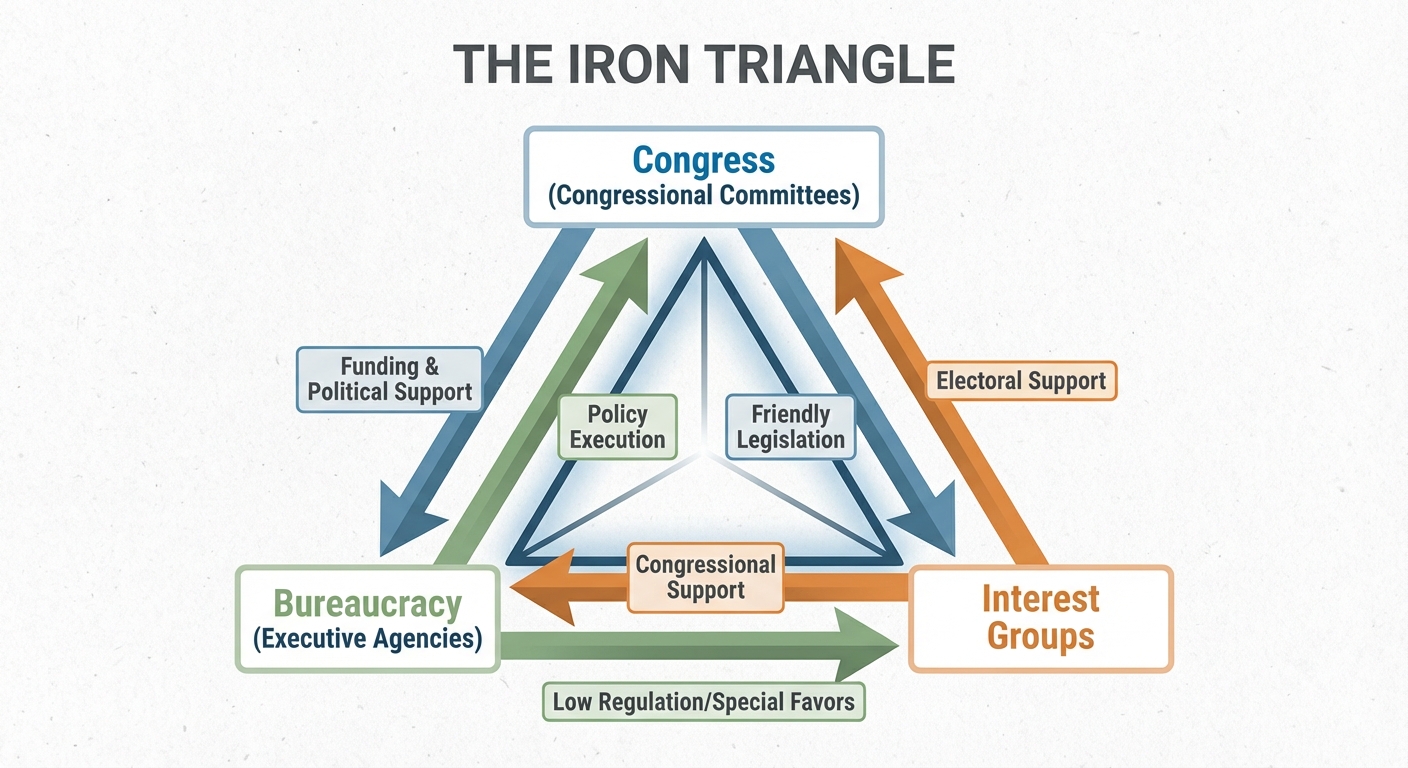
The Iron Triangle vs. Issue Networks
- Iron Triangle: A long-lasting, mutually beneficial relationship between an Interest Group, a Congressional Committee, and a Bureaucratic Agency. They work together to create policy that benefits all three.
- Issue Networks: Looser, temporary networks of interest groups, policy experts, and officials that form around specific policy issues and then dissolve.
Tactics of Influence
- Lobbying: Meeting with policymakers to persuade them. Lobbyists provide technical information and draft legislation.
- Electioneering: Aiding candidates financially (via PACs) and mobilizing members to vote.
- Litigation: Using the courts.
- Amicus Curiae Briefs: "Friend of the court" briefs filed by interest groups to influence a Supreme Court decision.
- Class Action Lawsuits: Combining plaintiffs with similar grievances.
- Grassroots Lobbying: Mobilizing members to contact their representatives (emails, phone calls) to create pressure from the bottom up.
The Free Rider Problem
Why join an interest group if you get the benefits anyway? (e.g., Clean air acts benefit everyone, not just Sierra Club members).
- Solution: Groups offer selective benefits (travel discounts, magazines, insurance) available only to members.
Common Mistakes: Parties vs. Interest Groups
- Mistake: Thinking they are the same.
- Correction: Political Parties exist to win elections and control government (Generalists). Interest Groups exist to influence policy (Specialists).
Elections and Campaigns
The Presidential Election Cycle
1. The Primaries and Caucuses
This stage narrows the field of candidates within a party.
- Primary Election: Voters go to polls and cast ballots for a candidate. (Most common).
- Open Primary: Any registered voter can vote in either party's primary.
- Closed Primary: Only registered party members can vote.
- Caucus: A meeting of local party members to choose candidates (e.g., Iowa). Lower turnout, more ideological participants.
- Front-loading: States moving their primaries earlier in the calendar to gain media attention and influence. This forces candidates to raise money early.
2. The National Convention
Delegates from the primaries gather to officially nominate the President and Vice President and adopt the Party Platform.
3. The General Election & Electoral College
The US does not elect the President by popular vote, but by the Electoral College.
- The Formula: Each state has electors = .
- Total Electors: .
- To Win: (Simple Majority).
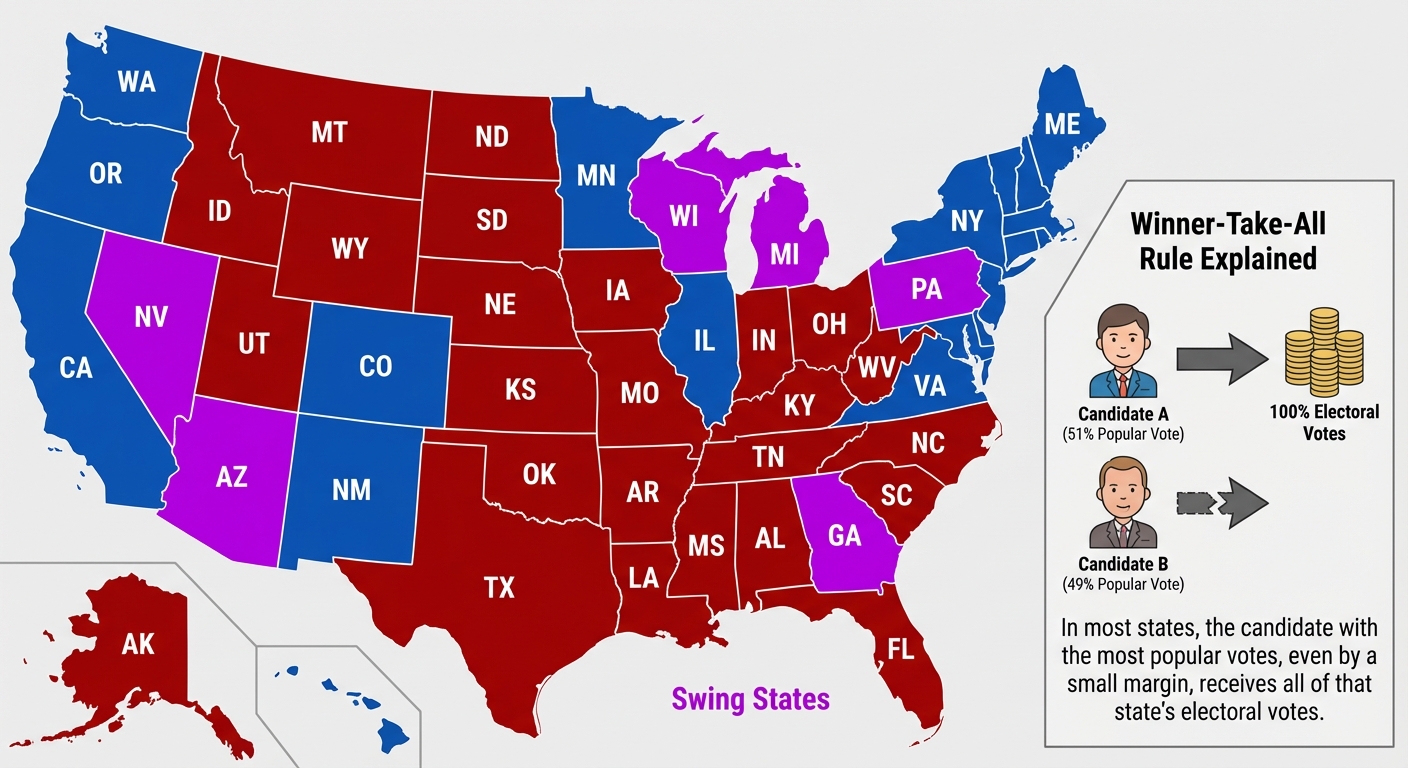
- Winner-Take-All: In 48 states, the candidate with the plurality of the popular vote gets all of that state's electoral votes. This causes candidates to focus entirely on Swing States (battleground states).
- No Majority?: If no one gets 270, the House of Representatives chooses the President (one vote per state).
Congressional Elections
- Incumbency Advantage: Sitting members of Congress win re-election roughly 90% of the time. Factors include:
- Name Recognition.
- Franking Privilege: Free mail to constituents.
- Casework: Assessing constituents with government problems.
- Gerrymandering: Redrawing district lines to favor a party (applies to House only).
Campaign Finance
This is the most technical part of the unit. Focus on the distinction between restrictions on different types of money.
Key Terms
- Hard Money: Political contributions given directly to a candidate that are tracked and limited by law.
- Soft Money: Unregulated, unlimited contributions to political parties for general "party-building" activities. (Largely banned by BCRA).
- Independent Expenditures: Money spent by outside groups (Super PACs) on ads that do not coordinate with the candidate.
Legislation and Supreme Court Rulings
1. Federal Election Campaign Act (FECA) - 1974
- Created the Federal Election Commission (FEC) to enforce laws.
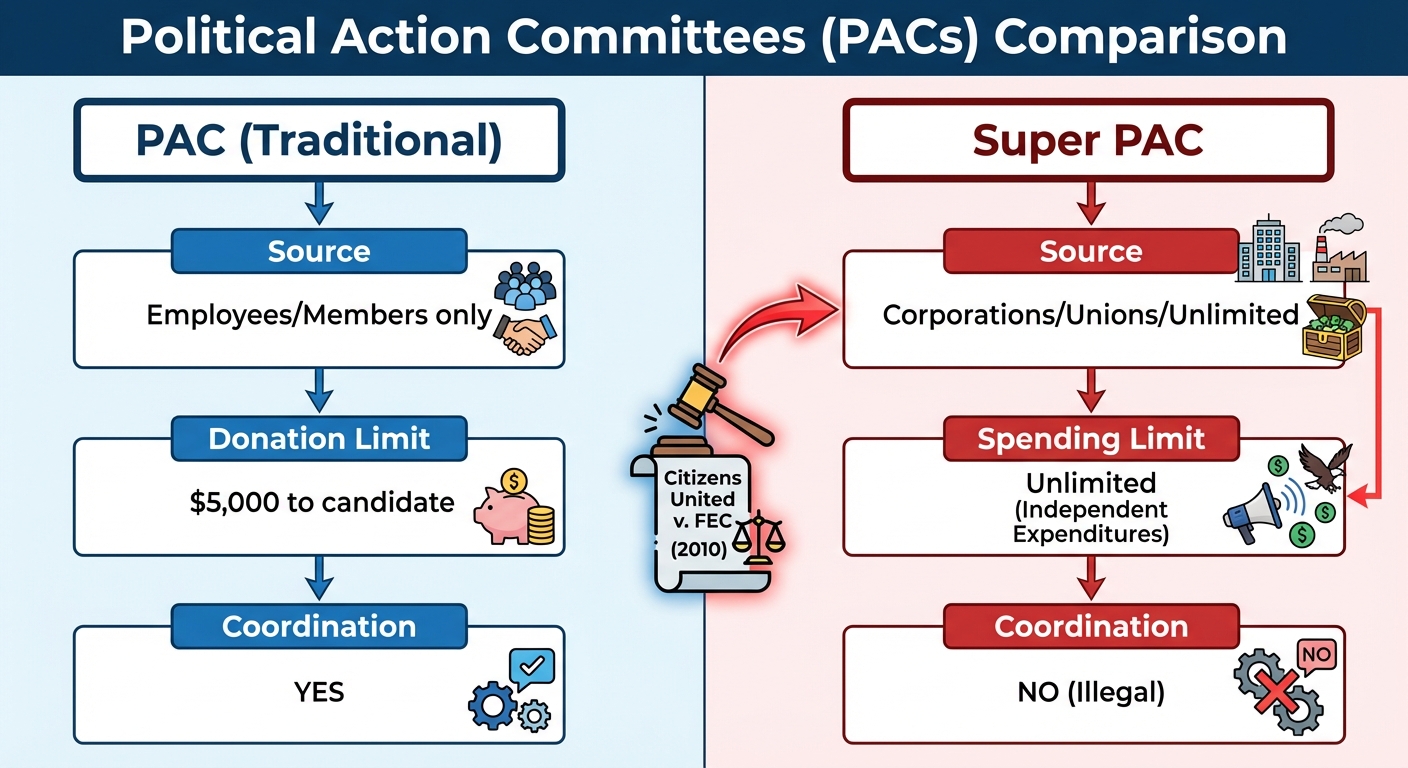
- Created Political Action Committees (PACs): Organizations allowing corporations/unions to pool money and donate to candidates (with strict limits).
- Buckley v. Valeo (1976): Ruled that candidates can spend an unlimited amount of their own personal money on their campaign (Money = Speech).
2. Bipartisan Campaign Reform Act (BCRA/McCain-Feingold) - 2002
- Banned Soft Money to national parties.
- Attempted to ban "Stand by Your Ad" provisions to reduce attack ads.
3. Citizens United v. FEC (2010) - REQUIRED CASE
- Background: A conservative group wanted to air an anti-Hillary Clinton movie before the primary.
- Holding: Political spending by corporations, associations, and labor unions is a form of protected speech under the First Amendment.
- Impact: It led to the creation of Super PACs. Corporations can now spend unlimited amounts on independent expenditures (ads) as long as they do not coordinate with the candidate.
The Media
Functions of the Media
- Gatekeeper (Agenda Setting): The media decides which issues are important enough to receive public attention.
- Scorekeeper (Horse Race Journalism): Coverage focuses on who is winning or losing in the polls rather than the substance of policy. This is why poll results dominate the news cycle.
- Watchdog: The media investigates public officials and exposes corruption/scandal.
Modern Media Trends
- Narrowcasting: Media programming on cable TV or the internet that is focused on one topic and aimed at a particular audience (e.g., Fox News vs. MSNBC). This reinforces confirmation bias.
- Social Media: Allows politicians to communicate directly with constituents, bypassing the "filter" of traditional news outlets.
- Consumer-Driven Media: Media outlets increasingly base content on what will get the most clicks/views, often sensationalizing news (Yellow Journalism 2.0).
Common Mistakes for Unit 5
- Voter Turnout: Students often think Motor Voter massively increased turnout. It increased registration, but turnout remained relatively flat.
- The Media: Do not say "The media tells people what to think." Instead, say "The media tells people what to think about" (Agenda Setting).
- Super PACs: Students often think Super PACs donate to candidates. They cannot. They can only spend money on their own ads supporting/attacking candidates.