Comprehensive Guide to Unit 4: Imperfect Competition
4.1 Introduction to Imperfectly Competitive Markets
Imperfect competition covers all market structures that fall between the theoretical extremes of Perfect Competition and pure Monopoly. Unlike perfect competition, firms in these markets possess some degree of market power—the ability to control the price of their product.
Key Characteristics
In imperfect markets (Monopoly, Oligopoly, Monopolistic Competition), firms are Price Makers, not price takers. This means the demand curve facing the firm is downward sloping, unlike the horizontal demand curve in perfect competition.
Comparing Market Structures
| Feature | Perfect Competition | Monopolistic Competition | Oligopoly | Monopoly |
|---|---|---|---|---|
| Number of Firms | Many | Many | Few | One |
| Type of Product | Identical (Homogeneous) | Differentiated | Standardized or Differentiated | Unique (No close substitutes) |
| Barriers to Entry | None (Low) | Low | High | Very High |
| Price Control | None (Price Taker) | Some | Significant | Absolute (Price Maker) |
| Long-Run Profit | Normal ($0) | Normal ($0) | Positive | Positive |
Barriers to Entry
Firms in Oligopolies and Monopolies maintain profits in the long run due to Barriers to Entry—obstacles that prevent new competitors from easily entering the market.
- Economies of Scale: High startup costs mean only large firms can produce at a low average cost.
- Legal Barriers: Patents, copyrights, and government licenses.
- Control of Resources: Owning a key raw material (e.g., De Beers and diamonds historically).
4.2 Monopoly
A Monopoly exists when a single firm is the sole producer of a product with no close substitutes.
The Graph Mechanics
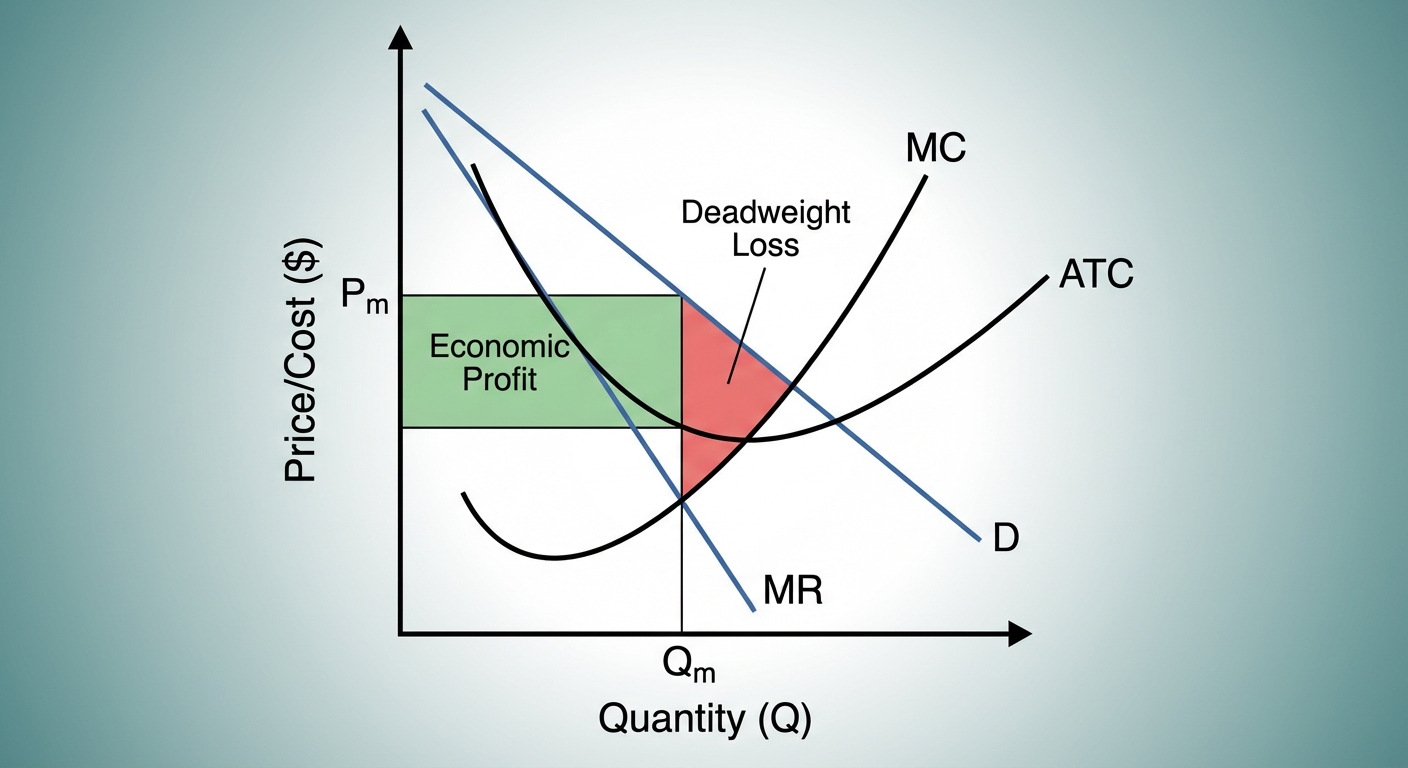
Because the monopolist faces the entire market demand, the Demand curve ($D$) slopes downward. Crucially, the Marginal Revenue ($MR$) curve lies below the Demand curve and is steeper.
Why? To sell one more unit, the monopolist must lower the price not just for that new unit, but for all previous units. This causes marginal revenue to fall faster than price.
Profit Maximization
- Maximize Profit Rule: Produce quantity where
- Determine Price: Go up from the intersection of $MR=MC$ to the Demand Curve.
- Calculate Profit: The vertical distance between Price ($P$) and Average Total Cost ($ATC$) at the profit-maximizing quantity.
The Revenue Test (Elasticity)
- A monopolist will strictly produce in the elastic range of the demand curve.
- If demand is inelastic, lowering the price decreases Total Revenue while increasing costs (bad for business).
- Peak Total Revenue: Occurs where . This is the midpoint of the demand curve (Unit Elastic).
Efficiency Analysis
Unlike Perfect Competition, Monopolies are inefficient.
- Allocative Inefficiency: They charge a price higher than Marginal Cost ($P > MC$). They underproduce and overcharge compared to the social optimum.
- Productive Inefficiency: They do not produce at the minimum of the $ATC$ curve ($P > ext{min } ATC$).
- Deadweight Loss (DWL): The triangle of lost welfare caused by the underproduction. (See Figure 1).
4.3 Natural Monopoly & Regulation
A Natural Monopoly occurs when it is more efficient for one firm to supply the entire market than for multiple firms to compete. This usually happens in utilities (electricity, water) due to massive fixed costs and Economies of Scale over the entire range of market demand.
Characteristics
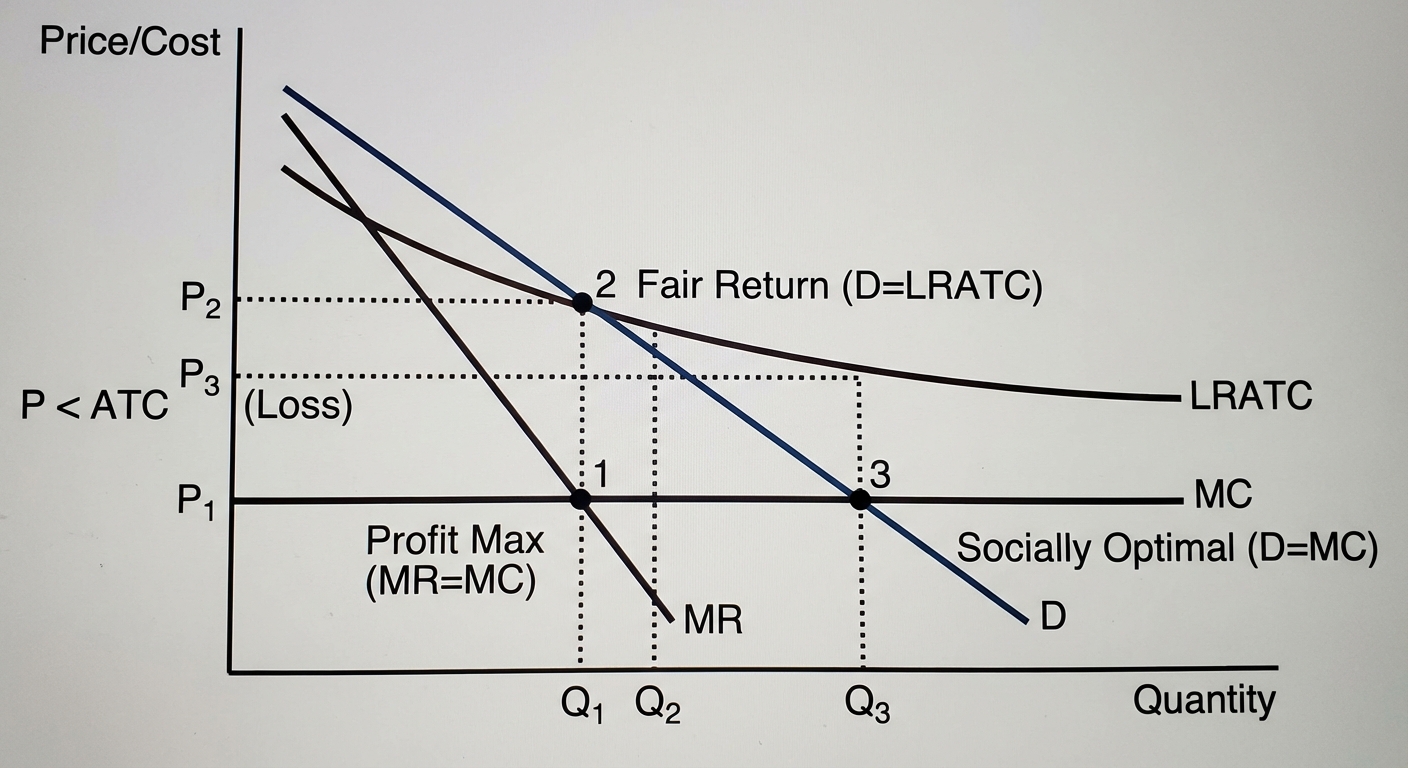
- The ATC curve falls continuously over the relevant range of demand.
- Marginal Cost ($MC$) is consistently below $ATC$ (because if average is falling, marginal must be lower).
Government Regulation Points
Without regulation, a natural monopoly will produce at $MR=MC$ and charge a very high price. Governments often regulate price ceilings:
- Socially Optimal Price ($P = MC$):
- Also called Allocative Efficiency.
- Problem: Since $MC < ATC$, the firm incurs a loss and requires a subsidy to stay in business.
- Fair Return Price ($P = ATC$):
- The firm breaks even (Normal Profit).
- No subsidy needed, but output is still slightly less than socially optimal.
4.4 Price Discrimination
Price Discrimination is the practice of selling the same product to different buyers at different prices based on their willingness to pay (not based on cost differences).
Conditions Required
- Market Power: The firm must be a price maker.
- Segment the Market: Ability to distinguish elasticity (e.g., students vs. business travelers).
- No Resale: Buyers cannot resell the good to others (arbitrage).
Perfect (First-Degree) Price Discrimination
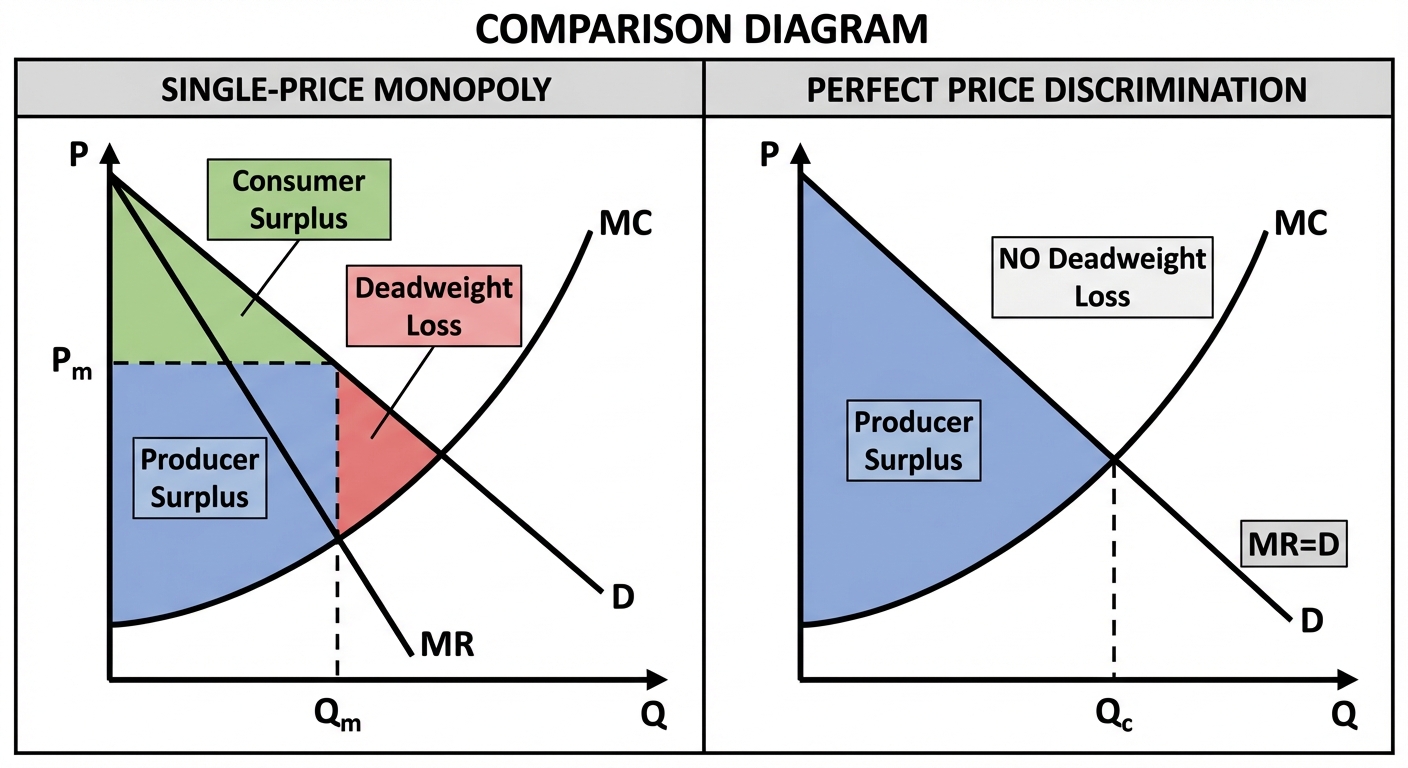
The firm charges every customer the exact maximum price they are willing to pay.
- Consumer Surplus: $0$. It is entirely converted into Producer Surplus (Profit).
- Deadweight Loss: $0$. The firm produces the allocatively efficient quantity ($P=MC$) because marginal revenue is no longer below demand—the Demand curve becomes the MR curve.
4.5 Monopolistic Competition
This market structure combines elements of monopoly (dignified products) and perfect competition (many firms).
Characteristics
- Many Sellers: Easy entry and exit.
- Differentiated Products: Products are similar but not identical (branding, features, location). Example: Fast food, clothing stores.
- Advertising: Heavily used to increase demand and make demand more inelastic (steeper).
Short Run vs. Long Run
- Short Run: Graphs look exactly like a Monopoly. Firms can earn economic profit ($P > ATC$) or loss ($P < ATC$).
- Long Run: Low barriers to entry allow firms to enter/exit.
- If firms profit $
ightarrow$ New firms enter $
ightarrow$ Demand for existing firms decreases (shifts left) $
ightarrow$ Profit erodes. - Equilibrium: Firms earn Normal Profit ($P = ATC$). Usually, the Demand curve is tangent to the ATC curve.
- If firms profit $
Excess Capacity
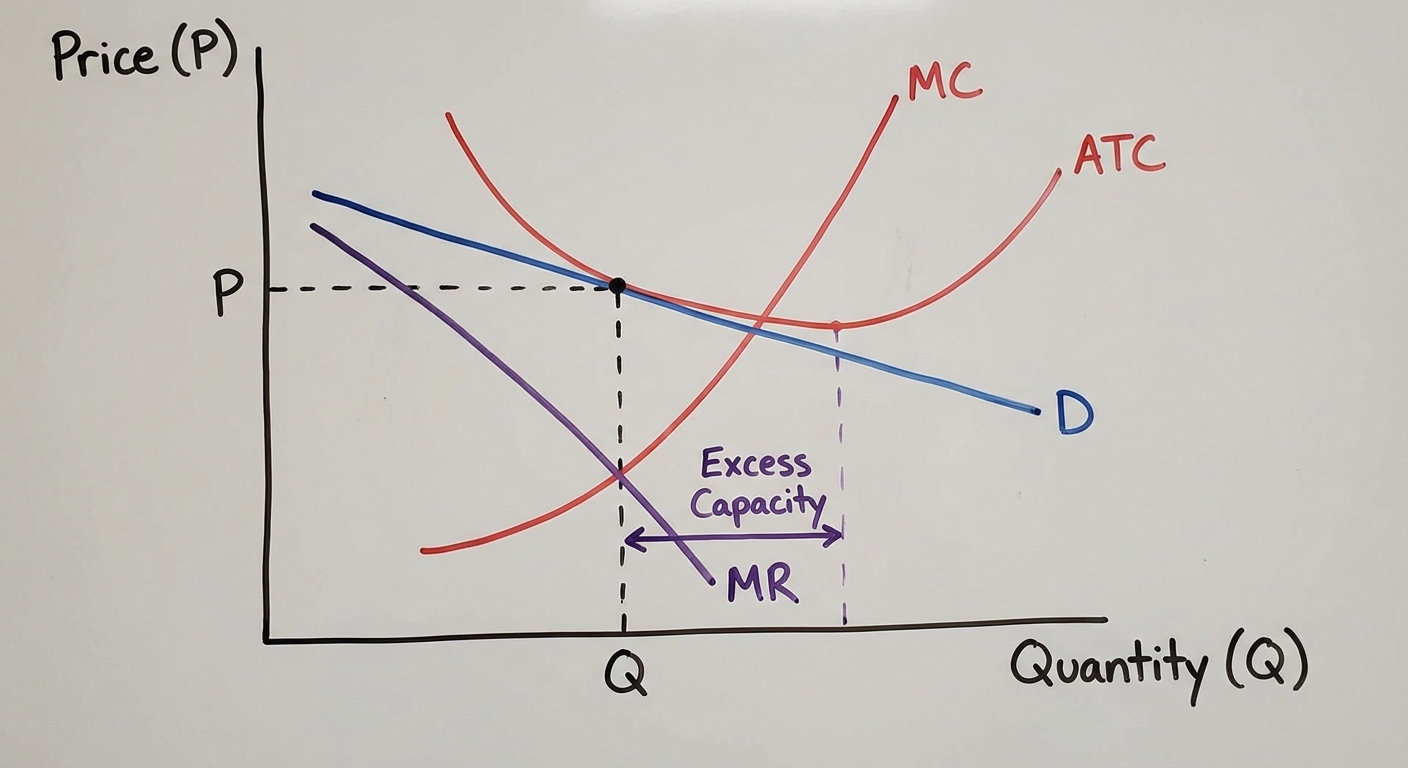
Monopolistic Competitors are Productively Inefficient even in the long run.
- They produce where $P = ATC$ (break even), but not at the minimum of the $ATC$ curve.
- Excess Capacity Definition: The gap between the quantity produced and the productive efficient quantity (min ATC).
- Concept: They "could" produce more at a lower cost, but they choose not to in order to keep prices higher.
4.6 Oligopoly and Game Theory
Oligopoly: A market dominated by a few large firms (e.g., Cell carriers, Auto manufacturers).
Mutual Interdependence
This is the defining trait of an Oligopoly. One firm's actions directly affect the profits of competitors. Therefore, firms must act strategically.
Game Theory
The study of how people/firms behave in strategic situations.
Terminology:
- Payoff Matrix: A table showing the potential outcomes for two players based on their decisions.
- Dominant Strategy: A strategy that is best for a player regardless of what the opponent chooses.
- Nash Equilibrium: A situation where no player benefits by changing their strategy while the other players keep theirs unchanged. (The optimal outcome given the other's choice).

Analyzing a Payoff Matrix (Step-by-Step)
(Refer to the image above mentally or draw a 2x2 box)
- Find Player 1's Best Moves: Cover Player 2's columns one by one. If Player 2 picks Left, what should Player 1 do? Circle that payoff.
- Find Player 2's Best Moves: Cover Player 1's rows. If Player 1 picks Top, what should Player 2 do? Circle that payoff.
- Identify Dominant Strategy: If a player circles the same strategy both times, that is their Dominant Strategy. (Note: Not all games have dominant strategies).
- Identify Nash Equilibrium: The cell where both numbers are circled.
Collusion and Cartels
- Collusion: Firms acting together to fix prices or output (illegal in many countries).
- Cartel: A formal agreement acting as a monopoly (e.g., OPEC).
- Instability: Cartels are hard to maintain because individual firms have a dominant incentive to cheat (lower price/increase output) to steal market share.
Common Mistakes & Mnemonics
Mnemonics
- "Mr. DARP" (for Perfect Competition, $MR=D=AR=P$) vs. "Mr. < DARP" (For Imperfect Competition, MR is less than Demand).
Common Pitfalls
- Confusing Efficiency:
- Mistake: Thinking Monopolies are efficient because they maximize profit.
- Correction: Monopolies are allocatively inefficient ($P > MC$) and produce deadweight loss. Only Perfect Price Discriminating monopolies are allocatively efficient.
- Price vs. Cost:
- Mistake: Reading the price off the MC curve.
- Correction: Always go up to the Demand Curve to set the price.
- Dominant Strategy vs. Nash Equilibrium:
- Mistake: Thinking they are the same.
- Correction: A dominant strategy is what one player does always. Nash Equilibrium is the outcome where the game settles. You can have a Nash Equilibrium without dominant strategies.
- Revenue Maximization:
- Mistake: Assuming firms maximize Revenue ($MR=0$).
- Correction: Firms maximize Profit ($MR=MC$), which is a lower quantity than revenue maximization.