Topic 3.3-3.4: Derivatives of Inverse Functions and Inverse Trigonometric Functions
Differentiating General Inverse Functions
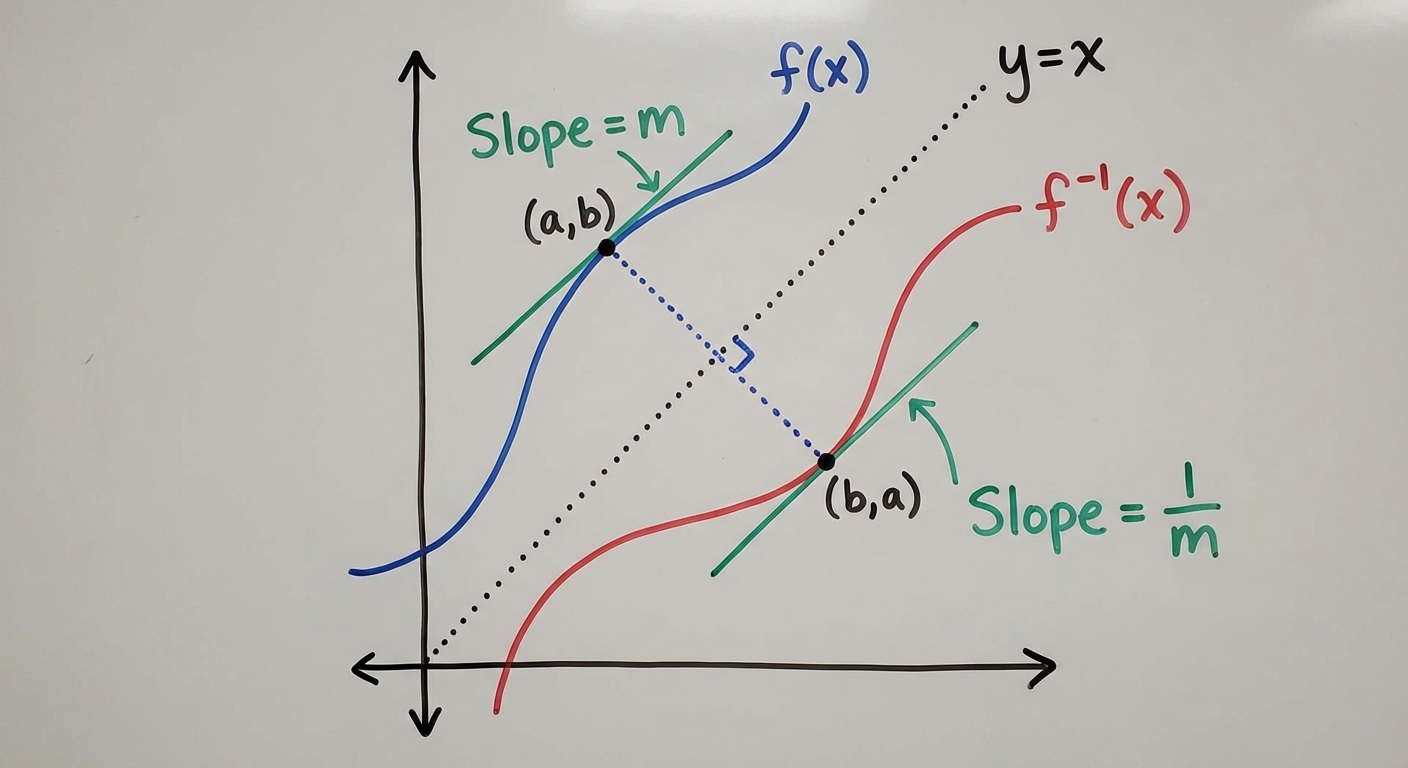
The relationship between a function $f$ and its inverse $f^{-1}$ is fundamental to calculus. Geometrically, the graph of an inverse function is the reflection of the original function across the line $y = x$. This geometric relationship leads directly to a relationship between their derivatives (slopes).
The Relationship Between Slopes
Start with the definition: If $(a, b)$ is a point on the graph of $f$, then $(b, a)$ is a point on the graph of $f^{-1}$.
Because the graphs are reflections of each other, the tangent lines at these corresponding points are also reflections. This means their slopes are reciprocals of one another.
The Inverse Function Derivative Theorem
Let $f$ be a function that is differentiable on an interval $I$. If $f$ has an inverse function $g$, then $g$ is differentiable at any $x$ for which $f'(g(x)) \neq 0$. The formula is:
Alternatively, if we let $g(x) = f^{-1}(x)$, the formula can be written as:
Key Interpretation: To find the derivative of the inverse at a specific input value $x$ (which was the output of the original function), evaluate the reciprocal of the derivative of the original function at the corresponding $y$ value.
Step-by-Step Problem Solving Strategy
Use this 4-step process when asked to find $(f^{-1})'(b)$:
- Identify the goal: You need the slope of the inverse at $x = b$.
- Find the corresponding coordinate: Set $f(a) = b$. You usually need to solve for $a$ by inspection or using a provided table.
- Find the derivative of the original: Calculate or look up $f'(a)$.
- Reciprocate: The answer is $\frac{1}{f'(a)}$.
Worked Example: Using a Table
Problem: Let $f$ be a differentiable function where $f(3) = 7$ and $f'(3) = -2$. Find the value of $(f^{-1})'(7)$.
Solution:
- We want the derivative of the inverse at input $x = 7$.
- Since $f(3) = 7$, the point on $f$ is $(3, 7)$. Therefore, the corresponding point on $f^{-1}$ is $(7, 3)$.
- We need the slope of $f$ at the "original" x-value, which is $3$. We are given $f'(3) = -2$.
- Take the reciprocal: .
Answer: $(f^{-1})'(7) = -\frac{1}{2}$.
Differentiating Inverse Trigonometric Functions
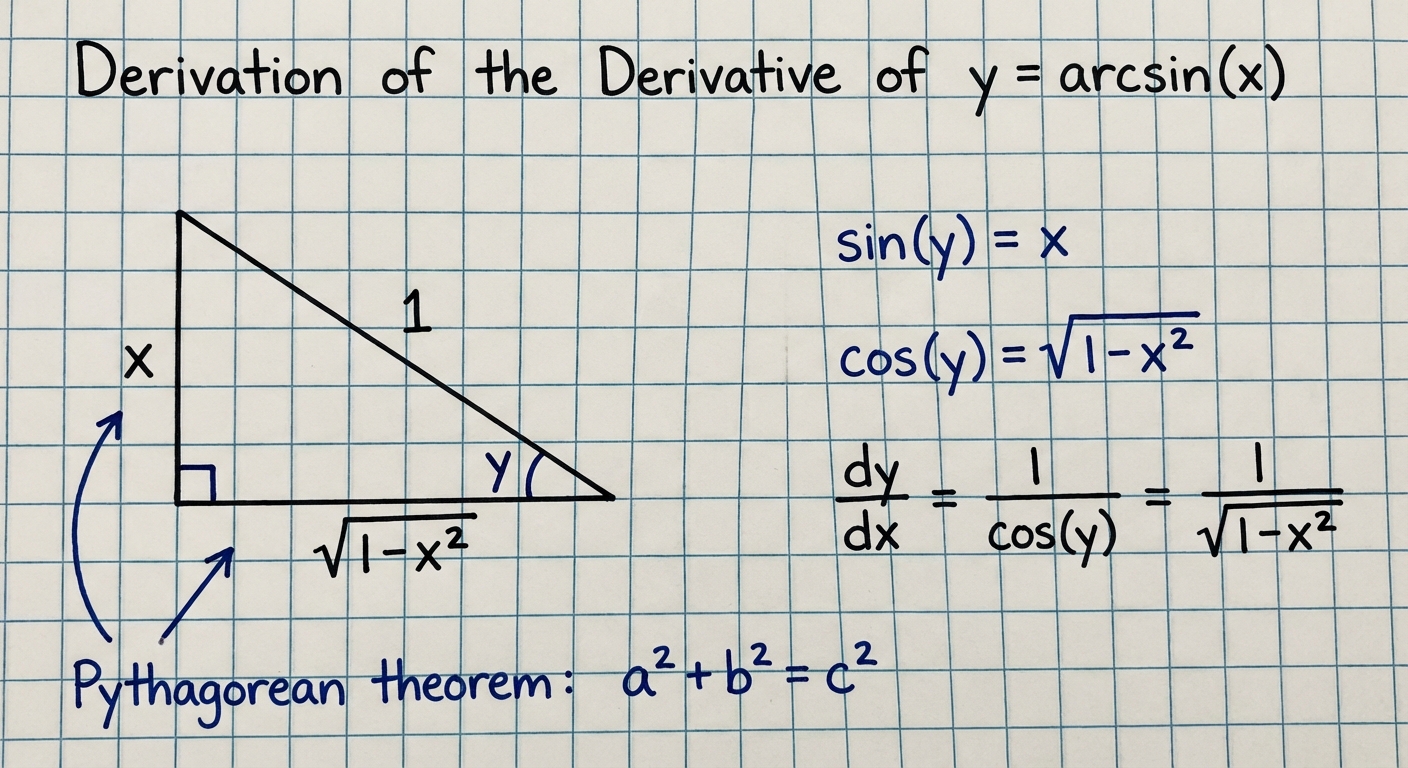
The derivatives of inverse trigonometric functions are algebraic functions (they often involve square roots and fractions, but not trig functions). These are frequently tested on the AP exam.
Notation Note
Be comfortable with both notations:
- $\arcsin x$ is the same as $\sin^{-1} x$
- $\arctan x$ is the same as $\tan^{-1} x$
The Essential Formulas
You must memorize these. The derivatives on the right assume the chain rule is applied to an inner function $u$ (where $u$ is a function of $x$).
| Function ($y$) | Derivative ($\frac{dy}{dx}$) |
|---|---|
| $\sin^{-1}(u)$ | |
| $\cos^{-1}(u)$ | |
| $\tan^{-1}(u)$ | |
| $\cot^{-1}(u)$ | |
| $\sec^{-1}(u)$ | \frac{u'}{ |
| $\csc^{-1}(u)$ | -\frac{u'}{ |
Note: On the AP Calculus AB exam, $\arcsin$, $\arccos$, and $\arctan$ are by far the most common. $\arcsec$, $\arccsc$, and $\arccot$ appear less frequently but are still part of the curriculum.
Memory Aids & Mnemonics
- The "Co" Rule: Just like standard trig derivatives, any "Co" inverse function (Arccosine, Arccotangent, Arccosecant) has a negative derivative.
- Tan has no Root: Tangent and Cotangent are the only ones without a square root in the denominator. Think "Tan is tough" (it holds up the fraction without a root).
- Sine/Cosine vs. Secant/Cosecant:
- Sine/Cosine have the number $1$ first: $\sqrt{1-u^2}$
- Secant/Cosecant have the variable $u$ first: $\sqrt{u^2-1}$
Worked Example: Applying the Chain Rule
Problem: Find $f'(x)$ if $f(x) = \arctan(3x^2)$.
Solution:
- Identify the outer function: $\arctan(u)$. The rule is $\frac{u'}{1+u^2}$.
- Identify the inner function: $u = 3x^2$.
- Differentiate the inner function: $u' = 6x$.
- Substitute $u$ and $u'$ into the formula:
Common Mistakes and Pitfalls
Notation Confusion
- The Mistake: Thinking $f^{-1}(x)$ means $\frac{1}{f(x)}$ or that $\sin^{-1}(x)$ means $\frac{1}{\sin(x)}$.
- The Fix: Remember that the superscript $-1$ on a function name denotes the inverse function, not the reciprocal exponent. The reciprocal of sine is cosecant, not arcsine.
Evaluating at the Wrong Value
- The Mistake: When asked for $(f^{-1})'(5)$, students often calculate $1/f'(5)$.
- The Fix: Remember the coordinate swap! If you are inputting $x=5$ into the inverse, that means $y=5$ for the original function. You must find the $x$ that produced that 5 (solve $f(x)=5$) and use that value in the derivative.
Chain Rule Omission with Inverse Trig
- The Mistake: Writing $\frac{d}{dx}(\arcsin(5x)) = \frac{1}{\sqrt{1-(5x)^2}}$.
- The Fix: You forgot $u'$. The numerator must differeniate the inside term. The correct answer is $\frac{5}{\sqrt{1-25x^2}}$.
Forgetting Absolute Values for Arcsec/Arccsc
- The Mistake: Writing the derivative of $\sec^{-1} x$ as $\frac{1}{x\sqrt{x^2-1}}$.
- The Fix: The formula strictly requires an absolute value around the coefficient term in the denominator: $\frac{1}{|x|\sqrt{x^2-1}}$.