Constitutional Protections: Balancing Liberty and Order
Distinguishing Civil Liberties and Civil Rights
To master Unit 3, you must first understand the fundamental difference between these two categories of protections. They are often used interchangeably in conversation, but in AP Government, the distinction is critical.
Definitions
- Civil Liberties: Constitutionally established guarantees that protect citizens, opinions, and property against arbitrary government interference. Key phrase: Protection FROM the government.
- Source: The Bill of Rights (Amendments 1–10).
- Example: Freedom of speech, right to a fair trial.
- Civil Rights: Acts of government designed to protect sectors of the population against discrimination and ensure equal treatment. Key phrase: Protection BY the government.
- Source: 14th Amendment (Equal Protection Clause) and congressional legislation (e.g., Civil Rights Act of 1964).
- Example: Preventing racial segregation in schools, ensuring voting rights.
Comparison Table
| Feature | Civil Liberties | Civil Rights |
|---|---|---|
| Primary Question | What can the government not do to me? | How must the government treat specific groups? |
| Key Constitutional Basis | Bill of Rights, Due Process Clause (14th Amd) | Equal Protection Clause (14th Amd) |
| Analogy | A shield against government intrusion. | A sword used by government to enforce equality. |
The 14th Amendment and Selective Incorporation
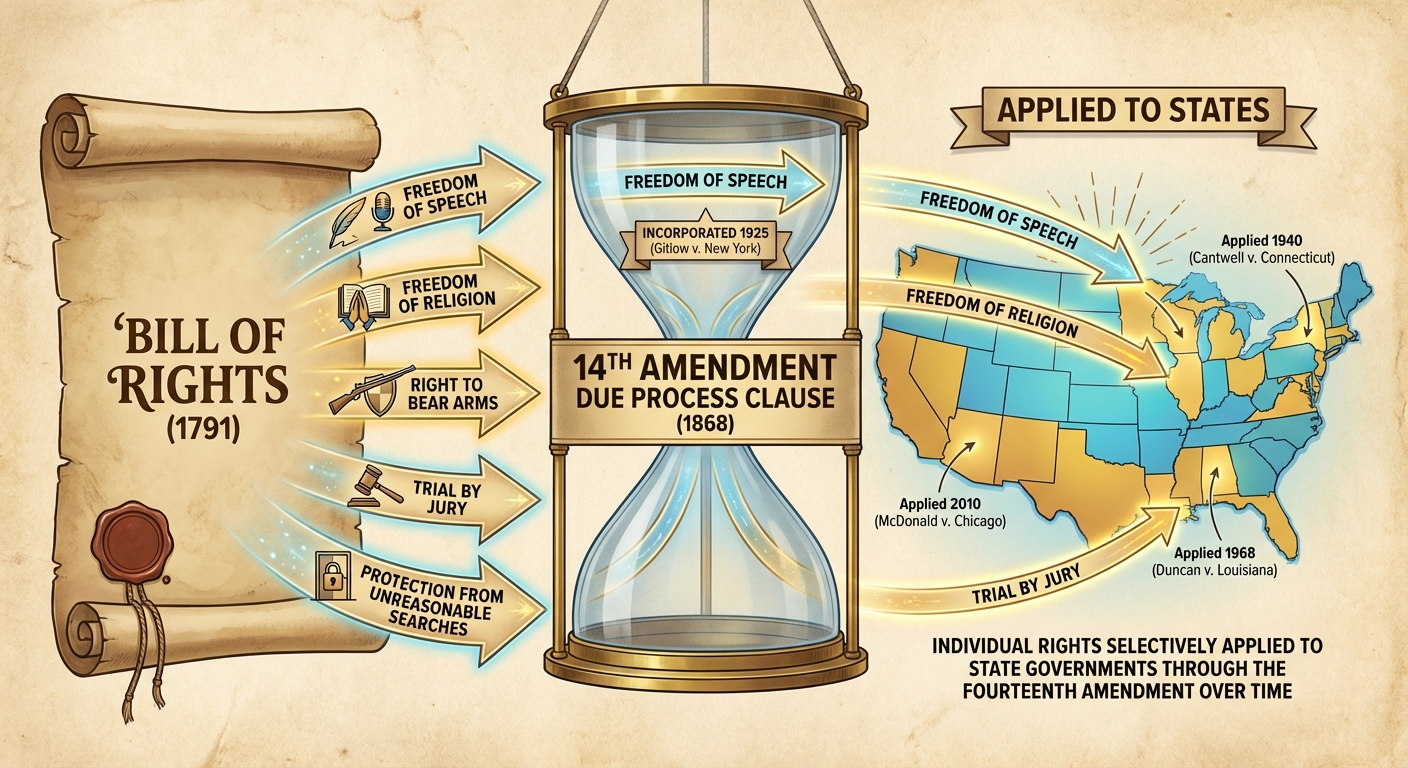
Before 1868, the Bill of Rights only restricted the federal government (confirmed in Barron v. Baltimore, 1833). If a state passed a law infringing on your speech, the First Amendment did not save you. The 14th Amendment changed this forever.
Key Clauses of the 14th Amendment(1868)
- Due Process Clause: "…nor shall any State deprive any person of life, liberty, or property, without due process of law."
- Function: Used to incorporate Civil Liberties to the states.
- Equal Protection Clause: "…nor deny to any person within its jurisdiction the equal protection of the laws."
- Function: Used to enforce Civil Rights and combat discrimination.
The Doctrine of Selective Incorporation
Selective Incorporation is the judicial process whereby the Supreme Court applies the Bill of Rights to the states one case at a time (selectively) using the Due Process Clause of the 14th Amendment.
- Not Total Incorporation: The Court has never ruled that the entire Bill of Rights applies effectively at once. It happens incrementally.
- Exceptions: To date, the 3rd Amendment (Quartering Troops), 7th Amendment (Jury in Civil Trials), and part of the 5th (Grand Jury Indictment) have not been incorporated.
The First Amendment: Freedom of Religion
The First Amendment contains two distinct clauses regarding religion. You must be able to identify which clause acts in a given scenario.
1. The Establishment Clause
Text: "Congress shall make no law respecting an establishment of religion…"
Meaning: The government cannot sanction an official religion, favor one religion over another, or (generally) favor religion over non-religion. It builds a "wall of separation" between church and state.
- Facts: Public schools in New York authorized a short, voluntary, nondenominational prayer at the start of the school day.
- Holding: State-sponsored prayer in public schools violates the Establishment Clause. Even if voluntary, the government cannot endorse religious activity.
- Impact: Strengthened the separation of church and state.
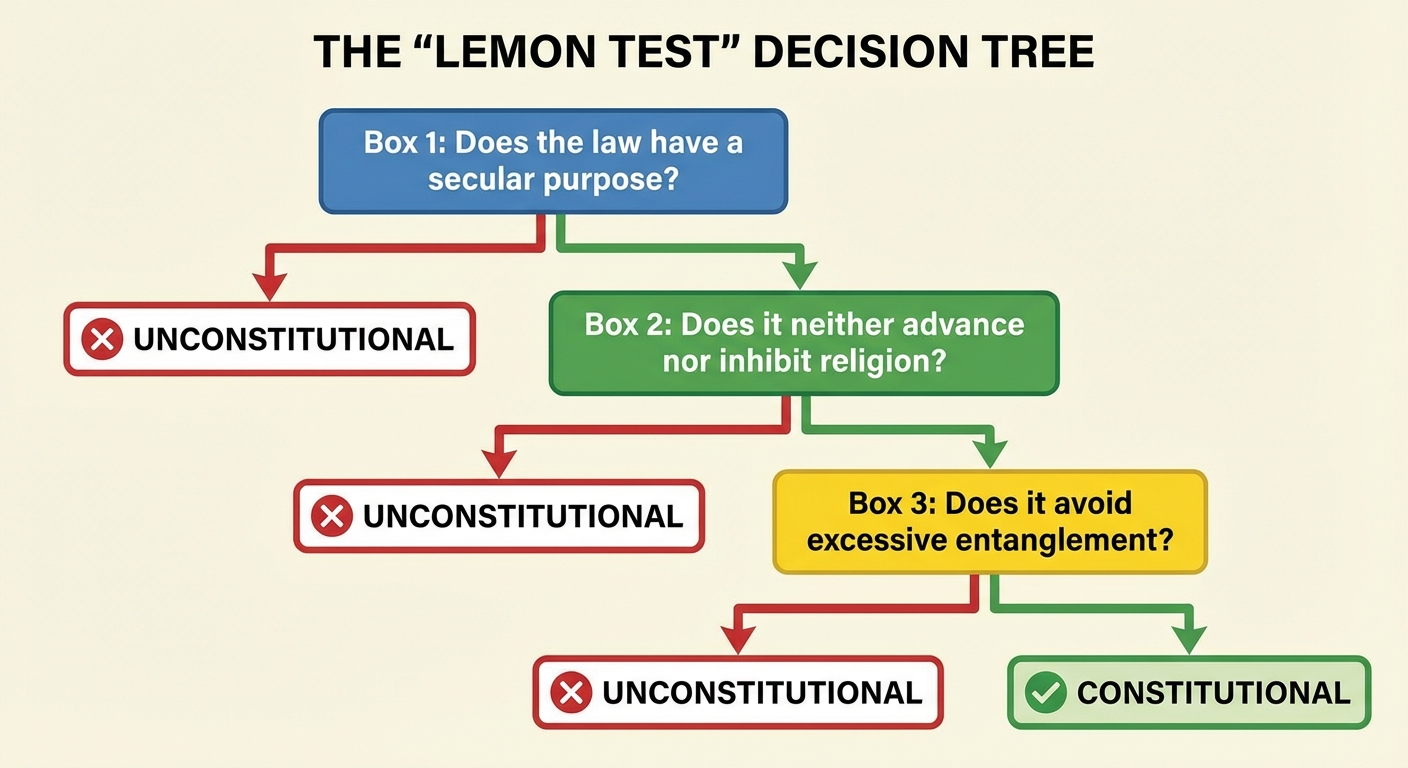
The Lemon Test (Lemon v. Kurtzman, 1971)
Current Status: While historically important, the Court has moved away from this strict test recently (Kennedy v. Bremerton, 2022) toward an analysis of "history and tradition."
- Old Standard: Law must have a secular purpose, neither advance nor inhibit religion, and avoid "excessive entanglement."
2. The Free Exercise Clause
Text: "…or prohibiting the free exercise thereof."
Meaning: Citizens have the right to believe and practice their religion as they see fit, provided the practice does not violate valid, neutral laws or public safety.
- Facts: Amish families refused to send children to high school (past 8th grade), violating Wisconsin's compulsory education law, citing religious beliefs that high school corrupted their children.
- Holding: Compelling Amish students to attend school past the 8th grade violates the Free Exercise Clause.
- Reasoning: The individual's right to free exercise outweighed the state's interest in educating children past 8th grade.
The First Amendment: Freedom of Speech & Press
Not all speech is protected. The Court balances social order with individual liberty.
Protected vs. Unprotected Speech
- Symbolic Speech: Actions that convey a message (e.g., flag burning, armbands) are protected.
- Defamation: Libel (written) and Slander (spoken) lies that damage reputation are not protected.
- Obscenity: Offensive sexual material lacking value (Miller test) is not protected.
- Imminent Lawless Action: Speech that incites immediate violence is not protected (supersedes "Clear and Present Danger").
Key Cases
1. [Symbolic Speech]
- Facts: Students wore black armbands to protest the Vietnam War and were suspended.
- Holding: Students do not "shed their constitutional rights to freedom of speech or expression at the schoolhouse gate."
- Rule: Schools can only suppress speech if it causes a "material and substantial disruption" to the educational process.
2. [Clear and Present Danger]
- Facts: Schenck distributed leaflets discouraging men from enduring the WWI draft. Convicted under the Espionage Act.
- Holding: Conviction upheld. Speech creating a "clear and present danger" is not protected.
- Current Context: This standard has been narrowed; speech must now incite imminent lawless action to be banned, but Schenck is foundational for establishing that rights are not absolute.
3. [Freedom of the Press]
- Facts: The Nixon administration attempted to stop the NYT from publishing the "Pentagon Papers" (classified Vietnam War documents) claiming national security.
- Concept: Prior Restraint (government censorship of material before publication).
- Holding: The government did not meet the "heavy burden" of justification required for prior restraint. Security concerns were vague; press freedom is paramount to hold government accountable.
The Second Amendment: Right to Bear Arms
Text: "A well regulated Militia, being necessary to the security of a free State, the right of the people to keep and bear Arms, shall not be infringed."
- Facts: Chicago passed effectively banning handgun ownership. McDonald sued.
- Holding: The Second Amendment right to keep and bear arms for self-defense is applicable to the states via the 14th Amendment's Due Process Clause.
- Significance: This case incorporated the Second Amendment. (Note: DC v. Heller established the individual right federally; McDonald applied it to the states).
The Fourth Amendment: Search and Seizure
Protects against "unreasonable searches and seizures."
Key Rules
- Warrant Requirement: Police usually need a warrant based on Probable Cause signed by a judge.
- Exclusionary Rule: Evidence obtained illegally (violating the 4th Amendment) cannot be used in court.
- Case reference: Mapp v. Ohio
- Exceptions: "Good faith" (police thought warrant was valid), "Inevitable discovery" (would have found it anyway).
- Digital Privacy: The 4th Amendment protects people, not places. Warrant usually required for cell phone data (Carpenter v. US).
The Fifth and Sixth Amendments: Rights of the Accused
Fifth Amendment (Protections against Abuse)
- Grand Jury: Requirement for indictment (federal only).
- Double Jeopardy: Cannot be tried twice for the same crime.
- Self-Incrimination: Right to remain silent ("Pleading the Fifth").
- Miranda Rule: Police must inform suspects of these rights upon arrest (Miranda v. Arizona). Exceptions exist for "public safety."
- Due Process: Federal government cannot deprive life/liberty/property without legal procedures.
Sixth Amendment (Trial Rights)
- Right to a speedy and public trial.
- Right to an impartial jury.
- Right to Counsel (Lawyer).
- Facts: Gideon was charged with a felony in Florida. Requested a lawyer; state refused (only provided for capital cases). He defended himself and lost.
- Holding: The Sixth Amendment’s right to counsel applies to state criminal proceedings via the 14th Amendment.
- Outcome: States must provide attorneys for defendants who cannot afford them (indigent defendants).
The Eighth Amendment and Privacy
Eighth Amendment
Prohibits excessive bail and cruel and unusual punishment.
- Death Penalty: Constitutional, but restricts how and to whom it is applied (e.g., no death penalty for minors or those with intellectual disabilities).
Right to Privacy (Implied)
Review the "Penumbras" (shadows) of the Bill of Rights (1st, 3rd, 4th, 5th, 9th).
- Historical Significance: Used the Due Process Clause of the 14th Amendment to extend the right of privacy to a woman's decision to have an abortion.
- Current Status: Overturned by Dobbs v. Jackson (2022). While Roe is no longer binding precedent, AP students must understand the constitutional reasoning (Privacy/Due Process) used in Roe and how it serves as a comparison point for judicial interpretation.
Civil Rights: The Struggle for Equality
Civil rights protect groups from discrimination. This struggle centers on the Equal Protection Clause of the 14th Amendment.
The African American Civil Rights Movement
- Context: MLK was arrested for marching without a permit.
- Key Arguments:
- Just vs. Unjust Laws: Humans have a moral obligation to disobey unjust laws (laws that degrade human personality).
- Direct Action: Nonviolent tension (marches/sit-ins) is necessary to force negotiation.
- Disappointment with White Moderates: Criticized those who preferred "order" over "justice."
- 14th Amendment: Appealed to the "equal protection" guaranteed by the Constitution.
- Facts: Black students were denied access to white schools based on "separate but equal" doctrine (Plessy v. Ferguson).
- Holding: Separate educational facilities are inherently unequal. Racial segregation violates the Equal Protection Clause.
- Impact: Overturned Plessy; marked the beginning of the end for de jure (by law) segregation.
Major Civil Rights Legislation
- Civil Rights Act of 1964: Banned discrimination in public accommodations (hotels/restaurants) and employment. Enforced via Congress's Commerce Clause power.
- Voting Rights Act of 1965: Banned literacy tests and federalized voter registration in states with history of discrimination. Massive increase in Black voter turnout.
Women’s Rights and Title IX
- Title IX of the Education Amendments (1972): "No person in the United States shall, on the basis of sex, be excluded from participation in… any education program or activity receiving Federal financial assistance."
- Impact: drastically increased funding for women's sports and academic equity in colleges.
Affirmative Action
- Definition: Policies trying to increase minority representation to correct past discrimination.
- Current Status: In Students for Fair Admissions v. Harvard (2023), the Supreme Court ruled that race-based admissions programs violate the Equal Protection Clause. (Note: This is a major update from older study guides). Race can no longer be a distinct factor in admissions, though students can discuss how race affected their individual lives in essays.
Common Mistakes & Pitfalls
- Confusing the Clauses:
- Mistake: Thinking Engel v. Vitale is about Free Exercise.
- Correction: It is about the Establishment Clause (Gov establishing prayer). Yoder is Free Exercise.
- Incorporation Mechanism:
- Mistake: Saying "The Bill of Rights applies to states."
- Correction: You must say "The [Specific Amendment] was incorporated to the states via the Due Process Clause of the 14th Amendment."
- Declaration vs. Constitution:
- Mistake: Quoting "All men are created equal" for a Civil Rights argument.
- Correction: That is the Declaration of Independence (philosophical). Legal arguments must use the 14th Amendment (binding law).
- Civil Rights vs. Liberties:
- Mistake: Calling Freedom of Speech a Civil Right.
- Correction: It is a Civil Liberty. Voting is a Civil Right.
Key Mnemonics
- Lemon Test: S.E.X. (Secular purpose, Effect neither aids/inhibits, no eXcessive entanglement).
- 1st Amendment: RAPPS (Religion, Assembly, Press, Petition, Speech).