Unit 6: Synthesis and Analysis in Latin Poetry
Mastering Synthesis and Analysis in AP Latin
Comparative Literary Analysis Across Texts
In Unit 6, the curriculum shifts toward high-level synthesis—the ability to connect distinct texts, authors, and eras. Whether your class focuses on Catullus, Ovid, Horace, or deeper dives into Vergil, the primary objective is Intertextuality.
Defining Intertextuality and Synthesis
Synthesis in AP Latin is the process of combining elements from separate sources to form a coherent argument about Roman literature as a whole. Intertextuality refers to the relationship between texts, specifically when one text alludes to, references, or challenges another.
- Direct Allusion: An author deliberately uses phrasing from a predecessor to evoke a specific context (e.g., Vergil using Ennius's hexameter style).
- Thematic Parallelism: Exploring how different authors treat the same subject (e.g., the concept of furor in Caesar vs. Vergil).
- Generic Convention: How an author adheres to or breaks the rules of their genre (Epic vs. Lyric vs. Elegy).
Cross-Reference Approaches
When analyzing poetry in this unit, you should ask three specific questions to synthesize the material:
- Diction (Word Choice): Does Author B use the same specific Latin word as Author A? (e.g., comparing the use of fides in Catullus 76 to fides in Aeneid Book 4).
- Contextual Reversal: Does the author use a traditional image in a subversive way?
- Tone Shift: How does the meter (e.g., Dactylic Hexameter vs. Hendecasyllabic) change the reception of the message?
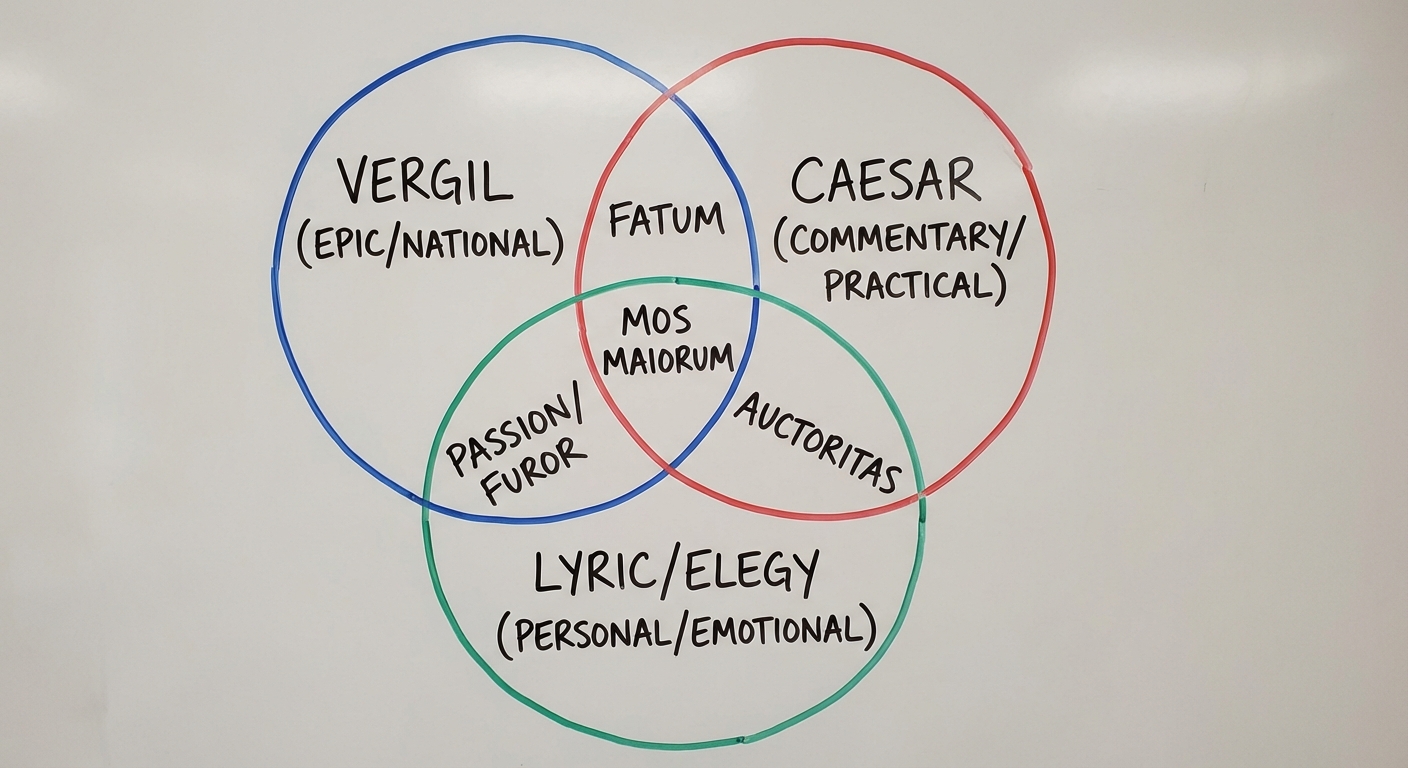
Comparative Example: The Concept of Abandonment
- The Epic View (Vergil): When Aeneas leaves Dido, it is tragic but necessary for fatum (fate). The tone is grand, elevated, and nationalistic.
- The Lyric/Elegiac View (Catullus or Ovid): When Ariadne is left by Theseus (Catullus 64), the focus is entirely on personal agony, betrayal, and emotional chaos. There is no "greater good" justification.
Note: In an exam setting, you may be asked to compare a syllabus reading (Vergil/Caesar) with a sight-reading passage. Look for common themes: Leadership, Betrayal, War, or Divine Intervention.
Roman Values and Cultural Perspectives
To analyze Latin poetry effectively, you must view it through the lens of Mos Maiorum (the custom of the ancestors). Roman poetry is rarely just about personal feelings; it is a commentary on societal obligations.
Key Cultural Pillars
Understanding these terms is non-negotiable for high-scoring analysis.
| Term | Definition | Contextual Application in Poetry |
|---|---|---|
| Pietas | Duty to gods, family, and country (in that order). | Aeneas suppresses his amor for Dido to fulfill his pietas toward Italy. |
| Virtus | Manliness, courage, excellence. | Turnus displays martial virtus, while Caesar displays administrative virtus. |
| Fides | Faithfulness, loyalty, trust. | Essential in political alliances (Caesar) and romantic contracts (Catullus's foedus). |
| Gravitas | Seriousness, dignity, self-control. | A Roman hero should not be overly emotional; emotional excess represents a loss of gravitas. |
| Auctoritas | Moral authority and prestige. | How leaders command respect without using force. |
The Tension Between Otium and Negotium
- Negotium: The business of the state, war, and politics. This is the realm of the Epic (Aeneid) and Commentary (De Bello Gallico).
- Otium: Leisure, private time, and sometimes dangerous idleness. This is the realm of Lyric poetry (Catullus, Horace).
Common Analysis Point: Analyze how a poet justifies their writing of poetry (otium) in a society that values war and politics (negotium). Often, poets like Horace or Propertius will claim they are "soldiers of love" (militia amoris) to bridge this cultural gap.
Analytical Writing and Argumentation
This section covers the mechanics of writing the Analytical Essay (FRQ). The goal is not to translate, but to argue how the Latin creates meaning.
The Argument Construction Formula
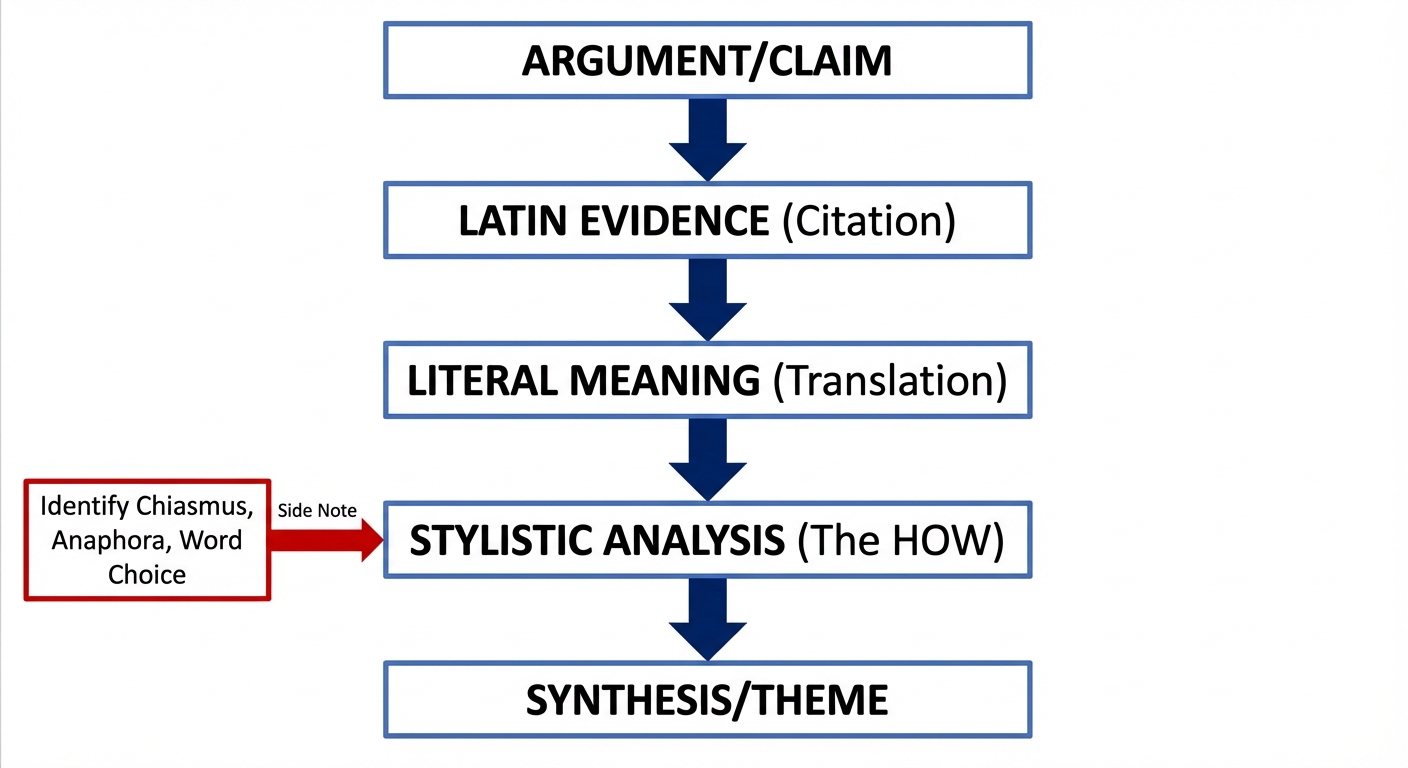
A strong analytical paragraph typically follows this structure:
- Claim (Thesis Point): What is the author doing in this specific section? (e.g., "Vergil uses auditory imagery to heighten the chaos of the storm.")
- Citation (Latin Evidence): Quote the specific Latin words. Do not quote the English translation.
- Literal Translation: Briefly define the Latin words cited to show you understand them.
- Analysis (The "Spotlight"): This is the most crucial step. Explain the grammatical or stylistic function.
- Is there an abnormal word order ( Hyperbaton )?
- Is there a clash of sounds ( Alliteration )?
- Is there a figure of speech?
- Connection: Tie it back to the main theme.
Essential Stylistic Devices for Analysis
You must move beyond basic identification (e.g., "this is a metaphor") and explain the effect.
- Chiasmus (ABBA): Often used to show contrast or containment. Example: Tantaene animis caelestibus irae? (A-B-B-A arrangement highlights the surrounding nature of the anger).
- Synchysis (Interlocked Word Order ABAB): Used to show confusion, entanglement, or inseparable connection.
- Anaphora: Repetition of words at the beginning of clauses. Creates emphasis, urgency, or a relentless tone.
- Litotes: Double negative usage. Often implies a strong affirmation or ironic understatement.
Example of Analysis
Text: Aeneid 1.11: Tantaene animis caelestibus irae?
Weak Analysis: Vergil asks if the gods are angry. He uses the word irae which means anger.
Strong Analysis: Vergil questions the morality of the divine through the rhetorical question "Tantaene animis caelestibus irae?" By placing animis caelestibus (heavenly spirits) inside the framing of tantae … irae (such great anger) via Chiasmus, Vergil structurally traps the concept of divinity within anger, suggesting that even the gods are consumed by the very furor Aeneas fights to avoid.
Mnemonics and Memory Aids
"TEAM" for Body Paragraphs:
- T - Topic Sentence (The Argument)
- E - Evidence (Latin Citation)
- A - Analysis (Stylistic devices/Word placement)
- M - Meaning (Connecting back to the prompt)
"VIF" for Cultural Values:
- V - Virtus (Courage)
- I - Integritas (Integrity - related to Fides)
- F - Fides (Loyalty)
Common Mistakes & Pitfalls
1. Summary vs. Analysis
- Mistake: Retelling the story. ("In this line, Aeneas walks down the path and sees his mother.")
- Correction: Focus on the how and why. ("The use of the patronymic strictly defines Aeneas by his lineage rather than his individual identity here.")
2. The "Floating Quote"
- Mistake: Dropping a Latin quote into a sentence without explaining it or translating it contextually.
- Correction: Always weave the Latin into your sentence structure or follow it immediately with a parenthetical translation/explanation.
3. Ignoring the Syllabus Context
- Mistake: Treating a Unit 6 (Teacher's Choice) poem as isolated.
- Correction: Even if analyzing Catullus, try to contrast his view of Roman values with the standard "Augustan" views found in Vergil. The AP exam creates synthesis by looking at the tension between personal desire and public duty.
4. Vague Terminology
- Mistake: Saying the author "emphasizes" or "highlights" something without saying how.
- Correction: Be specific. "The author emphasizes the violence of the storm through the use of sigmatism (repetition of 's' sounds) in line 4…"