Foundations of Limits in Calculus BC
Introduction to Limits and Notation
Calculus is the mathematical study of continuous change, and the Limit is the foundational tool used to define continuity, derivatives, and integrals. Understanding limits is essential because they allow us to discuss the behavior of a function at a specific point, even if the function is undefined at that exact moment.
Defining the Limit
Formally, we say that the limit of $f(x)$ as $x$ approaches $c$ is $L$ if the values of $f(x)$ get arbitrarily close to $L$ as $x$ gets sufficiently close to (but not equal to) $c$.
Notation:
It is crucial to distinguish between the limit value and the function value:
- Limit Value ($L$): What the graph is approaching (the trend).
- Function Value ($f(c)$): The actual dot on the graph at $x=c$ (the location).
One-Sided vs. Two-Sided Limits
For a general limit (two-sided) to exist, the function must approach the same value from both the left and the right sides.
- Left-Hand Limit (LHL): Approaches $c$ from values smaller than $c$.
- Right-Hand Limit (RHL): Approaches $c$ from values larger than $c$.
The Existence Rule:
If the left and right sides approach different values (or if one goes to infinity), the limit Does Not Exist (DNE).
Estimating Limit Values: Graphs and Tables
Before using algebra, you should develop an intuition for limits using visual and numerical methods.
Graphical Estimation
When looking at a graph, trace the curve with your fingers from the left and right toward the target $x$-value. Do your fingers meet?
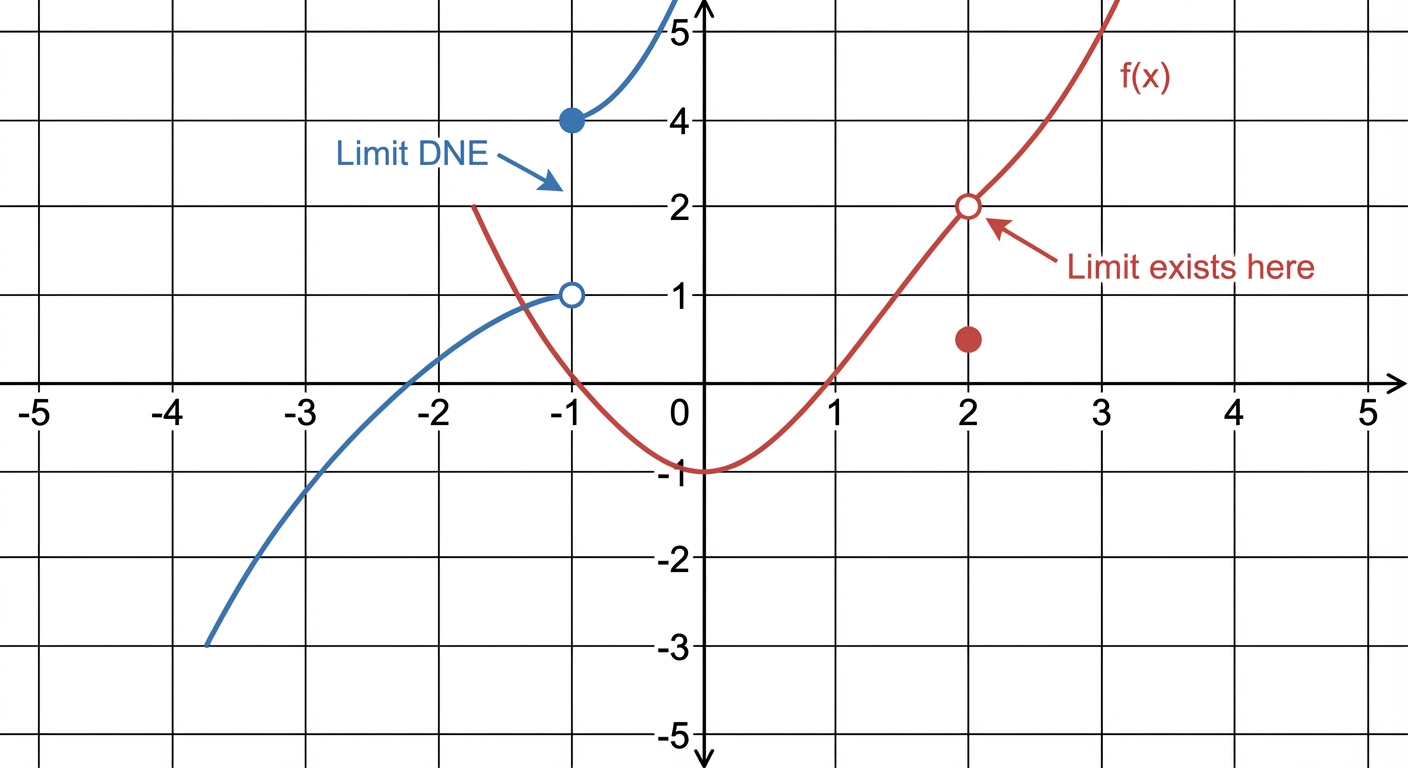
- Holes (Removable Discontinuity): The limit exists because the path meets, even if the point is hollow or moved elsewhere. The limit is the $y$-value of the hole.
- Jumps: The limit DNE because the left approach and right approach result in different $y$-values.
- Vertical Asymptotes: The limit DNE strictly speaking (though we often specify $\infty$ or $-\infty$ to describe the behavior).
Numerical Estimation (Tables)
To estimate $\lim_{x \to 2} (x^2 + 1)$, we can substitute values very close to 2 from both sides.
| $x$ (Approaching 2 from Left) | $f(x)$ | $x$ (Approaching 2 from Right) | $f(x)$ | |
|---|---|---|---|---|
| 1.9 | 4.61 | 2.1 | 5.41 | |
| 1.99 | 4.9601 | 2.01 | 5.0401 | |
| 1.999 | 4.996 | 2.001 | 5.004 |
Conclusion: As $x \to 2$, $f(x) \to 5$. Therefore, the limit is 5.
Algebraic Properties and Direct Substitution
Once familiar with the concept, we use algebraic rules to solve limits exactly.
Basic Limit Properties
Assuming $\lim{x \to c} f(x) = L$ and $\lim{x \to c} g(x) = M$:
- Sum/Difference: $\lim [f(x) \pm g(x)] = L \pm M$
- Product: $\lim [f(x) \cdot g(x)] = L \cdot M$
- Quotient: $\lim [\frac{f(x)}{g(x)}] = \frac{L}{M}$ (provided $M \neq 0$)
- Power: $\lim [f(x)]^n = L^n$
Direct Substitution Strategy
The first step for ANY algebraic limit problem is Direct Substitution.
Plug the target value $c$ into the function.
- If you get a real number (e.g., $5, 0, \pi$), you are done. That is the limit.
Example: $\lim_{x \to 3} (2x + 1) = 2(3) + 1 = 7$. - If you get $\frac{\text{non-zero constant}}{0}$ (e.g., $5/0$), the limit implies a vertical asymptote ($+\infty$, $-\infty$, or DNE).
- If you get $\frac{0}{0}$, this is an Indeterminate Form. You must use algebraic manipulation.
Solving Indeterminate Forms ($0/0$)
When direct substitution yields $\frac{0}{0}$, it means there is a "hole" in the graph, but the limit likely exists. We must remove the conflicting term causing the zero.
Technique 1: Factoring and Canceling
Used for polynomial rational functions.
Example: Evaluate $\lim_{x \to 3} \frac{x^2 - 9}{x - 3}$.
- Test: Subst $x=3 \Rightarrow \frac{3^2-9}{3-3} = \frac{0}{0}$. (Indeterminate)
- Factor: $x^2 - 9 = (x-3)(x+3)$.
- Rewrite: $\lim_{x \to 3} \frac{(x-3)(x+3)}{(x-3)}$.
- Cancel: Remove the common factor $(x-3)$. Note that we can do this because in a limit, $x \neq 3$.
- Solve: $\lim_{x \to 3} (x+3) = 3 + 3 = 6$.
Technique 2: Rationalizing with Conjugates
Used when the function contains square roots.
Example: Evaluate $\lim_{x \to 0} \frac{\sqrt{x+4}-2}{x}$.
- Test: $\frac{\sqrt{4}-2}{0} = \frac{0}{0}$.
- Multiply by Conjugate: Multiply numerator and denominator by $(\sqrt{x+4}+2)$.
- Cancel: The $x$ terms cancel out.
Technique 3: Special Trigonometric Limits
Memorize these two special limits for $x \to 0$ setups:
- $\lim_{x \to 0} \frac{\sin x}{x} = 1$ (also applies to $\frac{x}{\sin x}$)
- $\lim_{x \to 0} \frac{1 - \cos x}{x} = 0$
Note: These require the argument of the sine function to match the denominator exactly (e.g., $\frac{\sin(5x)}{5x} \to 1$).
The Squeeze Theorem
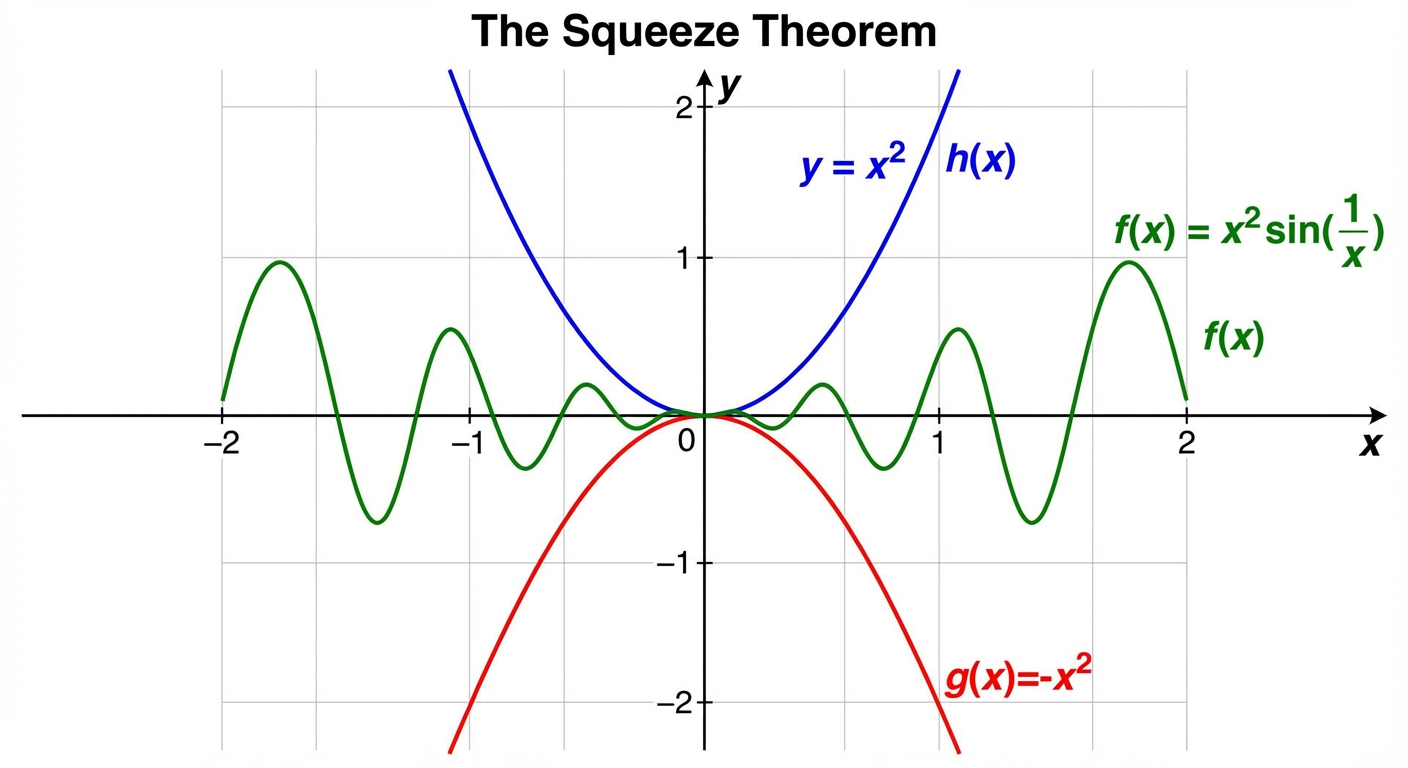
Also known as the Sandwich Theorem or Pinching Theorem, this is used for limits that are difficult to evaluate directly but can be "trapped" between two easier functions.
The Theorem
If $g(x) \le f(x) \le h(x)$ for all $x$ near $c$ (except possibly at $c$), and:
Then:
Worked Example
Problem: Evaluate $\lim_{x \to 0} x^2 \sin(\frac{1}{x})$.
- Analyze: We know that sine oscillates between -1 and 1.
- Build the Inequality: Multiply everything by $x^2$ (which is non-negative, so signs don't flip).
- Evaluate Outer Limits:
- $\lim_{x \to 0} (-x^2) = 0$
- $\lim_{x \to 0} (x^2) = 0$
- Conclusion: Since the outer functions both go to 0, by the Squeeze Theorem, $\lim_{x \to 0} x^2 \sin(\frac{1}{x}) = 0$.
Common Mistakes & Pitfalls
Confusing $f(c)$ with the Limit:
- Mistake: Assuming that if $f(c)$ is undefined, the limit does not exist.
- Correction: A limit describes behavior approaching the point. A hole at $x=c$ does not stop a limit from existing.
Assuming $\frac{0}{0}$ means "Undefined":
- Mistake: Evaluating a limit, getting $0/0$, and writing "DNE".
- Correction: $\frac{0}{0}$ is indeterminate. It means "do more work" (factor, conjugate, trig identities, or L'Hôpital's Rule later in the course).
Neglecting One-Sided Checks for Piecewise Functions:
- Mistake: Only plugging the number into one part of a piecewise function.
- Correction: Always check both the left equation and right equation. If they aren't equal, the limit DNE.
Notation Errors:
- Mistake: Dropping the "$\lim$" notation while still performing algebra with $x$.
- Correction: Keep writing $\lim_{x \to c}$ in every step until you actually substitute the number.