Comprehensive Guide to APES Unit 8: Aquatic and Terrestrial Pollution
Unit 8: Aquatic and Terrestrial Pollution
8.1 Sources of Pollution
Pollution is the introduction of contaminants into the natural environment that cause adverse change. In aquatic systems, identifying the source is the first step in remediation.
Point vs. Nonpoint Sources
Point Source Pollution refers to a single, identifiable source of a pollutant, such as a smokestack or waste discharge pipe.
- Regulation: Easier to monitor and regulate (e.g., via the Clean Water Act).
- Examples:
- Drainpipe from a factory releasing chemicals.
- Effluent from a sewage treatment plant.
- Oil spill from a tanker.
Nonpoint Source Pollution refers to diffused pollutants that come from many sources over a large area, often carried by runoff.
- Regulation: Difficult to control because the exact origin is hard to pinpoint.
- Examples:
- Agricultural runoff (fertilizers, pesticides, animal waste).
- Urban runoff (oil, grease, sediment from city streets).
- Sediment from construction sites.
Common Mistakes
- Mistake: Thinking all agricultural pollution is nonpoint.
- Correction: Runoff from a large open field is nonpoint. However, a pipe draining a specific manure lagoon at a Concentrated Animal Feeding Operation (CAFO) into a river is a point source.
8.2 Human Impacts on Aquatic Ecosystems
Aquatic organisms operate within a Range of Tolerance for abiotic conditions (pH, temperature, salinity, dissolved oxygen, sunlight). Pollution pushes these conditions beyond the range of physiological stress into the zone of intolerance, leading to death.
Coral Reefs
Coral reefs are highly sensitive biodiversity hotspots.
- Coral Bleaching: Stress factors (primarily high temperature and pH changes) cause corals to expel the symbiotic algae (zooxanthellae) living in their tissues. Without the algae, the coral loses its color and its main food source, often leading to death.
- Destructive Fishing: Bottom trawling breaks reef structures; cyanide fishing poisons corals.
- Sedimentation: Runoff increases turbidity (cloudiness), blocking sunlight necessary for the coral's symbiotic algae to photosynthesize.
Oil Spills
Oil spills have immediate and long-term impacts on marine life.
- Physical Smothering: Oil floats on the surface, coating the feathers of birds (destroying insulation/buoyancy) and the fur of marine mammals (causing hypothermia).
- Toxicity: Ingesting hydrocarbons damages the liver and kidneys of organisms.
- Benthic Impact: Heavy oil components sink, smothering bottom-dwelling organisms (crabs, oysters).
Ocean Dead Zones
These are areas of low oxygen (hypoxia) caused by excessive nutrient pollution, largely from agricultural runoff (e.g., the Gulf of Mexico Dead Zone caused by the Mississippi River).
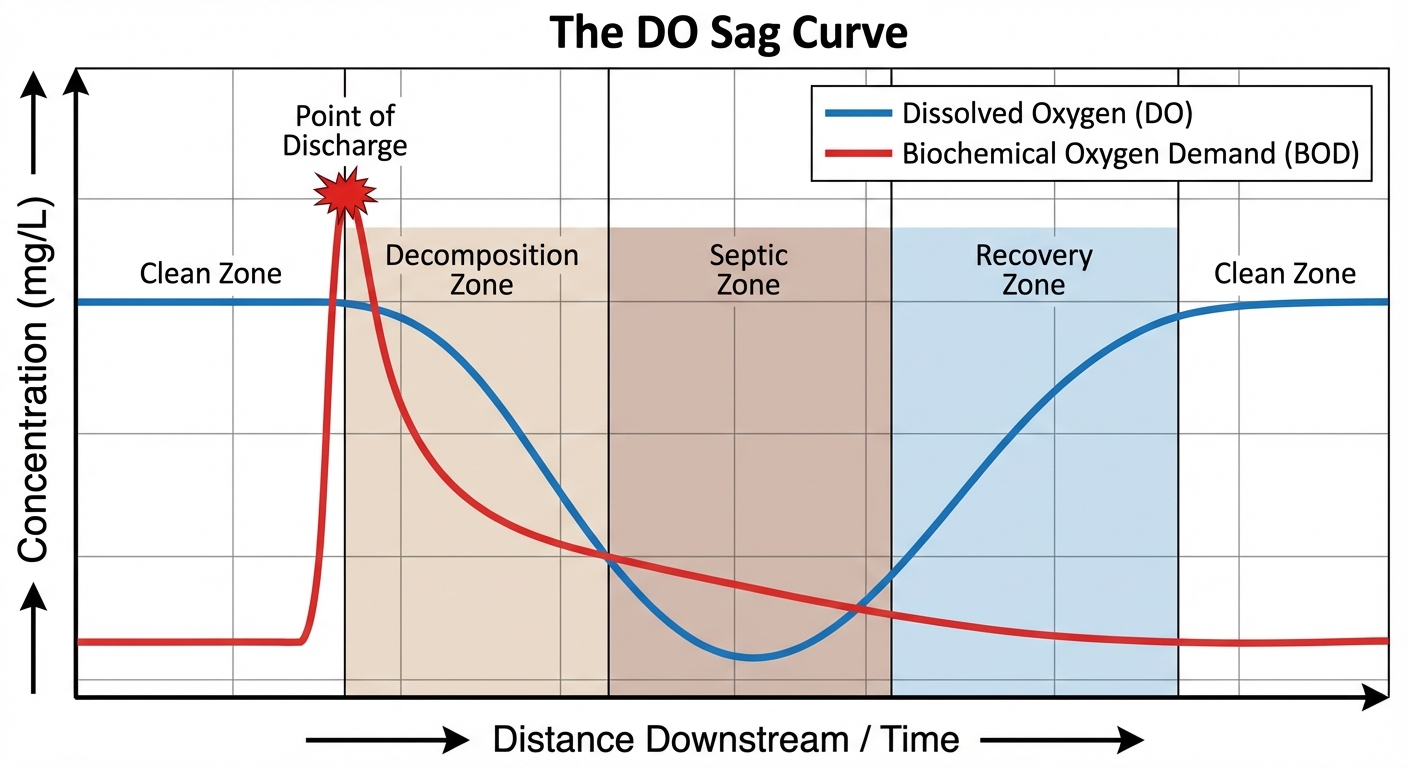
Dissolved Oxygen (DO) Sag Curve:
When organic waste (like sewage) enters a stream, biological oxygen demand (BOD) increases, and dissolved oxygen (DO) decreases drastically.
- Clean Zone: High DO, low BOD, high biodiversity (trout, bass).
- Decomposition/Pollution Zone: Waste enters. BOD spikes, DO drops. Trash fish (carp) survive.
- Septic Zone: Lowest DO levels. Only anaerobic organisms or fungi survive.
- Recovery Zone: Waste breaks down. DO begins to rise, BOD drops.
- Clean Zone: Ecosystem returns to normal.
8.3 & 8.7 Persistent Organic Pollutants (POPs) & Endocrine Disruptors
Persistent Organic Pollutants (POPs)
POPs are synthetic carbon-based compounds that do not easily break down in the environment.
- Characteristics:
- Fat-soluble (Lipophilic): They accumulate in fatty tissue.
- Resistant: They withstand biological, chemical, and photolytic degradation.
- Travel: Can travel long distances via wind and water (Grasshopper Effect), often ending up in the Arctic.
- Examples:
- DDT: Insecticide (now banned in many countries) used against mosquitoes.
- PCBs (Polychlorinated Biphenyls): Industrial fluid/coolant.
Endocrine Disruptors
Chemicals that interfere with the endocrine (hormone) system of animals.
- Mechanism: They mimic hormones (like estrogen) or block hormone receptors, preventing natural signaling.
- Consequences:
- Birth defects and developmental disorders.
- Gender Imbalance: Male fish developing female reproductive organs (intersex) in wastewater-contaminated streams.
- Reduced fertility/sperm counts in mammals.
- Common Disruptors:
- Atrazine: Common herbicide.
- DDT: Insecticide.
- Phthalates: Compounds used to make plastics flexible.
- Bisphenol A (BPA): Found in hard plastics/epoxy resins.
8.4 Human Impacts on Wetlands and Mangroves
Ecological Services of Wetlands
Wetlands (swamps, marshes, bogs) and Mangroves (coastal, salt-tolerant forests) provide critical services:
- Water Filtration: Plant roots trap sediment and absorb excess nutrients (N and P).
- Flood Control: Soils absorb excess water like a sponge, reducing storm surges.
- Biodiversity: Nurseries for fish, crustaceans, and birds.
Threats
- Commercial Development: Filling in wetlands for homes/malls.
- Dam Construction: Restricts water flow/sediment deposition needed to maintain wetlands.
- Pollution: Agricultural runoff carrying herbicides can kill wetland vegetation.
8.5 Eutrophication
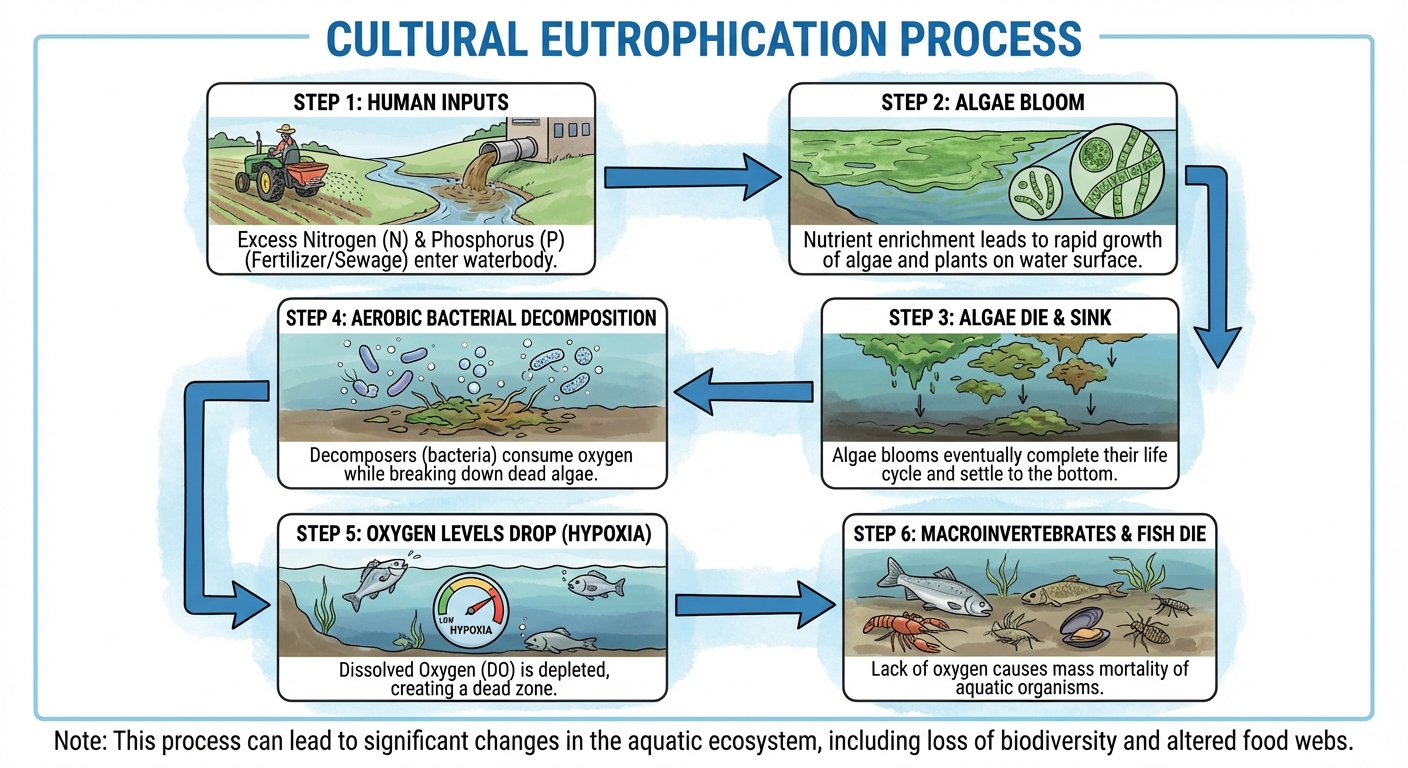
Eutrophication is the process of nutrient enrichment in a body of water.
The Step-by-Step Mechanism
- Nutrient Load: Excess Nitrogen ($N$) and Phosphorus ($P$) enter water via agricultural runoff (fertilizer) or wastewater.
- Algal Bloom: Nutrients cause a rapid explosion of algae populations on the surface.
- Sunlight Blockage: The thick algae mat blocks sunlight; accumulation of dead algae increases.
- Die-off: Algae eventually deplete nutrients and die.
- Decomposition: Aerobic bacteria in the water break down the dead algae.
- Oxygen Depletion (Hypoxia): The bacteria use up the Dissolved Oxygen (DO) during respiration.
- Dead Zone: DO levels drop too low to support life, leading to fish kills.
- Oligotrophic: Low nutrients, clear water, high oxygen, low productivity.
- Eutrophic: High nutrients, turbid water, potential for hypoxia, high productivity (algae).
8.6 Thermal Pollution
Thermal Pollution occurs when water is returned to a source at a temperature significantly higher or lower than ambient levels.
- Source: Power plants and industrial factories intake cool water to cool machinery/steam turbines and discharge hot water.
- Impact:
- Inverse Solubility: Warm water holds less Dissolved Oxygen (DO) than cold water.
- Thermal Shock: Sudden temperature changes kill organisms not adapted to the range.
- Solution: Use Cooling Towers to let water cool before discharging it back into the environment.
8.8 Bioaccumulation vs. Biomagnification
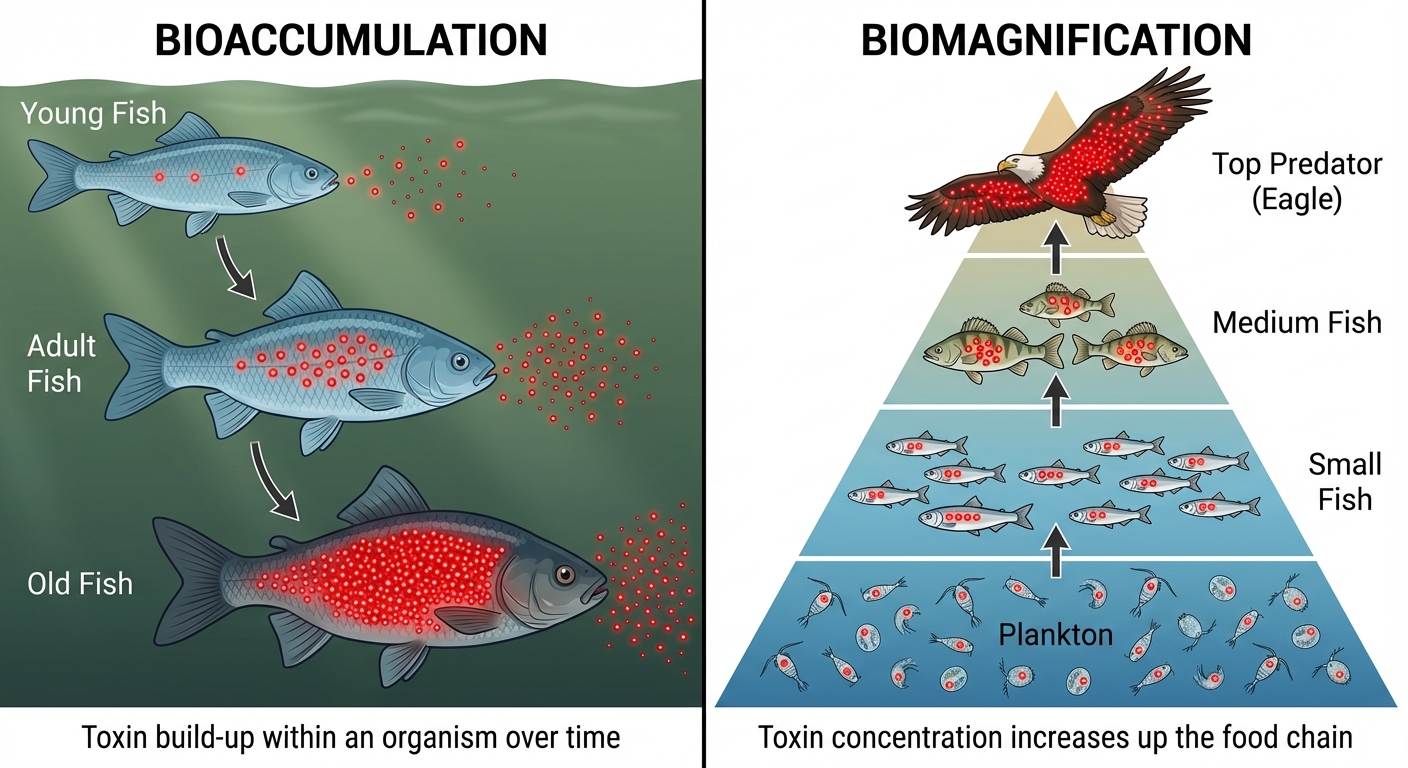
These terms describe how certain pollutants (like heavy metals and POPs) move through organisms. Use the mnemonic: "Accumulate in the individual, Magnify in the food chain."
Bioaccumulation
- Definition: The buildup of a substance in the tissue of a single organism over its lifespan.
- Why: The organism absorbs the toxin faster than it can excrete it (often because the toxin is fat-soluble).
- Example: A single tuna fish accumulating mercury in its muscle tissue over 10 years.
Biomagnification
- Definition: The increase in concentration of a toxin as it moves up the trophic levels (food chain).
- Mechanism: A predator eats many prey, inheriting the total toxic load of all the prey it consumed.
- Top Predators Impacted Most: Apex predators (eagles, humans, orcas) suffer the highest concentrations.
- Famous Case: DDT caused eggshell thinning in Bald Eagles, nearly leading to extinction.
8.9 Solid Waste Disposal
Municipal Solid Waste (MSW) is everyday "trash" created by homes and workplaces.
The Anatomy of a Sanitary Landfill
Modern landfills are engineered to protect the environment, unlike open dumps.
- Clay/Plastic Liner: Prevents pollutants from leaking into soil/groundwater.
- Leachate Collection System: Pipes collect Leachate (liquid trash juice) that settles at the bottom, helping pump it out for treatment.
- Methane Collection System: Anaerobic decomposition of organic waste produces methane ($CH_4$). Pipes collect this gas to be flared (burned) or used to generate electricity (Waste-to-Energy).
- Cap: When full, the landfill is covered with soil/clay to keep water out and pests away.
Problems with Landfills
- Leachate: Can contaminate groundwater if liners fail.
- Methane: Potent greenhouse gas.
- NIMBY (Not In My Backyard): Communities do not want landfills nearby.
Other Disposal Methods
- Incineration: Burning waste. Reduces volume by 90% and can generate heat/electricity, but releases air pollutants (PM, Dioxins) and creates toxic ash.
- Ocean Dumping: Illegal in many places but contributes to the Great Pacific Garbage Patch (gyres concentrate floating plastic, which photodegrades into microplastics).
8.10 Waste Reduction Methods
The hierarchy of waste management (from best to worst):
- Refuse/Reduce: Don't create waste in the first place (e.g., lightweighting packaging).
- Reuse: Use item again for same function.
- Recycle: Process materials into new products. Requires energy and money.
- Pros: Reduces demand for raw materials (mining/logging).
- Cons: Energy intensive; market fluctuations make some materials unprofitable to recycle.
- Composting: Microbial decomposition of organic waste (food scraps, yard trimmings) into humus-rich fertilizer.
- Benefit: Reduces methane in landfills.
E-Waste (Electronic Waste)
Contains heavy metals (lead, mercury, cadmium). Often exported to developing countries for uncontrolled recycling, causing severe health hazards.
8.11 Sewage Treatment
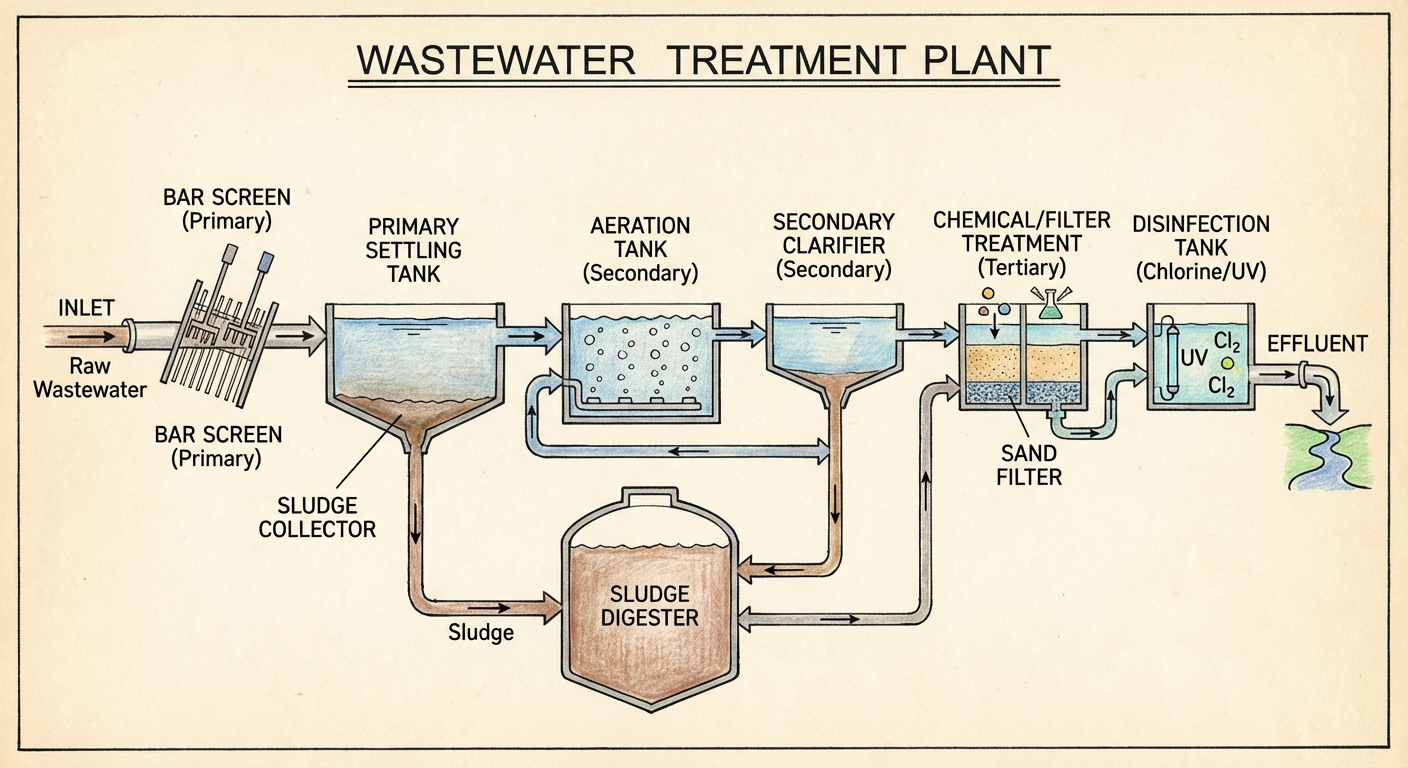
Wastewater treatment plants (WWTPs) process sewage before releasing it into nature. You MUST know the stages.
Primary Treatment (Physical)
- Goal: Remove large solids.
- Steps:
- Screens: Catch sticks, grit, and plastic.
- Settling Tank: Gravity allows sludge to sink and oils/grease to float.
Secondary Treatment (Biological)
- Goal: Break down organic matter (feces, food) into $CO_2$ and sludge.
- Mechanism: Aeration Tanks pump oxygen to encourage bacteria to decompose organic waste.
- Clarifier: Remaining bacteria settle out.
Tertiary Treatment (Chemical/Ecological)
- Goal: Remove remaining impurities, specifically nutrients ($N$ and $P$).
- Mechanism: Chemical filters or artificial wetlands. Crucial to prevent cultural eutrophication downstream.
Disinfection
- Goal: Kill pathogens (bacteria/viruses) before discharge.
- Methods: Chlorine, Ozone, or UV Light.
8.12 Lethal Dose 50% (LD50)
Toxicology is the study of poisons and their effects on organisms.
Dose-Response Curve
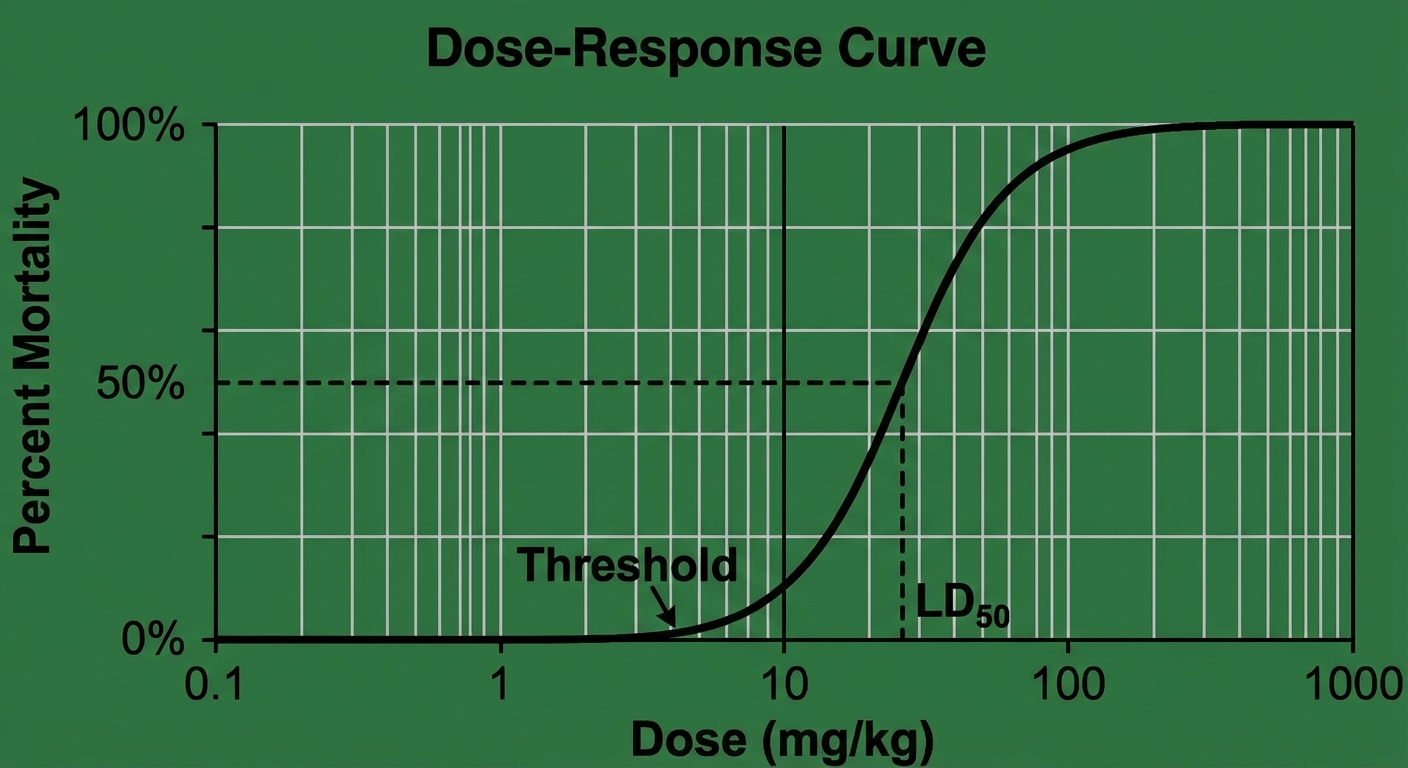
A graph showing the relationship between the dose of a chemical and the effect on a population.
- LD50 (Lethal Dose 50%): The dose of a chemical that kills 50% of the test population.
- Important Rule: A lower LD50 means the substance is more toxic (it takes less of it to kill you).
- ED50 (Effective Dose 50%): The dose that causes a non-lethal effect (e.g., infertility, dizziness) in 50% of the population.
- Threshold Level: The maximum dose with no observable effect. The point just before the curve rises.
8.13 - 8.15 Pollution and Human Health
Pathogens and Infectious Diseases
Water pollution creates breeding grounds for vectors and typically spreads dysentery.
- Dysentery: Caused by untreated sewage in streams. Severe diarrhea/dehydration.
- Cholera: Bacterial infection from contaminated water.
- Vectors: Organisms that transmit disease (e.g., mosquitoes transmit Malaria, Zika, West Nile).
- Link to Unit 8: Stagnant water (like water in old tires in landfills) allows mosquitoes to breed.
Specific Pollutant Health Impacts
- Mesothelioma: Cancer of the lung lining caused by Asbestos (insulation material).
- Lead: Neurotoxin found in old paint and pipes; causes brain damage.
- Mercury: Neurotoxin from coal burning; biomagnifies in fish; causes neurological damage (Minamata Disease).
Important Legislation (Know Acronyms!)
| Legislation | Key Function |
|---|---|
| Clean Water Act (CWA) | Regulates discharges of pollutants into US waters/surface waters. Sets wastewater standards. |
| Safe Drinking Water Act (SDWA) | Sets standards for drinking water quality (tap water) and groundwater safety. |
| RCRA (Resource Conservation & Recovery Act) | "Cradle-to-Grave" management of hazardous waste (monitoring from creation to disposal). |
| CERCLA (Superfund) | Funds the cleanup of hazardous waste sites (e.g., Love Canal) when polluter is unknown or bankrupt. |
| Delaney Clause | Part of Food, Drug, and Cosmetic Act. Prohibits cancer-causing additives in food. |
Final Common Mistakes for Unit 8
- Confusing CWA and SDWA: The CWA is about keeping rivers clean for fishing/swimming (nature). The SDWA is about the water coming out of your tap (human consumption).
- Confusing Leachate and Runoff: Runoff flows over the land into rivers. Leachate percolates through trash in a landfill into groundwater.
- Mixing up Bioaccumulation and Biomagnification: If the question is about one fish getting sicker as it grows, it's accumulation. If it's about an eagle getting sick from eating fish, it's magnification.
- Tertiary Treatment: Students often forget that secondary treatment removes organics, but tertiary is required to remove specific nutrients (N/P) to stop algal blooms.