Unit 7 Review: Expansionism, Empire, and Domestic Reform (1890–1945)
American Imperialism
The Shift from Isolationism to Expansionism
American Imperialism refers to the economic, military, and cultural influence of the United States on other countries, marking a distinct shift from the isolationist tendencies of the 19th century toward becoming a global power.
Following the Closure of the Frontier (declared in the 1890 census and analyzed by Frederick Jackson Turner), Americans looked outward for new opportunities. This shift was driven by three main factors:
- Economic: The Second Industrial Revolution created a surplus of goods. The U.S. needed new markets to sell products and new sources of raw materials.
- Military/Strategic: Influenced by Alfred Thayer Mahan’s The Influence of Sea Power Upon History, the U.S. began building a modern navy (the "Great White Fleet") and sought island bases for refueling.
- Ideological: Concepts of Social Darwinism and the "White Man’s Burden" (a phrase coined by Rudyard Kipling) provided a moral justification for expansion, suggesting that the U.S. had a duty to "civilize" non-Western nations.
The Spanish-American War (1898)
Often called the "Splendid Little War," this conflict marked the arrival of the U.S. as a world power.
Causes:
- Cuban Independence: Sympathy for rebels fighting Spanish rule.
- Yellow Journalism: Sensationalized reporting by Joseph Pulitzer and William Randolph Hearst that exaggerated Spanish atrocities to sell newspapers.
- The De Lôme Letter: A Spanish diplomat criticized President McKinley.
- U.S.S. Maine: The explosion of this battleship in Havana Harbor was blamed on Spain without evidence.
Effects (Treaty of Paris, 1898):
- The U.S. acquired Guam, Puerto Rico, and the Philippines.
- Cuba became independent but was subject to the Platt Amendment, which allowed U.S. intervention and established Guantanamo Bay.
- Debate: The annexation of the Philippines caused a fierce domestic debate involving the Anti-Imperialist League (members included Mark Twain and Andrew Carnegie), who argued that ruling over others violated the Declaration of Independence.
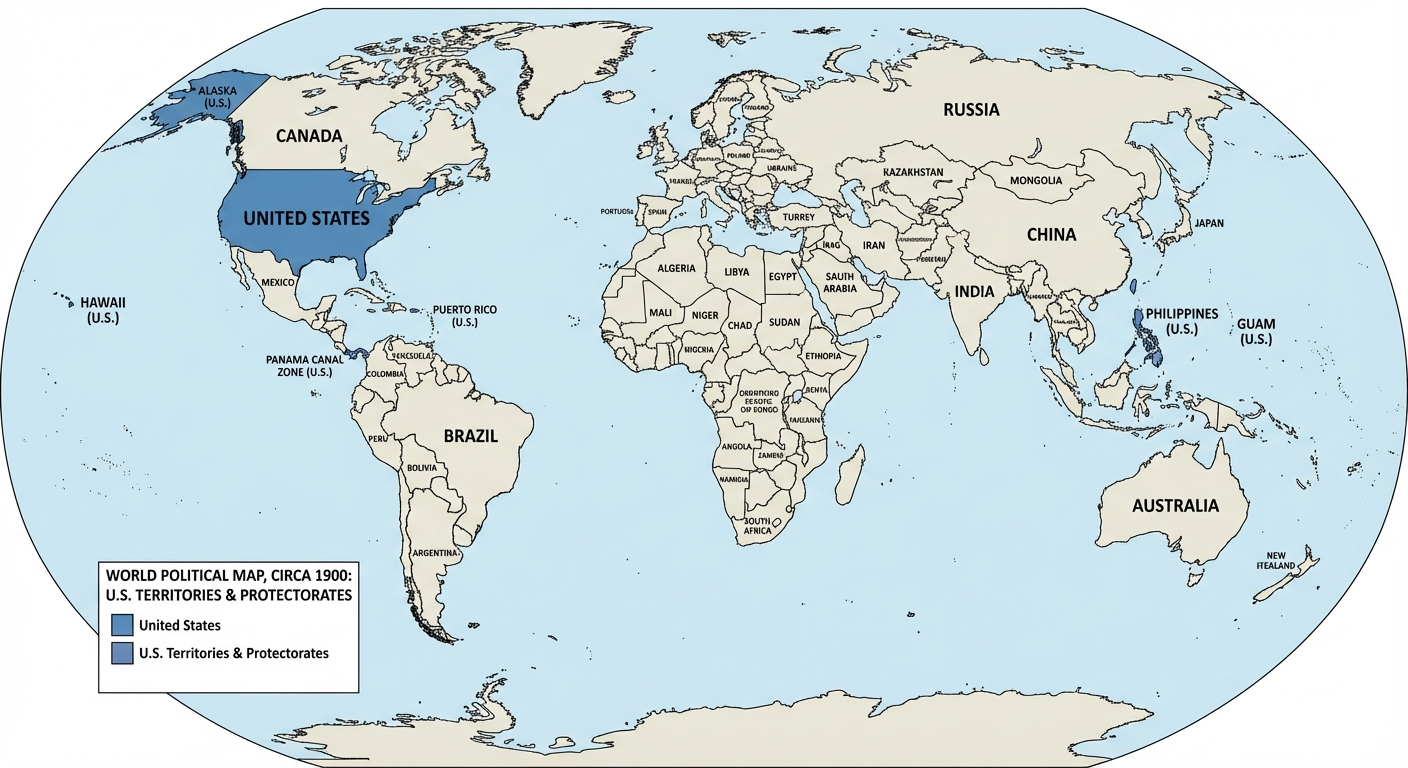
Foreign Policy Doctrines (1901–1917)
Major Presidents of this era utilized different methods to enforce U.S. power, particularly in Latin America.
| President | Policy Name | Description | Example |
|---|---|---|---|
| Theodore Roosevelt | Big Stick Diplomacy | "Speak softly and carry a big stick." Relied on military intimidation. | Roosevelt Corollary: The U.S. would act as a police power in Latin America to collect debts (extensions of the Monroe Doctrine). |
| William Howard Taft | Dollar Diplomacy | Encouraged U.S. businesses to invest in foreign regions to stabilize them and gain influence. | Investment in Nicaragua and Honduras railroads. |
| Woodrow Wilson | Moral Diplomacy | The U.S. would only support nations with similar moral/democratic beliefs. | Intervention in the Mexican Revolution. |
The Progressive Era
Roots of Progressivism
The Progressive Era (approx. 1890–1920) was a period of widespread social activism and political reform across the United States.
Definition: A movement by the urban middle class to use government power to correct the social and economic problems caused by industrialization, urbanization, and corruption.
There is a distinct difference between the Progressive movement and the earlier Populist movement:
- Populists: Rural, agrarian, focused on farmers' needs (silver coinage).
- Progressives: Urban, middle-class, focused on city issues and business regulation.
The Muckrakers
Progressivism was fueled by Muckrakers, investigative journalists who exposed corruption and societal ills.
- Upton Sinclair (The Jungle): Exposed unsanitary conditions in the meatpacking industry. Led directly to the Meat Inspection Act and Pure Food and Drug Act (1906).
- Jacob Riis (How the Other Half Lives): Used photography to document squalor in NYC tenements.
- Ida Tarbell (The History of the Standard Oil Company): Exposed the predatory business practices of John D. Rockefeller.
- Lincoln Steffens: Exposed political machine corruption in cities.
Environmental Policies: Conservation vs. Preservation
Under Theodore Roosevelt, the environment became a policy priority, but there was a philosophical divide.
- Conservation (Gifford Pinchot): The environment should be used wisely for the benefit of humanity (sustainable logging, mining). This was the dominant federal policy.
- Preservation (John Muir): Nature should be left untouched for its own sake. Led to the creation of the National Park Service (1916).
Progressive Reform Movements
Political Reforms (Expanding Democracy)
State-level reformers, such as Robert La Follette (author of the "Wisconsin Idea"), pushed for measures to break the power of political machines and increase voter participation.
- Secret Ballot: Prevented voter intimidation.
- Direct Primary: Voters, not party bosses, choose candidates.
- Initiative: Voters can propose laws.
- Referendum: Voters can vote directly on laws.
- Recall: Voters can remove elected officials early.
Federal Legislation and Amendments
The era culminated in four major Constitutional Amendments:
- 16th Amendment: Federal Income Tax (allowed for government revenue aside from tariffs).
- 17th Amendment: Direct election of Senators (previously chosen by state legislatures).
- 18th Amendment: Prohibition of alcohol (the result of the Temperance movement).
- 19th Amendment: Women's Suffrage (1920).
African American Civil Rights in the Progressive Era
Progressive reforms generally ignored African Americans. In the face of Jim Crow Laws and rising lynching, two major schools of thought emerged.
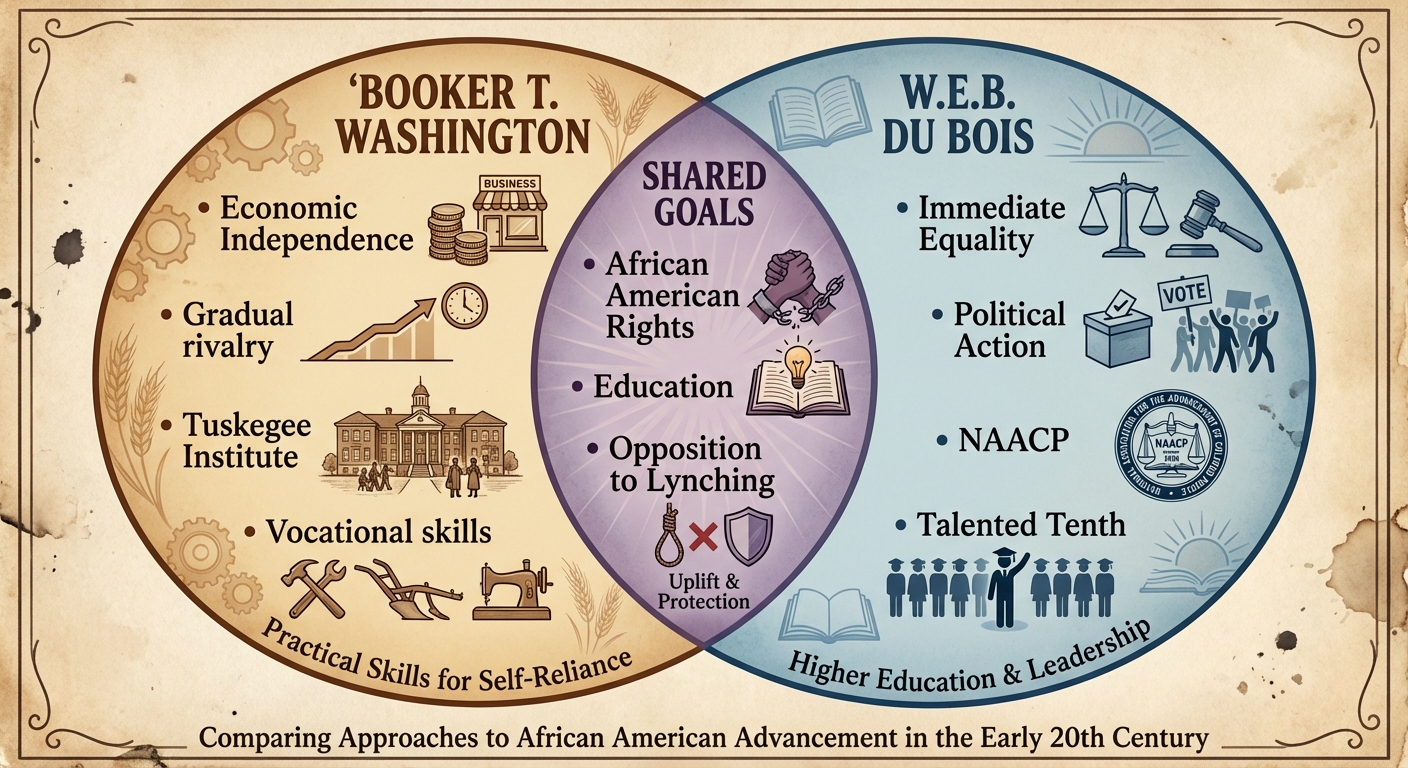
Booker T. Washington (Atlanta Compromise):
- Advocated for vocational training and economic self-reliance.
- Argued that African Americans should accept segregation temporarily and prove their economic worth to gain equality eventually.
- Founder of the Tuskegee Institute.
W.E.B. Du Bois (Niagara Movement/NAACP):
- Demanded immediate political and social equality.
- Argued for the "Talented Tenth"—the top 10% of educated Black men should lead the race.
- Critical of Washington's accommodationist stance.
Trust Busting and Economic Regulation
Presidents Roosevelt, Taft, and Wilson sought to regulate monopolies.
- Sherman Antitrust Act (1890): Originally used against unions, TR began using it to break up "bad trusts" (monopolies that harmed the public), starting with the Northern Securities Company.
- Clayton Antitrust Act (1914): Strengthened the Sherman Act and specifically exempted labor unions from being prosecuted as trusts.
- Federal Reserve Act (1913): Created a central banking system to regulate the money supply and stabilize the economy.
Common Mistakes & Pitfalls
- Confusing "Trust Busting" Stances: Students often think TR broke up all trusts. He distinguished between "Good Trusts" (efficient, public benefit) and "Bad Trusts." Surprisingly, Taft actually prosecuted more trusts than Roosevelt.
- Populist vs. Progressive: A common error is swapping these groups. Remember: Populist = Farmers/Rural (1890s); Progressive = Middle Class/Urban (1900–1920).
- The Timing of Suffrage: Students often assume the 19th Amendment happened earlier. It wasn't ratified until 1920, largely influenced by women's contributions during WWI, marking the very end of the Progressive Era.
- Washington vs. Du Bois: Do not mix them up. Washington = Economic/Gradual; Du Bois = Political/Immediate.
- Isolationism: While the U.S. became imperialist, it did not fully abandon isolationism regarding European affairs until WWI. The U.S. was interventionist in Latin America/Asia but hesitant to join European alliances.