Unit 2: The Transition from Enslavement to Citizenship
The Civil War and African American Agency
The Civil War (1861–1865) was not merely a conflict between white armies; it was a revolution in which enslaved people played a pivotal role in their own liberation. While President Abraham Lincoln initially framed the war as a struggle to preserve the Union, African American resistance and military necessity shifted the focus toward abolition.
Self-Emancipation and the Contraband Acts
Long before the government officially declared emancipation, enslaved people forced the issue by fleeing to Union lines.
- Contraband of War: In 1861, General Benjamin Butler declared that fugitive enslaved people were "contraband of war" (seized enemy property) rather than returning them to Confederate owners as required by the Fugitive Slave Act. This legal loophole allowed the Union to shield self-emancipating refugees.
- Confiscation Acts: Congress passed acts in 1861 and 1862 authorizing the seizure of Confederate property, including enslaved people, effectively legalizing this military strategy.
The Emancipation Proclamation
Issued on January 1, 1863, this executive order is often misunderstood. It dramatically altered the purpose of the war.
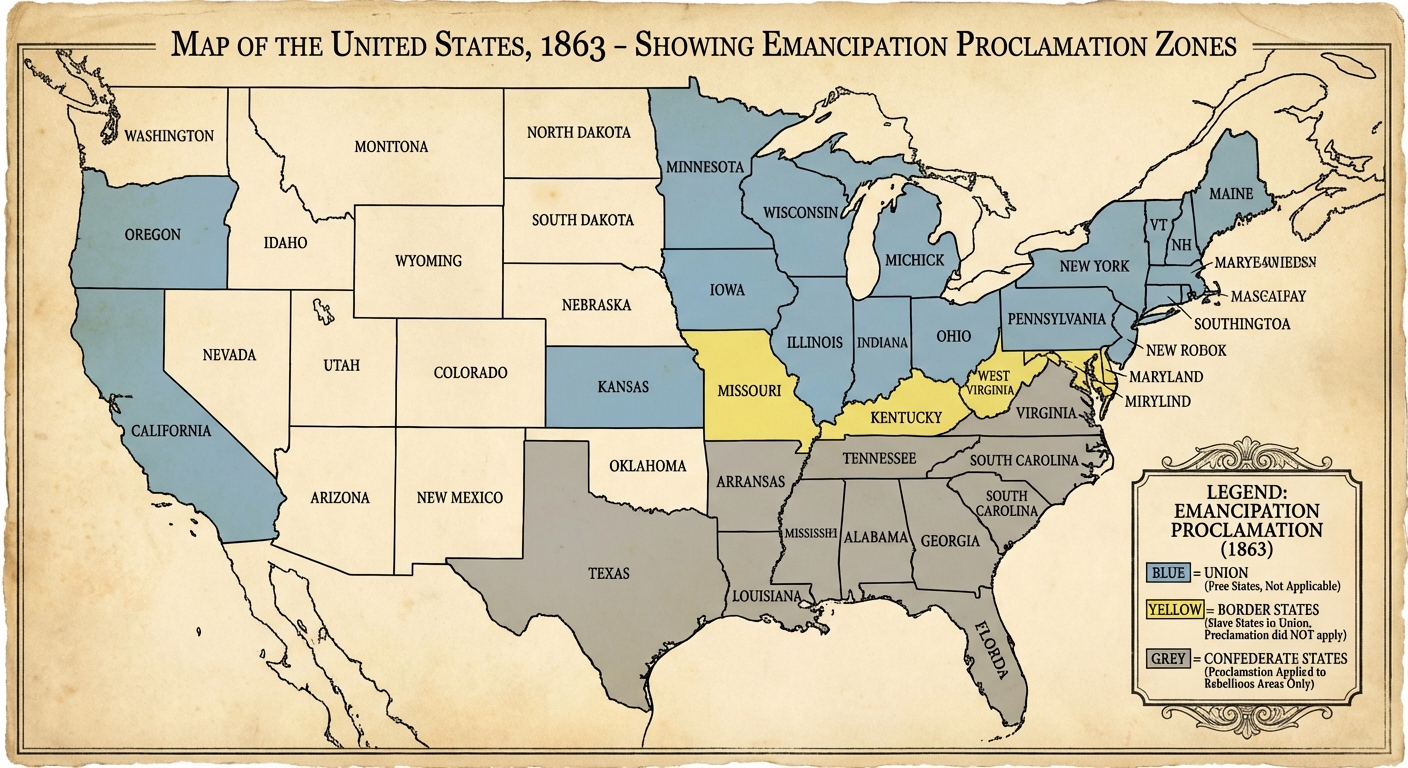
- Scope: It declared enslaved people free only in states (or parts of states) currently in rebellion against the Union.
- limitations: It did not free enslaved people in the Border States (Maryland, Delaware, Kentucky, Missouri) that had remained in the Union, nor in Union-occupied Confederate territory.
- Strategic Impact: It prevented Britain and France from intervening on the side of the Confederacy and authorized the recruitment of Black soldiers.
African American Military Service
Over 200,000 African Americans served in the United States Colored Troops (USCT) and the Navy.
- The 54th Massachusetts: One of the first official Black units in the U.S. armed forces. Their assault on Fort Wagner proved the bravery and capability of Black soldiers to a skeptical white public.
- Inequality: Black soldiers initially received lower pay ($10/month vs. $13/month for whites) and fewer opportunities for officer commissions, leading to protests and eventual equalization of pay in 1864.
Reconstruction and Its Aftermath (1865–1877)
Reconstruction refers to the period immediately following the Civil War, focused on reintegrating the Southern states and defining the rights of four million newly freed people. It is often divided into Presidential Reconstruction (lenient toward the South) and Radical Reconstruction (focused on racial equality).
The Reconstruction Amendments
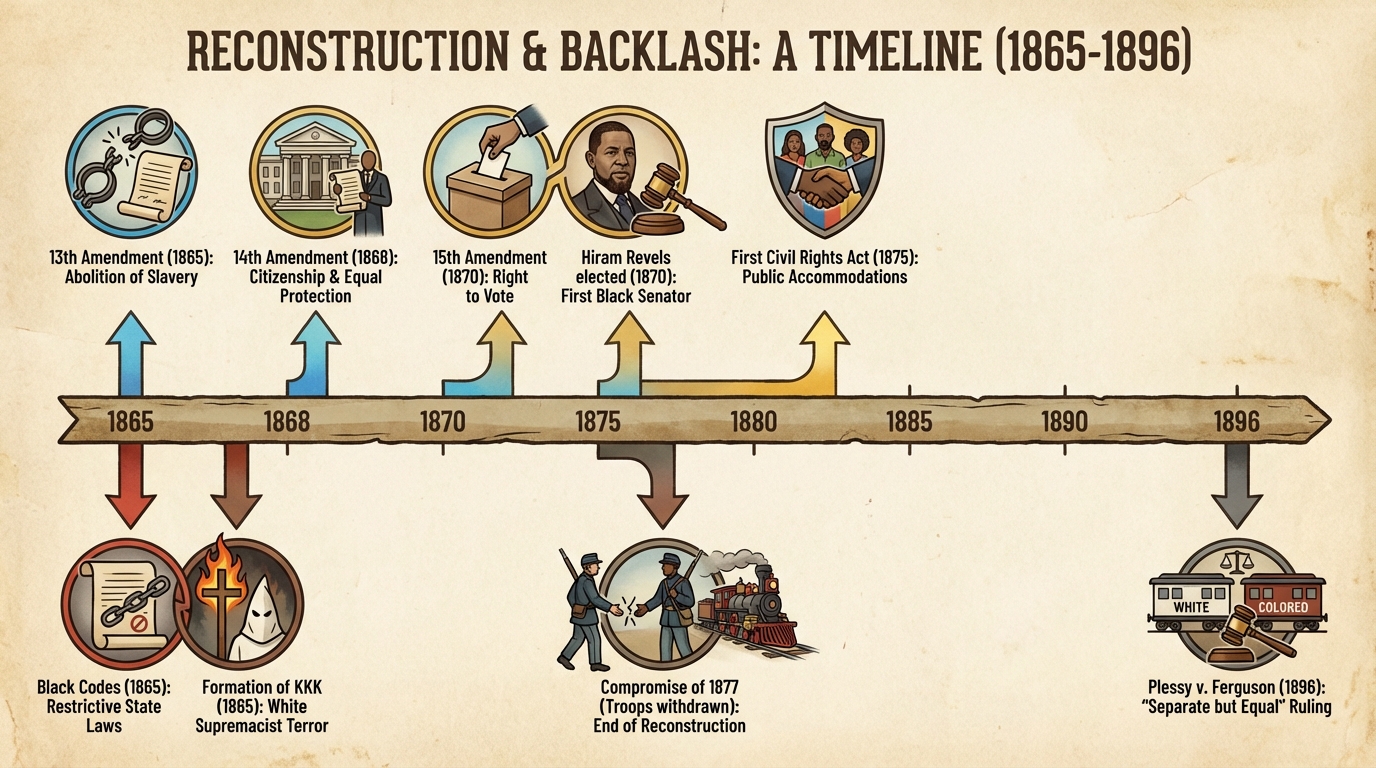
These three constitutional amendments permanently altered the legal status of African Americans. A common mnemonic to remember them in order is "Free, Citizens, Vote."
| Amendment | Year Ratified | Key Provision | Limitation |
|---|---|---|---|
| 13th | 1865 | Abolished slavery and involuntary servitude. | Exception clause: Slavery allowed as "punishment for crime." |
| 14th | 1868 | Established Birthright Citizenship and Equal Protection under the law. | Did not explicitly guarantee voting rights; often ignored by states. |
| 15th | 1870 | Prohibited denying the right to vote based on race, color, or previous servitude. | Did not prohibit voting restrictions based on gender, literacy, or wealth. |
The Freedmen’s Bureau
Established in 1865, the Bureau of Refugees, Freedmen, and Abandoned Lands was the first large-scale federal welfare agency.
- Successes: Its greatest achievement was in education. It founded over 4,000 schools and laid the groundwork for Historically Black Colleges and Universities (HBCUs) like Howard, Fisk, and Atlanta University.
- Failures: It failed to secure long-term economic independence for freedpeople. General William T. Sherman's Special Field Order No. 15 (promising "40 acres and a mule") was revoked by President Andrew Johnson, forcing many Black families back onto plantations as laborers.
Black Political Power
During Radical Reconstruction, African Americans exercised political power for the first time.
- Hiram Revels: The first African American to serve in the U.S. Senate (filling the seat formerly held by Jefferson Davis).
- Blanche K. Bruce: The first African American to serve a full term in the U.S. Senate.
- Over 2,000 African Americans held public office, ranging from local school boards to the U.S. Congress, helping to rewrite state constitutions to include public education and universal male suffrage.
Black Codes, Jim Crow, and the Backlash
As African Americans gained rights, white Southerners responded with violence and legal restrictions to re-establish white supremacy.
Black Codes vs. Jim Crow Laws
Students often confuse these two distinct legal periods.
- Black Codes (1865–1866): Immediate post-war laws passed by Southern states to restrict Black labor and activity. They aimed to replicate slavery by compelling Black people to sign annual labor contracts and arresting them for "vagrancy" (homelessness) if they refused.
- Jim Crow Laws (Post-1877 through 1960s): A formalized system of state and local laws creating racial segregation in public facilities, transportation, and schools. Defined by the phrase "Separate but Equal."
Economic Subjugation: Sharecropping
With the failure of land redistribution, a new labor system emerged.
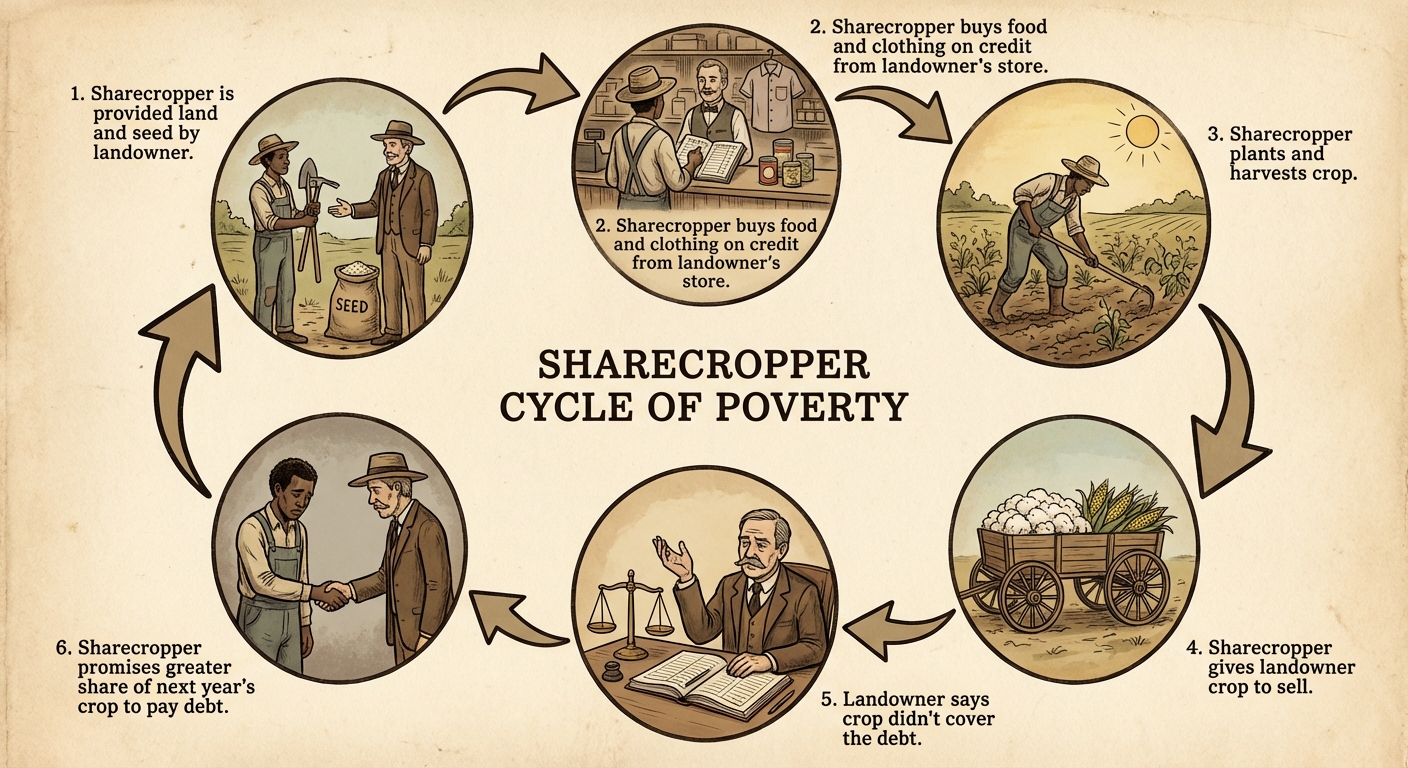
- Sharecropping: Landless Black families farmed a portion of a white landowner's land in exchange for a share of the crop.
- The Debt Cycle: Landowners inflated the cost of supplies (seeds, tools) sold on credit. High interest rates and fraudulent accounting often left sharecroppers in perpetual debt, unable to leave the land—a condition known as debt peonage.
- Convict Leasing: Leveraging the 13th Amendment's loophole, Southern states arrested Black men for minor crimes (like loitering) and leased their labor to private companies (mines, railroads). This system generated revenue for states and provided cheap, disposable labor.
The End of Reconstruction and Disenfranchisement
Reconstruction formally ended with the Compromise of 1877. Following a disputed presidential election, Republicans agreed to withdraw federal troops from the South in exchange for Rutherford B. Hayes becoming President. This removed the last protection for Black citizens.
Tools of Disenfranchisement:
To bypass the 15th Amendment, Southern states implemented:
- Poll Taxes: Fees required to vote (excluding the poor).
- Literacy Tests: Impossible exams administered subjectively to Black voters.
- Grandfather Clauses: Exempted men from tests/taxes if their grandfathers could vote before 1867 (allowing poor whites to vote while blocking Black citizens).
Plessy v. Ferguson (1896)
The legal nadir (low point) occurred when the Supreme Court ruled in Plessy v. Ferguson that segregation was constitutional as long as facilities were "separate but equal," cementing Jim Crow for decades.
Common Mistakes & Pitfalls
- Confusing the Emancipation Proclamation with the 13th Amendment: Remember, the Proclamation was a wartime military order focused on rebelling states. The 13th Amendment is what legally abolished slavery nationwide.
- Assuming the North was entirely anti-racist: While the Union fought against the Confederacy, many Northerners (and Union soldiers) held racist views and opposed Black equality. Discrimination existed in the North as well (e.g., the New York City Draft Riots).
- Viewing Reconstruction as a total failure: While it ended in the withdrawal of protections, Reconstruction succeeded in establishing Black institutions (families, churches, schools) and constitutional amendments that would later be the basis for the Civil Rights Movement.