Unit 3 Study Guide: Perspectives, Reasoning, and Argumentation
Anatomy of an Argument: Claims and Lines of Reasoning
In AP English Language, you move beyond simply defining "argument" to understanding its architecture. An argument is not a shouting match; it is a structured progression of ideas intended to persuade an audience.
Defining the Claim
A claim is a statement that asserts a perspective, position, or truth that is open to challenge. It is the destination where you want your reader to arrive.
- Fact vs. Claim:
- Fact: "School starts at 8:00 AM." (Not arguable)
- Claim: "School start times should be delayed to improve student cognitive function." (Arguable)
The Line of Reasoning
The line of reasoning is the organizational arrangement of claims and evidence that leads to a conclusion. Think of it as the path the author lays down for the audience to follow.
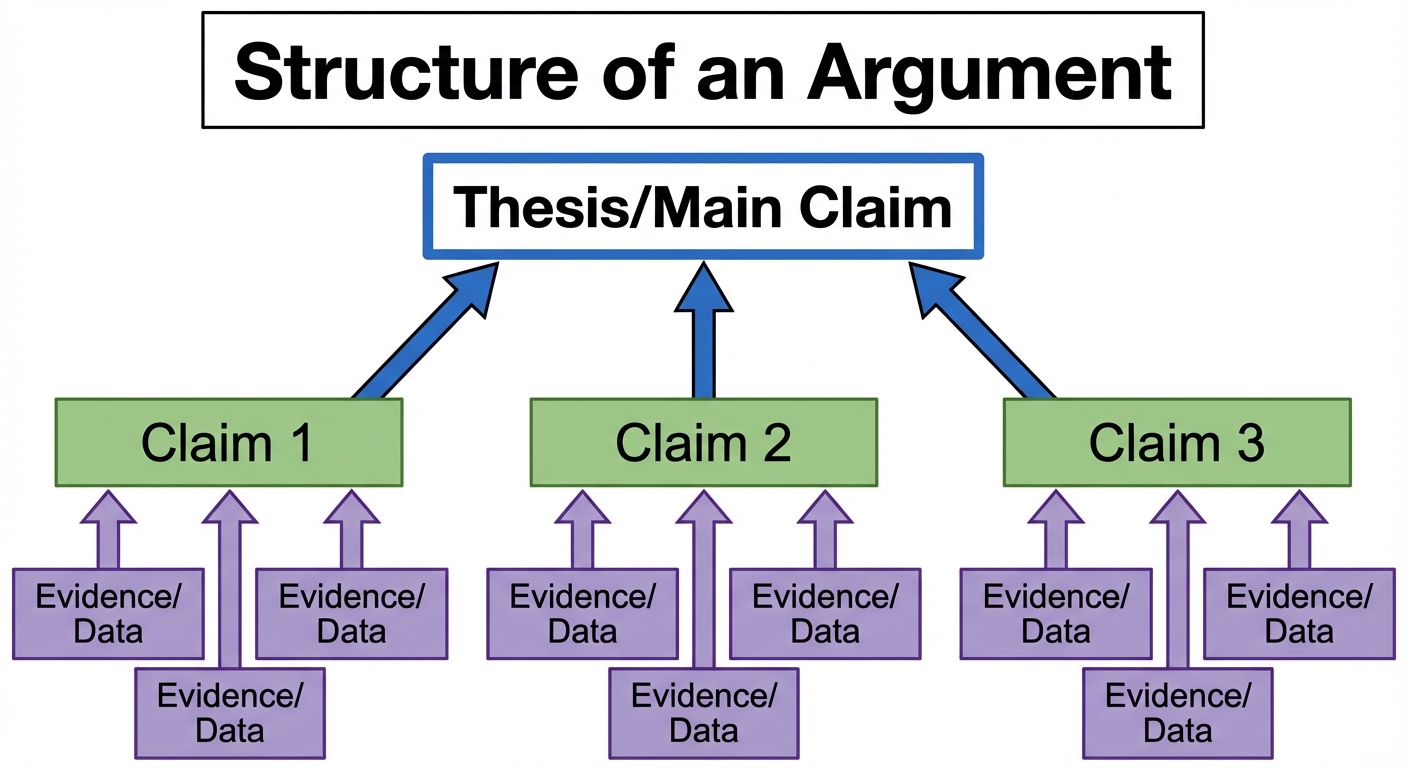
- Effective Reasoning: The claims build upon one another logically. Claim A supports the Main Thesis; Claim B supports Claim A; Evidence supports Claim B.
- Perspective Interaction: A strong line of reasoning often acknowledges opposing perspectives (counterarguments) to refute or qualify them, showing the author understands the complexity of the issue.
Example: Social Media Analysis
Consider the prompt: "Does social media strengthen or weaken human communication?"
- Thesis (The Main Position): While social media increases the volume of connection, it weakens the quality of communication by replacing nuance with algorithmic curation.
- Claim 1 (Support): Digital interfaces strip away non-verbal cues necessary for empathy.
- Claim 2 (Support): The "echo chamber" effect polarizes perspectives rather than bridging them.
Logical Fallacies: Flaws in Reasoning
To analyze an argument effectively (or write your own), you must be able to spot where the line of reasoning breaks. Logical fallacies are errors in reasoning that undermine the logic of an argument.
Common Fallacies in Unit 3
Unit 3 focuses heavily on causal relationships and generalizations. Watch out for these:
Slippery Slope: Assumes that one minor event will inevitably lead to a catastrophic chain reaction without evidence.
- Flawed: "If schools ban junk food, next they'll control everything students eat at home, and eventually we will live in a total dictatorship."
- Fix: Stick to the immediate consequences (e.g., health benefits, cafeteria revenue).
Post Hoc Ergo Propter Hoc (False Cause): Assumes that because Event B followed Event A, Event A caused Event B.
- Flawed: "I wore my red socks and we won the game; therefore, my red socks cause us to win."
- Fix: Establish a logical mechanism for the cause, not just a timeline.
Hasty Generalization: Drawing a broad conclusion based on a small or unrepresentative sample.
- Flawed: "My grandfather smoked and lived to be 90; therefore, smoking isn't bad for you."
- Fix: Use broad, verifiable data (e.g., CDC statistics).
Integrating Sources and Evidence
In the Synthesis Essay and Research Paper, you are not just compiling quotes—you are entering a conversation. This is often called Source Synthesis.
The "Quote Sandwich" Method
Never drop a quote into a paragraph without context. Use the sandwich method to integrate evidence smoothly:
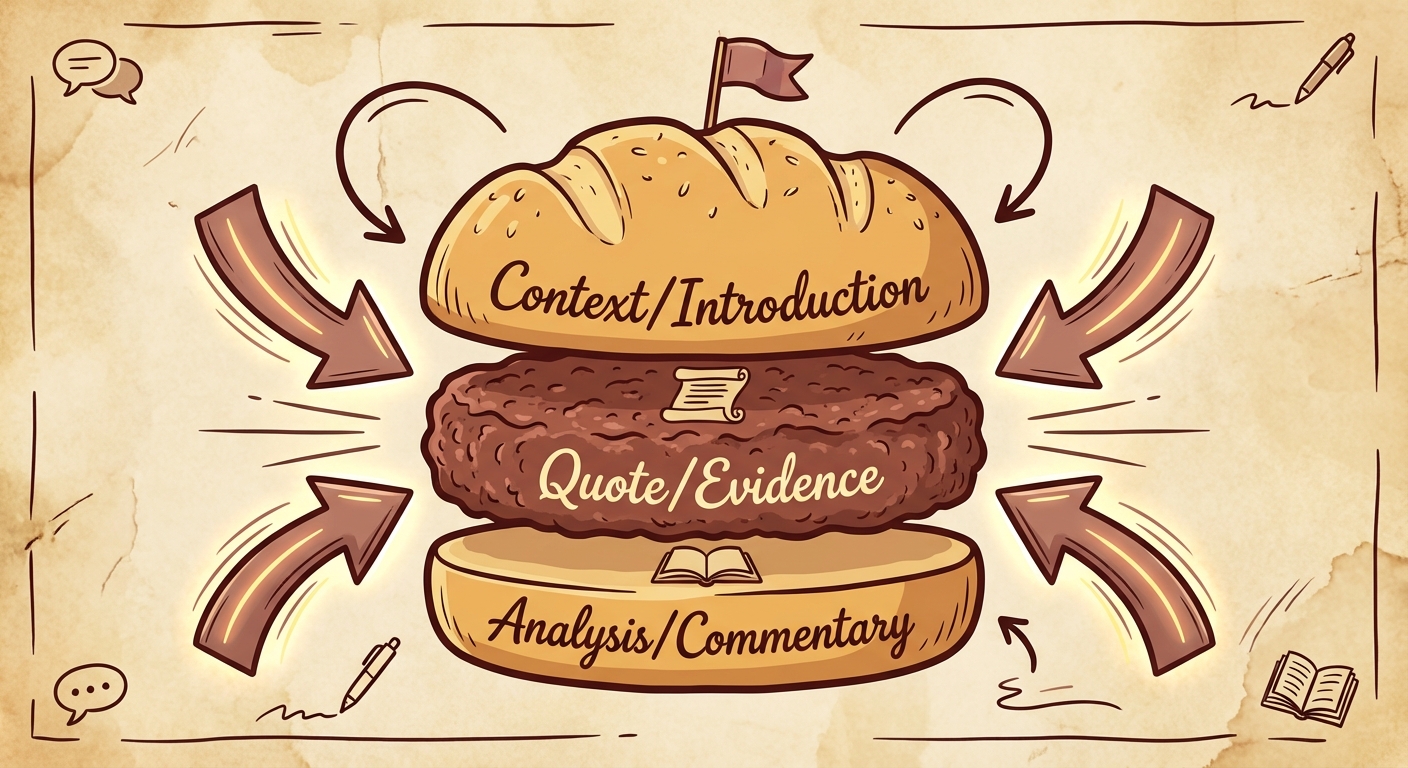
- Top Bun (Context/Lead-in): Introduce the speaker and the context of the quote.
- Meat (The Evidence): The direct quote or paraphrase.
- Bottom Bun (Commentary): Explain how this support your claim. This is the most important part.
Attribution and Citation
Proper attribution builds credibility (Ethos). You must signal to the reader whose ideas you are borrowing.
| Citation Type | Example | Usage Note |
|---|---|---|
| Signal Phrase | According to a 2021 UN Climate Report… | Builds authority before the data is presented. |
| Parenthetical | …losses could reach $23 trillion (UN, 2021). | Use for strictly data-heavy points to maintain flow. |
| Embedded | King argues that injustice is a "threat to justice everywhere," emphasizing the interconnectedness of society. | Best for rhetorical analysis; blends their voice with yours. |
Common Mistake: Avoid vague attribution like "A report says." Be specific: "The 2019 National Education Association study indicates…"
Methods of Development
Writers choose specific organizational patterns to support their arguments. Unit 3 focuses on specific methods that help clarify perspectives.
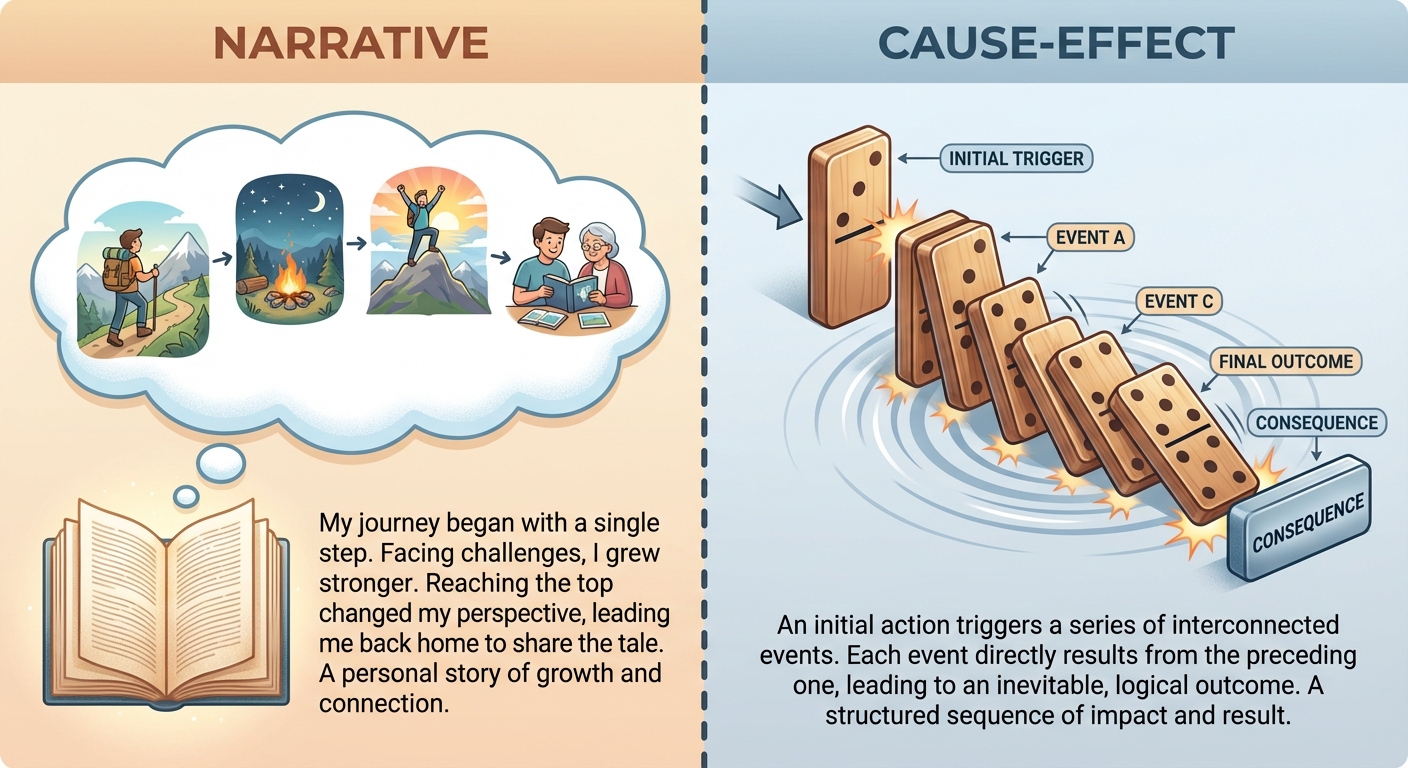
1. Cause-Effect Method
This method analyzes why something happens or what will happen as a result. It is essential for arguments regarding policy or history.
- Usage: To predict consequences or diagnose a problem.
- Example Topic: Urbanization.
- Drafting: "As cities expand (Cause), deforestation increases (Effect 1), which leads to biodiversity loss (Effect 2) and creates 'heat islands' that raise local temperatures (Effect 3)."
- Tip: Distinguish between immediate causes (the spark) and underlying causes (the fuel).
2. Narrative Method
This method uses storytelling, anecdotes, or personal experience to illustrate a point. While anecdotes are not scientific data, they are powerful for emotional appeal (Pathos) and establishing context.
- Usage: To make an abstract issue concrete and relatable.
- Example Topic: The Cost of Healthcare.
- Drafting: Instead of listing insurance statistics immediately, a writer opens with the story of a specific family forced to choose between rent and medication. This frames the ensuing argument.
Syntactic Structures: Connecting Perspectives
Grammar is rhetorical. The way you connect independent clauses determines the relationship between ideas. Unit 3 emphasizes using syntax to show how perspectives relate.
Coordination vs. Subordination
Coordination (Fanboys/Semicolons): Gives ideas equal weight.
- Example: "The proposal is expensive; however, the long-term benefits are undeniable."
- Effect: Suggests a balance between cost and benefit.
Subordination (Although, Because, Since): Makes one idea dependent on the other.
- Example: "Although the proposal is expensive, the long-term benefits make it necessary."
- Effect: Concedes the cost but prioritizes the benefit. This is crucial for nuance.
Summary of Common Mistakes
Confusing Topic with Claim:
- Wrong: "This paper is about the death penalty." (Topic)
- Right: "The death penalty is an ineffective deterrent and should be abolished." (Claim)
The "Dropped Quote" Error:
- Placing a quote in a sentence by itself without your own words attached. Always integrate references grammatically into your own sentences.
Correlation vs. Causation:
- Just because two things happen together doesn't mean one caused the other. Always explain the mechanism of the cause when using the Cause-Effect method.
Descriptive vs. Analytic thesis:
- Avoid merely describing the issue. Your thesis must provide a line of reasoning (the "because" clause) that hints at how you will prove your point.