AP French Unit 3: Aesthetics and Cultural Expression
Unit Overview: L’Esthétique (Influences of Beauty and Art)
This unit explores how art reflects the history, values, and perspectives of French-speaking communities. It is not simply about memorizing painting styles; it is about understanding how L'Esthétique (Aesthetics) permeates daily life—from the design of a city to the food on a plate—and how it serves as a bridge between the past and the future.
The Three Main Contexts
According to the AP curriculum, this unit focuses on three core sub-themes:
- Ideals of Beauty (Idéaux de beauté): What is considered beautiful in different Francophone cultures? How do fashion and physical appearance influence identity?
- The Arts (Les arts visuels et les arts du spectacle): How do painting, music, architecture, cinema, and theatre reflect society?
- Heritage and Creativity (Patrimoine et créativité): How is history preserved through monuments and museums? What is the role of cultural heritage?
Essential Guiding Questions
Use these questions to frame your cultural comparisons:
- How do ideals of beauty influence daily life? (En quoi les idéaux de beauté influencent-ils la vie quotidienne ?)
- How does art challenge and reflect cultural perspectives? (Comment l’art défie-t-il et reflète-t-il les perspectives culturelles ?)
- Why do communities value beauty and art? (Pourquoi les communautés accordent-elles de l’importance à la beauté et aux arts ?)
Context 1: Ideals of Beauty (Idéaux de beauté)
This section deals with subjective perceptions of beauty, including physical attributes, clothing (fashion), and philosophical definitions.
La Mode et la Haute Couture
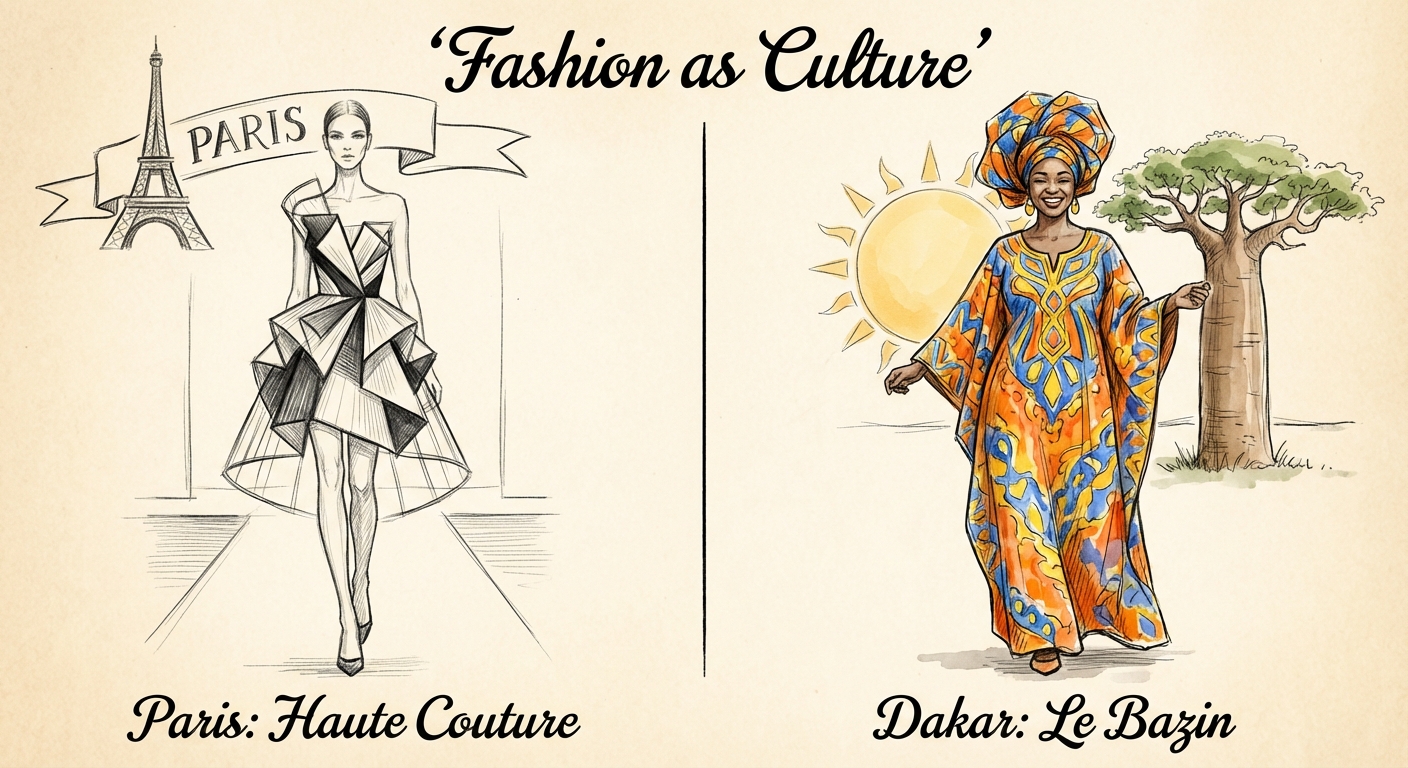
In France, fashion is considered an art form. Paris is historically the capital of La Haute Couture (high fashion).
- Key Concept: Fashion is a vehicle of cultural identity and economic power.
- Francophone Perspectives:
- France: Brands like Chanel, Dior, and Yves Saint Laurent are national icons. The concept of le chic décontracté (casual chic) is a pervasive ideal.
- West Africa: In countries like Senegal and Mali, traditional fabrics like le Bazin or le Pagne (wax print) are symbols of beauty and status. Modern designers often fuse these traditional prints with Western cuts.
Physical Beauty and Self-Image
The definition of beauty varies across the Francophone world, though globalization has standardized some ideals.
- Le Body Positivisme: A growing movement in Europe and Quebec challenging unrealistic beauty standards in media.
- Traditional Practices: In some Maghreb cultures, the application of Henné (henna) is a ritual of beauty and celebration which differs from the Western focus on makeup (le maquillage).
Context 2: The Visual and Performing Arts (Les Arts)
This is the broadest section. You must be able to discuss various art forms and specific movements.
Visual Arts (Les Arts Visuels)
Visual arts serve as historical records. You should know the broad strokes of French art history to articulate how art evolved.
- Classical & Neoclassical: Order, symmetry, and logic (e.g., Jacques-Louis David).
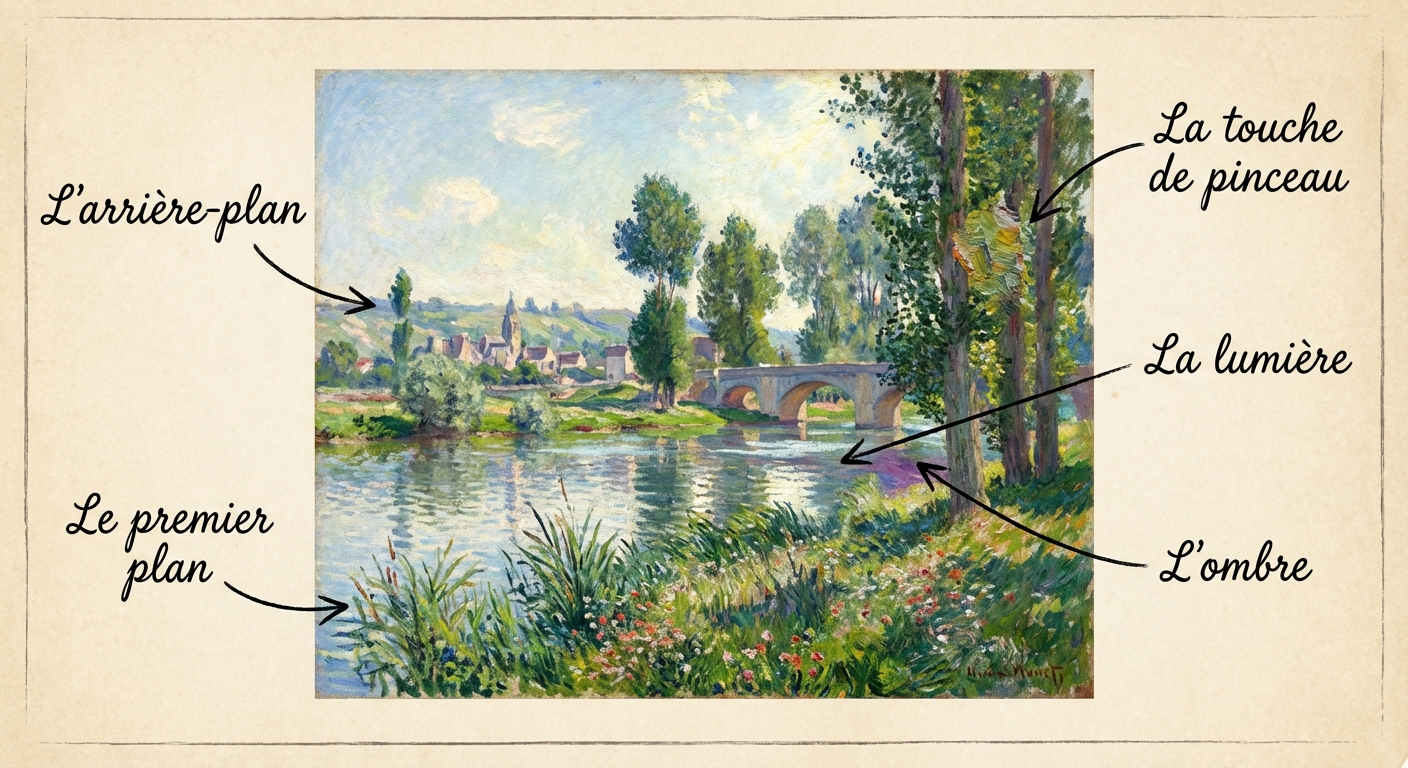
- L'Impressionnisme: Born in France in the late 19th century. Artists like Claude Monet and Pierre-Auguste Renoir focused on light (la lumière), movement, and daily life rather than historical precision.
- L'Art Moderne & Le Surréalisme: Movements that challenged reality. René Magritte (Belgian) is essential for understanding Francophone surrealism—challenging what we see.
- Bande Dessinée (La BD): In the Francophone world (especially France and Belgium), comic books are known as Le Neuvième Art (The 9th Art). Tintin and Astérix are cultural monuments, not just cartoons.
Architecture (L'Architecture)
Architecture reflects the priorities of a society.
- Haussmann (Paris): Baron Haussmann redesigned Paris in the 19th century, creating the wide boulevards and uniform beige limestone buildings (la pierre de taille) seen today. This reflects a desire for order, hygiene, and grandeur.
- Traditional Architecture: Compare this with the Kasbahs of Morocco (earth/clay architecture adapted to heat) or the colonial architecture in Louisiana and Quebec (adapted to local climate and resources).
Performing Arts (Les Arts du Spectacle)
- Le Cinéma: France is the birthplace of cinema (Lumière Brothers). The French government protects its film industry through the "Exception Culturelle" (cultural exception), treating cinema as art to be protected from free-market forces rather than just a commercial product. The Cannes Film Festival is a global hub for this.
- La Musique:
- Chanson Française: Lyrics (les paroles) are often more important than the rhythm (e.g., Edith Piaf, Jacques Brel).
- Modern Fusion: Contemporary Francophone music is heavily influenced by immigration. Artists like Stromae (Belgium, Rwandan heritage) or Gims (Congolese heritage) blend electronic, rap, and African rhythms.
Context 3: Heritage and Creativity (Patrimoine et Créativité)
Defining "Le Patrimoine"
Le Patrimoine refers to what is inherited from ancestors. It includes monuments (tangible) and traditions (intangible).
- Tangible Heritage: Castles (Châteaux de la Loire), Cathedrals (Notre-Dame), and Museums (Le Louvre, Le Musée d'Orsay).
- Intangible Heritage: Gastronomy (La Gastronomie) was declared a "world intangible heritage" by UNESCO. In France, a meal is a ritual involving structure (entrée, plat, dessert) and socialism.
Conservation vs. Modernity
A major debate in Francophone cities is how to modernize without destroying history.
- Example: The glass pyramid at the Louvre (designed by I.M. Pei) initially caused a scandal by mixing modern glass with classic Renaissance architecture, but is now a beloved symbol of le mélange (the mix) of old and new.
Essential Vocabulary
To score high, you need precise vocabulary, not just general terms.
Describing Art (Visual Analysis)
- Le chef-d'œuvre: A masterpiece.
- L'arrière-plan / Le premier plan: Background / Foreground.
- Une nature morte: A still life painting.
- Un paysage: A landscape.
- Le coup de pinceau: Brushstroke (crucial for describing Impressionism).
- Abstrait vs. Figuratif: Abstract vs. Representational.
Discussing Heritage
- La préservation: Preservation.
- Léguer: To bequeath/pass down.
- Les vestiges (m): Ruins/Remains.
- Un mécène: A patron of the arts (someone who funds artists).
- Le vernissage: An art exhibition opening (useful for Cultural Comparison or Roleplay).
Describing Beauty & Taste
- Époustouflant(e): Breathtaking.
- Le raffinement: Refinement/sophistication.
- L'esthétique (f): Aesthetics.
- Avant-gardiste: Avant-garde/ahead of its time.
AP Exam Strategy: Application
Cultural Comparison (Task 4)
Theme: How is art funded or appreciated in your community vs. a Francophone community?
- Francophone Example (The "Target"): In France, the government heavily subsidizes the arts. Museums often have free entry days (e.g., 1st Sunday of the month). The Fête de la Musique (June 21st) is a government-sponsored national holiday where everyone plays music in the streets.
- Your Community (The "Source"): Contrast this with the US/local approach, where art is often funded by private donors (mécènes privés) or non-profits, and isn't usually state-run.
Email Reply (Task 1)
Scenario: You receive an email from an art gallery, a festival organizer, or a museum curator.
- Useful phrases:
- "Je suis passionné(e) par l'art contemporain…" (I am passionate about contemporary art…)
- "Pourriez-vous me donner plus de détails sur le vernissage ?" (Could you give me more details about the opening?)
- "J'aimerais souligner l'importance de préserver notre patrimoine…" (I would like to emphasize the importance of preserving our heritage…)
Common Mistakes & Pitfalls
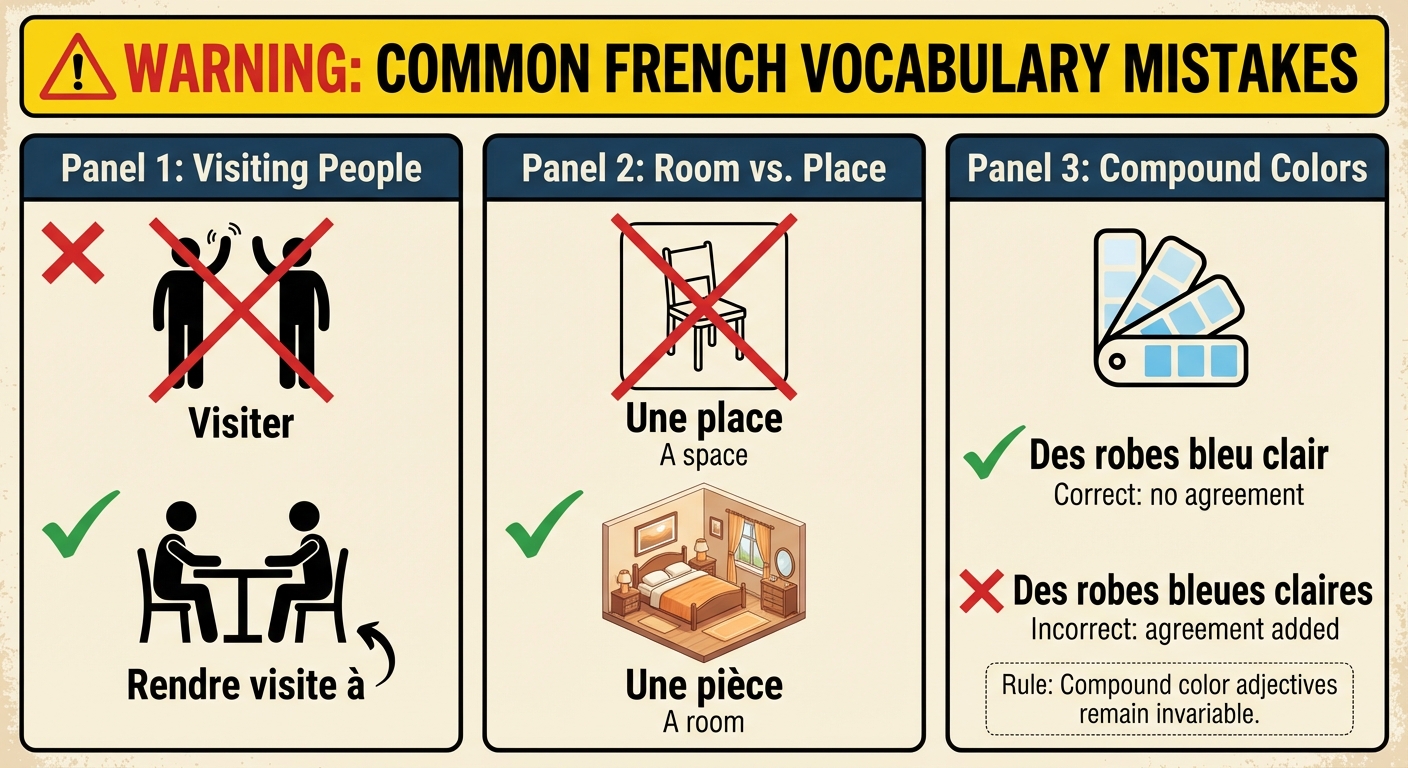
Confusion of "Place":
- La place: A town square or a seat in a venue.
- Le lieu / L'endroit: A general place/location.
- La pièce: A room in a house or a play (une pièce de théâtre).
- Don't say: "J'ai vu une belle place de peinture." (Wrong). Say: "J'ai vu une belle œuvre d'art."
"Painter" vs. "Painting":
- Peinture: The painting (the object) or the substance (paint).
- Peintre: The painter (the person).
- Tableau: A specific word for a canvas painting.
To Visit:
- Visiter: Used for places (cities, museums). Je visite le musée.
- Rendre visite à: Used for people. Je rends visite à l'artiste.
Stereotyping:
- Avoid saying "French people love art" as a blanket statement. Instead, discuss strictly institutional differences: "In France, the Ministry of Culture actively promotes art accessibility through initiatives like the Culture Pass for 18-year-olds."
Describing Colors:
- Remember that colors can be nouns or adjectives. When using compound colors (bleu clair, vert foncé), the adjective remains invariable (it does not pluralize).
- Des yeux marron (invariable because 'marron' comes from a noun).