APUSH Unit 2: The Structure of Colonial North America (1607–1754)
European Imperial Goals and Colonization Patterns
During Period 2 (1607–1754), distinct patterns of colonization emerged among European powers. While all sought to extract value from the New World, their methods, relationships with Native Americans, and settlement structures differed significantly.
Comparing European Powers
Spain:
- Goals: Gold, God, and Glory. Focused on converting Native Americans to Catholicism and extracting precious metals.
- Relationship with Natives: Originally the Encomienda System (forced labor), shifting to the Mission System. A Caste System developed due to intermarriage between Spanish men and Native/African women (Mestizos/Mulattos).
- Key Conflict: The Pueblo Revolt (1680) — A successful uprising by Pueblo Indians against Spanish religious suppression in the Southwest, leading to slightly more accommodation of Native culture by the Spanish upon their return.
France & The Netherlands (Dutch):
- Goals: Trade, specifically the lucrative Fur Trade (beaver pelts).
- Relationship with Natives: Generally more cooperative than the English or Spanish. Few European settlers arrived, so they relied on trade alliances (e.g., French with Hurons, Dutch with Iroquois) and intermarriage to secure commercial ties.
England:
- Goals: Social mobility, economic prosperity (agriculture), and religious freedom.
- Settlement Pattern: Sent large numbers of men and women (families) to establish permanent agricultural settlements.
- Relationship with Natives: Exclusionary. The English did not generally intermarry or attempt to rule over Native populations; they wanted Native land for farming, leading to wars of extermination or displacement.
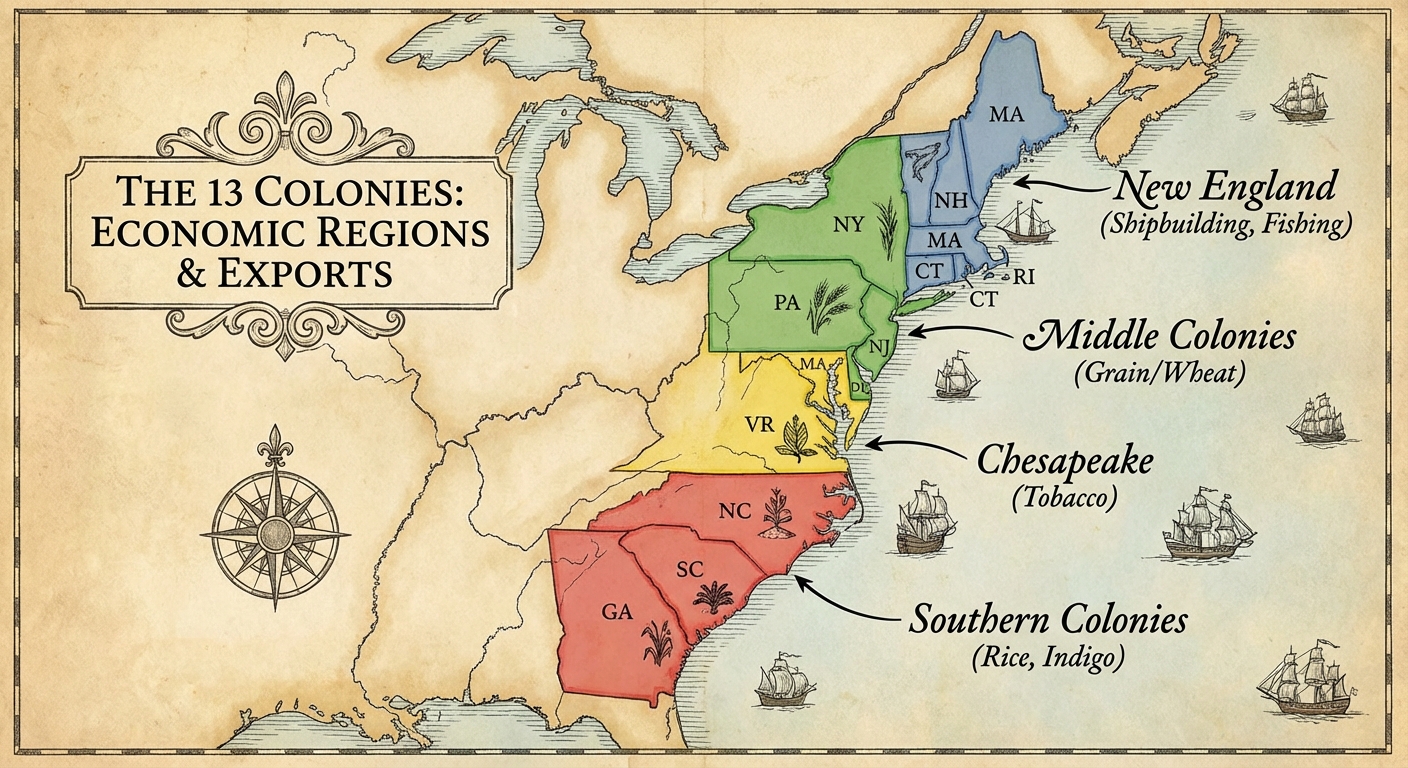
British Colonial Regions
The British colonies were not a monolith; they developed distinct societies based on environmental conditions and the motivations of the settlers.
1. The Chesapeake (Virginia & Maryland)
- Environment: Fertile soil, long growing seasons, navigable rivers.
- Economy: Comparison of "Gold vs. Tobacco." The Jamestown settlers starved looking for gold until John Rolfe introduced Tobacco. This cash crop required intensive labor and exhausted the soil, driving expansion.
- Labor Systems: Initially relied on Indentured Servants (Headright System gave land for paying passage). Following Bacon’s Rebellion (1676)—a revolt of poor frontier farmers against the colonial elite—planters shifted toward Chattel Slavery to avoid class conflict among whites.
- Religion: Maryland was founded as a haven for Catholics (Act of Toleration), but the region was generally Anglican.
2. New England (Massachusetts, Rhode Island, Connecticut, NH)
- Demographics: Settled by Puritans seeking religious freedom. Arrived in family groups, leading to natural population increase.
- Economy: "Mixed Economy" of agriculture and commerce. Rocky soil prevented large plantations. The region relied on fishing, lumber, shipbuilding, and small-scale farming.
- Society: Close-knit, town-centered communities. Town Meetings allowed adult male church members to vote, an early form of direct democracy.
- Dissenters: Roger Williams and Anne Hutchinson were banished for challenging Puritan strictness; Williams founded Rhode Island on the separation of church and state.
3. The Middle Colonies (New York, Pennsylvania, NJ, Delaware)
- Characteristics: Known as the "Breadbasket" colonies due to cereal crop production (wheat, oats).
- Demographics: The most diverse region ethnically and religiously.
- Pennsylvania: Founded by William Penn as a refuge for Quakers. They were pacifists, opposed slavery, and established friendly relations with Native Americans. They promoted religious toleration, attracting German and Scots-Irish migrants.
4. The Southern Colonies (South Carolina, Georgia) & West Indies
- Economy: Long growing seasons allowed for rice and indigo production.
- Labor: Modeled after the West Indies (Barbados). Harsh slave codes defined enslaved people as property.
- Slave Society: In many areas, enslaved Africans became the majority of the population, allowing them to maintain legitimate cultural autonomy (e.g., Gullah language/culture).
Comparison Table: 13 Colonies Regions
| Region | Primary Economy | Key Labor Source | Religious Tone |
|---|---|---|---|
| New England | Mixed (Shipbuilding, Fishing) | Family Labor | Strict Puritan |
| Middle | Cereal Crops ("Breadbasket") | Indentured/Free Labor | Diverse/Tolerant |
| Chesapeake | Tobacco | Indentured $\rightarrow$ Slaves | Anglican/Catholic |
| Southern | Rice/Indigo | Heavy Chattel Slavery | Anglican |
Transatlantic Trade and Mercantilism
Mercantilism
Mercantilism is the economic theory that drove colonial policy. It posits that there is a finite amount of wealth in the world, and a nation's power is determined by its wealth (gold/silver).
Balance \ of \ Trade: \ Exports > Imports
- Role of Colonies: Colonies exist solely to enrich the mother country by providing raw materials and purchasing manufactured goods.
- Navigation Acts (1651–1673): Laws passed by Britain to enforce mercantilism. They required certain colonial goods (enumerated list) to be shipped only to England on English ships.
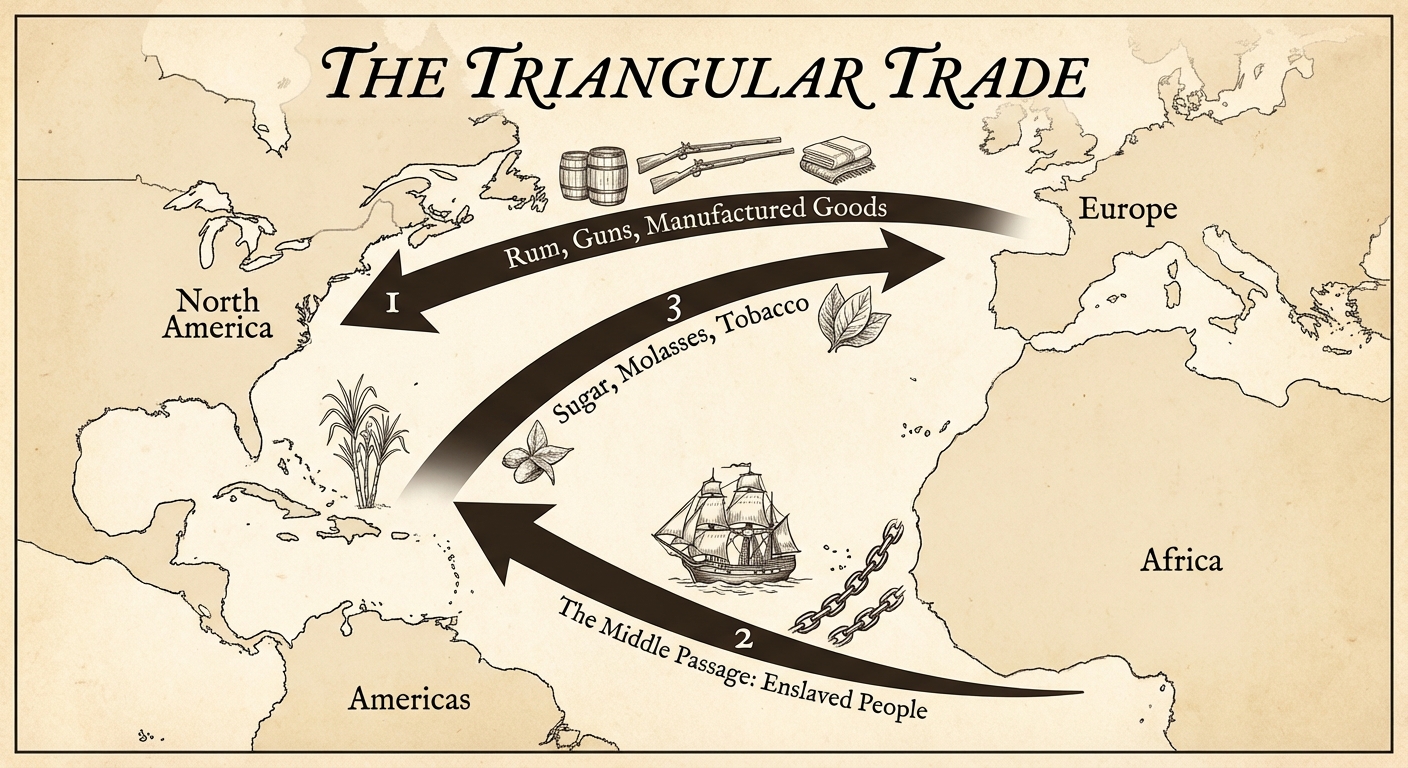
The Triangular Trade
A complex trading network developed connecting Europe, Africa, and the Americas:
- New England/Europe: Rum, guns, and manufactured goods shipped to West Africa.
- West Africa: Goods exchanged for enslaved people.
- The Middle Passage: The horrific journey across the Atlantic to the West Indies/Americas. High mortality rates and inhumane conditions.
- Americas: Slaves exchanged for sugar, molasses, or tobacco, which returned to New England/Europe.
Colonial Society and Culture (1700–1754)
Anglicization
Despite regional differences, the colonies increasingly became more "British" over time. This process is called Anglicization.
- Causes: Development of autonomous political communities based on English models, trans-Atlantic print culture (newspapers), and the spread of Protestant Evangelicalism.
The First Great Awakening (1730s–1740s)
A massive religious revival that swept through the colonies.
- Key Figures: Jonathan Edwards ("Sinners in the Hands of an Angry God") and George Whitefield (itinerant preacher).
- Impact:
- Emphasized emotion and personal relationship with God over ritual.
- Split churches into "Old Lights" (traditionalists) and "New Lights" (revivalists).
- Political Consequence: It was the first shared experience among all colonies. It challenged traditional authority—if you can question your minister, you can question your King.
The Enlightenment
While the Great Awakening emphasized emotion, the Enlightenment emphasized reason and science.
- John Locke: Proposed the concept of Natural Rights (Life, Liberty, Property) and the Social Contract. These ideas heavily influenced colonial leaders (e.g., Benjamin Franklin) and eventual revolutionary thought.
Slavery and Resistance
As Chattel Slavery became dominant, strict racial categories were constructed.
- Overt Resistance: Stono Rebellion (1739) in South Carolina—enslaved people tried to flee to Spanish Florida. It failed and led to stricter slave codes.
- Covert Resistance: working slowly, breaking tools, and maintaining cultural customs (religion, music, naming patterns).
Common Mistakes & Pitfalls
- Confusing the Chesapeake with the South: While both had slavery, the Chesapeake (VA/MD) relied on Tobacco, while the Lower South (SC/GA) relied on Rice and Indigo. The mortality rates and density of the enslaved population were higher in the Lower South.
- Pilgrims vs. Puritans: Students often use these interchangeably. Pilgrims were Separatists (wanted to leave the Church of England entirely); Puritans wanted to "purify" it. The Puritans (Mass Bay Colony) were a much larger, more influential group.
- Treating "Slavery" as Static: Slavery evolved. In 1619, the status of Africans in Virginia was ambiguous. By 1700, it was a hereditary, racialized system of perpetual servitude. You must track this evolution (often linked to Bacon's Rebellion).
- Misunderstanding "Salutary Neglect": Britain often ignored its own Navigation Acts because trade was profitable. When Britain ends this "neglect" after 1763 (Unit 3), it triggers the Revolution. Do not claim Britain enforced strict control throughout Period 2.