Mastering Craft and Structure for the Digital SAT
The Craft and Structure domain constitutes approximately 28% of the questions in the Reading and Writing module of the Digital SAT. Unlike the "Information and Ideas" domain, which asks what the text says, Craft and Structure asks why the text was written, how it is organized, and how distinct texts relate to one another.
Words in Context
This question type tests your ability to interpret high-utility academic vocabulary and determine the most logical choice to complete a sentence based on the surrounding context.
Core Concept: Context > Definition
The SAT does not test obscure words in isolation. It tests Tier 2 Vocabulary—words frequently used in academic texts (e.g., empirical, substantiate, ambivalent)—and how their meanings shift based on the sentence's tone and logic.
Key strategies include:
- Connotation vs. Denotation: You must determine if the blank requires a word with a positive, negative, or neutral charge.
- Secondary Meanings: Common words often have academic definitions (e.g., afford meaning "to provide," not just "to have enough money for").
- The "Blank-Out" Method: Before looking at the answer choices, cover the choices and come up with your own word that fits. Then, match your prediction to the options.
Logical Clues and Transitions
Context clues usually fall into specific patterns:
| Relationship | Clue Words | Example |
|---|---|---|
| Synonym/Support | and, also, similarly, furthermore | The research was meticulous; the data was collected with great care and precision. |
| Contrast/Shift | but, however, despite, yet, although | Though the initial results were promising, the final conclusion was disappointing. |
| Cause/Effect | because, therefore, consequently | Due to the heavy rain, the event was postponed. |
Worked Example
Text: In high-context cultures, communication relies heavily on implicit nonverbal cues. Conversely, low-context cultures prioritize explicit verbal communication, valuing clarity and directness. Therefore, a business negotiator from a low-context culture might find the subtle gestures of a high-context counterpart to be .
Choice A: Overt
Choice B: Ambiguous
Choice C: Comprehensions
Choice D: Offensive
Analysis:
- Identify the Pivot: The word "Conversely" sets up a contrast. Low-context values "clarity."
- Predict: If low-context values clarity, they would find "subtle gestures" (from high-context) to be unclear or confusing.
- Evaluate: Choice B, Ambiguous (open to more than one interpretation; having a double meaning), is the closest synonym to "unclear."
Text Structure and Purpose
These questions ask you to analyze rhetorical strategies. You will encounter two main variations: asking for the main purpose of the text, or asking for the function of a specific underlined sentence.
Distinguishing Purpose from Main Idea
It is crucial to understand the difference between these two concepts:
- Main Idea: What the text is about (The content/summary).
- Purpose: Why the author wrote it (The verb/intent).
Common "Purpose" Verbs:
- To criticize (a common misconception or opposing view)
- To introduce (a new hypothesis or figure)
- To contrast (two different methodologies)
- To concede (admit a limitation in an argument)
Analyzing Text Structure
Structure refers to how the information unfolds. SAT passages often follow predictable patterns.
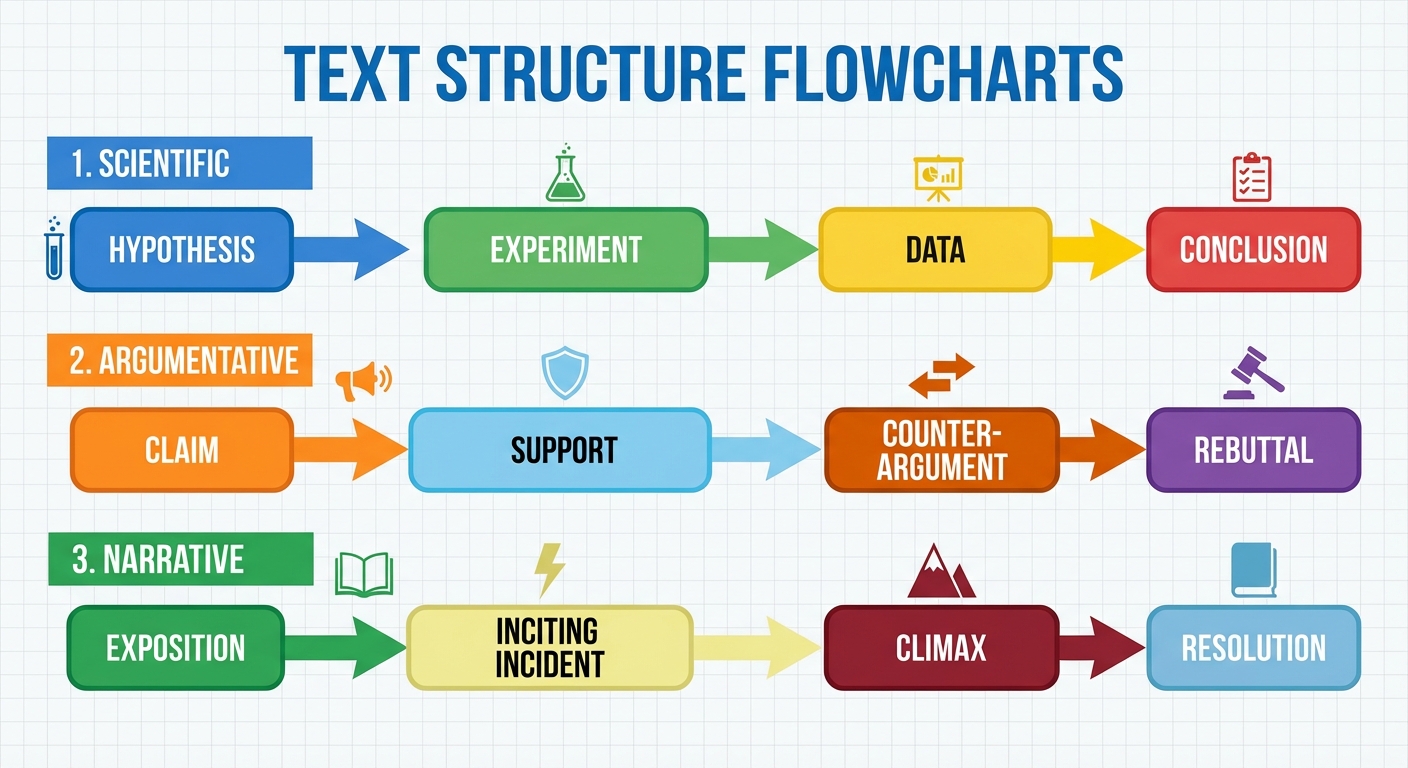
- The Scientific Progression: Context $\rightarrow$ Problem/Question $\rightarrow$ Methodology $\rightarrow$ Results $\rightarrow$ Implications.
- The Literary Shift: Setting the Scene $\rightarrow$ Introduction of Character $\rightarrow$ Conflict/Realization.
- The Argumentative Flow: Main Claim $\rightarrow$ Counter-claim $\rightarrow$ Rebuttal $\rightarrow$ Conclusion.
Strategy: The Function of Specific Sentences
When asked about the function of an underlined sentence, ask yourself: "What is this sentence doing for the argument?"
- Is it providing evidence for a previous claim?
- Is it offering a definition?
- Is it presenting a qualification (limiting the scope of a claim)?
Common Mistakes in Structure & Purpose
- Too Narrow vs. Too Broad: The correct answer for "Overall Structure" must cover the entire passage, not just the first half.
- Confusing the Narrative: In fiction passages, students often mistake the character's perspective for the narrator's purpose.
- Literal vs. Abstract: Structure answers are often abstract (e.g., "A claim is presented and then detailed") rather than specific content summaries.
Cross-Text Connections
This is a high-complexity topic involving two short passages (Text 1 and Text 2) on the same topic. You will be asked to determine how the author of one text would respond to the other, or to identify a point of disagreement/agreement.
The Synthesis Strategy
Do not attempt to hold both texts in your head at once. Use a systematic approach:
- Analyze Text 1: Summarize the core claim in 3-4 words. (e.g., "Text 1: Bees like purple flowers.")
- Analyze Text 2: Summarize the core claim. (e.g., "Text 2: Bees actually prefer UV patterns, regardless of color.")
- Map the Relationship: How do they interact?
- Do they strictly disagree?
- Does Text 2 add nuance to Text 1?
- Does Text 2 refute a specific piece of evidence in Text 1?
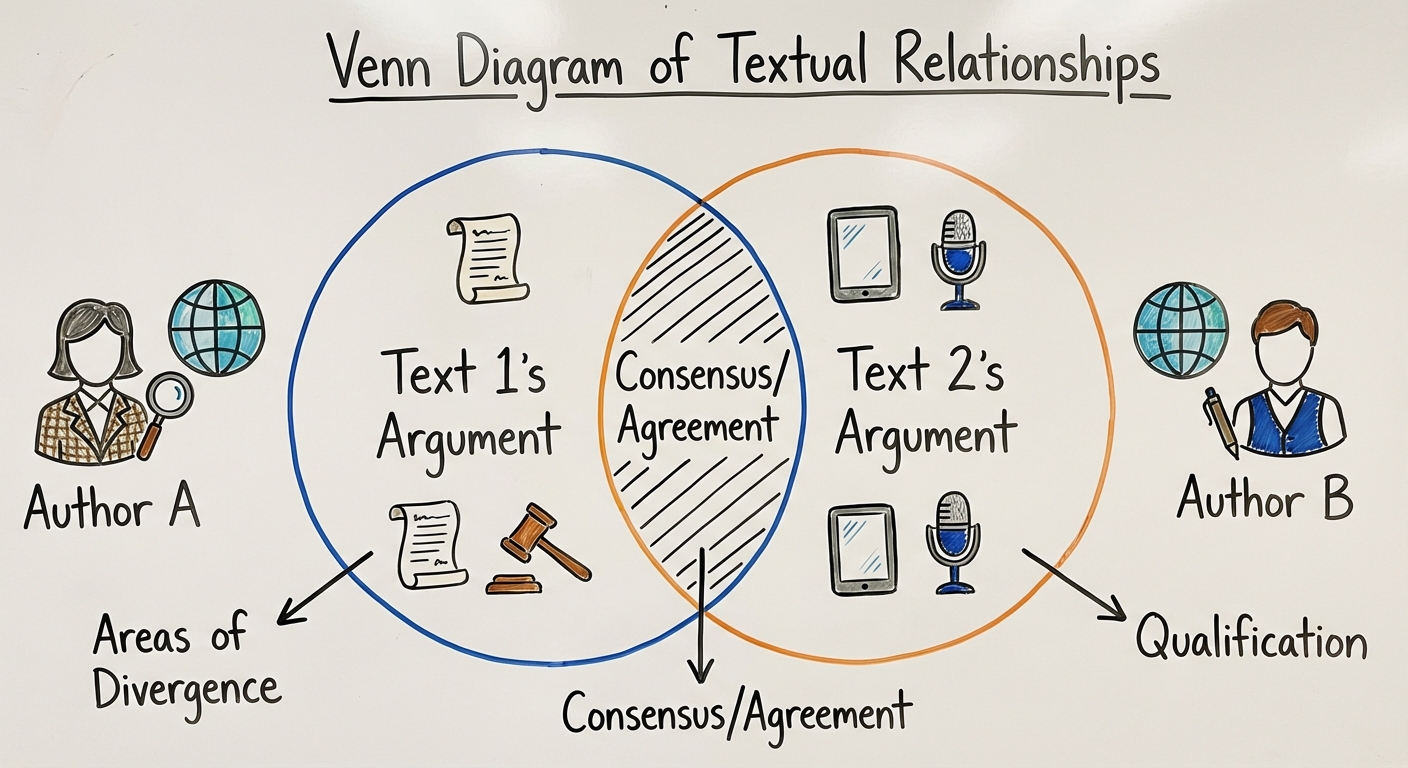
Types of Relationships
- Direct Refutation: Text 2 says Text 1 is wrong about a specific fact.
- The Qualification: Text 2 agrees with Text 1 generally, but adds a condition (e.g., "This is true, but only in winter").
- The Extension: Text 2 takes Text 1's idea and applies it to a new field.
Worked Example Concept
- Text 1 claims that Writer X was the most influential poet of the 19th century because he revolutionized rhyme schemes.
- Text 2 claims that while Writer X was popular, his "revolutionary" rhymes were actually borrowed from obscure 18th-century folk songs.
- Question: How would the author of Text 2 likely respond to the claim in Text 1 regarding Writer X's "revolutionizing" of rhyme?
- Answer: They would argue that the innovation was derivative rather than original.
Common Pitfalls in Cross-Text Questions
- The Perspective Trap: If the question asks "How would Text 2 respond to Text 1?", ensure your answer reflects Text 2's opinion, not Text 1's opinion or your own.
- The Half-Right Answer: An answer choice might correctly describe Text 1 but inaccurately describe Text 2's reaction to it.
Summary of Common Mistakes in Craft and Structure
- Ignoring Tone (Words in Context): Choosing a word that means the right thing but has the wrong "vibe" (e.g., using slang in a formal scientific text).
- Stopping at the First Definition: Assuming a word only means what you use it for in daily conversation (e.g., ignoring that "check" can mean "to restrain").
- Misidentifying the Subject: In structure questions, failing to realize that the text describes someone else's theory, not the author's own views.
- Extreme Language: In Comparative Reading, beware of answers that use words like always, never, impossible, or completely refutes unless the text is equally extreme.