Module 2: Minor Keys, Melody, Texture, and Timbre
Minor Scales and Key Signatures
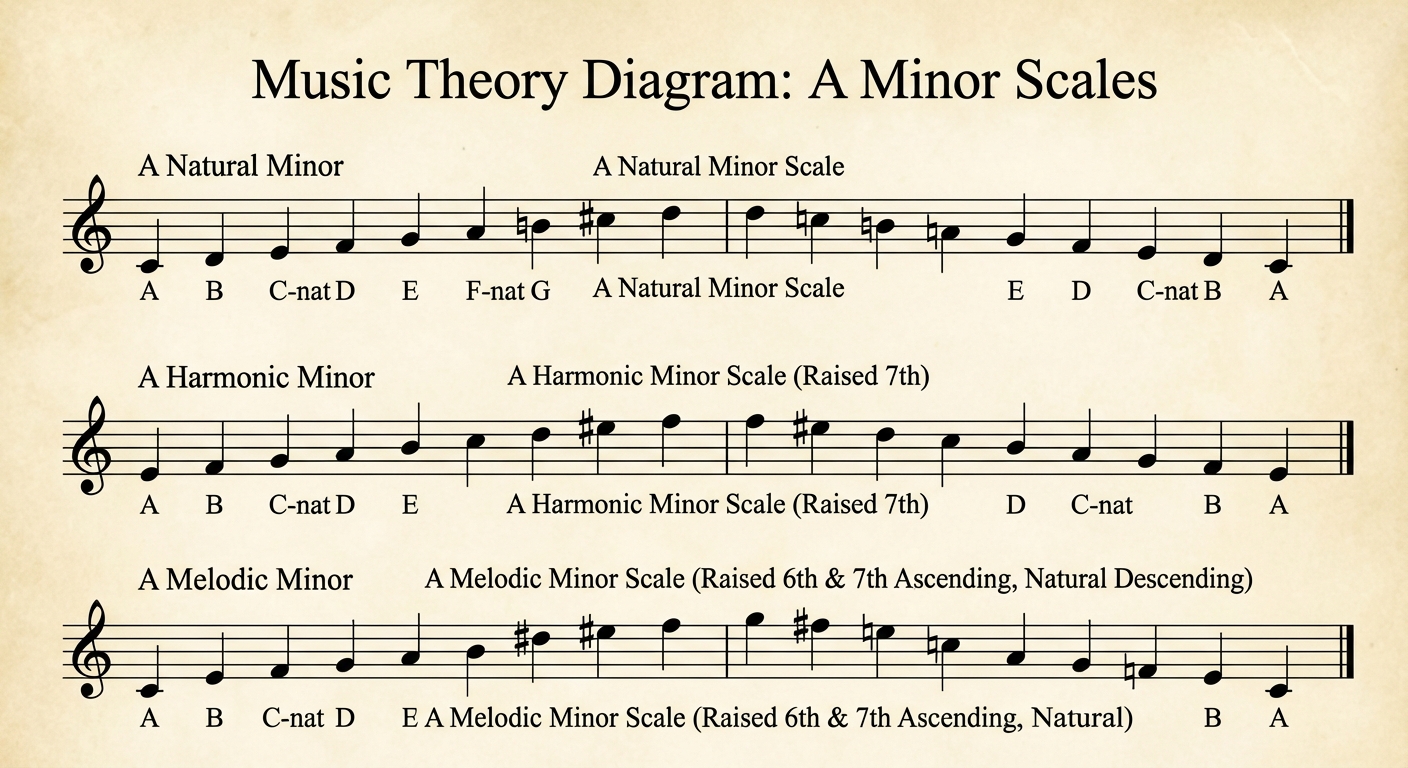
In Unit 2, we move beyond Major keys into the complexity of the Minor Key system. Unlike Major keys, which have one standard form, minor keys function using a composite of three different scale variations to accommodate both harmonic (chordal) and melodic (linear) needs.
The Three Forms of the Minor Scale
All minor scales are distinguished from major scales by a lowered third scale degree ($\flat\hat{3}$). The relationship between the sixth and seventh scale degrees changes depending on the form.
1. Natural Minor
This is the diatonic form found in the key signature without any accidentals added. It corresponds to the Aeolian Mode.
- Pattern: Whole, Half, Whole, Whole, Half, Whole, Whole ($W-H-W-W-H-W-W$)
- Scale Degrees: $\hat{1}, \hat{2}, \flat\hat{3}, \hat{4}, \hat{5}, \flat\hat{6}, \flat\hat{7}, \hat{1}$
- Distinctive Feature: Contains a Subtonic $\hat{7}$ (a whole step below the tonic), not a Leading Tone.
2. Harmonic Minor
This form is used primarily to build chords (harmony), specifically to create a major Dominant (V) chord.
- Alteration: Raise the $\hat{7}$ of the Natural Minor by one half-step.
- Scale Degrees: $\hat{1}, \hat{2}, \flat\hat{3}, \hat{4}, \hat{5}, \flat\hat{6}, \natural\hat{7}, \hat{1}$
- Distinctive Feature: Creates a Leading Tone (half step below tonic).
- The Augmented Second: This creates a gap of 1.5 steps (an augmented 2nd) between $\flat\hat{6}$ and $\natural\hat{7}$, giving it a distinctive "exotic" sound.
3. Melodic Minor
This form is used to create smooth melodic lines by eliminating the awkward augmented 2nd interval found in Harmonic Minor.
- Ascending: Raise both $\hat{6}$ and $\hat{7}$.
- Descending: Revert to Natural Minor (lower $\hat{6}$ and $\hat{7}$).
- Scale Degrees (Ascending): $\hat{1}, \hat{2}, \flat\hat{3}, \hat{4}, \hat{5}, \natural\hat{6}, \natural\hat{7}, \hat{1}$
- Scale Degrees (Descending): $\hat{1}, \flat\hat{7}, \flat\hat{6}, \hat{5}, \hat{4}, \flat\hat{3}, \hat{2}, \hat{1}$
Scale Degrees and Solfège
Scale degree names describe the function of a note within the key. Mastery of these names is essential for AP analysis.
| Degree | Name | Solfège (Do-based Minor) | Note in C Minor |
|---|---|---|---|
| $\hat{1}$ | Tonic | Do | C |
| $\hat{2}$ | Supertonic | Re | D |
| $\hat{3}$ | Mediant | Me (lowered Mi) | Eb |
| $\hat{4}$ | Subdominant | Fa | F |
| $\hat{5}$ | Dominant | Sol | G |
| $\hat{6}$ | Submediant | Le (lowered La) | Ab |
| $\hat{7}$ | Subtonic (Natural Minor) | Te (lowered Ti) | Bb |
| $\hat{7}$ | Leading Tone (Harmonic/Melodic) | Ti | B natural |
Key Concept: The term Subtonic refers specifically to the 7th scale degree when it is a whole step below the tonic. The term Leading Tone refers to the 7th degree when it is a half step below the tonic.
Key Relationships
Understanding how keys relate to one another is vital for analyzing modulation (changing keys) and structure.
Relative Keys
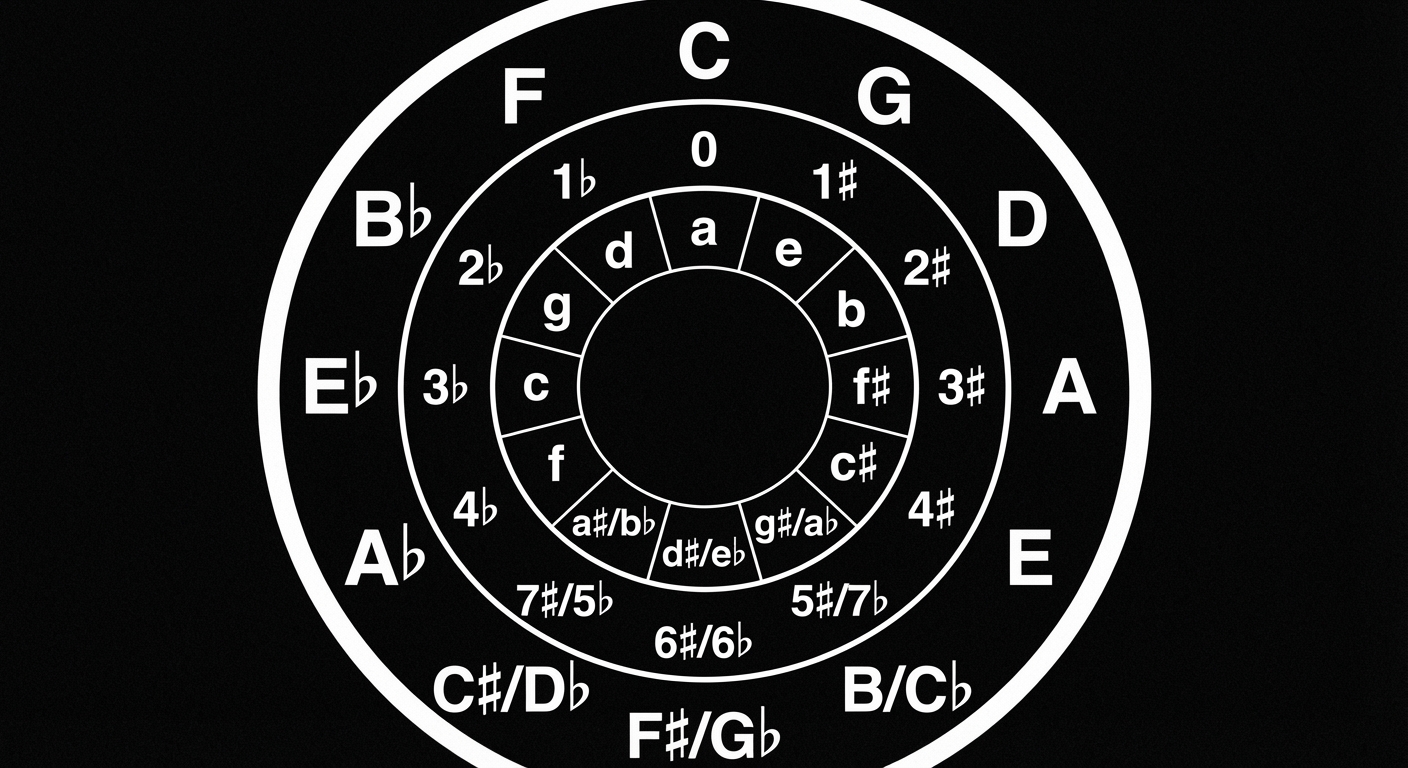
Relative Major and Minor keys share the same key signature but have different tonics.
- To find Relative Minor: Go down a minor 3rd (3 semitones) from the Major tonic (e.g., C Major $\to$ A Minor).
- To find Relative Major: Go up a minor 3rd from the Minor tonic (e.g., D Minor $\to$ F Major).
Parallel Keys
Parallel Major and Minor keys share the same tonic but have different key signatures.
- Relationship: Parallel minor always has 3 more flats (or 3 fewer sharps) than its parallel major.
- Example: C Major (0 flats) vs. C Minor (3 flats: B, E, A).
- Example: A Major (3 sharps) vs. A Minor (0 sharps/flats).
Closely vs. Distantly Related Keys
- Closely Related Keys: Keys that differ by no more than one accidental in their key signature. On the Circle of Fifths, these are the immediate neighbors.
- Example for C Major: G Major (1 sharp), F Major (1 flat), and their relative minors (A mi, E mi, D mi).
- Distantly Related Keys: Keys that differ by two or more accidentals.
Common Mistakes: Minor Scales
- Forgetting the Descending Melodic Minor: Students often write the raised $\hat{6}$ and $\hat{7}$ on the way down. Remember: Melodic minor is "Natural" on the way down.
- Confusing Subtonic vs. Leading Tone: Using the term "Leading Tone" for a Natural Minor $\hat{7}$ is incorrect. It must be a half-step below tonic to "lead" to it.
- Mixing Parallel and Relative:
- Relative = Same Notes, Different Tonic.
- Parallel = Same Tonic, Different Notes.
Melody and Motivic Transformation
Melody is a linear succession of musical tones that the listener perceives as a single entity. In AP Music Theory, you must analyze how melodies are constructed and transformed.
Features of Melody
- Contour: The shape of the melody (ascending, descending, arch-shaped).
- Conjunct Motion: Stepwise movement (intervals of a 2nd).
- Disjunct Motion: Leaping movement (intervals larger than a 2nd).
- Range: The distance between the lowest and highest notes.
Motivic Transformation
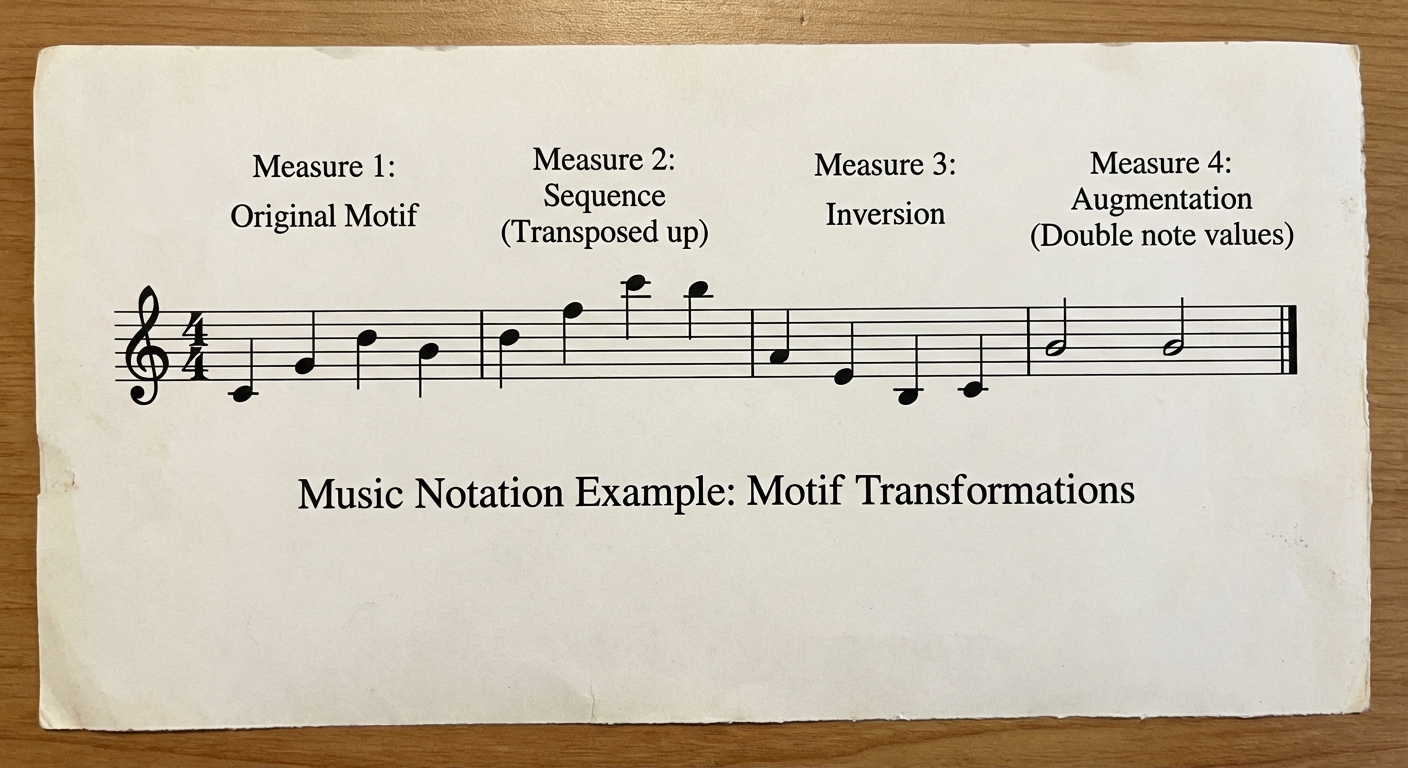
Composers develop short musical ideas (motifs) using specific devices. You will often be asked to identify these in multiple-choice questions.
1. Review of Pitch Transformations
- Sequence: Repeating a melodic pattern starting on a different pitch level (usually immediately after the original).
- Inversion (Melodic Inversion): Flipping the melody upside down. If the original goes "up a 3rd", the inversion goes "down a 3rd."
- Mirror Inversion: Intervals are exact (Major 3rd becomes Major 3rd).
- Tonal Inversion: Intervals adjust to stay within the key (Major 3rd might become Minor 3rd).
- Retrograde: Playing the melody backward (last note to first note).
- Retrograde Inversion: Playing the melody backward and upside down.
2. Rhythmic Transformations
- Augmentation: Lengthening the rhythmic values proportionally (e.g., quarter notes become half notes). The melody sounds slower.
- Diminution: Shortening the rhythmic values proportionally (e.g., quarter notes become eighth notes). The melody sounds faster.
- Rhythmic Displacement: Keeping the rhythm intact but moving it to a different beat in the measure.
Intervals: Size, Quality, and Inversions
While Unit 1 creates the foundation, Unit 2 solidifies the understanding of intervals, including compound intervals and inversions.
Interval Inversion Rules
When you invert an interval (move the bottom note up an octave or the top note down an octave), two things change according to the "Rule of 9" and "Opposite Quality."
1. The Rule of 9 (Quantity):
- 2nd becomes a 7th
- 3rd becomes a 6th
- 4th becomes a 5th
2. Quality Changes:
- Perfect stays Perfect ($P \leftrightarrow P$)
- Major becomes Minor ($M \leftrightarrow m$)
- Augmented becomes Diminished ($A \leftrightarrow d$)
| Original | Inversion |
|---|---|
| Perfect 5th | Perfect 4th |
| Major 3rd | Minor 6th |
| Augmented 4th (Tritone) | Diminished 5th (Tritone) |
| Minor 2nd | Major 7th |
Compound Intervals
Intervals larger than an octave are compound intervals. To name them, usually reduce them to their simple equivalent by subtracting 7.
- 10th = 3rd plus an octave (Treat as a 3rd for harmony).
- 9th = 2nd plus an octave.
Consonance vs. Dissonance
- Perfect Consonances: P1, P5, P8, (P4 is consonant harmonically unless it is formed with the bass, where it is often treated as dissonant/unstable in common practice style).
- Imperfect Consonances: M3, m3, M6, m6.
- Dissonances: M2, m2, M7, m7, all Augmented/Diminished intervals.
Rhythm, Meter, and Texture
Rhythmic Devices
- Syncopation: Stressing the weak beat or the off-beat (between beats). This disrupts the expected pulse.
- Hemiola: A specific rhythmic feel where two bars of triple meter ($3/4$) sound like three bars of duple meter ($2/4$), or vice versa. It creates a "2 against 3" feel.
- Anacrusis: Pick-up notes; notes occurring before the first full bar.
Accent Types
- Dynamic Accent: Using louder volume (indicated by $>$) to stress a note.
- Agogic Accent: Emphasis by duration (holding a note longer than surrounding notes) or pitch (a note stands out because it is significantly higher/lower).
- Metrical Accent: The natural stress on strong beats (Beat 1 in all meters; Beat 3 in 4/4).
Musical Texture
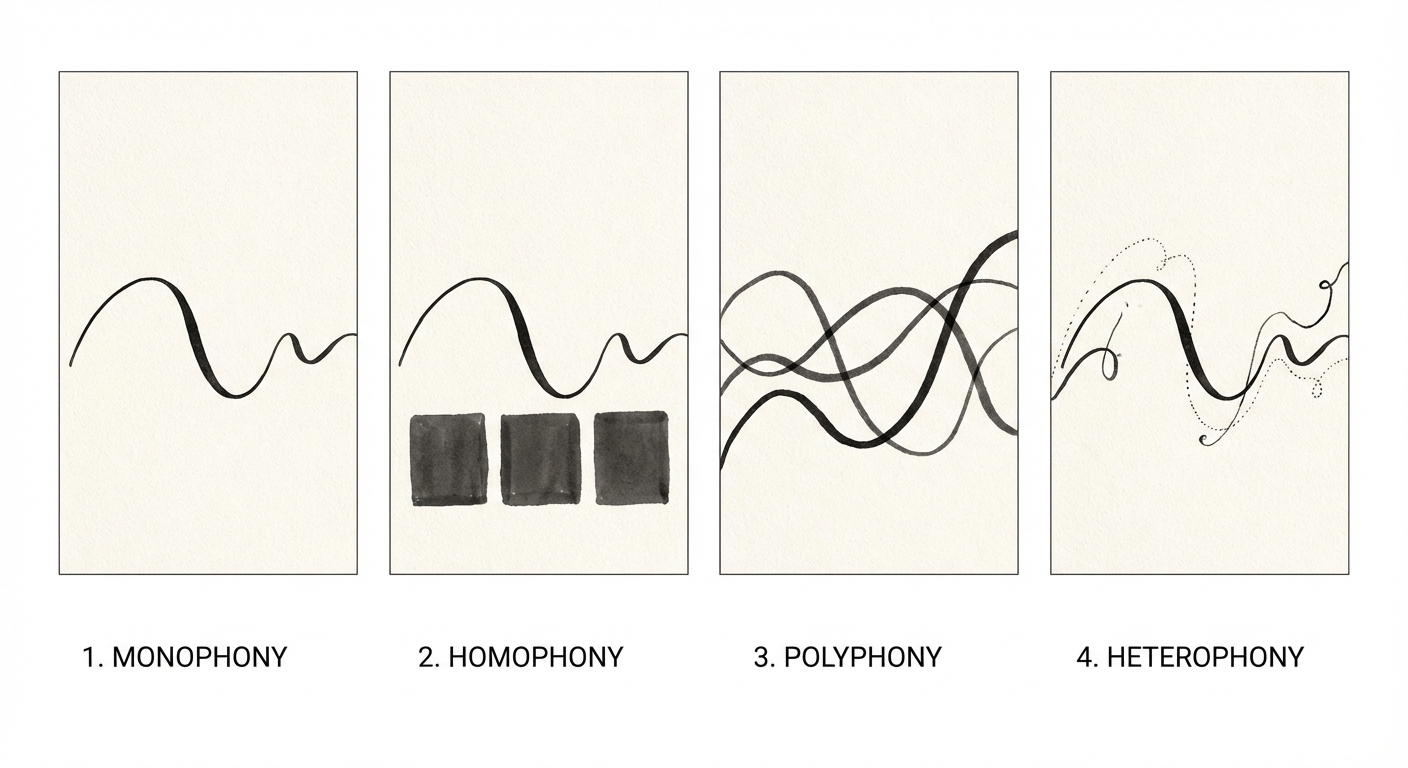
Texture refers to how many layers of sound are heard and how they relate.
1. Monophony
A single melodic line with technically no accompaniment.
- Check: If multiple people sing the same melody in octaves, it is still monophonic.
2. Homophony
One distinct melody with harmonic accompaniment.
- Melody and Accompaniment: A clear solo voice with background chords.
- Chordal Homophony (Homorhythmic): All voices move together in the same rhythm (like a hymn).
3. Polyphony
Two or more independent melodic lines occurring simultaneously.
- Non-Imitative Polyphony: Melodies are independent and different.
- Imitative Polyphony: Melodies share the same shape but start at different times (e.g., a Round, Canon, or Fugue).
4. Heterophony
Simultaneous variation of a single melodic line.
- Example: One instrument plays a simple melody while another plays an ornamented version of the same melody at the same time. Common in non-Western music and jazz.
Timbre (Tone Color)
Timbre describes the quality of the sound (what makes a flute sound different from a violin).
- Descriptive terms: Bright, dark, brassy, reedy, harsh, mellow.
- Instrumentation: Be able to identify standard orchestral instruments by ear.
- Performance Techniques:
- Pizzicato: Plucking strings.
- Arco: Bowing strings.
- Legato: Smooth, connected.
- Staccato: Short, detached.
Common Mistakes: Texture & Rhythm
- Monophony Confusion: Students think drums/percussion usually count as a polyphonic line. In AP Theory, unpitched percussion generally does not change the texture classification from monophony/homophony.
- Agogic Accent Errors: Do not confuse Agogic (duration stress) with the symbol for staccato or standard accents.
- Polyphony vs. Homophony: If the accompanying lines are interesting but clearly subordinate (just outlining chords), it is homophony. If the accompanying lines have their own rhythmic independence and melodic integrity, it is polyphony.