AP Calculus AB Unit 2: Product and Quotient Rules (with Notation, Strategy, and Pitfalls)
In earlier differentiation work, the Power Rule and the Sum and Difference Rules can make derivatives feel almost “linear.” That intuition breaks when functions multiply or divide. This section covers the Product Rule and Quotient Rule, two core tools for differentiating combinations such as
and
where simpler rules fail.
The Product Rule
What the product rule says (and what it’s really for)
In calculus, you often need the derivative of a function built by combining simpler functions. When two functions are multiplied, the result is called a product. If
and %%LATEX3%% and %%LATEX4%% are both differentiable, then their product is differentiable, and the product rule tells you
Many students remember it as “differentiate the first and keep the second, plus keep the first and differentiate the second.” A common mnemonic is:
- “Left derivative times right, plus left times right derivative”
which you may see written as:
In shorthand notation using %%LATEX7%% and %%LATEX8%%:
Why you need it (and why you can’t just multiply derivatives)
The most common early mistake is assuming derivatives distribute over multiplication. It is true that
but it is not true that
This false idea is sometimes nicknamed “the Freshman’s Dream.” Differentiation measures how a quantity changes, and when two quantities multiply, each one’s change affects the product.
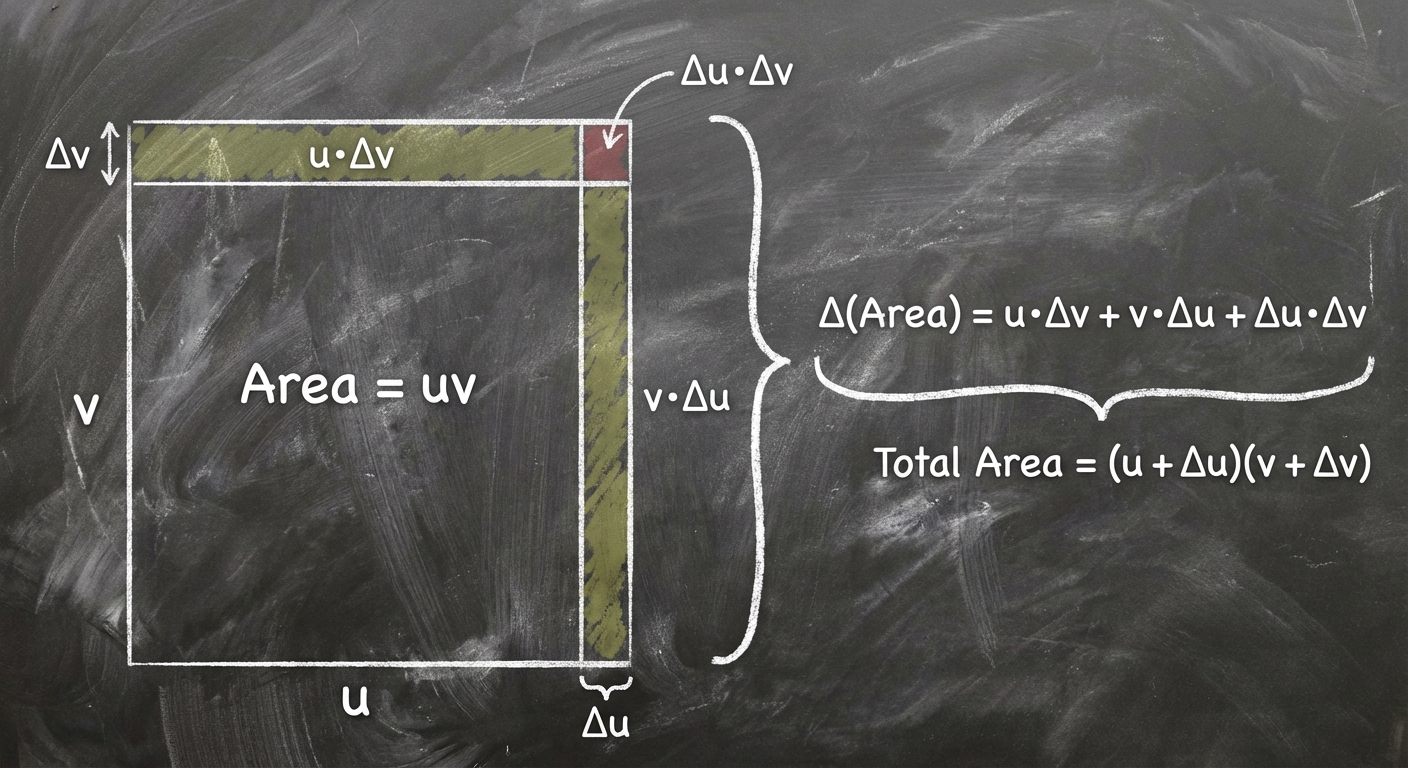
A helpful geometric analogy is a rectangle with area
If both side lengths change, the change in area includes the “strip” added from changing %%LATEX13%% while %%LATEX14%% stays fixed, plus the strip added from changing %%LATEX15%% while %%LATEX16%% stays fixed (not just the tiny corner piece coming from both changing at once). This is the intuition behind why two terms appear in the rule.
How it works (the idea behind the formula)
You do not need to re-derive the product rule on the AP exam, but seeing the mechanism helps prevent “one-term” or “wrong-term” errors.
Start from the derivative definition for :
The key move is adding and subtracting the mixed term so you can split the numerator:
Then each piece factors:
- one part has %%LATEX21%% times a difference in %%LATEX22%%
- the other part has %%LATEX23%% times a difference in %%LATEX24%%
In the limit, those become %%LATEX25%% and %%LATEX26%%, giving
Notation you may see (same idea, different symbols)
On AP Calculus, derivative notation varies. All of these mean “derivative with respect to .”
| Meaning | Common notation | Example for |
|---|---|---|
| Derivative of a function | ||
| Derivative of | ||
| Leibniz notation |
If , then equivalently:
and
How to apply the product rule (a reliable process)
When you see a product, your goal is to identify two factors that you can differentiate.
- Name the factors: decide what is %%LATEX40%% and what is %%LATEX41%%.
- Differentiate each factor: compute %%LATEX42%% and %%LATEX43%%.
- Substitute into the template:
- Simplify if helpful. Simplifying is often optional on Free Response, but it can be very useful on Multiple Choice.
A practical tip: if one factor is complicated, do not expand unless expansion truly makes the derivative easier.
Product rule examples (worked, step by step)
Example 1: A polynomial times a trig function
Differentiate:
Identify factors:
Differentiate:
Apply the product rule:
This is a correct final answer (further factoring is optional unless asked).
Example 2: Product rule combined with the chain rule inside a factor
Differentiate:
Identify factors:
Differentiate:
For , use the chain rule:
so
Apply the product rule:
Optional factoring (often useful later for sign analysis):
Example 3: Worked example with two polynomials
Find for
Let
Differentiate each:
Apply the product rule:
Optional simplification:
so
Example 4: Mixing function types
Differentiate:
Let
Then
So
What commonly goes wrong with the product rule
Errors usually come from either remembering the formula vaguely or skipping needed sub-rules.
- Believing the “Freshman’s Dream” idea that the derivative is .
- Forgetting one of the two terms and writing only %%LATEX76%% or only %%LATEX77%%.
- Differentiating the wrong factor (for instance, leaving %%LATEX78%% unchanged instead of turning it into %%LATEX79%%).
- Not using the chain rule when needed inside a factor, such as with
Exam Focus
- Typical question patterns:
- Find for products like (polynomial)(trig/exponential/log).
- Find the slope of the tangent line at for a function given as a product.
- Given values %%LATEX83%%, %%LATEX84%%, %%LATEX85%%, %%LATEX86%%, find the derivative of a product at .
- Common mistakes:
- Using %%LATEX88%% instead of %%LATEX89%%.
- Plugging in too early and losing track of which pieces still need derivatives.
- Dropping parentheses when factors have multiple terms (for example, treating like a single-term factor without grouping).
- Forgetting chain rule effects inside a factor.
The Quotient Rule
What the quotient rule says (and when you actually need it)
A quotient is one function divided by another:
where %%LATEX93%%. If %%LATEX94%% and %%LATEX95%% are differentiable and %%LATEX96%%, then the quotient is differentiable and
The structure matters:
- numerator: “derivative of the top times bottom” minus “top times derivative of bottom”
- denominator: “bottom squared”
In shorthand form with %%LATEX98%% (numerator) and %%LATEX99%% (denominator):
A common mnemonic is:
Lo d-Hi minus Hi d-Lo, all over Lo Lo.
Here “Hi” is the numerator (top) and “Lo” is the denominator (bottom). The phrase “Lo Lo” reminds you the denominator is squared.
Why it matters (and how it connects to other rules)
Just as with products, you cannot “divide the derivatives.” The quotient rule is a standard, expected tool in AP Calculus AB because quotients show up constantly in rational functions, average-rate formulas, and applied models.
Strategically, though, you do not have to use the quotient rule every time you see a fraction.
- Sometimes you can simplify first (for instance, cancel common factors) and then differentiate using simpler rules.
- Sometimes you can rewrite using negative exponents, turning a quotient into a product:
- If the denominator is a constant, you do not need the quotient rule. For example,
can be rewritten as
and differentiated using constant multiples plus the power and sum rules.
A good AP mindset is: “What method is least error-prone here?” Either approach is fine if done correctly.
How it works (conceptual reason for the formula)
Dividing changing quantities is sensitive because changes in the denominator affect the entire fraction. A clean way to remember where the minus sign comes from is to connect the quotient rule to the product rule.
Start with
Differentiate using the product rule:
Then use the chain rule for a reciprocal. Since
you get
So
Putting everything over the common denominator gives
How to apply the quotient rule (a reliable process)
- Identify numerator and denominator:
- Differentiate each separately to get %%LATEX113%% and %%LATEX114%%.
- Substitute carefully:
- Use parentheses aggressively, especially when the numerator or denominator has multiple terms.
- Simplify if helpful. It is often standard practice to keep the denominator in a structured/factored form (for example, instead of expanding), because that structure is useful later when analyzing zeros/critical behavior.
Quotient rule examples (worked, step by step)
Example 1: Rational function with polynomials
Differentiate:
Identify parts:
Differentiate:
Apply quotient rule:
Simplify the numerator:
So
Example 2: Quotient involving trig (and an opportunity to simplify thinking)
Differentiate:
You can also rewrite it as a product:
but here we practice the quotient rule.
Identify parts:
Differentiate:
Apply quotient rule:
Simplify structure:
Factor and cancel (valid for %%LATEX133%%, and the original function is undefined at %%LATEX134%% anyway):
so
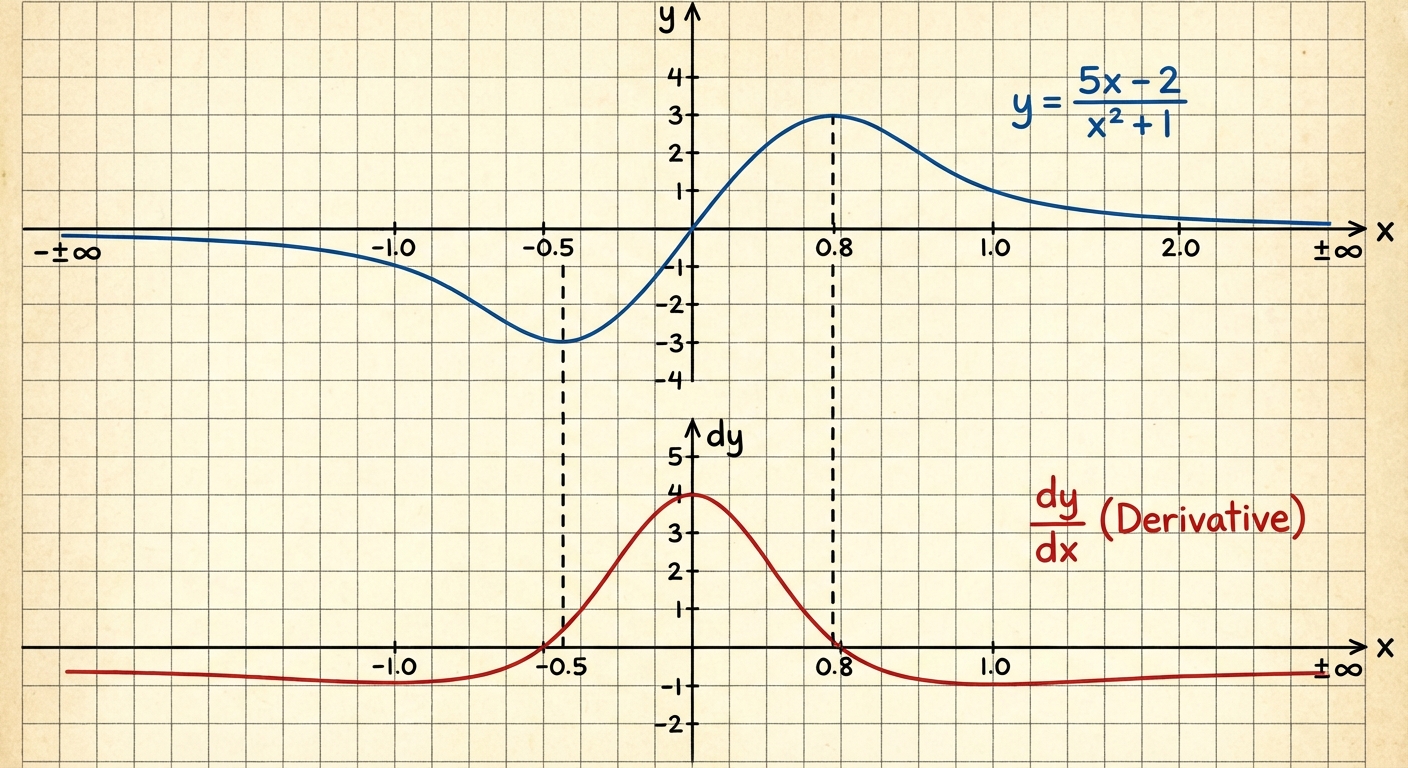
Example 3: Rational function with linear over quadratic
Find for
Identify:
Differentiate:
Apply “Lo d-Hi minus Hi d-Lo”:
Put over “Lo Lo”:
Simplify the numerator:
So
Note: It is standard practice to leave the denominator as rather than expanding it.
Choosing between quotient rule vs rewriting as a product
You will often gain speed and accuracy by rewriting first when the denominator is a simple power (especially powers of ).
For example:
Then using the product rule and power rule may be faster than the quotient rule. But if the denominator is complicated, the quotient rule is often the cleanest approach.
A common student error is to think “quotient means quotient rule.” Instead, decide which method is least error-prone.
What commonly goes wrong with the quotient rule
- Sign/order errors: the numerator must be
or equivalently . Swapping the order flips the sign of the entire derivative.
- Forgetting to square the denominator: it must be
not just .
- Failure to distribute the negative: in %%LATEX155%%, the minus applies to the entire product %%LATEX156%%, so parentheses matter.
- Missing parentheses with multi-term expressions (a classic algebra trap).
- Simplifying incorrectly: you may cancel common factors only, not terms added by plus or minus. For instance, you cannot cancel term-by-term in
unless the whole numerator has a common factor.
Exam Focus
- Typical question patterns:
- Find %%LATEX158%% for quotients such as (polynomial)/(polynomial), then evaluate at %%LATEX159%%.
- Given %%LATEX160%%, %%LATEX161%%, %%LATEX162%%, %%LATEX163%%, find .
- Find the equation of the tangent line to a quotient at a specified value.
- Common mistakes:
- Dropping the minus sign, reversing the numerator order, or forgetting parentheses around the second product.
- Forgetting the denominator is squared (or squaring only part of a multi-term denominator).
- Substituting the point value too early and losing the structure needed to differentiate correctly.
- Using the quotient rule when the denominator is a constant (wasting time and increasing error risk).
Higher-Order Derivatives & Notation
Higher-order derivatives (second derivative and beyond)
Occasionally, you will be asked to find the second derivative, denoted
or
in situations that involve products or quotients. This often requires nesting rules.
For example, if
then
To find the second derivative, you differentiate again. That usually means applying the product rule again to each product term like %%LATEX170%% and %%LATEX171%%. Expressions expand quickly, so clear organization and careful parentheses are essential.
Notation reference (prime vs Leibniz)
| Notation Type | Derivative of Product | Derivative of Quotient |
|---|---|---|
| Prime notation | ||
| Leibniz notation |
Exam Focus
- Typical question patterns:
- “Find %%LATEX176%%” when %%LATEX177%% is a product or quotient (be ready to apply rules repeatedly).
- Common mistakes:
- Losing terms when differentiating a product result like .
- Dropping parentheses and signs during the second round of differentiation.
- Expanding too early and creating avoidable algebra errors.