Mastering Latin Prose Mechanics: Preparation for Caesar and Beyond
Fundamentals of Prose Translation
Unit 1 of the AP Latin curriculum is designated as Teacher's Choice. While the specific authors read in this unit vary (common choices include Nepos, Cicero, Livy, or Pliny), the objective is universal: to bridge the gap between intermediate Latin and the rigorous textual analysis required for Caesar's De Bello Gallico.
This unit focuses on solidifying your grasp of Latin prose syntax, vocabulary, and sight-reading skills. Unlike poetry, prose follows stricter grammatical logic, though word order can still be fluid. Success in this unit depends on mastering the structural formulas that govern complex sentences.
The Literal Translation Requirement
One of the most critical skills to develop in Unit 1 is the ability to produce a Literal Translation. The AP exam imposes a strict standard for translation that differs from literary interpretation.
- Precision: You must render the precise meaning of words (e.g., distinguishing between imperfect audiebat "he was hearing" and perfect audivit "he heard").
- Voice: Maintain active or passive voice as written. Do not swap them for flow.
- Structure: Subordinate clauses must remain subordinate in English.
Advanced Noun Syntax
While you should know your five declensions by now, AP Prose requires identifying specific, nuanced uses of the cases. These "uses" dictate how a noun functions contextually.
The Genitive Case
Beyond simple possession ("of the girl"), watch for:
- Partitive Genitive (Genitive of the Whole): Used to denote the whole from which a part is taken. Often appears with words like pars (part), nihil (nothing), or satis (enough).
- Example: (nothing of bad / no bad thing).
- Objective Genitive: Used with nouns implying action or emotion.
- Example: (love for the country, not the country's love).
- Genitive of Description: Describes a quality of a person or thing, usually modified by an adjective.
- Example: (a man of great courage).
The Dative Case
Prose authors often use the Dative for more than just indirect objects:
- Dative with Compounds: Verbs compounded with prefixes (ad, ante, circum, com, in, inter, ob, post, prae, pro, sub, super) often take a Dative object.
- Example: (He put the lieutenant in charge of the camp).
- Dative of Possession: Used with sum, esse.
- Example: (A horse is to me $\rightarrow$ I have a horse).
- The Double Dative: A combination of a Dative of Reference (person concerned) and Dative of Purpose (the outcome).
- Example: (as a help to our men).
The Ablative Case
The Ablative is the "adverbial" case, answering how, when, where, or why.
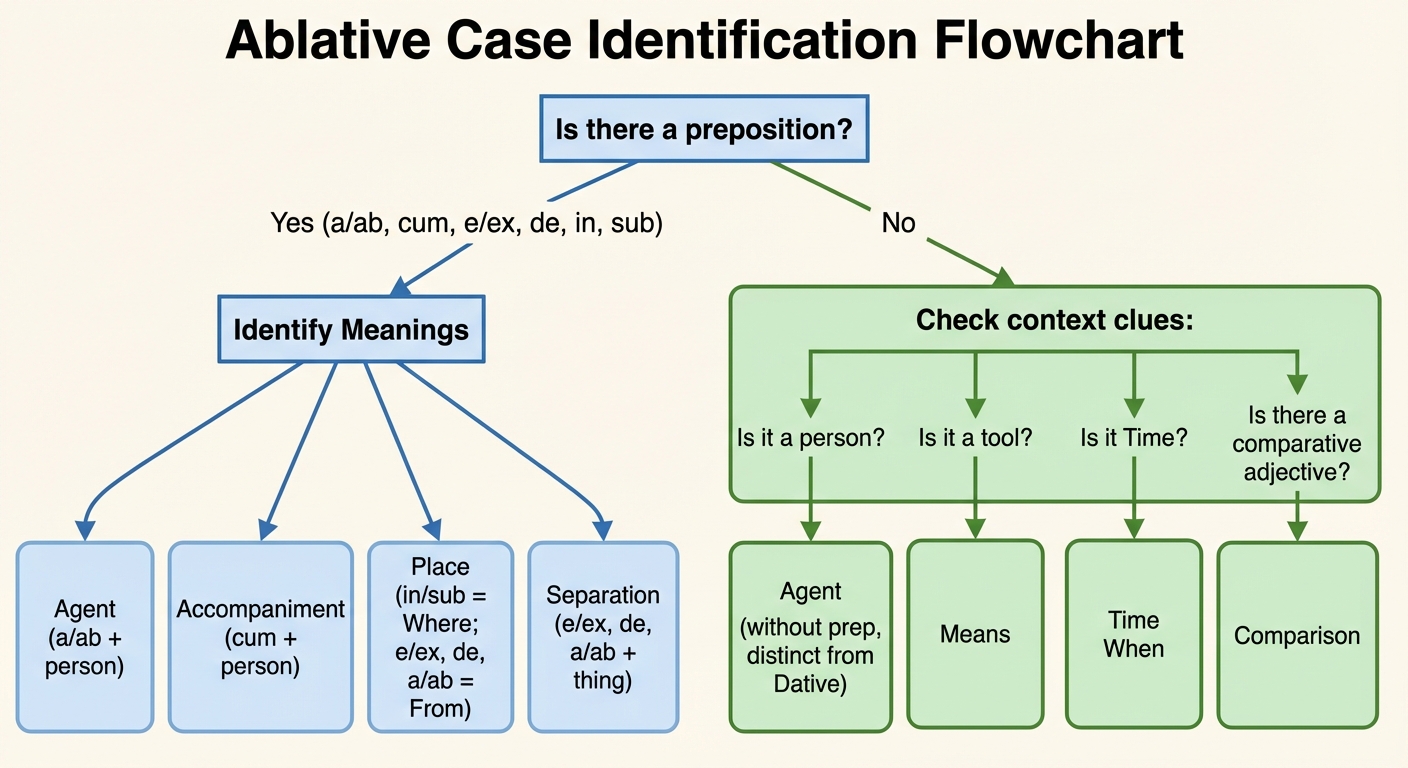
| Ablative Type | Latin Marker | Translation Strategy |
|---|---|---|
| Means/Instrument | No preposition | "by means of," "with" |
| Agent | a/ab + person | "by [person]" (with passive verb) |
| Manner | cum (sometimes omitted if adj is present) | "with [emotion/style]" |
| Separation | a/ab, e/ex, de (or none) | "from" |
| Comparison | No preposition (after comparative adj) | "than" |
| Degree of Difference | No preposition (e.g., multo) | "(by) much" |
The Ablative Absolute
The Ablative Absolute is the quintessential Latin prose construction. It sets the scene, establishing the time, cause, or circumstances of the main action. It is grammatically independent from the rest of the sentence.
Formulation
Sometimes, it involves two nouns or a noun and an adjective (with the verb esse implied, as esse lacks a distinct present participle).
Translation Strategies
Avoid mechanically translating as "with the [noun] having been [verbed]." Instead, use temporal or causal conjunctions:
- Temporal: "When…"
- Causal: "Because/Since…"
- Concessive: "Although…"
- Example: Urbe capta, cives fugerunt.
- Literal: With the city having been captured, the citizens fled.
- Better: When the city was captured, the citizens fled.
Indirect Statement (Oratio Obliqua)
In Caesar and other prose reporters, speakers often report speech rather than quoting it directly. This triggers the Indirect Statement.
The Formula
Tense Relationships
The tense of the Infinitive is relative to the tense of the Main Verb. It acts like a floating timeline.
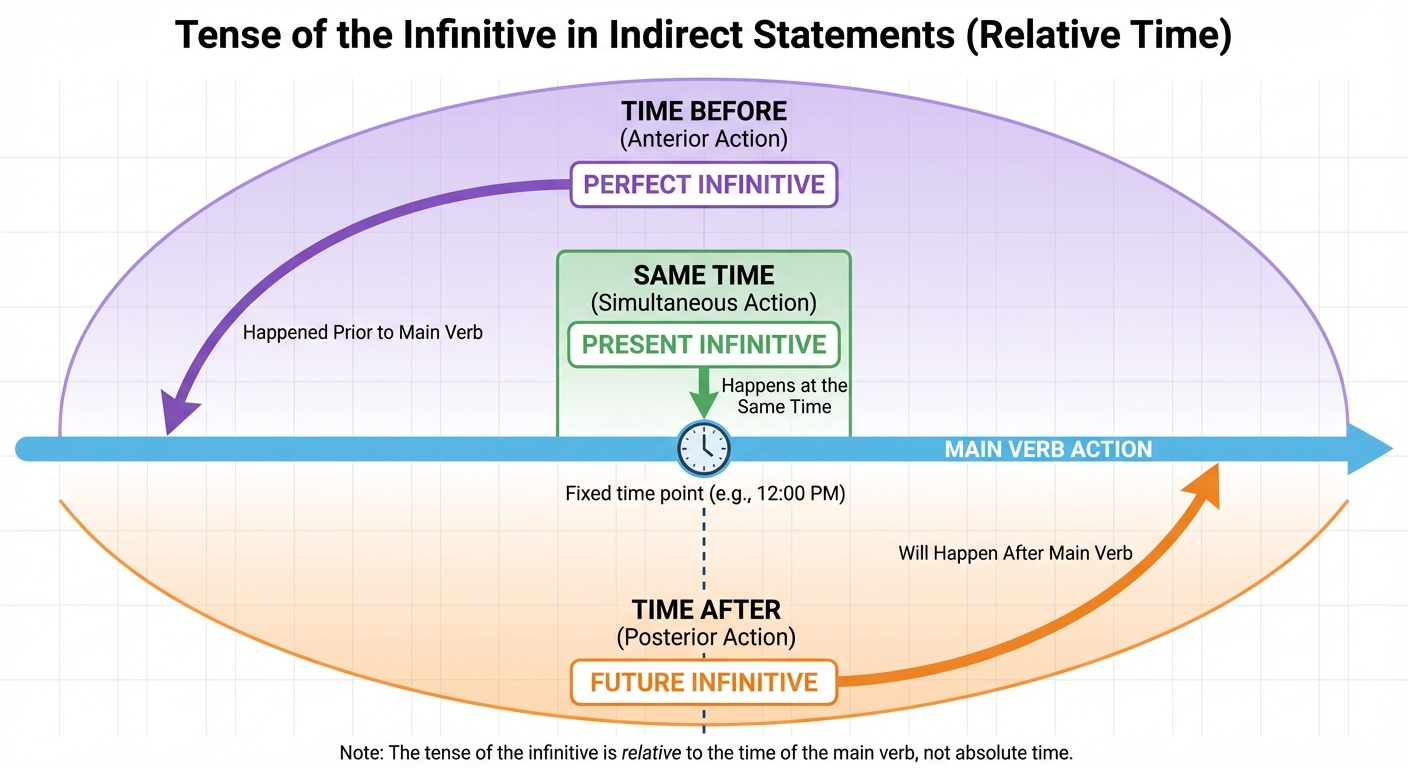
| Infinitive Type | Relation to Main Verb | Example (Main verb is Past) |
|---|---|---|
| Present Infinitive | Same Time | He said that he was running (at that moment). |
| Perfect Infinitive | Time Before | He said that he had run (earlier). |
| Future Infinitive | Time After | He said that he would run (later). |
Common Mistake: Translating a Present Infinitive as "to [verb]." In Indirect Statement, you must translate it as a conjugated verb following "that."
The Subjunctive Mood in Clauses
While the Indicative mood states facts, the Subjunctive mood expresses potential, will, or subordinate logical relationships. In prose, you rarely translate the Subjunctive as "might" or "may"; instead, the translation depends on the clause type.
Sequence of Tenses
The tense of the subjunctive verb in a dependent clause is determined by the main verb.
- Primary Sequence: Main verb is Present/Future $\rightarrow$ Subjunctive is Present/Perfect.
- Secondary Sequence: Main verb is Past $\rightarrow$ Subjunctive is Imperfect/Pluperfect.
Common Prose Clauses
1. Purpose Clause
- Marker: ut (positive) or ne (negative).
- Function: Explains why an action was done.
- Translation: "in order to," "so that."
- Example: Venit ut videat. (He comes so that he may see.)
2. Result Clause
- Marker: ut (positive) or ut non (negative). Look for "signal words" in the main clause: tam (so), talís (such), tantus (so great), ita (in such a way).
- Function: Explains the outcome.
- Translation: "that."
- Example: Tam celeriter cucurrit ut vinceret. (He ran so quickly that he won.)
3. Indirect Command (Jussive Noun Clause)
- Marker: ut or ne.
- Function: Triggered by verbs of ordering, asking, or persuading (imperare, mandare, persuadere, quaerere).
- Translation: Translate as an infinitive phrase in English.
- Example: Persuadet ei ut exiret. (He persuades him to leave.)
4. Cum Clauses
- Circumstantial/Temporal: Cum + Subjunctive. Translated as "When."
- Causal: Cum + Subjunctive. Translated as "Since/Because."
- Concessive: Cum + Subjunctive (w/ tamen in main clause). Translated as "Although."
Participles
Participles are verbal adjectives. They hold tense and voice but modify nouns like adjectives.
| Tense | Voice | Ending | Translation |
|---|---|---|---|
| Present | Active | -ns, -ntis (3rd decl) | "Verbing" |
| Perfect | Passive | -tus, -a, -um (1st/2nd) | "Having been verbed" |
| Future | Active | -turus, -a, -um (1st/2nd) | "About to verb" |
| Future | Passive (Gerundive) | -ndus, -a, -um (1st/2nd) | "Must be verbed" |
Note on Deponent Verbs: Perfect Participles of Deponent verbs (e.g., locutus from loquor) are translated Actively: "Having spoken," not "Having been spoken."
Sight Reading Strategies for Prose
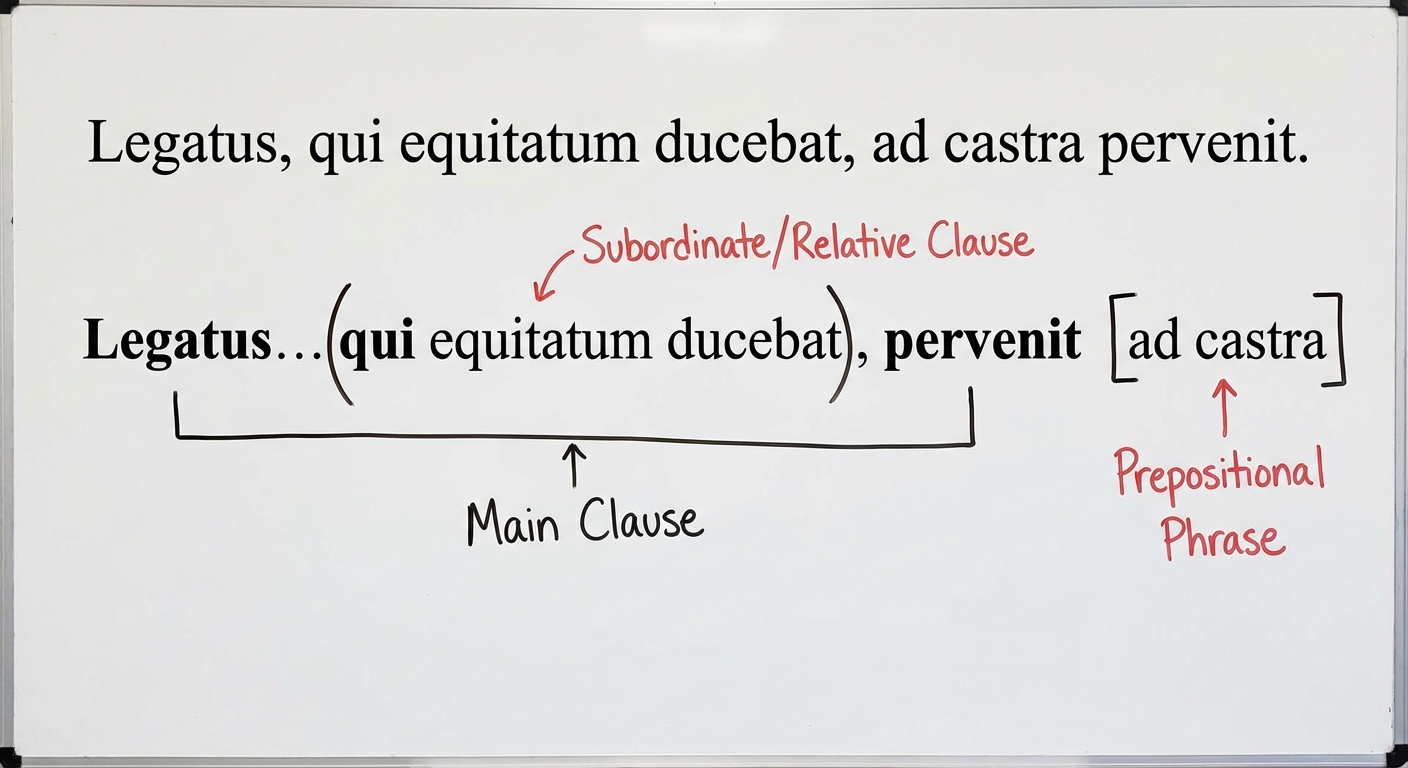
When facing a block of Latin text (like Nepos or Cicero) without a dictionary, use the "Bracketing Method."
- Isolate the Main Sentence: Find the main Nominative Subject and the main Indicative Verb. Ignore everything else initially.
- Bracket Prepositional Phrases: Put brackets
[ ]around everything from a preposition (in, ad, ex) to its object. - Parenthesize Subordinate Clauses: Put parentheses
( )around clauses starting with ut, ne, cum, quod, qui/quae/quod.
Example Analysis:
(Cum Caesar in Galliam veniret), [propter metum], hostes fugerunt.
Main Clause: hostes fugerunt (The enemies fled).
Context: When Caesar came into Gaul (circumstantial), on account of fear (cause).
Common Mistakes & Pitfalls
- Confusing Ut Clauses: Students often guess whether ut means "as," "so that," or "that." Check the mood of the verb! Ut + Indicative usually means "As" or "When." Ut + Subjunctive is Purpose or Result.
- The "Floating" Ablative Absolute: Students frequently try to make the Ablative Absolute the subject of the sentence. Remember, it is grammatically disconnected. It explains the background, not the main action.
- Misidentifying the Subject of Infinitives: In an Indirect Statement, the Subject is Accusative. Do not translate the Accusative as a direct object if it is the actor of the infinitive.
- Relative Pronoun Antecedents: A relative pronoun (qui, quae, quod) gets its Gender and Number from the antecedent, but its Case comes from its job in its own clause.
- Lookalike Words:
- via (road) vs. vi (by force - ablative of vis)
- aestas (summer) vs. aetas (age)
- quidam (a certain one) vs. quidem (indeed)