Unit 2: Differentiation: Definition and Fundamental Properties
From Average Rate of Change to Instantaneous Rate of Change
A lot of calculus begins with a simple question: when something is changing, how fast is it changing right now?
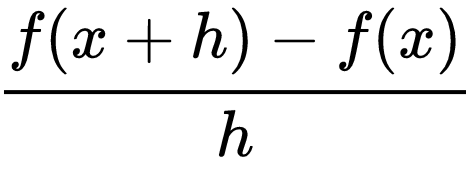
You already know how to compute an average rate of change. If a function gives an output (like position, cost, or temperature) from an input (like time), then over an interval from to , the average rate of change is
Geometrically, that fraction is the slope of the secant line through the two points and on the graph. A common “algebra 1” way to say the same thing is
Why average rate of change is not enough
Average rate of change “smears out” what happens across an interval. If you’re driving a car and your position is changing, your average speed over 10 seconds does not tell you your speed at the exact instant at 3 seconds. The exact instant is what we call an instantaneous rate of change.
In a graphing context, an instantaneous rate of change corresponds to the slope of the tangent line at a point. The tangent line is the line that best matches the curve “right at” that point.
How calculus makes “instantaneous” precise
The key idea is approximation that becomes exact in the limit.
- Pick a point .
- Compute the slope of the secant line from to a nearby point .
- Then shrink the “nearby” distance toward .
That secant slope is
This is still a difference quotient, but now we are thinking about what happens as the interval gets infinitesimally small.
Units matter (a common hidden skill)
If is measured in seconds and is measured in meters, then
has units of meters per second. On AP questions, interpreting units is often part of “explain your reasoning” even when it isn’t explicitly asked.
Example: average vs instantaneous (conceptual)
Suppose is position. If you compute
you found the average velocity from to . To estimate velocity at , you’d use a smaller and smaller interval around , like
and
The pattern of these slopes motivates the derivative.
Exam Focus
- Typical question patterns
- Interpret a secant slope as average rate of change and connect it to units.
- Describe how secant slopes approach a tangent slope as the interval shrinks.
- Explain what “instantaneous rate” means in a real-world context (motion, growth, cost).
- Common mistakes
- Treating average and instantaneous rate as interchangeable.
- Forgetting units or using inconsistent units between input and output.
- Using the wrong interval direction when interpreting “approach from the left/right.”
Slopes of Secant Lines, Tangent Lines, and the Limit Definition of the Derivative
For a linear function, slope is just “rise over run,” and it’s the same everywhere. For a curved graph, the slope changes from point to point, so we need a strategy.
A natural idea is to approximate the curve near a point by a secant line (a line through two points on the curve). The closer those two points are, the more accurate the secant slope becomes as an approximation to the “true” slope at the point.
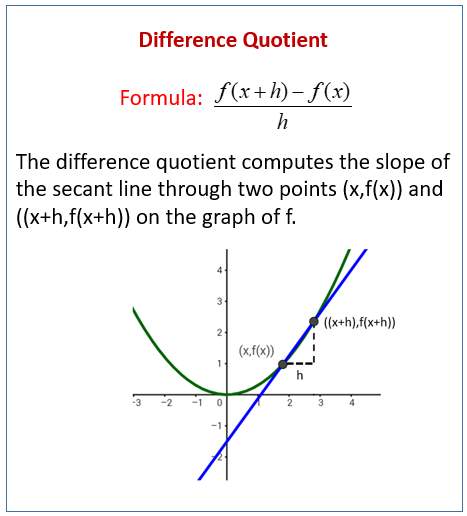
If we keep shrinking the interval between the two points, the secant line pivots toward a tangent line, which touches the curve at exactly one point and best matches the curve right there.
Definition at a point
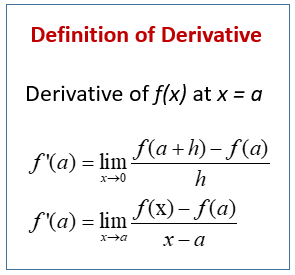
The derivative of at is defined by the limit of the difference quotient:
You might also see an equivalent form that uses approaching instead of approaching :
These describe the same idea: the slope of the secant line becomes the slope of the tangent line in the limit. This limit-based definition is the definition of the derivative.
When the derivative exists
The derivative exists at if the limit exists and is a finite real number. Practically, that requires left-hand and right-hand behaviors to agree.
If
and
both exist and are equal, then exists.
Derivative as a function (not just a number)
A major conceptual leap is that you can compute the derivative at every input where it exists. That produces a new function whose output is “slope of the original function.” This derivative function is written .
Notation you must recognize
AP Calculus uses multiple derivative notations. They all refer to the same concept, but they emphasize different viewpoints.
| Meaning | Common notation | What it emphasizes |
|---|---|---|
| Derivative of at | A single slope value at a specific point | |
| Derivative function | A new function giving slope at each | |
| Leibniz notation | Rate of change of with respect to | |
| At a point | The rate at |
It’s also common to see notation for second derivatives:
| Function | First derivative | Second derivative |
|---|---|---|
| or | or |
A common misconception is to treat as an ordinary fraction all the time. Later in the course, it can be manipulated in useful ways, but conceptually here it represents a limit.
Worked example: derivative from the definition
Let . Find using the limit definition.
Start with
Compute :
Substitute:
Simplify the numerator:
Factor out and cancel (this cancellation is exactly why you simplify before taking the limit):
Now take the limit:
So the slope of the tangent line to at input is .
Tangent line equation (using the derivative)
Once you know the slope at , you can write the tangent line at that point using point-slope form.
Slope:
Tangent line:
Students often mix up (a number) and (a function). The tangent line formula needs the slope at that point, so you must evaluate the derivative at .
Exam Focus
- Typical question patterns
- Compute from the limit definition for a given function.
- Find the equation of a tangent line using and .
- Determine whether a derivative exists at a point using one-sided limits or graph features.
- Common mistakes
- Plugging in too early (before simplifying), causing a false “division by zero” dead end.
- Confusing with in tangent line problems.
- Forgetting that the limit must exist from both sides.
Estimating Derivatives from Graphs and Tables
In many AP problems, you are not given a clean formula. Instead, you might get a table of values or a graph, and you have to estimate or interpret the derivative.
What it means to “estimate the derivative”
If is the slope of the tangent line at , then estimating means approximating that tangent slope numerically. The basic strategy is to use secant slopes with points near . In general, the closer the points are to , the more accurate the approximation tends to be.
A forward (right-hand) secant slope:
A backward (left-hand) secant slope:
A symmetric (often better) secant slope:
The symmetric version tends to reduce error because it balances behavior from both sides.
Estimating from a table
Suppose you have a table of values around . To estimate , choose points close to .
If the table gives and , then a symmetric estimate is
The smaller the interval, the better the estimate usually is (assuming the function is smooth there). But with real data, extremely small intervals can amplify measurement error, so AP questions typically pick sensible step sizes.
Estimating from a graph
From a graph, you can approximate the tangent slope by drawing (or imagining) the tangent line and selecting two readable points on that tangent line, not necessarily points on the curve.
A key idea: the tangent line is a line, so its slope is constant. You pick two points on the line and compute rise over run.
Common pitfall: students pick two points on the curve near the tangency point. That computes a secant slope, not the tangent slope. On AP, you can still do this as an approximation, but if the problem explicitly says “tangent line,” use the line.
Interpreting derivative values
A derivative value is a rate and has meaning:
- means is increasing at .
- means is decreasing at .
- often corresponds to a horizontal tangent (possible local max/min, but not guaranteed).
Worked example: estimate from nearby values
A function satisfies , , and . Estimate .
Using a symmetric difference with :
Substitute:
Compute:
So the instantaneous rate of change near is about output-units per input-unit.
Exam Focus
- Typical question patterns
- Estimate from a table using secant slopes (often symmetric).
- Estimate from a graph by reading the slope of a tangent line.
- Interpret the sign and magnitude of in context.
- Common mistakes
- Using points far from , producing a poor “derivative” estimate.
- Mixing up secant slope (average rate) and tangent slope (instantaneous rate).
- Forgetting that a slope is rise over run (subtracting in inconsistent order).
Differentiability: When a Tangent Slope Makes Sense
It’s tempting to think every function has a derivative everywhere, but derivatives have requirements. The formal word for “has a derivative at a point” is differentiable.
Definition (conceptual)
A function is differentiable at if the limit
exists (as a finite number). Geometrically, differentiability means the graph has a well-defined tangent line slope at that point.
Differentiability implies continuity
A crucial theorem you use constantly is:
- If is differentiable at , then is continuous at .
The converse is not always true: a function can be continuous but not differentiable.
Continuity only requires the graph not “break” at the point. Differentiability requires a smooth enough shape that the slope from the left matches the slope from the right.
Where differentiability fails (graph features)
On AP, you are expected to recognize common non-differentiable situations from graphs.
Discontinuities
- If is not continuous at , then does not exist.
- Breaks, holes, jumps, vertical asymptotes all destroy differentiability.
Corners (sharp turns)
- Example shape: at .
- The left-hand slope and right-hand slope are different finite numbers.
Cusps (pointy with vertical behavior)
- Slopes blow up to infinity in opposite ways.
Vertical tangents
- The slope becomes infinite (undefined as a real number), so the derivative does not exist as a finite value.
A subtle but important point: a vertical tangent line can exist visually, but in AP Calculus, “derivative exists” means a finite real number.
One-sided derivatives and matching condition
Even if the two-sided derivative fails, you can talk about one-sided derivatives.
Left derivative at :
Right derivative at :
For differentiability, these must both exist and be equal.
Worked example: continuity but not differentiability
Consider .
At , the function is continuous because the graph meets at the origin and there is no break.
But the slopes differ:
- For , , slope is .
- For , , slope is .
So the tangent slope at is not well-defined, and does not exist.
Exam Focus
- Typical question patterns
- Decide where is differentiable from a graph (identify corners, cusps, discontinuities, vertical tangents).
- Use one-sided derivatives to justify why does or does not exist.
- Use the fact “differentiable implies continuous” to make a logical conclusion.
- Common mistakes
- Claiming continuity guarantees differentiability.
- Forgetting that unequal one-sided slopes mean “not differentiable” even if the graph looks connected.
- Treating vertical tangent slopes as valid derivatives (they are not finite).
Building Differentiation Rules (Constant, Power, Sum, and Constant Multiple)
The limit definition is the foundation, but it’s too slow to use every time. Differentiation rules are shortcuts that are proved from the definition and then reused.
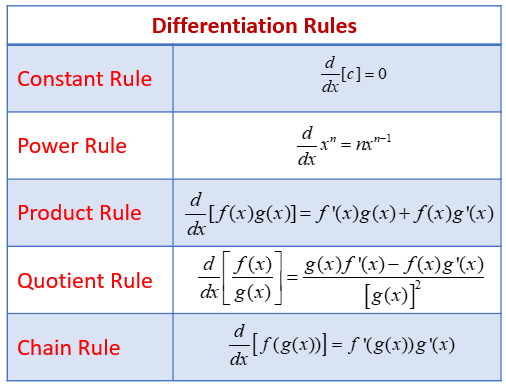
Constant rule
If where is a constant, the graph is a horizontal line. Its slope is always zero.
Example: if then
Why it matters: constants appear everywhere (intercepts, offsets, baseline values). Forgetting this rule causes lots of small algebraic errors later.
Constant multiple rule
If you multiply a function by a constant, the derivative gets multiplied by that constant:
This matches the slope idea: scaling the vertical axis by a factor of scales slopes by .
Power rule (for integer powers)
For where is a positive integer, the derivative is
A good way to remember the mechanics is: multiply down and decrease the power.
Examples:
- becomes
- becomes
This rule is a workhorse. It turns polynomial differentiation into something fast and reliable.
Where the power rule comes from (a sketch you should understand)
Using the definition,
When you expand (via the binomial theorem), every term except has at least one factor of , so you can factor out , cancel it, and then take the limit as . The surviving coefficient becomes and the remaining power becomes .
You are not usually required to reproduce a full binomial proof on the AP exam, but understanding the cancellation idea helps prevent the classic error of substituting too early.
Sum and difference rules
Derivatives distribute over addition and subtraction:
This matters because most functions you meet are built from smaller pieces.
Worked example: differentiating a polynomial
Let
Differentiate term-by-term using constant multiple + power + sum rules.
So
Common pitfall: forgetting that (students sometimes incorrectly write ).
Worked example: tangent line using derivative rules
Let . Find the tangent line at .
- Differentiate:
- Evaluate slope at :
- Find the point:
- Tangent line:
Simplify:
Exam Focus
- Typical question patterns
- Differentiate polynomials quickly and accurately.
- Use to find tangent line equations.
- Interpret as a rate of change in context (units included).
- Common mistakes
- Misapplying the power rule: writing instead of .
- Forgetting constants differentiate to zero.
- Confusing the derivative function with the slope value .
Product and Quotient Rules
Sum and power rules handle many expressions, but they do not handle multiplication and division in the way students often wish they did.
A very common incorrect guess is
That is not true in general.
Product rule
If (often written as ), then
In and language, this is often written as
A popular mnemonic is “1d2 + 2d1” (first times derivative of second, plus second times derivative of first).
Why this formula makes sense
Think of a small change in causing small changes in both factors.
- One part of the change comes from changing while is roughly the old value.
- Another part comes from changing while is roughly the old value.
The product rule captures both contributions.
Quotient rule
If
then (where )
In and language:
A useful memory aid is “low d-high minus high d-low over low squared,” where “high” means the numerator and “low” means the denominator. The order matters because of the minus sign.
Worked example: product rule
Differentiate
Let and .
Compute derivatives:
Apply product rule:
Substitute:
You could expand and simplify, but AP problems often accept correct factored forms unless a specific form is requested.
It’s also worth noting that if you had two polynomials like
you could multiply it out and then use the power rule, but the product rule saves time and reduces algebra work.
Worked example: quotient rule
Differentiate
Let and .
Then
Apply quotient rule:
Simplify the numerator carefully:
If you expand:
So
Common pitfall: forgetting parentheses, which often flips signs incorrectly.
Exam Focus
- Typical question patterns
- Differentiate expressions that are explicit products or quotients of polynomials.
- Evaluate a derivative at a point after using product/quotient rules.
- Explain (sometimes verbally) why is not .
- Common mistakes
- Using the false rule .
- Dropping parentheses in quotient rule and losing the minus sign.
- Forgetting the denominator becomes squared in the quotient rule.
Derivatives of Trig, Exponential, and Logarithmic Functions (Memory Derivatives)
Some derivatives show up so often that it’s more efficient to memorize them than to derive them repeatedly. Trigonometric functions model periodic behavior (waves, rotations, oscillations), and exponential/logarithmic functions model growth and scaling.
Trig derivatives and why radians matter
For angles measured in radians:
These formulas have this clean form only when is in radians. Switching from radians to degrees rescales the input unit, and derivatives measure “change per unit input,” so the rate would pick up a conversion factor.
You are not usually expected to re-derive these from scratch on the exam, but you are expected to use them correctly and to remember the negative sign for cosine.
Exponential and logarithmic memory derivatives
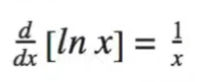
Two other standard “memory derivatives” are:
(For , the function is defined for in the real-number setting used in AP Calculus.)
Reference images commonly used for memorization:

Worked example: trig + algebraic rules
Differentiate
This is a product of and , so use the product rule.
Let and .
Then
So
A common mistake here is to try to apply the power rule to or to write
The derivative of sine is cosine.
Worked example: tangent slope for a trig function
Find the slope of the tangent line to at .
Differentiate:
Evaluate at :
So the tangent line is horizontal at .
Exam Focus
- Typical question patterns
- Differentiate expressions involving and combined with polynomials using product/quotient rules.
- Evaluate trig derivatives at special angles like , , and .
- Use derivatives to interpret slope behavior of sinusoidal graphs.
- Use standard memory derivatives correctly for and .
- Common mistakes
- Using degrees implicitly (or forgetting that AP assumes radians).
- Missing the negative sign in .
- Confusing and derivative relationships.
Higher-Order Derivatives and Meaning in Context
Once you have a derivative function, you can differentiate again. This is not just an algebra trick; it often represents “rate of change of a rate of change.”
What higher-order derivatives are
The second derivative of is the derivative of . Notation:
Similarly, the third derivative is , and so on.
If you use Leibniz notation and , you will see
for the second derivative.
Why second derivatives matter (motion is the cleanest interpretation)
If is position as a function of time , then:
- Velocity is the first derivative:
- Acceleration is the derivative of velocity, i.e., the second derivative of position:
This modeling chain is worth knowing cold:
- Position tells where you are.
- Velocity tells how fast position is changing.
- Acceleration tells how fast velocity is changing.
Even outside physics, a second derivative often means “how the trend itself is changing.” For example, if cost is increasing (positive first derivative) but increasing faster and faster (positive second derivative), that’s very different from cost increasing steadily (second derivative near zero).
Computing higher-order derivatives
You compute higher-order derivatives by differentiating again using the same rules.
Worked example:
Let
First derivative:
Second derivative:
A common mistake is to “double the powers twice” or to try to apply a special second-derivative rule. There isn’t one here; you just differentiate the derivative.
Interpreting the sign of the derivative vs the sign of the second derivative
Even in Unit 2, you should be able to interpret these meanings:
- : is increasing at .
- : is decreasing at .
- : the slope is increasing (often described later as “concave up”).
- : the slope is decreasing (often described later as “concave down”).
You do not need full curve sketching yet to use this interpretation in context questions.
Worked example: motion interpretation
Suppose
Compute velocity and acceleration.
Velocity:
Acceleration:
Interpretation example: at ,
So the object is moving in the negative direction at that time. And
So at , the velocity is not changing instantaneously.
Students often confuse “negative velocity” with “slowing down.” Negative velocity only means direction. “Slowing down” depends on velocity and acceleration having opposite signs.
Exam Focus
- Typical question patterns
- Compute for a polynomial or a function built from basic rules.
- Interpret and in a context (especially motion).
- Use given information about velocity/acceleration to describe behavior.
- Common mistakes
- Treating negative velocity as automatically “decreasing position” without considering context wording.
- Mixing up what the first vs second derivative represents.
- Differentiating incorrectly on the second pass (especially sign errors).