Unit 1 Overview: Frameworks for Comparing Political Systems
Foundational Concepts: Power, Authority, and Sovereignty
Comparative politics begins by understanding the tools political entities use to control populations and territories. You must distinguish between raw ability and recognized rights.
Power vs. Authority
- Power: The ability of one person or group to get another person or group to do something they otherwise would not do. This can be achieved through coercion (force), incentives (money), or persuasion.
- Authority: The legal right to use power. Authority is generally recognized by the people as binding.
Example: A mugger with a gun has power over you (he can make you give up your wallet). A police officer seizing evidence has authority (the legal right to valid seizure).
Sovereignty
Sovereignty is the ultimate legal authority and power over a specific territory. It is the defining trait of a state.
- Internal Sovereignty: The right to determine matters within one's borders without internal rivals (e.g., maintaining a monopoly on violence/army/police).
- External Sovereignty: The right to conclude binding agreements with other states and be recognized by the international community (autonomy).
Legitimacy
Legitimacy is the popular acceptance of the government's right to rule. It turns power into authority. According to Max Weber, there are three main sources:
- Traditional Legitimacy: Based on history, myth, and continuity ("It has always been this way").
- AP Example: The UK (Monarchy traditions), Iran (Religious tradition).
- Charismatic Legitimacy: Based on the dynamic personality of a leader or revolutionary hero.
- AP Example: Mao Zedong in China, Ayatollah Khomeini in Iran (historically).
- Rational-Legal Legitimacy: Based on a system of well-established laws and procedures. The office holds the power, not the person.
- AP Example: UK (Common Law), Nigeria/Mexico (Constitutional adherence).
The "Big Three": State, Regime, and Government
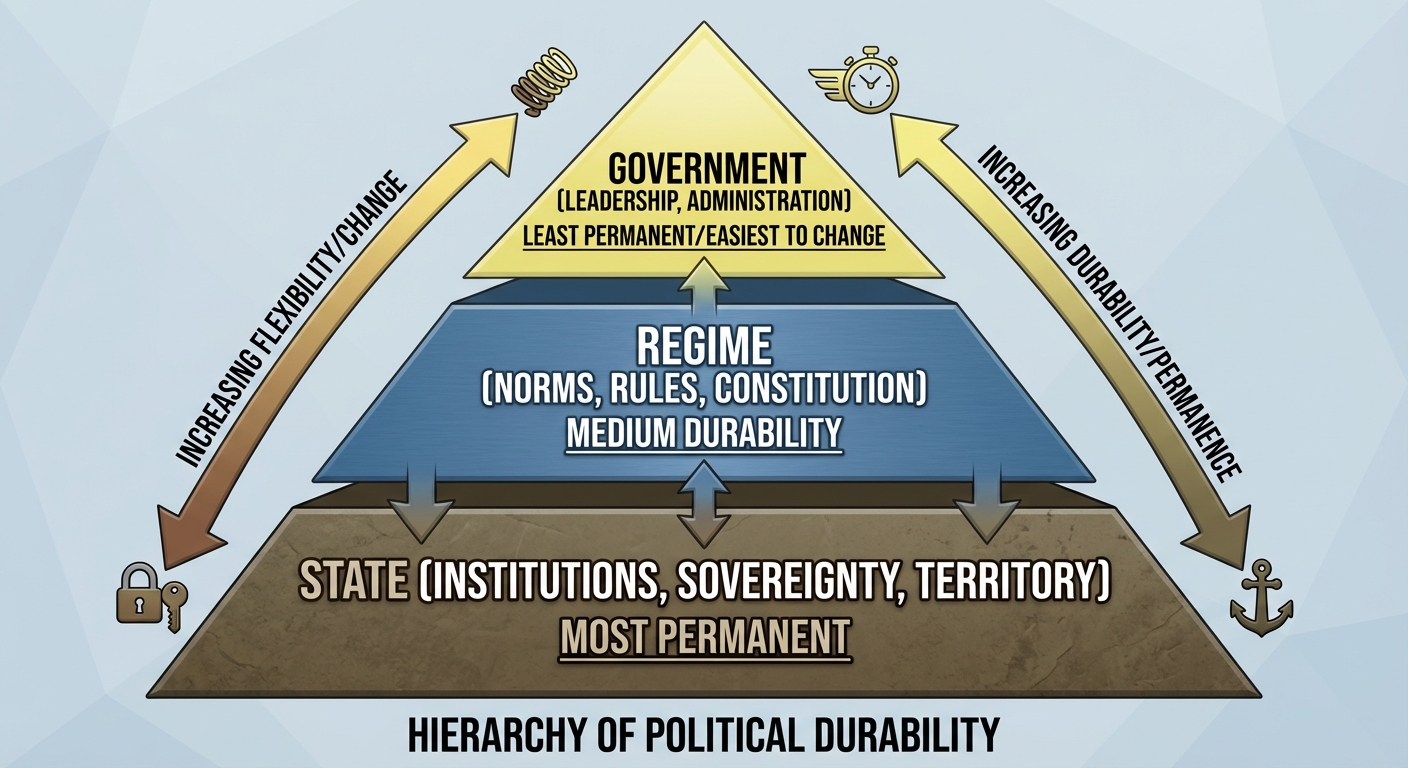
Students frequently confuse these three terms. In AP Comparative Government, they represent a hierarchy of institutional permanence.
1. The State
The most permanent institution. The state comprises the political institutions with a monopoly of force over a specific territory.
- Includes: The military, police, bureaucracy, judiciary, and taxation systems.
- Durability: Highly resistant to change.
2. The Regime
The fundamental rules and norms of politics. A regime determines how power is acquired and used (e.g., Democracy vs. Authoritarianism).
- Change: Regimes can change (e.g., the Iranian Revolution of 1979 changed the regime from a monarchy to a theocracy), but it is a major event, often violent.
- Constitution: The regime is often embodied in a constitution (written or unwritten).
3. The Government
The leadership or elite currently in charge of running the state. This refers to the specific people occupying offices.
- Durability: The least permanent. Governments change frequently through elections, term limits, or resignation.
- Example: The "Biden Administration" or the "Sunak Ministry."
Classifying Political Systems: Democracy vs. Authoritarianism
Democratic Regimes
Democracies bases their authority on the will of the people.
- Liberal Democracy (Substantive):
- Free, fair, and competitive elections.
- Protection of civil liberties and civil rights.
- Rule of Law (laws apply equally to everyone, including leaders).
- Independent judiciary and media.
- AP 6 Example: United Kingdom.
- Illiberal Democracy (Procedural):
- Holding elections that appear competitive but are manipulated.
- Restricted civil liberties.
- Lack of a truly independent judiciary.
- AP 6 Example: Russia (often categorized here or as authoritarian).
Authoritarian Regimes
Regimes where a small group of elites exercises power with no constitutional responsibility to the public.
- Theocracy: Rule by religious leaders based on religious law.
- AP 6 Example: Iran.
- Totalitarianism: The state controls virtually all aspects of society (politics, economy, social life).
- One-Party State: A single political party controls the state and bans rivals.
- AP 6 Example: China (CCP).
- Military Rule: The military exerts control, often following a coup d'état.
- AP 6 Example: Nigeria (historically, currently a democracy).
Comparing Government Structures: The AP Six
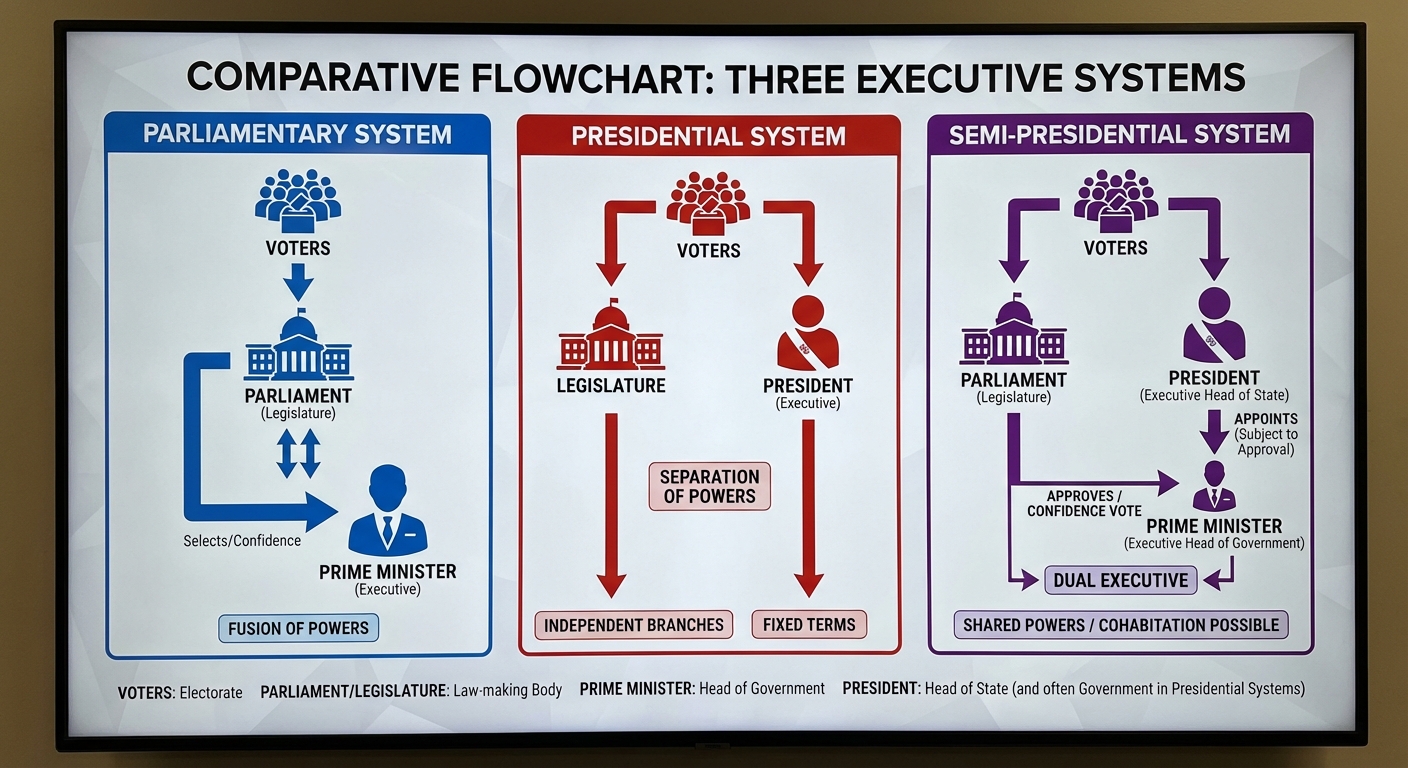
You must know how power is distributed geographically (Federal vs. Unitary) and how the executive interacts with the legislature (Parliamentary vs. Presidential).
Geographic Distribution of Power
| System | Definition | Advantages | Disadvantages | AP 6 Examples |
|---|---|---|---|---|
| Unitary | Power is concentrated in the central (national) government. Regional govs only have power given by the center. | Efficiency; Uniform laws. | Ignores local needs; Minority marginalization. | UK (Devolved), China, Iran |
| Federal | Power is constitutionally divided between central and regional governments. | Checks power; Represents local diversity. | Inefficient; Conflict between layers. | Russia, Mexico, Nigeria |
Note on Russia: While constitutionally federal, Russia forces "Asymmetric Federalism," where some regions have more autonomy than others, but power is heavily centralized under Putin.
Executive-Legislative Relations
Parliamentary System (UK)
- Fusion of Power: The Executive (Prime Minister) is a member of the Legislature.
- Selection: PM is chosen by the majority party in the legislature, not directly by voters.
- Removal: Can be removed via a "Vote of No Confidence."
- Head of State vs. Head of Government: Separate roles (Monarch = State context; PM = Gov policy).
Presidential System (Mexico, Nigeria)
- Separation of Powers: Executive and Legislature are elected independently.
- Roles: President is usually both Head of State and Head of Government.
- Checks and Balances: Harder to remove the executive (impeachment needed).
Semi-Presidential System (Russia)
- Hybrid system with two executives: A President (Head of State, usually strong) and a Prime Minister (Head of Government).
- The President typically handles foreign policy/defense; PM handles domestic policy.
Political Change and Continuity
How do systems evolve? You must distinguish between evolutionary and revolutionary change.
Types of Change
- Reform: Changes that do not overthrow basic institutions (e.g., UK expanding voting rights).
- Revolution: A fundamental change in the political and social institutions of a society, often accompanied by violence, leading to a Regime Change (e.g., China 1949, Iran 1979).
- Coup d'état: The seizure of government power by a small group (usually military). This replaces the leadership (Government change) but often leads to Regime change (e.g., Nigeria's history of coups).
Democratization
The transition from an authoritarian regime to a democratic one.
- Democratic Consolidation: The process by which a new democracy matures, making it unlikely to revert to authoritarianism without an external shock. (e.g., UK is consolidated; Nigeria is unconsolidated).
Common Mistakes & Pitfalls
- Nation vs. State: Do not use these interchangeably.
- A State is a political institution with clear borders and sovereignty.
- A Nation is a group of people with a common psychological or political identity (e.g., the Kurds are a nation without a state).
- Government vs. Regime:
- If the Conservative Party loses to the Labour Party in the UK, that is a Change in Government.
- If the UK dissolves Parliament and the King takes absolute control, that is a Change in Regime.
- Rule of Law vs. Rule by Law:
- Rule of Law (Democracy): The law rules over the leaders.
- Rule by Law (Authoritarian): Leaders use the law as a tool to control subjects, but exempt themselves from it.
- Federalism vs. Decentralization:
- The UK has devolved power to Scotland, but it is still a Unitary state because London can theoretically take that power back. In a Federal state (like Mexico), the central government cannot constitutionally abolish the regions.