Comprehensive Guide to AP Calculus BC Unit 1
Defining and Understanding Limits
The Intuitive Definition
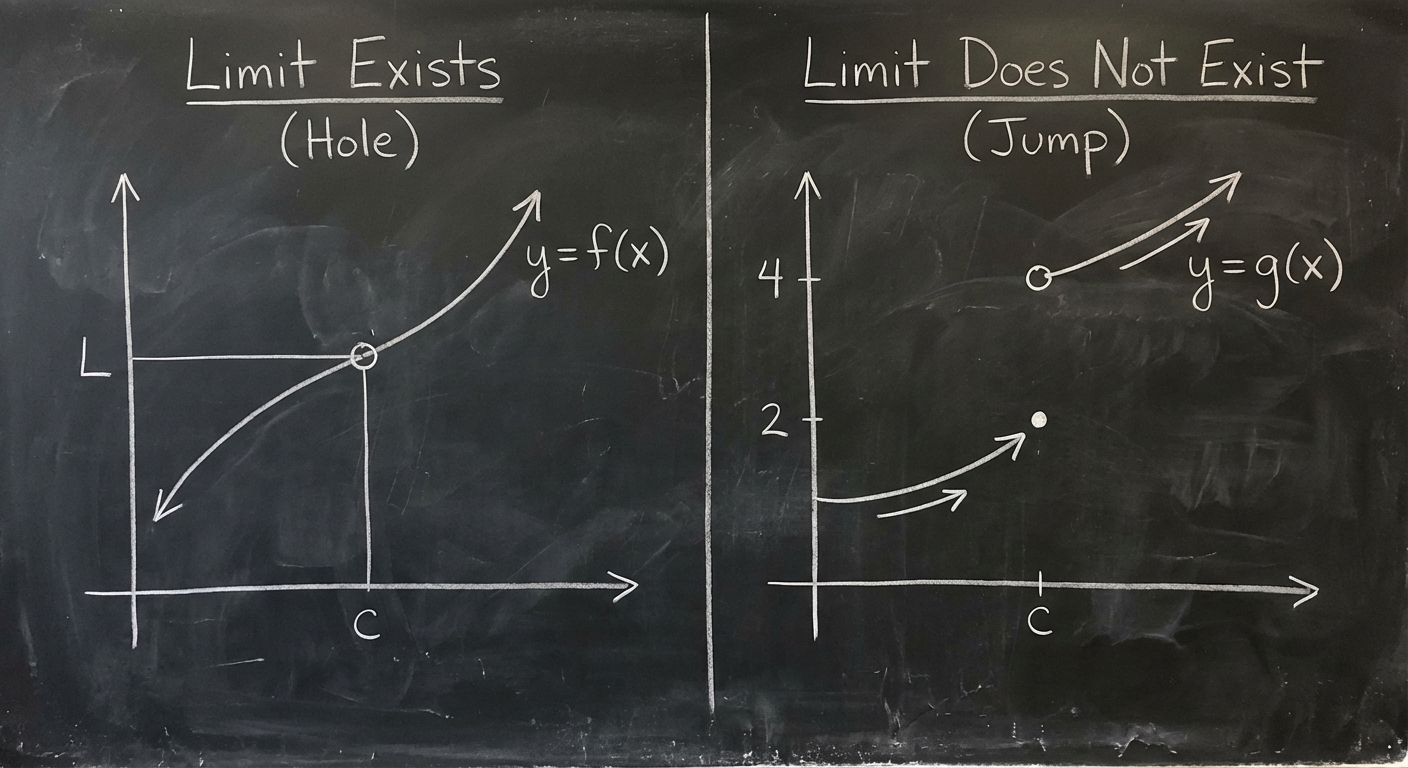
In Calculus, a limit describes the behavior of a function regarding what value it approaches as the input variable gets closer to a specific number. It is distinct from the actual value of the function at that number.
We write this as:
- Translation: "The limit of $f(x)$ as $x$ approaches $c$ is $L$."
- Key Concept: We care about what is happening around $x=c$, not necessarily what happens at $x=c$. The function can be undefined at $c$ (a hole), but the limit can still exist.
One-Sided vs. Two-Sided Limits
For a general limit to exist, the function must approach the same value from both the left and the right.
- Left-Hand Limit: $ \lim_{x \to c^-} f(x) $ (approaching from values smaller than $c$)
- Right-Hand Limit: $ \lim_{x \to c^+} f(x) $ (approaching from values larger than $c$)
The Existence Theorem:
If the left and right sides approach different values (a jump), the limit Does Not Exist (DNE).
Estimating Limits
1. Graphical Estimation
To find a limit graphically, trace the graph with your fingers from both the left and right sides toward the $x$-value in question.
- If your fingers meet at a specific $y$-value, that is the limit.
- If your fingers are at different heights (a gap/jump), the limit DNE.
- If the graph goes up or down forever (vertical asymptote), the limit is $\infty$, $-\infty$, or DNE (unbounded).
2. Tabular Estimation
Create a table of values very close to $c$ on both sides.
Example: Find $\lim_{x \to 2} (x^2)$:
| $x$ (Left) | $1.9$ | $1.99$ | $1.999$ | 2 | $2.001$ | $2.01$ | $2.1$ | $x$ (Right) |
|---|---|---|---|---|---|---|---|---|
| $f(x)$ | $3.61$ | $3.96$ | $3.996$ | ? | $4.004$ | $4.04$ | $4.41$ | $f(x)$ |
Since both sides are converging on 4, $\lim_{x \to 2} x^2 = 4$.
Determining Limits Algebraically
When given an equation, we use specific algebraic steps to solve for limits strictly.
Method 1: Direct Substitution
Always try this first! Simply plug the value $c$ into the function.
- If you get a Real number (e.g., $5$, $0$, $-2$), you are done. That is the limit.
- If you get $\frac{\text{non-zero}}{0}$ (e.g., $5/0$), there is a Vertical Asymptote.
- If you get $\frac{0}{0}$, this is an Indeterminate Form. It usually means there is a hole (removable discontinuity). You must manipulate the function.
Method 2: Factoring (Removable Discontinuities)
If you get $0/0$, try factoring both the numerator and denominator to cancel common terms.
Example:
- Direct sub yields $0/0$.
- Factor: $\frac{(x-3)(x+3)}{(x-3)}$
- Cancel $(x-3)$. The expression becomes $(x+3)$.
- Re-try substitution: $3 + 3 = 6$.
Method 3: Conjugates (Radicals)
If the function contains a square root and yields $0/0$, multiply the numerator and denominator by the conjugate.
Example:
- Multiply by $\frac{\sqrt{x+4}+2}{\sqrt{x+4}+2}$.
- Simplify top: $(x+4) - 4 = x$.
- Cancel the $x$ with the denominator.
- Solve: $\frac{1}{\sqrt{0+4}+2} = \frac{1}{4}$.
Method 4: Squeeze Theorem (Sandwich Theorem)
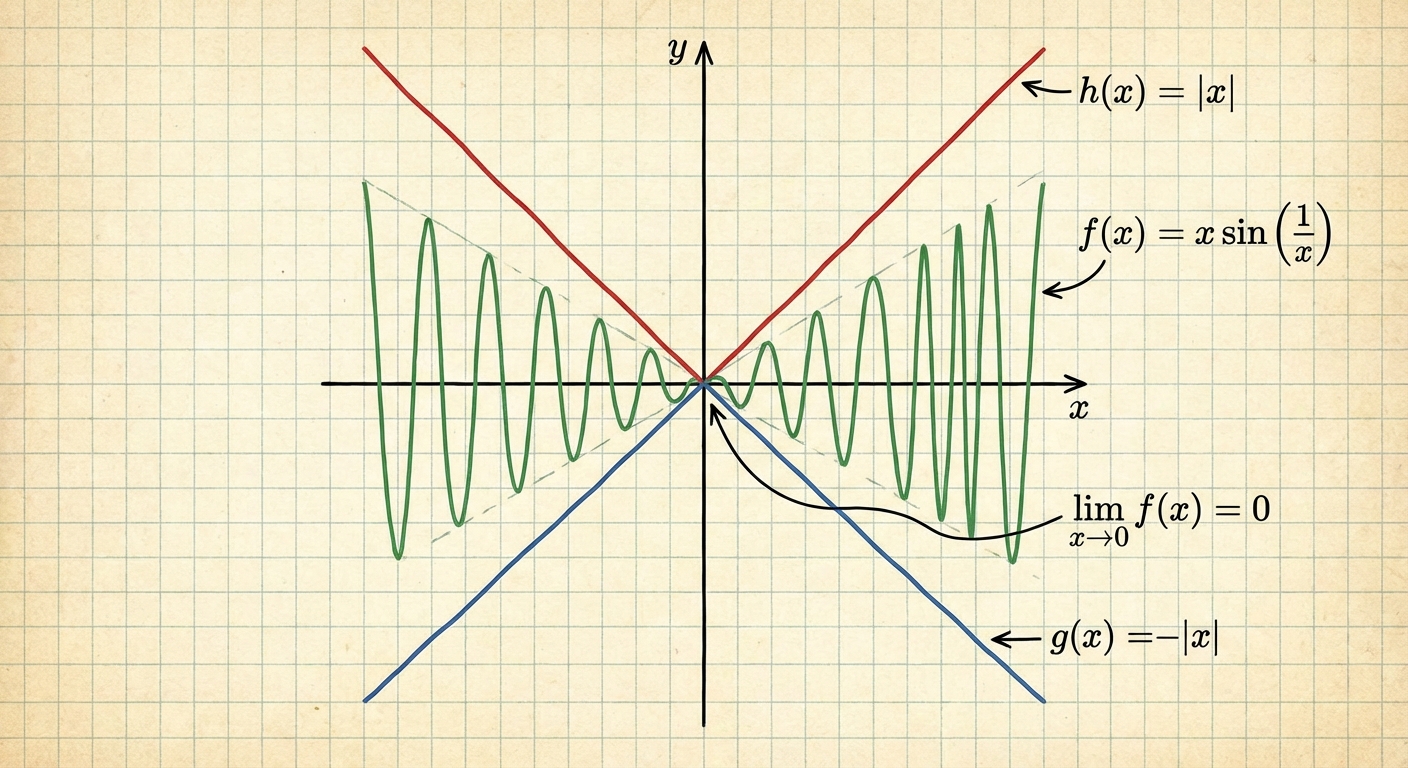
Used when a function oscillates wildly (like $\sin(1/x)$) or is difficult to evaluate directly, but is trapped between two easier functions.
Conditions:
If $g(x) \le f(x) \le h(x)$ for all $x$ near $c$, and:
Then:
Important Special Trig Limits
You must memorize these derived from the Squeeze Theorem:
Note: These rules handle coefficients too. $\lim_{x \to 0} \frac{\sin(ax)}{\sin(bx)} = \frac{a}{b}$.
Continuity
Definition of Continuity
A function $f(x)$ is continuous at a point $x=c$ if and only if three conditions are met:
- $f(c)$ is defined (The point exists).
- $\lim_{x \to c} f(x)$ exists (Left limit = Right limit).
- $\lim_{x o c} f(x) = f(c)$ (The limit equals the function value).
If any of these fail, the function is discontinuous at $c$.
Types of Discontinuities
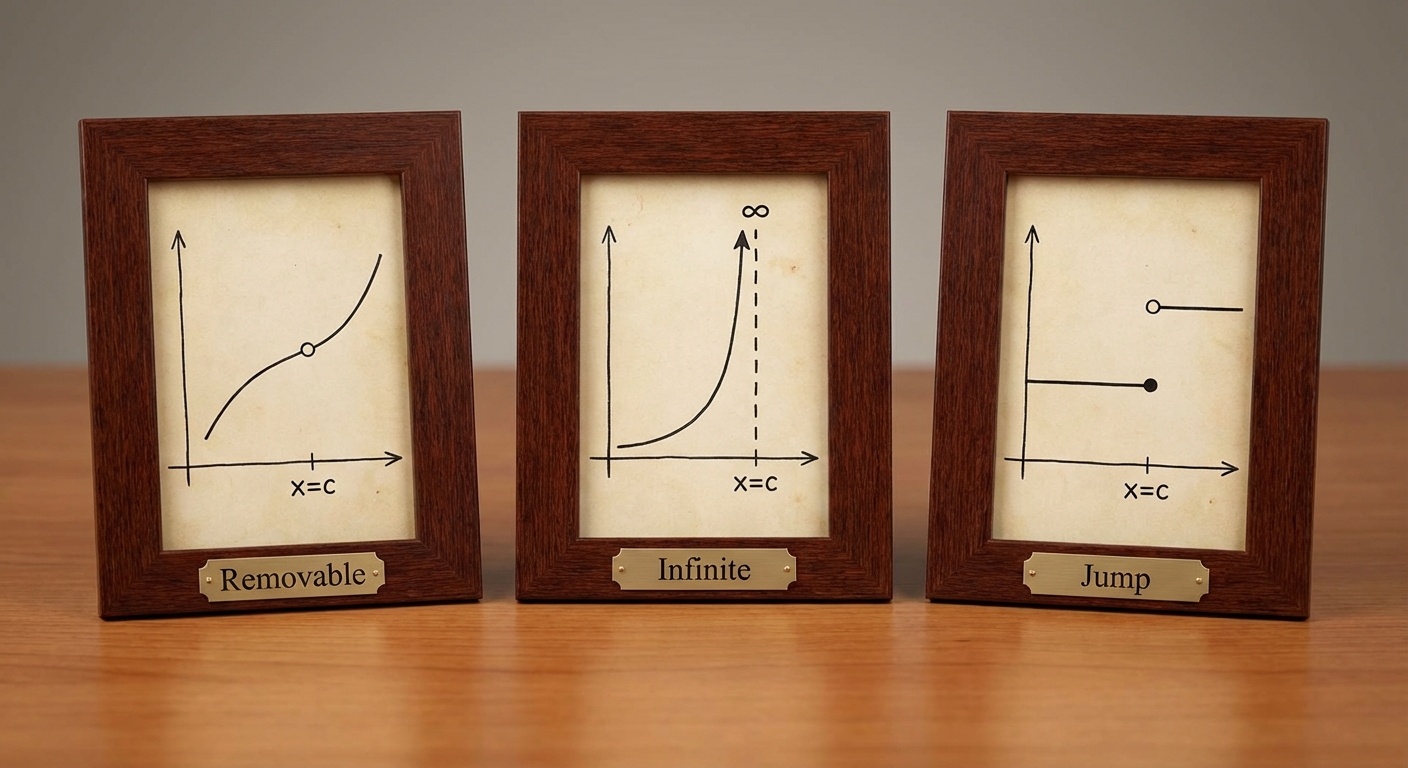
| Type | Description | Cause | Evaluation |
|---|---|---|---|
| Removable (Hole) | The graph continues but misses one point. | $0/0$ in limits. Factors cancel out. | Limit exists, but $f(c)$ is undefined or different. |
| Jump | The graph breaks and starts at a new height. | Piecewise functions or absolute values like $ | x |
| Infinite (Asymptotic) | The graph shoots up or down to infinity. | Non-zero number divided by zero. | Limit is $\pm \infty$ (which technically means DNE). |
Asymptotic Behavior
Vertical Asymptotes (Infinite Limits)
A vertical asymptote exists at $x=c$ if the limit approaches infinity.
- Identification: Occurs when the denominator is $0$ and the numerator is not $0$.
- Notation: $\lim_{x \to c} f(x) = \infty$ or $-\infty$.
Horizontal Asymptotes (Limits at Infinity)
Horizontal asymptotes describe the End Behavior of a function as $x$ gets extremely large (positive or negative).
Calculation: Evaluate $\lim_{x \to \infty} f(x)$.
Rational Function Rules (Shortcut):
Compare the degree (highest exponent) of the Numerator ($N$) vs Denominator ($D$).
- Bottom Heavy ($D > N$):
- Limit = $0$.
- Asymptote: $y = 0$.
- Balanced ($D = N$):
- Limit = Ratio of leading coefficients.
- Asymptote: $y = \frac{\text{coeff numerator}}{\text{coeff denominator}}$.
- Top Heavy ($N > D$):
- Limit = $\pm \infty$ (DNE).
- No Horizontal Asymptote (Check for Slant Asymptote via long division if $N = D+1$).
Memory Aid:
- BOBO: Bigger On Bottom, O ($0$)
- BOTN: Bigger On Top, None
- EATS DC: Exponents Are The Same, Divide Coefficients
Intermediate Value Theorem (IVT)
The IVT is an "Existence Theorem". It doesn't tell you what the answer is or where it is, only that it exists.
The Theorem
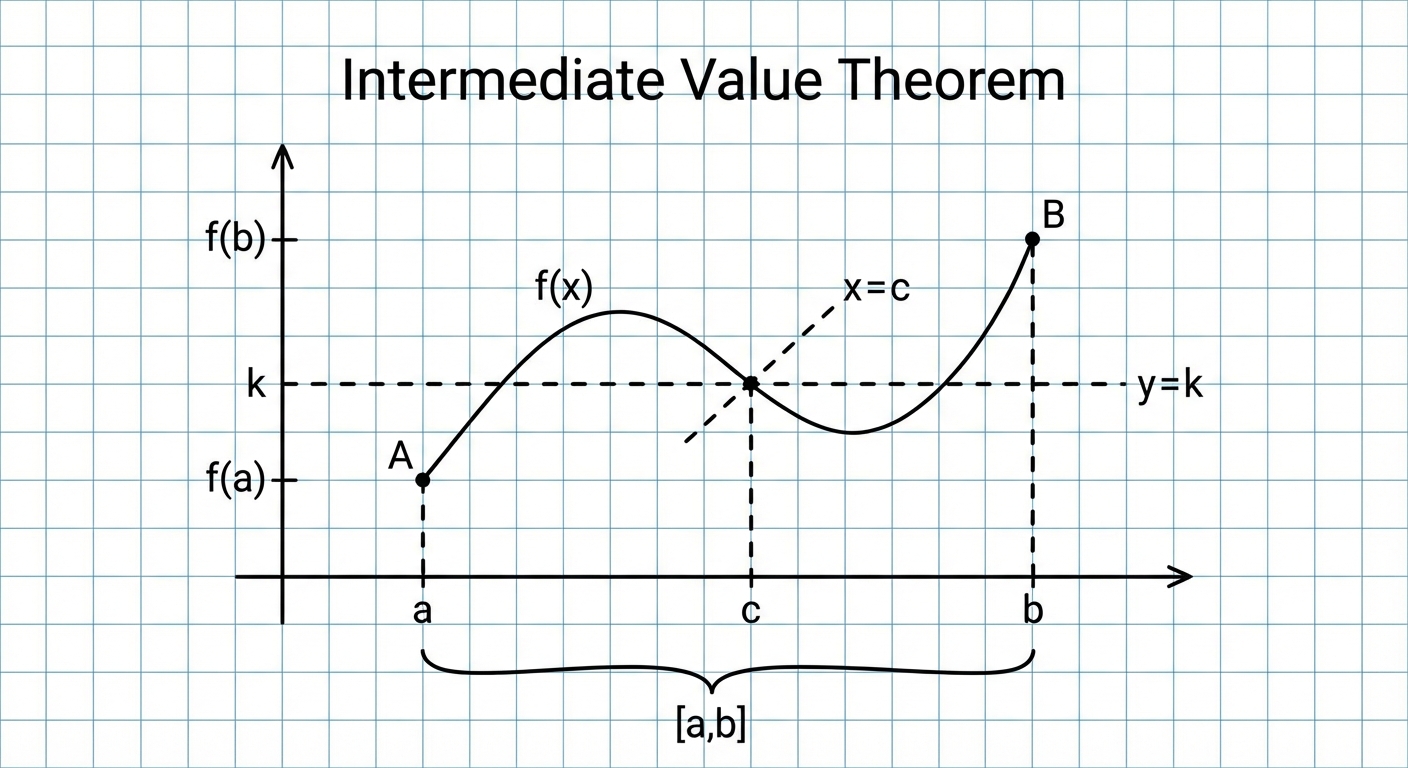
If $f(x)$ is continuous on the closed interval $[a, b]$, and $k$ is any number between $f(a)$ and $f(b)$, then there is at least one number $c$ in $[a, b]$ such that $f(c) = k$.
Real World Logic: If you accelerate continuously from 0 mph to 60 mph, at some specific moment in time, you MUST have been going exactly 30 mph. You cannot skip values if you are continuous.
Common Exam Question: "Show that there is a root for $f(x)$ on $[1, 2]$."
- Check if $f$ is continuous.
- Find $f(1)$ and $f(2)$.
- If one is positive and one is negative, then $0$ is between them.
- State: "Since $f$ is continuous and $f(1) < 0 < f(2)$, by IVT, there exists a $c$ such that $f(c) = 0$."
Common Mistakes & Pitfalls
- Notation Errors:
- Students often drop the "$\lim_{x \to c}$" notation while doing algebra steps. You must keep writing