Unit 3: Dynamic Citizen Engagement & Dissent
Understanding Political Participation
Political participation is the toolbox citizens use to influence the selection of political leaders or the policies they pursue. In AP Comparative Government, the crucial distinction lies in how and why citizens participate depending on whether they live in a democratic or authoritarian regime.
Forms of Political Participation
Participation is generally categorized into two types: conventional (working within the system) and unconventional (challenging the system).
1. Conventional Participation
This involves routine, approved behaviors that use institutional channels.
- Voting: The most common form of participation.
- Democracies (UK, Mexico, Nigeria): Voting is generally voluntary and used to choose representatives and hold the government accountable.
- Authoritarian/Hybrid Regimes (China, Russa, Iran): Voting often serves to legitimize the regime rather than offer a genuine choice.
- Campaigning & Party Activity: Donating money, canvassing, or attending rallies.
- Contacting Officials: Writing letters or emails to representatives.
- Running for Office: Seeking a position in government.
2. Unconventional Participation
This involves activities outside established institutions, often arising when citizens feel the system is unresponsive (low political efficacy).
- Protests & Demonstrations: Public gatherings to express opposition.
- Boycotts: Refusing to buy goods or services for political reasons.
- Civil Disobedience: Deliberately and publicly breaking unjust laws (e.g., blocking traffic).
- Violence/Terrorism: Used by extreme fringe groups when all other channels are viewed as closed (e.g., Boko Haram in Nigeria).
Democratic vs. Authoritarian Participation
The most significant thematic difference in Unit 3 is the distinction between voluntary and coerced participation.
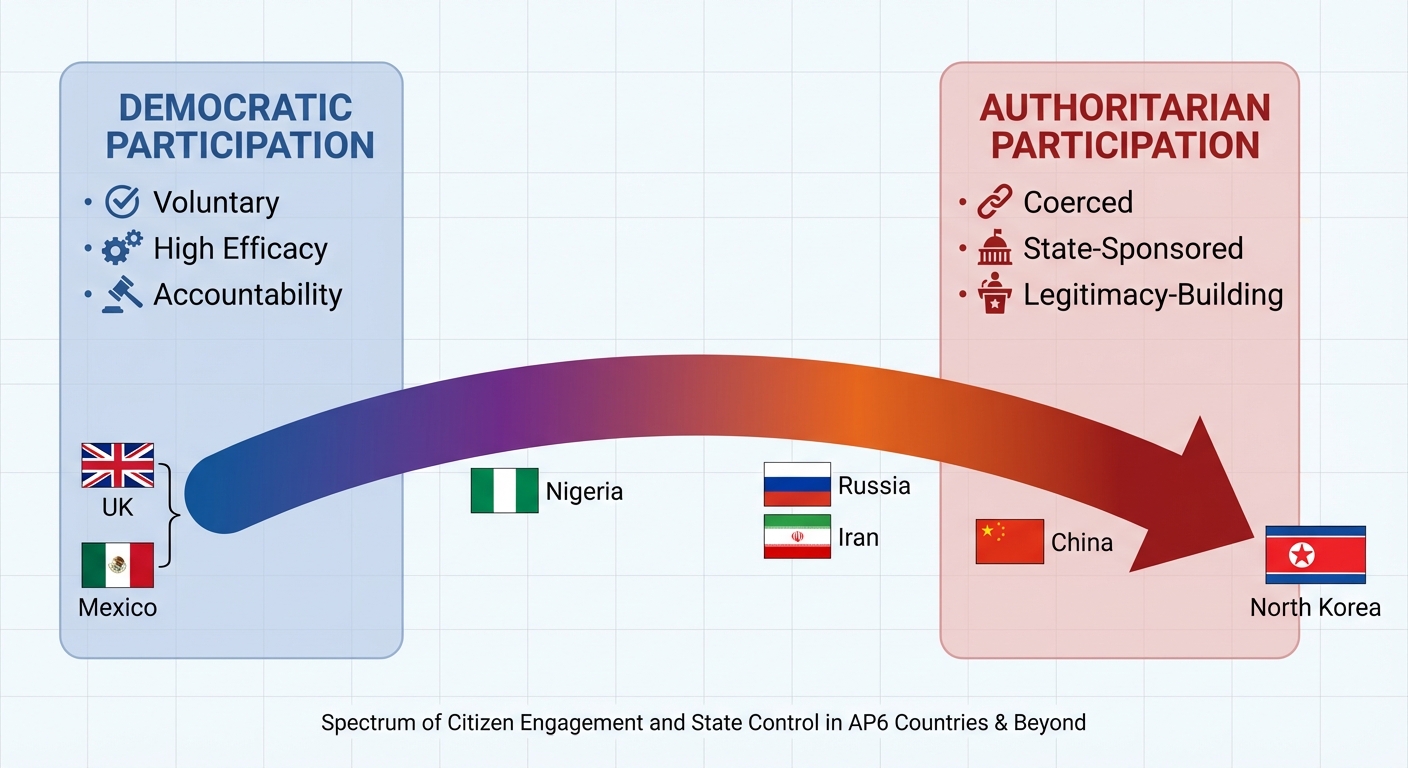
| Feature | Democratic Regimes (UK, Mexico, Nigeria) | Authoritarian/Hybrid Regimes (China, Russia, Iran) |
|---|---|---|
| Nature of Participation | Primarily Voluntary. Citizens choose to participate based on personal motivation. | Often Coerced or State-Sponsored. The state compels participation to show support. |
| Purpose of Elections | To select leaders and policies; to allow peaceful transfer of power. | To provide legitimacy; to create an illusion of democracy; to identify opposition; to mobilize the masses in support of the state. |
| Safety Valve | Participation channels dissent into policy changes. | Controlled participation (like local complaints) acts as a safety valve to prevent system-wide explosions. |
Practical Applications in the AP6 Countries
- China: Participation is highly regulated. Local village elections allow some choice to reduce corruption, but national leadership is chosen by the CCP, not citizens. Membership in the CCP is a primary path to political influence.
- Russia: While multiple parties exist, the state uses managed democracy. Opposition candidates are often barred from running, and state employees may be pressured to attend pro-Putin rallies.
- Iran: Participation is high but vetted. The Guardian Council excludes reformist candidates, meaning citizens can only vote for those established as sufficiently Islamic by the theocracy.
- Nigeria: High enthusiasm for conventional participation (voting), but logistics, violence, and intimidation often suppress turnout. Unconventional participation (protests like #EndSARS) is common due to dissatisfaction.
- Mexico: Transitioned from a corporatist system (PRI dominance) where participation was transactional (patron-clientelism) to a multi-party competitive democracy.
- The UK: High levels of civil society. Participation is voluntary, free, and protected by strong civil liberties.
Protests and Social Movements
When institutional channels (voting, courts) fail to address grievances, citizens turn to social movements. A Social Movement is organized collective action motivated by the desire to enact, stop, or reverse social change.
Why Protests Occur
- Lack of Efficacy: Citizens feel their votes don't matter.
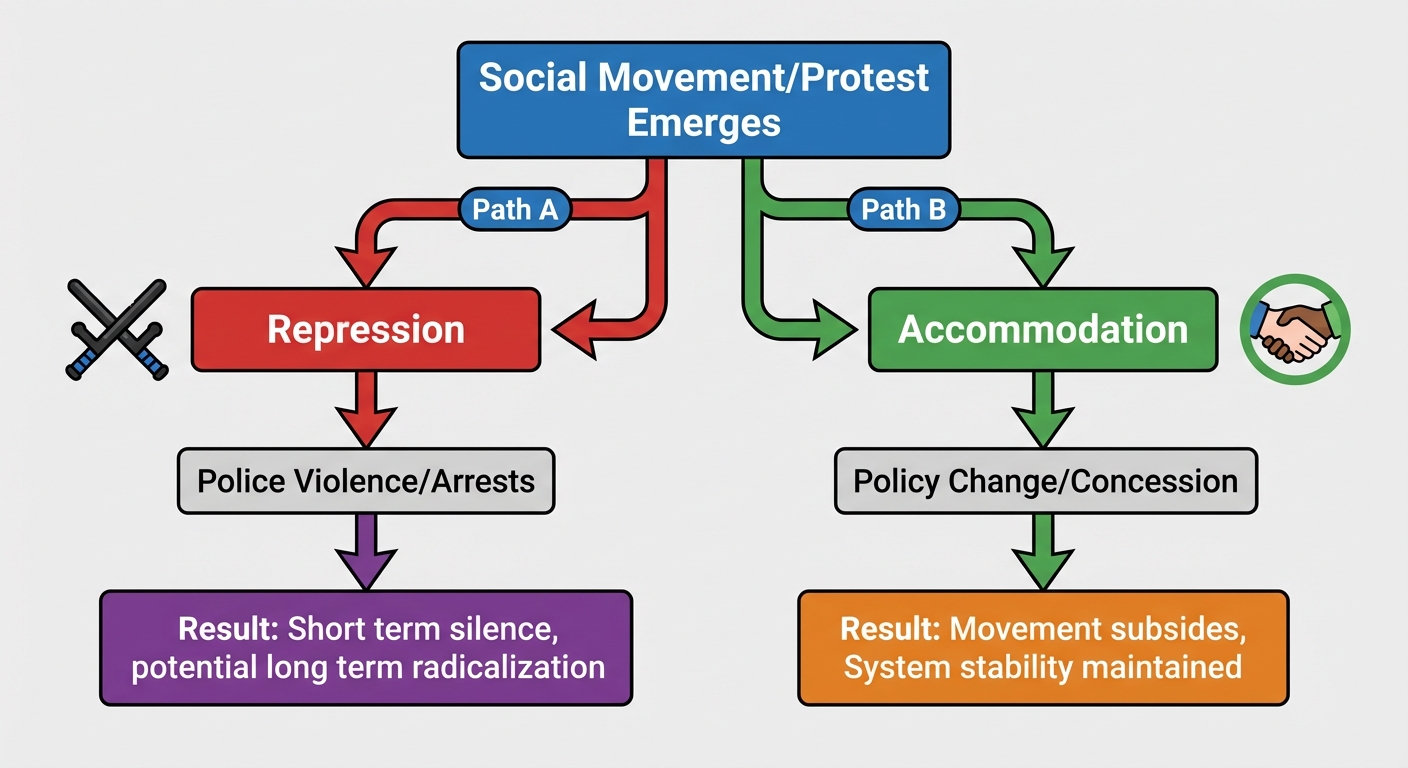
- State Repression: In authoritarian regimes, minor grievances can escalate into regime-threatening protests if the state responds with violence.
- Economic Hardship: Inflation or unemployment (often the spark for unrest in Iran and Nigeria).
- Corruption: Distrust in the fairness of the system (Russia, Mexico).
State Responses to Protests
States generally use two tactics to handle protests:
- Accommodation: Conceding to some demands to defuse the movement (more common in democracies or resilient authoritarian regimes).
- Coercion/Repression: Using force (police, military) to crush the movement (common in China, Iran, Russia).
Case Studies (Crucial for FRQs)
China: Tiananmen Square (1989) vs. "White Paper" Protests (2022)
- 1989: Determining repression. The CCP used the military to crush pro-democracy protests to maintain the monopoly on power.
- 2022: Citizens protested strict Zero-COVID lockdowns holding blank papers (symbolizing censorship). The state used high-tech surveillance to identify protesters but also lifted the lockdowns (accommodation) to restore stability.
Russia: Navalny Protests
- Supporters of Alexei Navalny protested government corruption. The state responded with mass arrests and by labeling organizations as "extremist," illustrating the restriction of civil society.
Nigeria: #EndSARS (2020)
- A decentralized youth movement against police brutality (SARS unit). It utilized social media to bypass state media control. The government eventually disbanded the unit (nominal accommodation) but used the military to shoot protesters at Lekki Toll Gate (repression).
Iran: Green Movement (2009) & Mahsa Amini Protests (2022)
- 2009: Protested fraudulent election results. Crushed by the Basij militia.
- 2022: Sparked by the death of Mahsa Amini in morality police custody. Protests targeted the theocratic system itself (compulsory hijab). The regime used lethal force and internet blackouts to suppress coordination.
Comparing Political Efficacy
It is vital to distinguish between specific concepts of efficacy:
- Internal Efficacy: The belief that you understand politics and can participate.
- External Efficacy: The belief that the government will respond to your participation.
Formula for Participation:
In authoritarian regimes, the "Cost" is physically higher (arrest/violence), and "Probability of Impact" is lower, which usually depresses genuine voluntary participation.
Common Mistakes & Pitfalls
- Mistake 1: Assuming authoritarian citizens never support the regime.
- Correction: Many citizens in Russia or China genuinely support their government due to nationalism, economic growth, or effective propaganda. Not all participation in these countries is forced.
- Mistake 2: Confusing "Legitimacy" with "Legal Authority."
- Correction: A government has legal authority if it holds power. It has legitimacy only if the people accept its right to rule. Participation (even rigged elections) is an attempt to build legitimacy.
- Mistake 3: Thinking all protests are pro-democracy.
- Correction: Some protests are about specific economic issues (fuel prices in Nigeria or Iran) and do not necessarily demand a change in regime type.
- Mistake 4: Equating "Civil Society" with "Government."
- Correction: Civil society is autonomous voluntary groups outside the state (churches, bowling leagues, NGOs). If the state runs the group (like the Nashi youth group in Russia), it is not true civil society.