Study Notes: Period 6 - The Gilded Age (1865–1898)
Unit 6: Period 6: 1865–1898
6.1 Westward Expansion and Economic Development
During this period, the federal government actively promoted economic development and the movement west through subsidies to railroads and legislation like the Homestead Act. The "closing of the frontier" fundamentally changed the American identity.
The Transcontinental Railroads
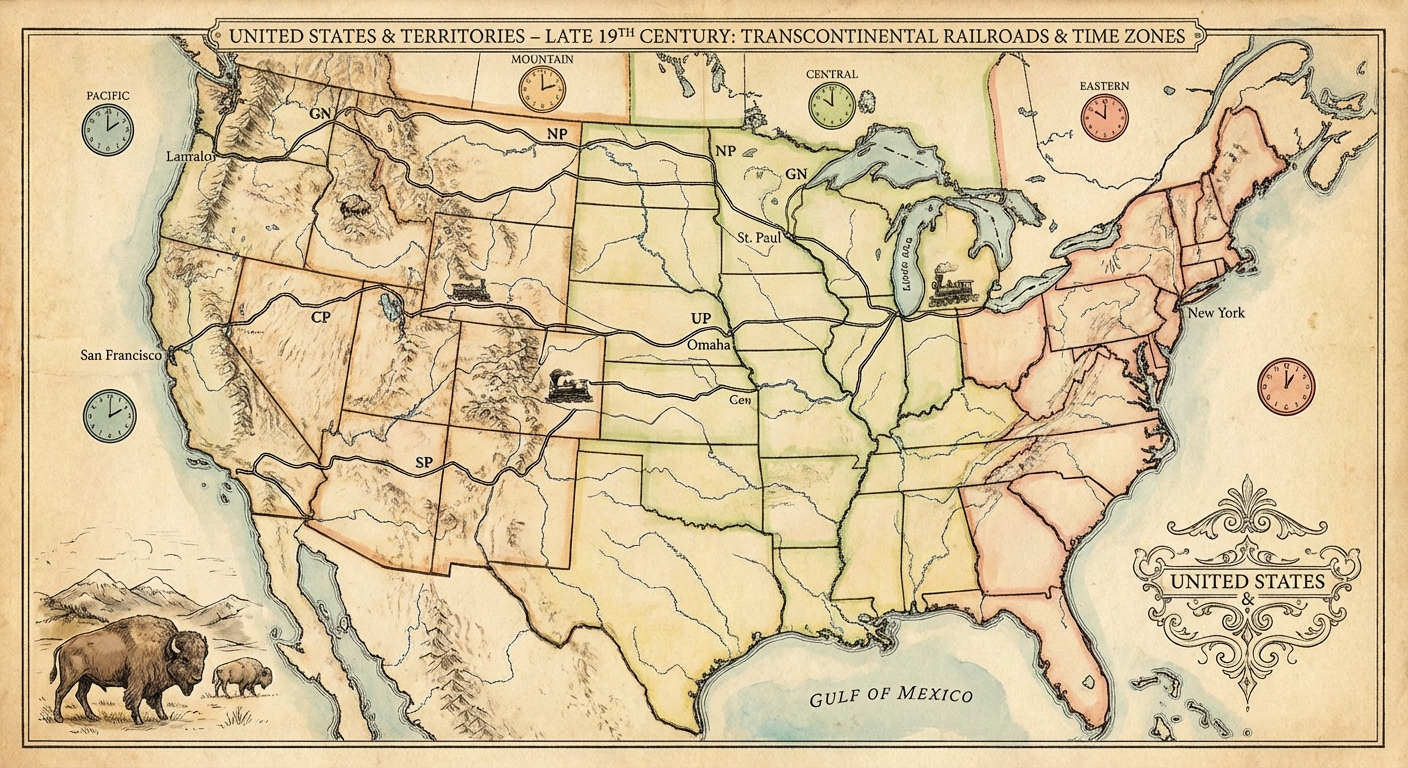
- Government Subsidies: The Federal government provided massive land grants and loans to railroad companies (e.g., Union Pacific and Central Pacific) to build transcontinental lines.
- Impact:
- Created a national market for goods.
- Stimulated the steel and coal industries.
- Facilitated the mass migration of settlers to the West.
- Standardized time: The creation of four time zones (Railroad Time) to manage schedules.
Migration and Settlement
- The Homestead Act (1862): Offered 160 acres of public land free to any citizen who lived on, planted, and improved it for five years. This accelerated settlement but often put farmers on land with insufficient rainfall.
- The Mining Frontier: Gold and silver rushes (e.g., Comstock Lode in Nevada) drew people to the West. Mining shifted from individual prospectors to large corporations requiring heavy machinery.
- The Cattle Frontier: The "Long Drive" moved cattle from Texas to railroad depots in Kansas (like Abilene) to be shipped to Chicago meatpacking plants. This era ended due to overgrazing, blizzards, and the invention of barbed wire, which closed the open range.
The Turner Thesis
In 1893, historian Frederick Jackson Turner published The Significance of the Frontier in American History.
- Argument: The frontier experience promoted a distinct American democracy, individualism, and rapid innovation.
- Safety Valve Theory: The existence of free land served as a "safety valve" to release social tension in eastern cities (though in reality, few city workers actually moved west).
Conflict with Native Americans
As settlers moved west, the U.S. government violated treaties and engaged in military force against Plains Indians.
- The Reservation System: Tribes were forced onto clearly defined zones of land with poor soil.
- The Indian Wars:
- Battle of Little Bighorn (1876): Sioux victory over General Custer; a temporary success for Native Americans.
- Flight of the Nez Perce: Chief Joseph attempted to lead his people to Canada but was captured.
- Assimilation Policy:
- The Dawes Severalty Act (1887): The most important Native American policy of the 19th century. Review this carefully. It dismantled tribes as legal entities and broke up tribal land ownership, offering 160 acres to individual families to turn them into "civilized" farmers. It resulted in a massive loss of Native land.
- Carlisle Indian School: "Kill the Indian, Save the Man." Boarding schools forced Native children to adopt white culture, language, and dress.
- Ghost Dance Movement: A religious revitalization movement predicting the return of buffalo and disappearance of white settlers. The government feared it was an uprising, leading to the Massacre at Wounded Knee (1890), marking the tragic end of organized Native American resistance.
6.2 The Rise of Industrial Capitalism
Late 19th-century America saw the transition from an agrarian society to an industrial powerhouse, driven by technology, abundant resources, and new corporate structures.
Technological Innovation
- Thomas Edison: Menlo Park (New Jersey) became the first modern research laboratory.
- Key invention: Incandescent Light Bulb (1879). This extended the workday into the night and powered factories.
- Alexander Graham Bell: Telephone (1876) revolutionized communication.
Corporate Consolidation and Management
Business leaders, often called Captains of Industry (by supporters) or Robber Barons (by critics), used new strategies to reduce competition and maximize profits.
- Laissez-Faire Capitalism: The economic philosophy that the government should not regulate business.
- Taylorism (Scientific Management): Frederick Taylor introduced methods to maximize worker efficiency by breaking tasks into small, repetitive steps.
Strategies of Integration
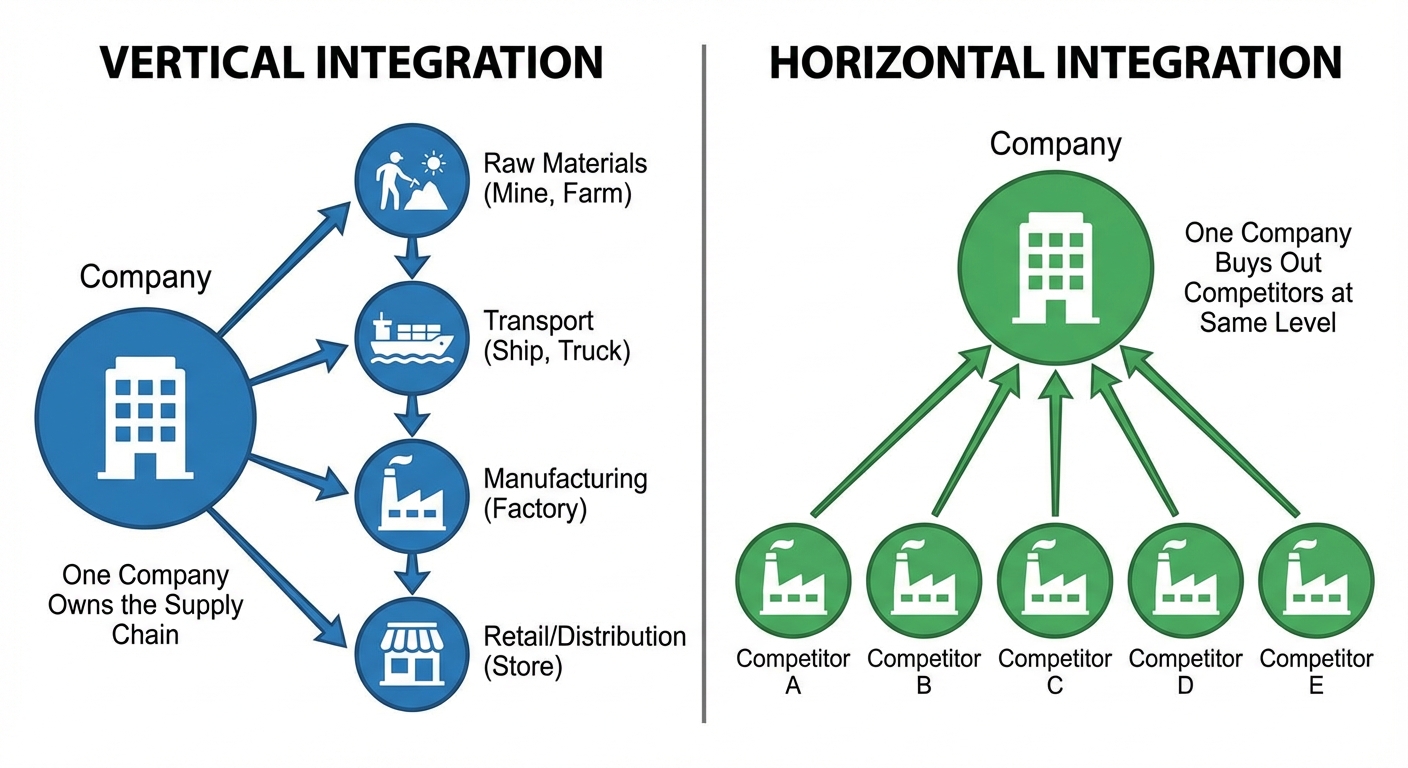
| Strategy | Definition | Key Example |
|---|---|---|
| Vertical Integration | Controlling every stage of the production process, from raw materials to distribution. | Andrew Carnegie (Carnegie Steel) owned mines, ships, railroads, and mills. |
| Horizontal Integration | Merging with or buying out competitors in the same industry to create a monopoly. | John D. Rockefeller (Standard Oil) controlled 90% of oil refining. |
Trusts and Antitrust
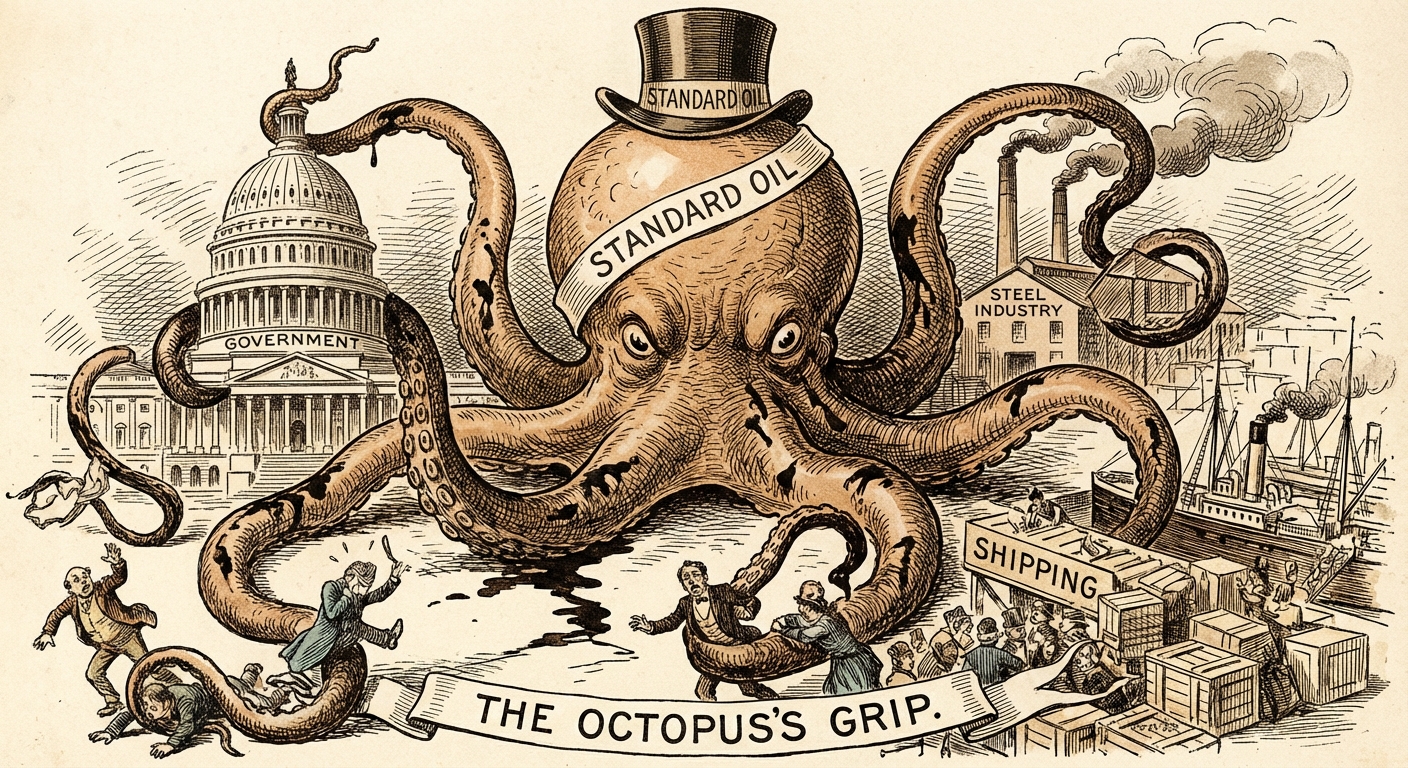
- Trusts: Legal devices where a board of trustees manages the affairs of a group of companies to eliminate competition.
- Sherman Antitrust Act (1890): First federal act to outlaw monopolistic business practices.
- Flaw: It was vaguely worded ("restraint of trade").
- Irony: It was initially used by courts against labor unions, arguing that strikes restrained trade.
- U.S. v. E. C. Knight Co. (1895): The Supreme Court ruled that the Act applied to commerce, not manufacturing, severely weakening the law's power against monopolies.
Socio-Economic Philosophies
- Social Darwinism: Applying Darwin's "survival of the fittest" to society. Wealth belonged to the fit; poverty was evidence of inferiority. Used to justify the gap between rich and poor and oppose welfare.
- The Gospel of Wealth: Andrew Carnegie’s essay arguing that the wealthy had a moral obligation to use their money for the public good (philanthropy), such as building libraries and schools, rather than direct charity to the poor.
Common Mistake: Do not confuse the Gospel of Wealth (philanthropy) with Social Darwinism (survival of the fittest). They are related justifications for wealth but necessitate different actions.
6.3 Labor in the Gilded Age
The industrial workforce expanded, including immigrants, women, and children. Wages rose historically but remained precarious. Working conditions were often dangerous.
Major Labor Unions
| Feature | Knights of Labor | American Federation of Labor (AFL) |
|---|---|---|
| Leader | Terrence Powderly | Samuel Gompers |
| Membership | Open to ALL (skilled, unskilled, women, African Americans) | Skilled workers ONLY (mostly white men) |
| Philosophy | Idealistic; sought broad social reform (end child labor, owned coop factories) | "Bread and Butter" unionism: higher wages, shorter hours, better conditions |
| Decline | Declined after the Haymarket Riot association | Survived and became the dominant union |
Key Strikes and Conflicts
- Great Railroad Strike of 1877: Triggered by wage cuts. President Hayes used federal troops to end the strike (setting a precedent of government siding with business).
- Haymarket Square Riot (1886): A bombing at a labor rally in Chicago was blamed on anarchists. The public associated the Knights of Labor with violence, leading to the union’s collapse.
- Homestead Strike (1892): At Carnegie’s steel plant. Manager Henry Clay Frick used Pinkerton detectives to break the strike. The governor sent in the state militia to support the company.
- Pullman Strike (1894): Led by Eugene V. Debs (American Railway Union). It shut down rail traffic. President Cleveland sent troops, justifying intervention because the strike interfered with the delivery of U.S. Mail. Debs was jailed.
6.4 Urbanization and Immigration
Cities grew vertically (skyscrapers, elevators) and horizontally (streetcars). This growth created distinct class districts and massive social problems.
The "New Immigrants"
- Old Immigrants (Pre-1880): Mostly from Northern/Western Europe (Britain, Germany, Scandinavia). Protestant, English-speaking, skilled.
- New Immigrants (Post-1880): Mostly from Southern/Eastern Europe (Italy, Russia, Poland, Greece). Catholic, Jewish, Orthodox. Often illiterate, unskilled, and poor.
Push/Pull Factors:
- Push: Poverty, religious persecution (Russian pogroms).
- Pull: Jobs in American factories.
Urban Life and Reform
- Tenements: Overcrowded, unsanitary slum housing (e.g., "Dumbbell Tenements").
- Ethnic Enclaves: "Little Italy," "Chinatown" provided support networks.
- Jacob Riis: Muckraker photographer who published How the Other Half Lives, exposing the misery of tenement life.
- Settlement Houses: Community centers in poor neighborhoods run by middle-class women.
- Hull House: Founded by Jane Addams in Chicago. Provided English lessons, childcare, and cultural activities. This helped launch the social work profession.
Political Machines
- Definition: Organized groups that controlled the activities of a political party in a city.
- Tammany Hall: The Democratic machine in NYC, led by William "Boss" Tweed.
- Corruption vs. Service: Machines provided jobs, housing, and citizenship help to immigrants in exchange for votes. However, they stole millions through graft (e.g., the Tweed Courthouse scandal).
- Thomas Nast: Political cartoonist whose drawings helped bring down Tweed.
6.5 The New South and the Problem of Race
Despite the vision of a "New South" based on industry, the region remained largely agricultural and poor.
The Reality of the New South
- Economics: Some industry grew (textiles, tobacco, Birmingham steel), but sharecropping and tenant farming remained the dominant way of life for Black and poor white farmers.
- Crop Lien System: Farmers bought supplies on credit from merchants in exchange for a lien on their future crop, creating a cycle of debt.
Segregation and Limits on Rights
After Reconstruction ended (1877), Southern states stripped African Americans of their rights.
- Disenfranchisement:
- Poll Taxes: Fees to vote.
- Literacy Tests: Impossible exams designed to fail Black voters.
- Grandfather Clauses: Exempted you from tests if your ancestor voted before 1867 (allowed poor whites to vote).
- Jim Crow Laws: State and local laws enforcing racial segregation in public facilities.
- Plessy v. Ferguson (1896): The Supreme Court ruled that "separate but equal" facilities were constitutional. This legalized segregation for the next 60 years.
Black Responses to Discrimination
Two major leaders emerged with opposing views on how to achieve progress:
- Booker T. Washington:
- Background: Born a slave.
- Institution: Tuskegee Institute.
- Philosophy: Economic Self-Help. He argued Black people should acquire vocational skills and economic security first. He essentially accepted segregation temporarily (accommodationism).
- Famous Speech: The Atlanta Compromise (1895).
- W.E.B. Du Bois:
- Background: Harvard educated Ph.D., Northerner.
- Philosophy: Immediate Equality. He demanded full civil and political rights immediately. He criticized Washington's accommodation as accepting inferiority.
- Concept: "Talented Tenth" (the top 10% of the Black community should lead the race).
6.6 Gilded Age Politics and Reform
Politics were characterized by high voter turnout, party loyalty, and corruption. The two parties differed little on major issues (the tariff and currency being exceptions).
Corruption and Reform
- Patronage (Spoils System): Giving government jobs to political supporters.
- Assassination of James Garfield (1881): Killed by a disgruntled office-seeker.
- Pendleton Civil Service Act (1883): Created the Civil Service Commission. Federal jobs would now be awarded based on merit (exams), not patronage.
The Populist Movement
Farmers faced falling crop prices, high railroad shipping rates, and tight money supply (deflation).
- The Grange (1867): Social organization that evolved into political lobbying (Granger Laws regulating RR rates).
- Munn v. Illinois (1877): Supreme Court upheld the right of states to regulate businesses (like railroads) that served a public interest.
- Wabash v. Illinois (1886): Court reversed Munn, saying states cannot regulate interstate commerce. This led to the federal Interstate Commerce Act (1887).
The People’s Party (Populists)
Formed in 1892, their Omaha Platform proposed radical reforms:
- Direct election of Senators.
- Graduated income tax.
- Government ownership of railroads.
- Free Silver: Unlimited coinage of silver to create inflation (raise crop prices).
The Election of 1896
- William Jennings Bryan (Democrat/Populist): Famous for the "Cross of Gold" speech, condemning the gold standard. He represented farmers and the West.
- William McKinley (Republican): Represented big business, gold standard, and high tariffs. He won via a massive, well-funded front-porch campaign.
- Significance: Marked the decline of the Populist Party, though many of their ideas (income tax, direct election of senators) were later enacted by Progressives.
Common Mistakes to Avoid
- Mistake: Assuming the Federal Government followed strict Laissez-Faire.
- Correction: While they didn't regulate business conditions, they intervened heavily to help business via tariffs, land grants, and using troops to break strikes.
- Mistake: Confusing the "Old Immigrants" with "New Immigrants."
- Correction: Old = Pre-1880, Protestant, North/West Europe. New = Post-1880, Catholic/Jewish, South/East Europe.
- Mistake: Thinking the Sherman Antitrust Act was immediately effective against monopolies.
- Correction: It was initially used against labor unions. Real trust-busting happened later under T. Roosevelt (Period 7).
- Mistake: Mixing up the dates of Reconstruction and Jim Crow.
- Correction: Reconstruction ended in 1877; legal Jim Crow (Plessy) was cemented in 1896.