Strategic Organization in Rhetoric
Effective communication involves more than simply conveying information; it requires structuring content in a manner that is appropriate for the intended audience and effective for the specific purpose. In AP English Language and Composition, Unit 2 focuses on how writers organize their arguments to guide an audience through a Line of Reasoning.
The Rhetorical Situation and Audience
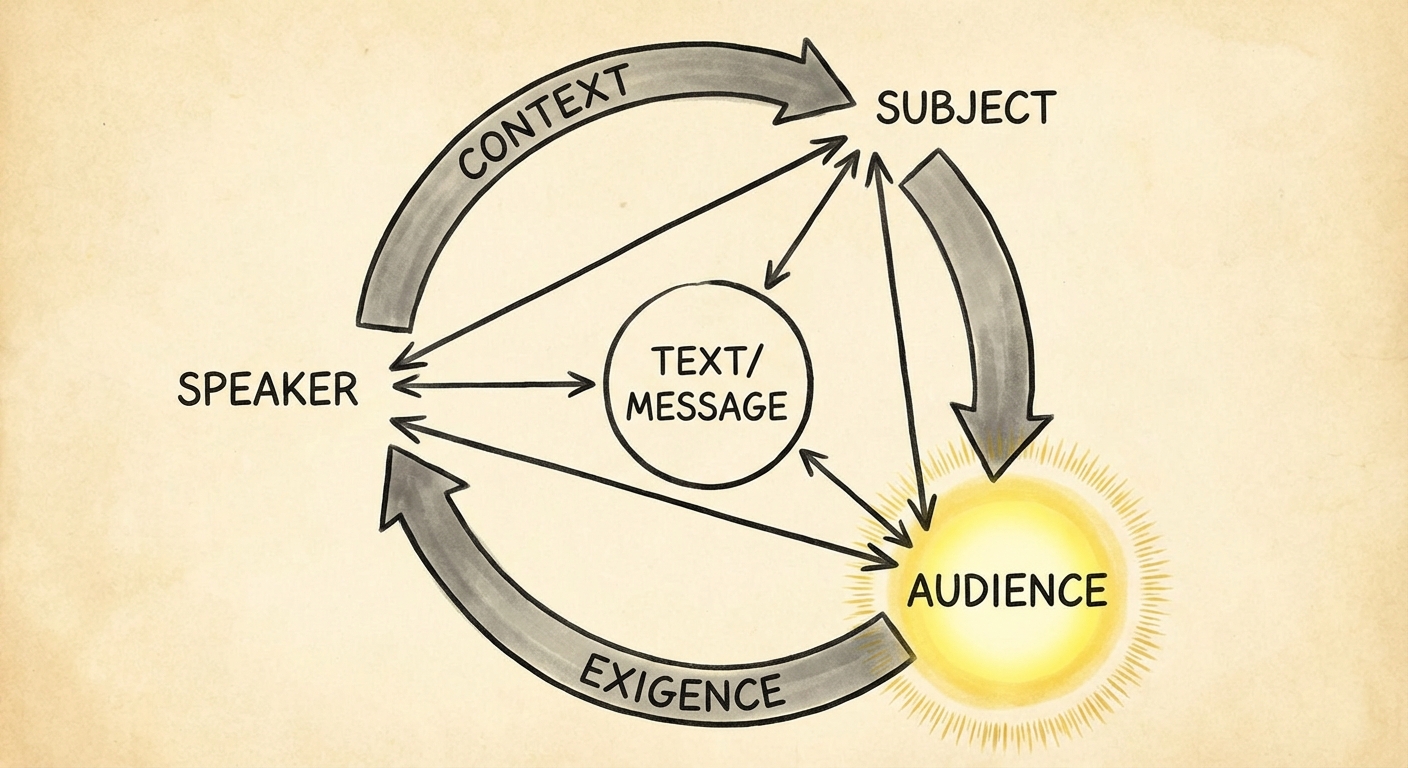
Organizing information for a specific audience entails carefully considering the audience's background, knowledge level, and values. This ensures the message is clear, engaging, and persuasive. In the context of the Rhetorical Situation, organization is not just about grammar; it is a strategic choice.
Audience Analysis Questions
Before organizing an argument, a writer must analyze the audience. In AP Lang, this often involves analyzing a text to see how an author did this, or doing it yourself for an essay.
- Who are they? (e.g., Experts vs. Laypeople, Hostile vs. Friendly)
- What do they already know? This determines the amount of background context (exposition) required.
- What are their values and beliefs? Knowing this helps a writer structure the argument to find common ground early (especially with a hostile audience) or save the most controversial points for later.
- What is the Exigence? Why is this text being written now, and is the audience receiving it in a moment of crisis, reflection, or celebration?
Matching Structure to Purpose
The organization must serve the primary purpose:
- To Inform: Often uses Expository structures like Definition or Process Analysis.
- To Persuade: Often uses Argumentative structures like Problem-Solution, Cause-Effect, or Classical Oration.
- To Entertain: Often uses Narrative structures involving chronological sequencing and descriptive elements.
The Thesis Statement: The Organizational Blueprint
In Unit 2, the Thesis Statement is paramount. It is not merely a statement of fact; it is a defensible claim that establishes the essay’s topic and typically previews the essay’s organization.
Components of a Defensible Thesis
- Subject: The topic being discussed.
- Claim: The specific stance or position taken.
- Rationale (Optional but helpful): The "because" clause that hints at the main points.
Closed vs. Open Thesis statements
- Closed Thesis: Explicitly lists the points to be made in the order they will appear.
- Example: "School uniforms should be abolished because they limit self-expression, promote conformity, and fail to improve academic performance."
- Organization: Paragraph 1 = Self-expression; Paragraph 2 = Conformity; Paragraph 3 = Academics.
- Open Thesis: States the overall argument without listing every sub-point.
- Example: "While proponents argue for discipline, school uniforms ultimately stunt the necessary social development of teenagers."
The Line of Reasoning
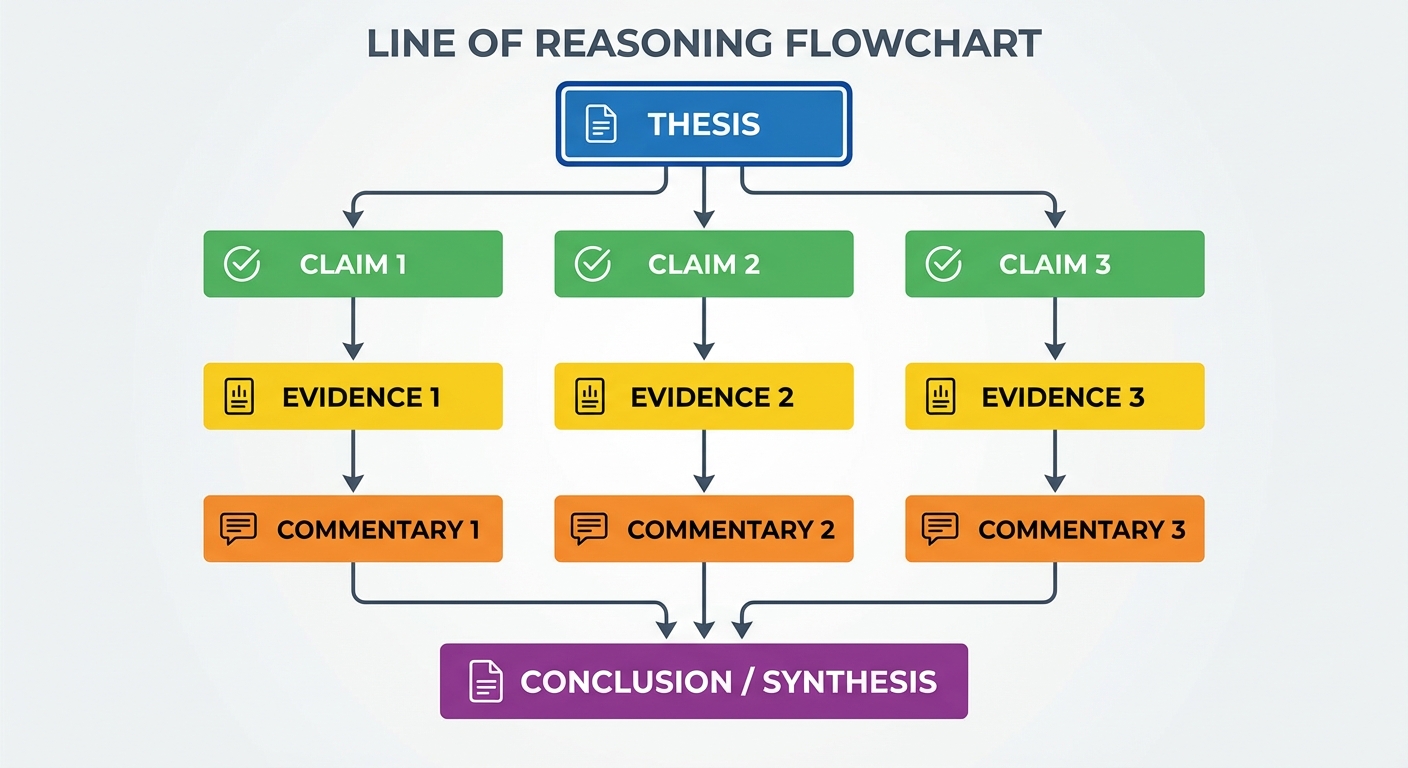
The Line of Reasoning is the formal term for potential logical flow of an argument. It is the connective tissue that links the thesis, claims, evidence, and commentary together in a coherent chain.
Logical Structure within Paragraphs
An effective line of reasoning typically follows this formula within a body paragraph:
- Claim: A sub-point supporting the thesis.
- Evidence: Facts, anecdotes, or data tailored to the audience (e.g., using scientific data for scientists, or emotional anecdotes for a general audience).
- Commentary: Explaining how the evidence supports the claim.
- Connection: Linking back to the main thesis.
Modes of Development (Methods of Organization)
AP Lang writers use specific Modes of Development to organize their thoughts. These are not mutually exclusive; a single essay may use several, but one usually dominates.
1. Narration (Chronological)
- Definition: Telling a story or detailing events in the order they occurred.
- When to use: To establish background, humanize an abstract issue, or explain a history.
- Audience Effect: Engaging and emotional; often used in introductions to hook the reader.
2. Cause and Effect
- Definition: Analyzing why something happened or predicting what will happen.
- Structure: Can be structured as specific causes leading to one effect, or one cause leading to multiple effects.
- When to use: When discussing history, science, or social policy.
- Audience Effect: Appeals to logic (Logos) and helps the audience understand consequences.
3. Comparison and Contrast
- Definition: Juxtaposing two things to highlight similarities or differences.
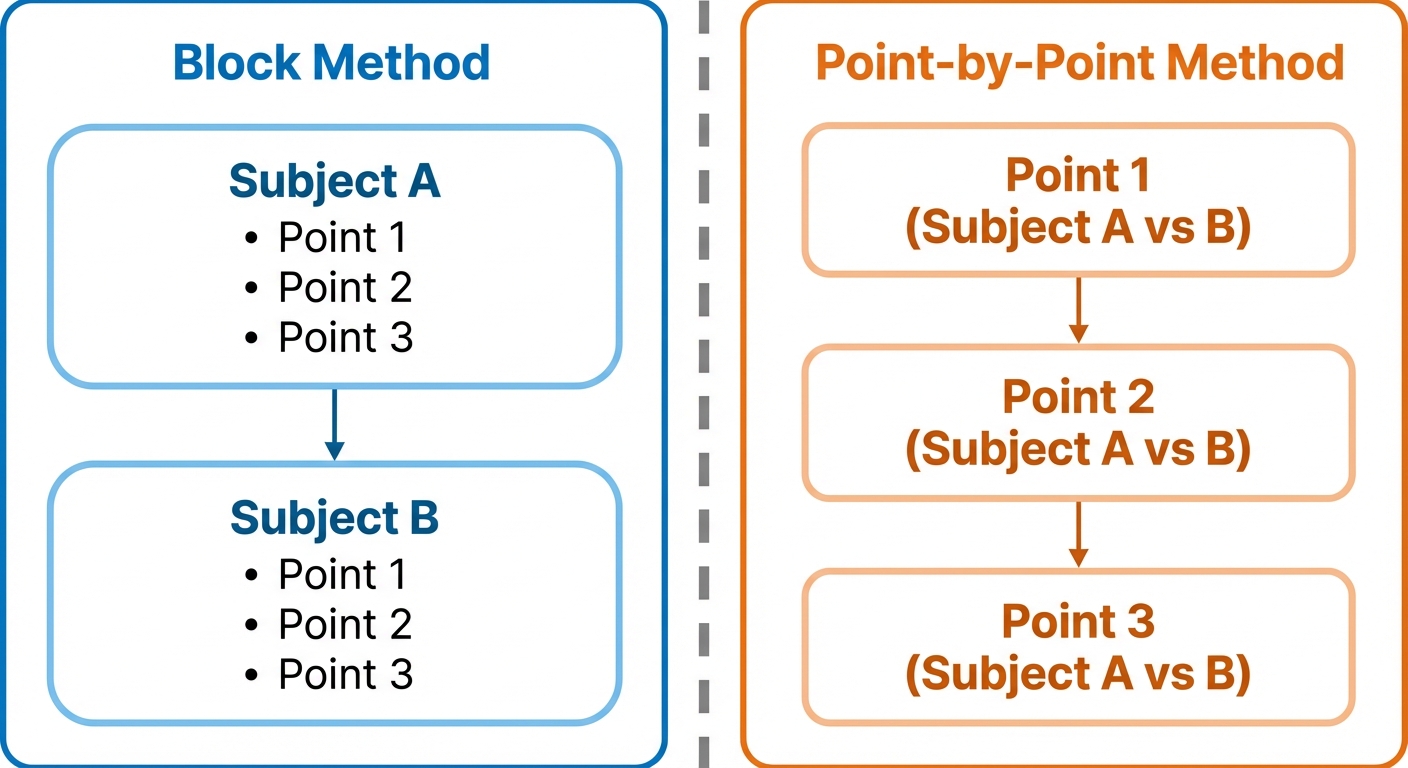
- Structure Options:
- Block Method: Discuss all points of Subject A, then all points of Subject B.
- Point-by-Point: Discuss Point 1 for A and B, then Point 2 for A and B.
- When to use: When asking the audience to choose between two options.
4. Definition
- Definition: Explaining the meaning of a term or concept, often expanding beyond the dictionary definition (Extended Definition).
- When to use: When the debate hinges on ambiguity (e.g., defining "Justice" or "Freedom").
- Audience Effect: Ensures the writer and audience are "on the same page" before arguing.
5. Description
- Definition: Using sensory details to portray a person, place, or thing.
- When to use: To create a mood or atmosphere.
Cohesion and Transitions
Organization is invisible without Transitions. These words act as signposts that tell the audience how the current information relates to what came before.
| Relationship | Transition Words |
|---|---|
| Contrast | However, conversely, on the other hand, yet |
| Addition | Furthermore, moreover, in addition, similarly |
| Caustion | Therefore, consequently, thus, as a result |
| Sequence | Subsequently, previously, meanwhile, finally |
Note: Good transitions often repeat key terms or ideas from the previous paragraph to create a "logic bridge."
Common Mistakes & Pitfalls
- The "Data Dump": Presenting evidence without a Claim or Commentary. The audience is left to figure out the point on their own. Correction: Always wrap evidence in an argument.
- Thesis Mismatch: The essay promises a Compare/Contrast structure in the thesis but delivers a Cause/Effect essay. Correction: Ensure your body paragraphs fulfill the promise of the thesis.
- Ignoring the Hostile Audience: Using an aggressive structure (attacking immediately) with an audience that disagrees with you. Correction: Use a Rogerian structure—validate their view first, then pivot.
- Lack of Signposting: Moving from point A to point B without a transition. Correction: Use transitional phrases to guide the reader through your line of reasoning.