Unit 7: Global Conflict — World War II Comprehensive Review
World War II: Global Conflict (1939–1945)
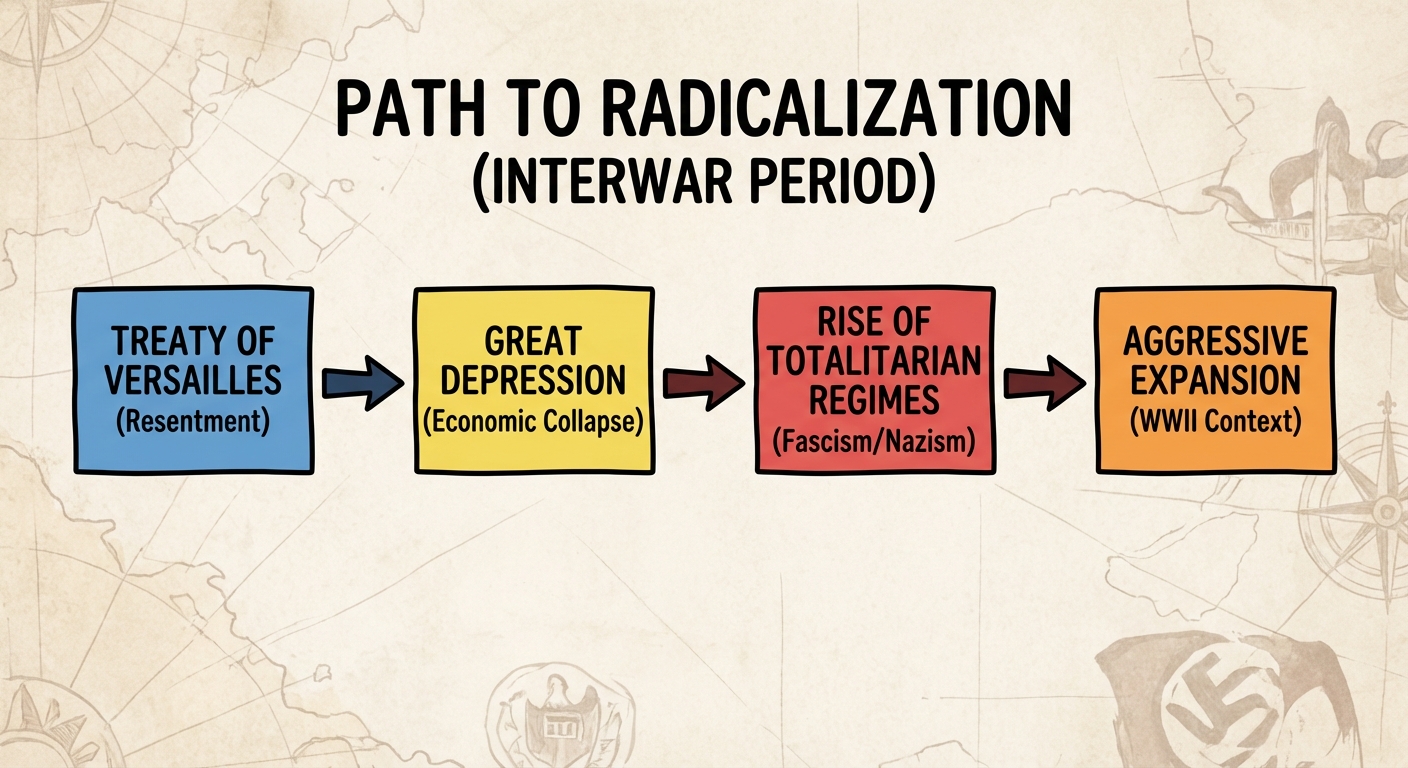
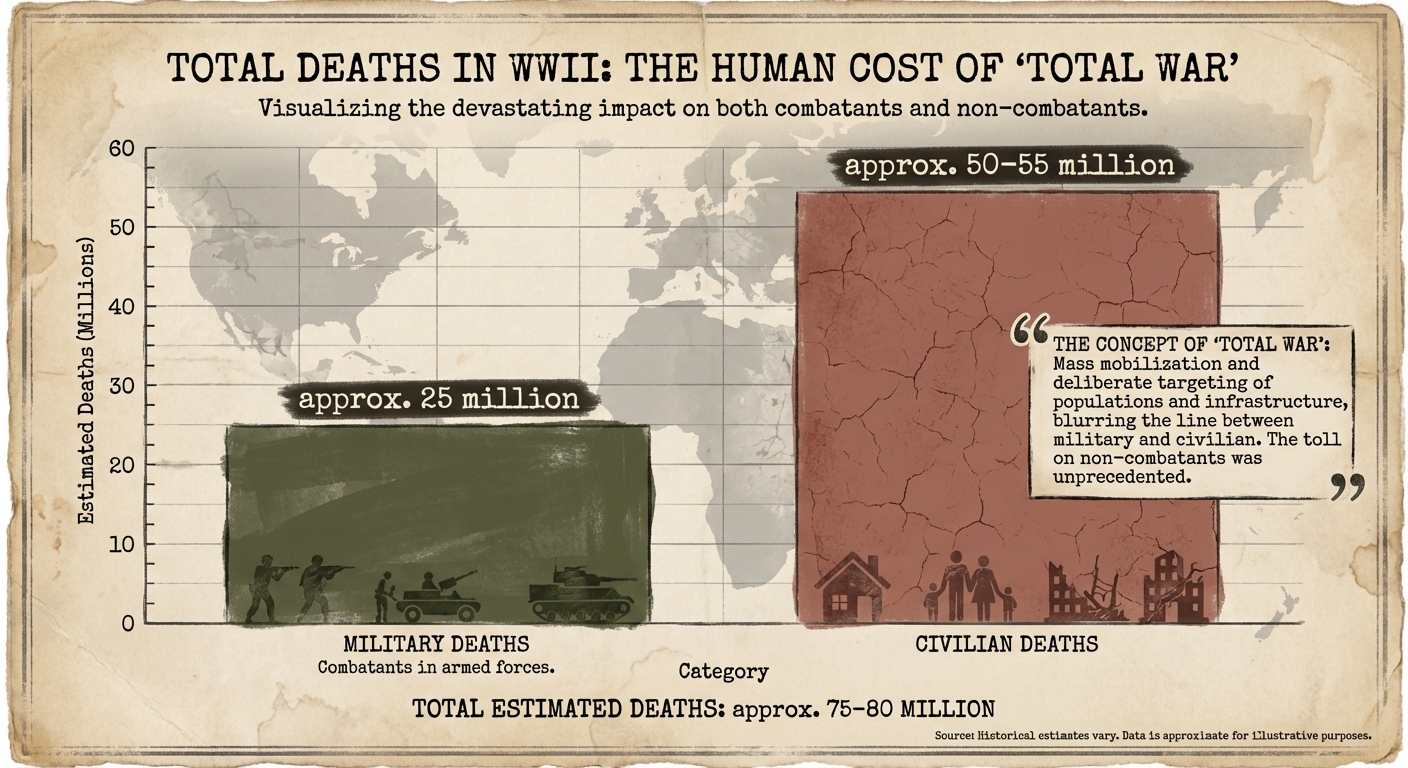
World War II was not an isolated event; it was the direct, albeit delayed, consequence of unresolved issues from the First World War, compounded by the Great Depression and the rise of totalitarian regimes. In AP World History terms, this is the ultimate example of Total War—where the lines between combatant and civilian were completely erased.
Unresolved Tensions After World War I
To understand 1939, you must look back at 1919. The Paris Peace Conference and the Treaty of Versailles created a fragile peace that sowed the seeds of resentment.
The Failure of the Global Order
- Strict Punishments on Germany: The "War Guilt Clause" and massive reparations crippled the Weimar Republic economy, leading to hyperinflation. This economic instability made radical solutions (like Fascism) attractive to the German populace.
- The Mandate System: Instead of granting independence, the Allies (Britain and France) took control of former Ottoman and German colonies in the Middle East and Africa. This fueled anti-colonial nationalism.
- Italian and Japanese Resentment: Despite being on the winning side of WWI, Italy and Japan felt they didn't receive enough territory or respect in the post-war settlements.
The Great Depression's Impact
The global economic crash of 1929 destroyed the economies of industrialized nations.
- Equation of Instability: $Economic Despair + Nationalism = Rise of Totalitarianism$
- Nations turned to strongman dictators who promised to restore national pride and economic self-sufficiency, often through military expansion.
Causes of World War II
The causes can be remembered through the aggressive expansion of the Axis Powers (Germany, Italy, and Japan) and the passive failure of the League of Nations.
Axis Expansionism
While the Western democracies practiced Appeasement (giving in to an aggressor's demands to keep peace), the totalitarian states expanded aggressively:
- Japan: Invaded Manchuria in 1931 (establishing the puppet state Manchukuo) and launched a full-scale invasion of China in 1937. Their goal was the Greater East Asia Co-Prosperity Sphere—an imperial concept claiming to free Asia from Western colonialism but actually replacing it with Japanese domination.
- Italy: Benneto Mussolini invaded Ethiopia in 1935. The League of Nations condemned it but did nothing substantive.
- Germany: Adolf Hitler systematically violated the Treaty of Versailles:
- Rebuilt the military (1935).
- Remilitarized the Rhineland (1936).
- Anschluss: Annexed Austria (1938).
- Took the Sudetenland (claimed at the Munich Conference via appeasement) and then all of Czechoslovakia.
The Spark
The policy of appeasement ended on September 1, 1939, when Germany invaded Poland. Britain and France declared war, formally starting WWII in Europe.
Conducting World War II
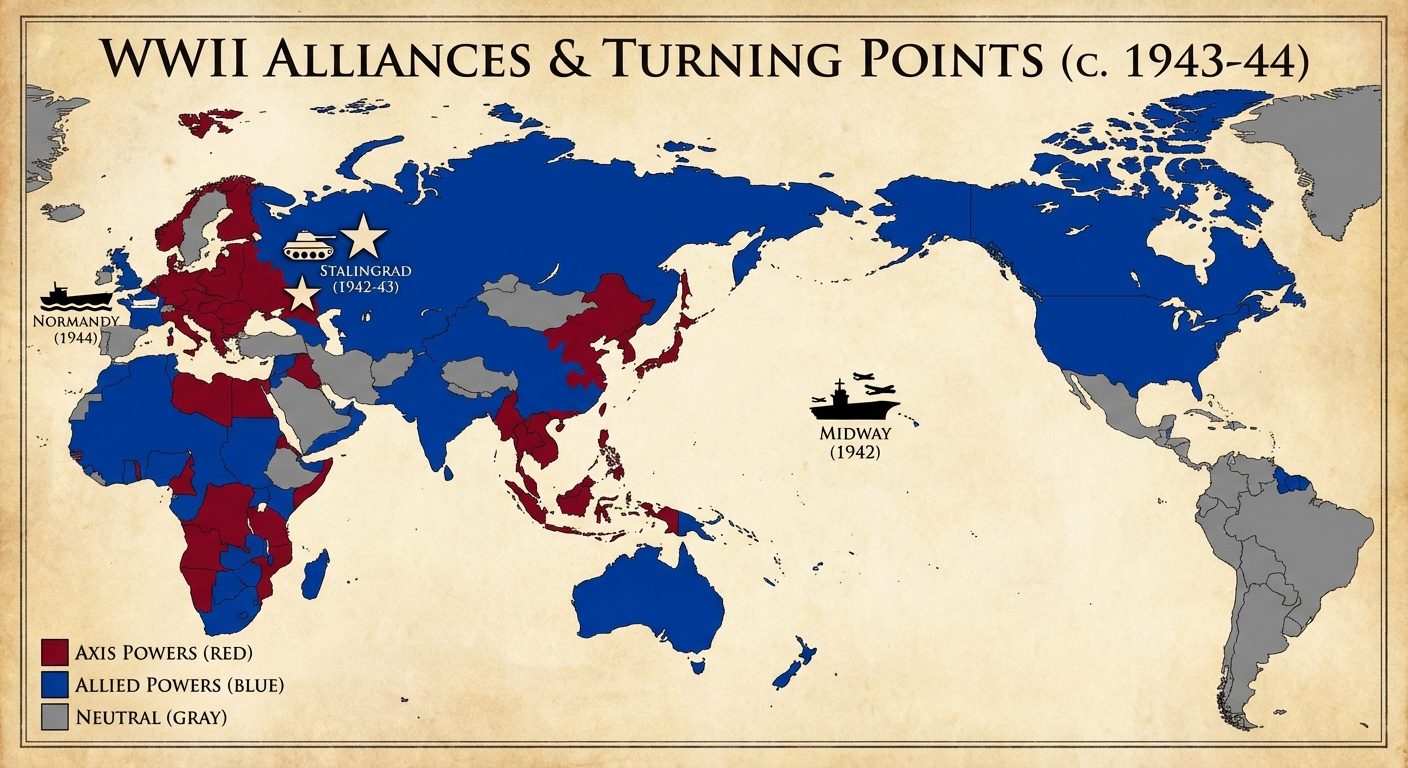
WWII was a conflict between the Axis Powers (Germany, Italy, Japan) and the Allied Powers (Great Britain, USA, Soviet Union, France, and China).
Total War and Mobilization
Like WWI, this was a total war, but on a grander scale. Governments used all available resources—ideological, economic, and military—to win.
- Economic Mobilization: Factories in the US and USBSR shifted entirely to war production. The US became the "Arsenal of Democracy."
- Women in Warfare: Women took on crucial roles in factories ("Rosie the Riveter" in the US) and in combat roles (especially in the Soviet Union, where women served as snipers and pilots).
- Colonial Troops: Britain and France once again relied on troops from India, Africa, and Southeast Asia. These soldiers fought for the empire, hoping their service would lead to independence later.
New Technology and Strategies
| Feature | Description | Impact |
|---|---|---|
| Blitzkrieg | German "Lightning War" using tanks and planes. | Allowed rapid conquest of Poland and France. |
| Island Hopping | US strategy in the Pacific. | Bypassed heavily fortified Japanese islands to cut off supplies. |
| Radar/Sonar | Detection technology. | Helped Britain survive the Blitz; helped Allies hunt U-boats in the Atlantic. |
| Atomic Bomb | Nuclear weaponry (Manhattan Project). | forced Japanese surrender; ushered in the Cold War. |
Key Theaters of Conflict
- European Theater: The USSR bore the brunt of the fighting. The turning point was the Battle of Stalingrad, where the Soviet Red Army stopped the German advance. Meanwhile, the Western Allies opened a second front with D-Day (Invasion of Normandy) in 1944.
- Pacific Theater: Japan dominated early, but the US turned the tide at the Battle of Midway. The war ended only after the US dropped atomic bombs on Hiroshima and Nagasaki in August 1945.
Mass Atrocities and Genocide
A grim distinctive feature of WWII was the systematic targeting of civilians and specific ethnic groups.
The Holocaust
Motivated by anti-Semitism and the desire for Lebensraum (living space), the Nazi regime implemented the Final Solution. This was the industrial organized genocide of Jews.
- Methods: Death camps (like Auschwitz), gas chambers, and mass shootings.
- Victims: 6 million Jews and 5-6 million others (Roma, homosexuals, disabled people, political dissidents).
Japanese Atrocities
- Rape of Nanking (1937): During the invasion of China, Japanese soldiers massacred hundreds of thousands of civilians and soldiers, involving mass rape and looting.
- Comfort Women: The Japanese military forced women from occupied territories (mostly Korea and China) into sexual slavery to serve soldiers.
Allied Firebombing
The Allies also targeted civilians to break enemy morale.
- Firebombing of Dresden & Hamburg: British and American raids destroyed German cities.
- Firebombing of Tokyo: US raids caused massive firestorms, killing more people than the atomic blasts in a single night.
Common Mistakes & Pitfalls
- Confusing Alliances: Students often forget that Italy and Japan were on the Allied side in WWI but the Axis side in WWII.
- Tip: Remember the "Axis" revolved around Berlin, Rome, and Tokyo.
- The Timing of US Entry: The US did not join immediately in 1939. They joined in 1941 after the attack on Pearl Harbor.
- Atomic Bomb Misconception: The atomic bomb was used after Germany surrendered. It ended the war in the Pacific, not Europe.
- Ideological Unity: Do not assume the Allies (US/UK/USSR) were friends. The US (Capitalist) and USSR (Communist) were only united by a common enemy (Germany). This tension led directly to the Cold War.