Unit 4 Guide: Civil Society, Media, and Citizen Participation
Understanding Civil Society and NGOs
Defining Civil Society
In Comparative Government, Civil Society refers to the collection of voluntary organizations outside of the state, the market, and the family that help people define and advance their own interests. It is often described as the "space" where citizens organize themselves.
Strong civil society is a hallmark of liberal democracy, as it builds social capital—the networks of relationships among people who live and work in a particular society, enabling it to function effectively.
Characteristics of Civil Society:
- Voluntary: Participation is not coerced.
- Autonomous: They operate largely free from government control.
- Diverse: Includes religious groups, sports clubs, labor unions, environmental groups, and professional associations.
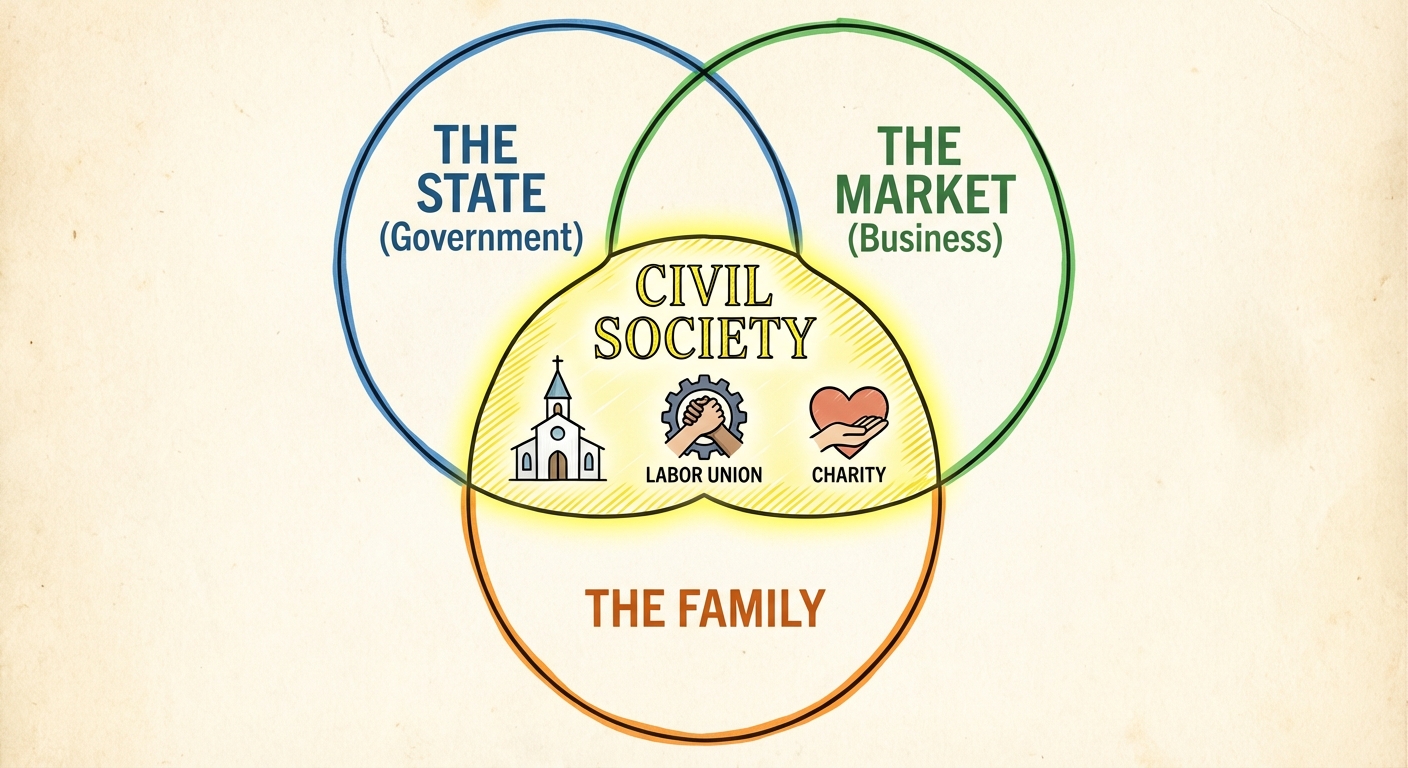
Non-Governmental Organizations (NGOs)
Non-Governmental Organizations (NGOs) are a specific subset of civil society. These are national and international groups, independent of any state, that pursue policy objectives and foster public participation.
- Role in Democracies: They hold the government accountable, advocate for specific policies, and provide services the state might attempt to fill (e.g., disaster relief).
- Role in Authoritarian Regimes: They are often restricted, monitored, or harassed. In countries like Russia and China, foreign-funded NGOs are often labeled as "foreign agents" or threats to national security.
The Rise of GONGOs
A critical concept for the AP exam is the GONGO (Government-Organized Non-Governmental Organization). These are groups that look like NGOs but are actually set up or sponsored by the state to control the political narrative or distribute social services to maintain regime stability.
- Example: In China, many labor unions and social organizations are GONGOs; they serve as a bridge between the party-state and the people, rather than independent advocates.
Interest Groups and Lobbying Systems
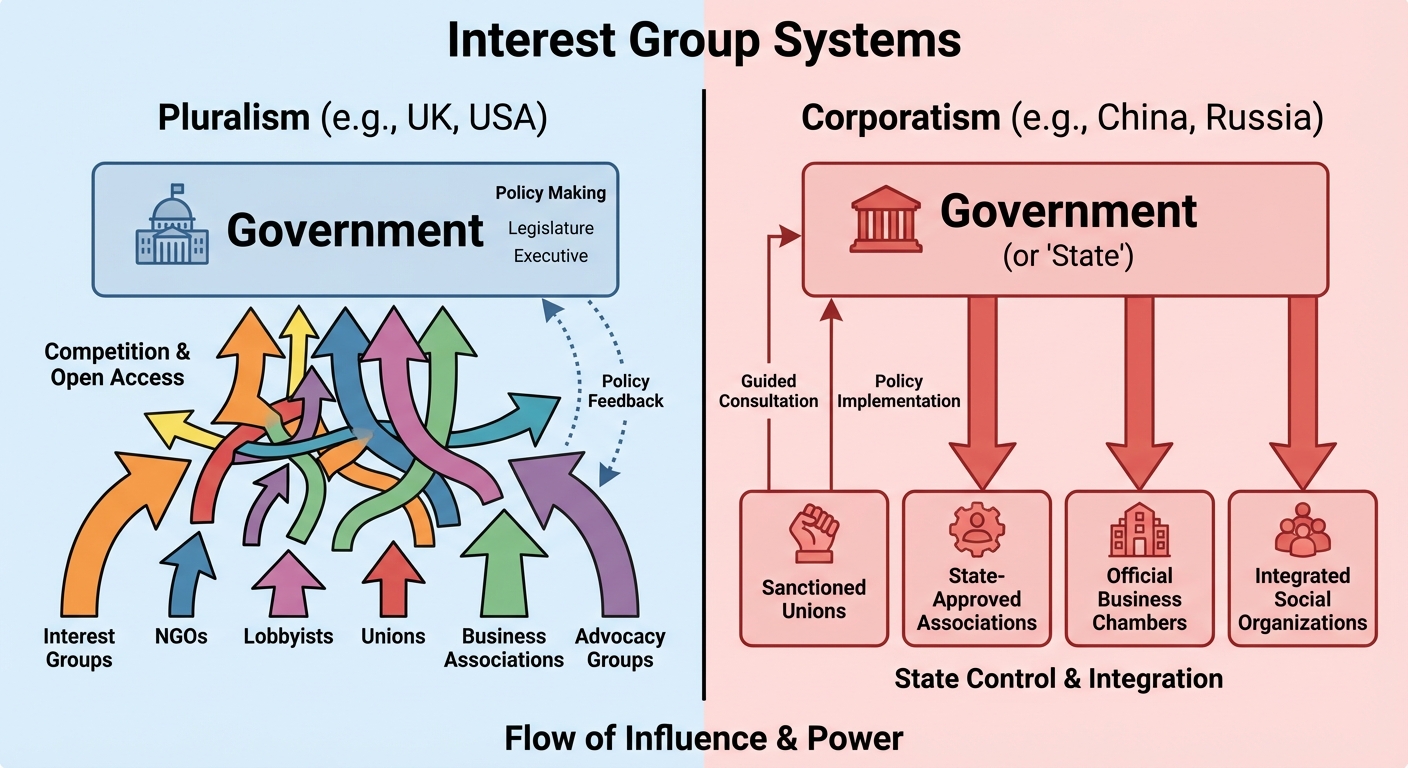
While civil society is broad, Interest Groups are organizations specifically created to influence public policy in favor of their members' concerns. How these groups interact with the state depends heavily on the regime's system of interest representation.
Pluralism vs. Corporatism
This is one of the most frequently tested comparisons on the AP exam.
| Feature | Pluralist System (Pluralism) | Corporatist System (Corporatism) |
|---|---|---|
| Competition | Groups compete openly for government attention and influence. | The state controls which groups are allowed to exist and represent interests. |
| Formation | Groups form spontaneously from the bottom up (grassroots). | Groups are often created or sanctioned by the state (top down). |
| Exclusivity | Many groups can represent the same interest (e.g., multiple teachers' unions). | Usually one monopoly group is recognized for each sector (e.g., one state-sanctioned labor union). |
| AP Examples | UK, Nigeria (mostly), Mexico (currently) | China, Russia, Mexico (Historically under the PRI), Iran |
Country-Specific Applications
United Kingdom (Pluralist):
- Interest groups (like the TUC or CBI) compete for access to MPs and bureaucracies.
- Lobbying is regulated but open; "quangos" (quasi-autonomous non-governmental organizations) act as advisory bodies integrating experts into policymaking.
Mexico (Transitioning):
- Historical: Under the PRI (Institutional Revolutionary Party), Mexico was State Corporatist. The state managed three main sectors: labor, peasants, and the middle class, incorporating them into the party.
- Current: Since 2000, Mexico has shifted toward Pluralism, though cartel violence intimidates civil society.
Russia (State Corporatism/Statism):
- Under Putin, the state has cracked down on independent civil society.
- The "Civic Chamber" is a body intended to facilitate consultation, but it is largely seen as a tool for state management of dissent.
China (State Corporatism/Transmission Belts):
- The CCP uses mass organizations (e.g., All-China Federation of Trade Unions) as transmission belts—organizations that convey the party's will to the people rather than the people's will to the party.
Social Movements
Unlike interest groups (which are organized and established), Social Movements are loose coalitions of individuals who organize usually outside of established institutions to push for social or political change, often through protest.
Why Social Movements Matter
- Democratization: They press for expanded rights (e.g., suffrage, ending segregation).
- Check on Power: In hybrid regimes, they may be the only outlet for opposition.
Key Examples for AP Comp Gov
- Iran (Green Movement 2009 & Mahsa Amini Protests 2022): Massive protests challenging the legitimacy of the theocracy and demanding civil liberties. Met with violent state repression.
- Nigeria (#EndSARS): A decentralized youth movement against police brutality (the Special Anti-Robbery Squad). It demonstrated the power of social media in mobilizing Nigerian youth despite a weak state infrastructure.
- Mexico (Zapatistas/EZLN): An indigenous movement in Chiapas demanding land rights and opposing neoliberal trade policies (NAFTA). It represents the cleavage between the wealthy/industrial north and the poor/agricultural south.
Media and Press Freedom
The media is often called the "Fourth Estate" due to its role in checking government power. Its freedom is a primary indicator of democratization.
Media Roles by Regime Type
1. Democratic Regimes (UK, Mexico, Nigeria)
- Role: The media acts as a watchdog, investigating corruption and holding officials accountable.
- Structure: A mix of public (state-funded but independent, e.g., BBC) and private ownership.
- Challenges:
- Mexico: Violence against journalists by criminal organizations causes self-censorship.
- Nigeria: While the press is vibrant and critical, journalists face harassment and intimidation from security forces.
2. Authoritarian Regimes (China, Russia, Iran)
- Role: The media acts as a mouthpiece for the state, promoting propaganda and national unity while suppressing dissent.
- Mechanisms of Control:
- Censorship: Direct removal of content.
- State Ownership: The government owns the largest broadcasters (e.g., CCTV in China, RT/Channel One in Russia, IRIB in Iran).
- Great Firewall (China): Massive internet filtering system that blocks foreign sites and filters keywords (e.g., "Tiananmen," "Dalai Lama").
- Sovereign Internet (Russia): Efforts to create an internal internet that can be cut off from the global web to control information flow.
Common Mistakes & Pitfalls
Confusing Civil Society with the State:
- Correction: If the government runs it, controls its leadership, and funds it entirely, it is usually not civil society. Civil society must be autonomous.
Assuming all Authoritarian States Ban Interest Groups:
- Correction: They don't usually ban them entirely; they control them (Corporatism). They want groups to exist so the state can monitor the population (Transmission Belts).
Mixing up Pluralism and Corporatism:
- Memory Aid: Pluralism = Plenty of groups competing. Corporatism = The state integrates groups into the Corps (body) of the government.
Thinking the BBC is "State-Controlled" Propaganda:
- Correction: The BBC is state-funded (via license fees) but operationally independent. Do not equate it with Russia's RT or China's CCTV, which take direct orders from the regime leadership.