AP French Unit 2 Study Guide: Language, Culture, and Identity
Unit Overview: The Influence of Language and Culture on Identity
In Unit 2 of the AP French Language and Culture curriculum, definitions of Identity refer to more than just a name on a passport. This unit explores how private and public selves interact, how language determines community belonging, and how cultural heritage (or the loss of it) shapes who we are.
Identity is fluid (fluide) and evolves (évolue) throughout a lifetime based on geography, education, technology, and social choices.
Core Themes and Essential Questions
The College Board centers this unit around specific "Essential Questions" (Questions Essentielles). You must be able to discuss these in both the written argument and the cultural comparison.
- How does one's identity evolve over time? (Comment l'identité évolue-t-elle au fil du temps ?)
- How does language shape our cultural identity? (Comment la langue façonne-t-elle notre identité culturelle ?)
- How does technology influence the development of personal and public identity? (Comment la technologie influence-t-elle le développement de l'identité personnelle et publique ?)
- How does the art of a community reflect its public identity? (Comment l'art d'une communauté reflète-t-il son identité publique ?)
Personal vs. Public Identity (L'identité personnelle et publique)
Defining the Concepts
Understanding the distinction between how we view ourselves and how the world views us is the foundation of this unit.
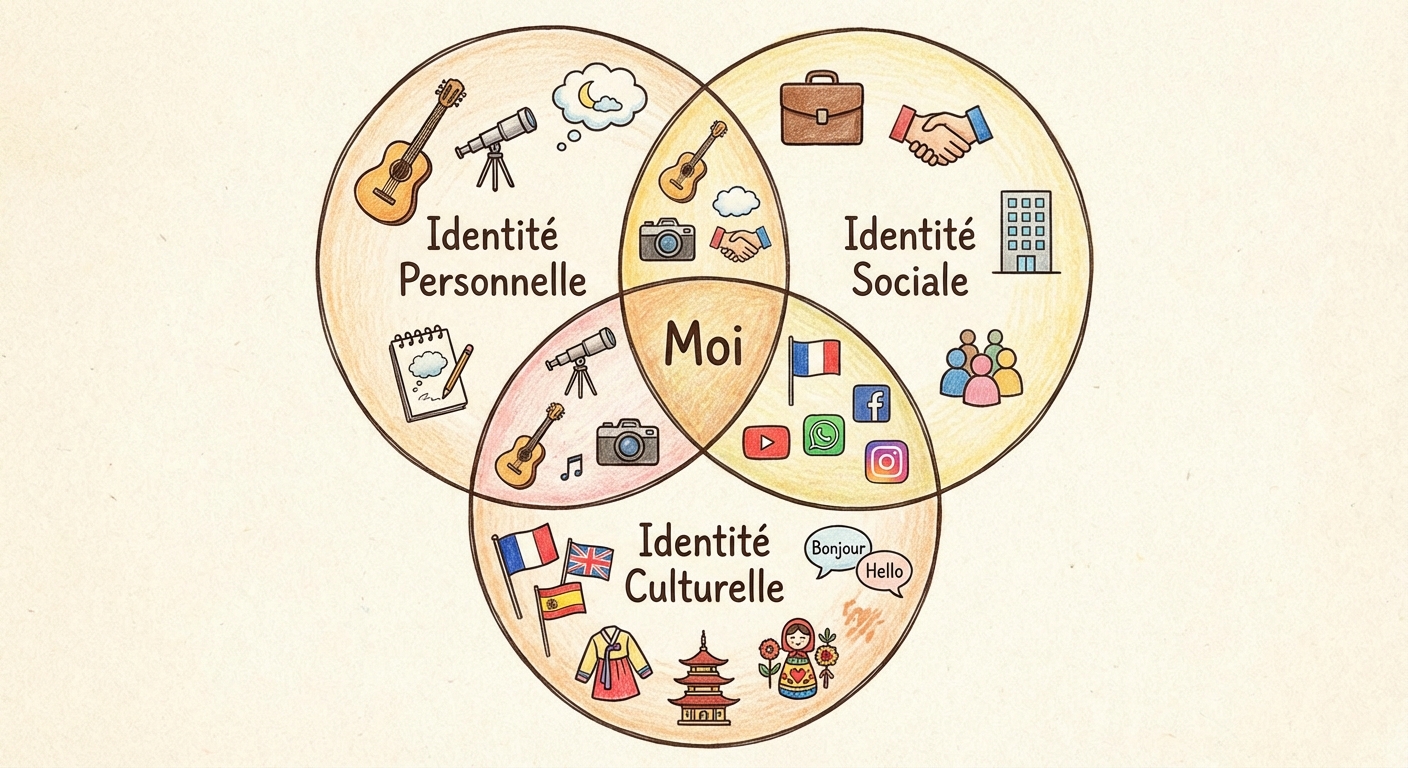
- L'identité personnelle (Private Identity): This includes your values (valeurs), beliefs (croyances), sexuality (sexualité), and personal interests (goûts personnels). It is often shaped by family and upbringing.
- L'identité publique (Public Identity): This is how you present yourself to society. It involves your profession, your citizenship, how you dress, and your social media presence.
Key Vocabulary
- L'image de soi (Self-image): How a person perceives themselves.
- L'estime de soi (Self-esteem): The value one gives to oneself.
- Le regard des autres (The gaze of others): How society's perception influences our behavior.
- L'appartenance (Belonging): The feeling of being part of a group.
Language as a Cultural Marker
Language is not merely a tool for communication; it is a vehicle for culture. In the Francophone world, language is often a political and emotional topic.
The Power of Language (Le poids des mots)
- Language and Thought: The language we speak influences how we see the world (linguistic relativity). For example, the formal "S'il vous plaît" vs. casual slang changes social dynamics.
- Accent and Dialect: Regional accents (e.g., l'accent marseillais, l'accent québécois) signal geographic roots but can unfortunately lead to discrimination (glottophobie - discrimination based on accent).
Le Verlan and Youth Identity
In France, particularly in the banlieues (suburbs), youth identity is often expressed through Le Verlan (inverting syllables; e.g., femme $\rightarrow$ meuf, lourd $\rightarrow$ relou).
- Function: It serves as a code to exclude adults/authority and solidify group membership.
- Identity: It marks a distinct "urban youth" identity that often blends French with Arabic, English, or Romani inputs.
Bilingualism and Code-Switching
For many Francophones in Africa (e.g., Senegal, Côte d'Ivoire) or North America (e.g., Quebec, Louisiana), identity is navigated through code-switching (alternating between languages).
- Example: A Senegalese student might speak Wolof at home (personal identity) and French at school (public/professional identity).
Alienation, Assimilation, and Integration
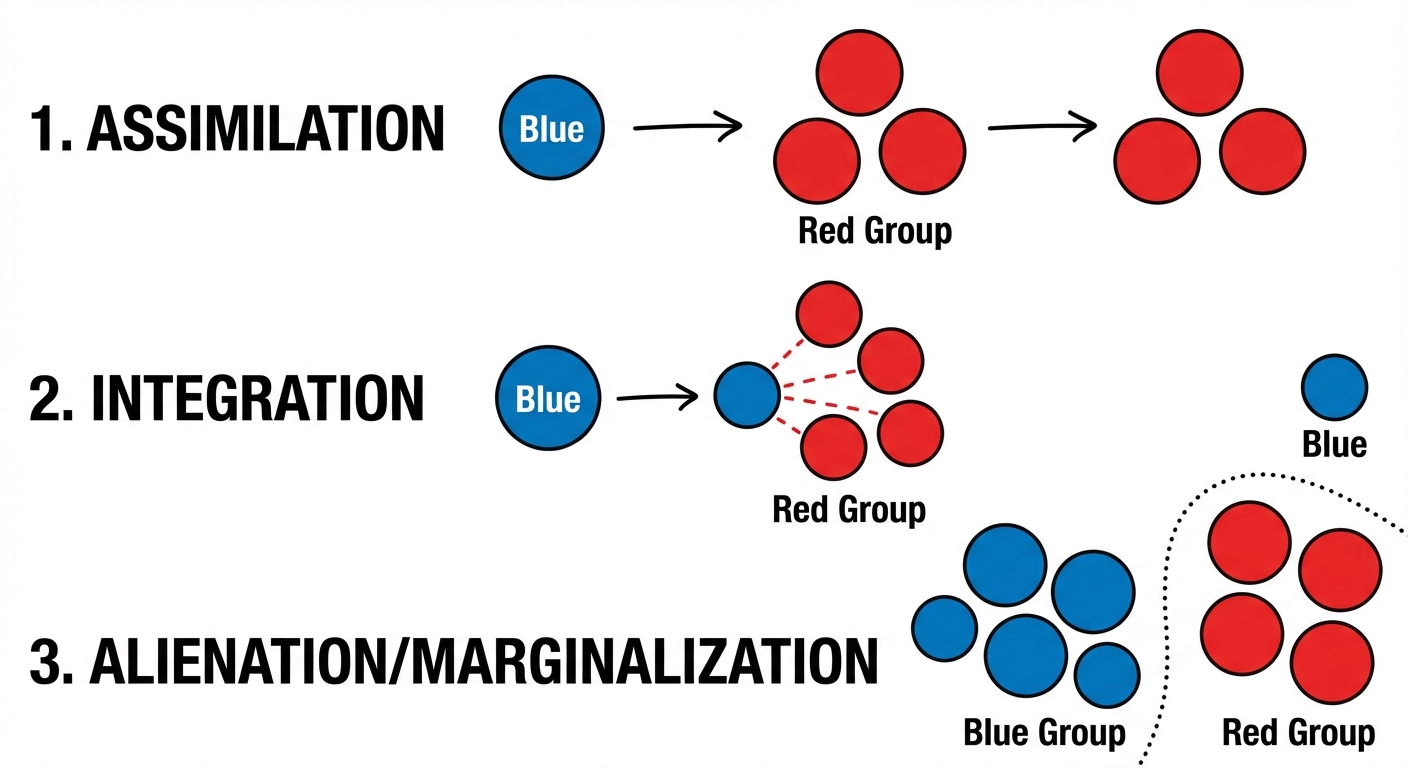
Immigration impacts identity profoundly. Students must distinguish between these three critical sociological terms.
1. L'Assimilation
- Definition: The process of fully adopting the culture of the dominant society, often at the expense of one's original culture.
- Context: Historically, France favored this model (the "Republican model"), expecting immigrants to leave their ethnic differences at home to become purely "French citizens."
- Verb: S'assimiler (to assimilate).
2. L'Intégration
- Definition: Participating fully in the new society (economic, social participation) while maintaining one's original cultural identity.
- Context: This is the modern ideal—hyphenated identities (e.g., une identité franco-algérienne).
- Verb: S'intégrer (to integrate).
3. L'Aliénation (Marginalization)
- Definition: The feeling of belonging to neither the original culture nor the new culture.
- Context: This often leads to a crisis of identity (une crise d'identité), common in "Second Generation" immigrants who feel foreign in their parents' home country but rejected by their birth country.
- Key Term: Le dépaysement (culture shock / disorientation).
The Impact of Technology on Identity
Technology acts as a mirror and a mask.
- Filters and Fake Reality: Social media allows users to curate a perfect identité publique, which often damages l'estime de soi when it doesn't match reality.
- Global Citizenship: The internet allows isolated individuals to find communities (e.g., LGBTQ+ youth in conservative areas), fostering a sense of belonging (appartenance).
- Cyber-bullying (La cyberintimidation): Attacks on online identity can have devastating real-world effects.
Cultural Spotlights (La Francophonie)
To score high on the Cultural Comparison, you need specific examples:
Quebec, Canada (La Loi 101)
- Concept: Language is the core of Québécois identity.
- Example: La Charte de la langue française (Bill 101) makes French the official language of government and courts in Quebec. Immigrants must attend school in French. This preserves their identity against the surrounding "English sea" of North America.
The Maghreb (North Africa)
- Concept: Post-colonial Identity.
- Example: In Algeria, Morocco, and Tunisia, French is a prestige language used in business/science, while Arabic/Amazigh is the language of religion and home. This creates a complex "double" identity for citizens.
France (Regional Languages)
- Concept: Revival of Heritage.
- Example: In Brittany (Bretagne) or Corsica (Corse), there is a movement to teach regional languages (le breton, le corse) in schools to reclaim an identity suppressed by the French central government in the 20th century.
Grammar Focus: Narrating Identity in the Past
When discussing how identity evolved, you must master the narrative tenses. A common exam task is telling a story about a life change.
The Timeline of Tenses
1. Le Passé Composé (The Event)
Used for actions that happened once, are completed, or interrupt a scene.
- Usage: Plot points in your story.
- Example: "J'ai déménagé en France en 2010." (I moved to France in 2010.)
2. L'Imparfait (The Context)
Used for descriptions, habits, states of mind, and background setting.
- Usage: Setting the scene or describing how you felt.
- Example: "Quand j'étais jeune, je parlais anglais." (When I was young, I used to speak English.)
3. Le Plus-que-parfait (The Flashback)
Used for actions that happened before another past action. It emphasizes the sequence of events.
- Formation: [Auxiliary in Imparfait] + [Past Participle].
- Example: "J'avais déjà appris le français avant de voyager." (I had already learned French before traveling.)
4. Comparison Table
| Feature | Passé Composé | Imparfait |
|---|---|---|
| Focus | Result / Completion | Process / Duration |
| English Equivalent | I ate / I did eat | I was eating / I used to eat |
| Mental Image | A snapshot (camera click) | A video stream (ongoing) |
| Key Triggers | Soudain, Hier, Une fois | Souvent, Tous les jours, D'habitude |
Comprehensive Vocabulary List
Verbs of Identity and Adaptation
- S'adapter (à): To adjust to a new environment.
- S'assimiler: To adopt the customs of a culture (losing one's own).
- Se conformer: To comply with rules/norms.
- Se démarquer: To stand out / distinguish oneself.
- Appartenir à: To belong to.
- S'enrichir: To enrich oneself (culturally/intellectually).
- Bouleverser: To upset/overturn (e.g., a life-changing event).
- Remettre en question: To challenge or question (beliefs).
Nouns
- L'amour-propre (m): Self-worth / self-respect.
- Le patrimoine: Heritage.
- Les aïeux / Les ancêtres: Ancestors.
- Le metissage: Cultural mixing / biracialism.
- La laïcité: Secularism (crucial concept in French public identity).
- Les mœurs (f): Customs / habits / moors of a society.
- L'argot (m): Slang.
Adjectives
- Hétérogène vs. Homogène: Diverse vs. Uniform (populations).
- Polyglotte: Speaking many languages.
- Dépayse(e): Disoriented (feeling out of place).
- Accueillant(e): Welcoming.
Common Mistakes & Pitfalls
"C'est" vs. "Il est" with Identity:
- Mistake: C'est un français. / Il est un médecin.
- Correction: C'est un Français (Noun). / Il est médecin (Profession/Adjective).
- Rule: Use Il est + unmodified profession/adjective. Use C'est + article + noun.
Confusing "Habiter" and "Vivre":
- while often interchangeable, "Vivre" implies the experience of life, while "Habiter" is strictly residence. When discussing identity, "Vivre" is often more poignant. "J'ai vécu une expérience difficile."
Imparfait Overuse:
- Mistake: Using Imparfait for everything in the past.
- Check: Did it happen once at a specific time? Use Passé Composé. Did it happen every day? Use Imparfait.
False Cognates (Faux Amis):
- Actuellement means "Currently" (at this moment), NOT "Actually" (in reality). Use En fait for "Actually."
- Caractère usually refers to personality/temperament, while Personnage is a character in a book/movie.
Agreement in Passé Composé:
- Remember that verbs using Être (Dr. & Mrs. Vandertramp + Reflexive verbs) must agree with the subject!
- Elle s'est habituée (She got used to it).
Summary
Unit 2 teaches us that identity is a negotiation. It is negotiated between our personal history (Passé Composé/Imparfait) and our future goals. It is negotiated between the language we speak at home and the language of the state. To succeed in AP French, you must be able to describe this negotiation using rich vocabulary (s'adapter, l'assimilation, les valeurs) and precise grammar.