Music Fundamentals I: Pitch, Rhythm, Meter, and Expression
Music Theory Unit 1: Fundamentals of Pitch, Rhythm, and Meter
1. Pitch and Notation
Definitions of Sound
- Pitch: The highness or lowness of a sound, determined by the frequency of the sound wave. In physics, this is measured in Hertz (Hz).
- Tone: A musical sound with a definite pitch.
- Intensity: The loudness or volume of the sound (amplitude).
- Timbre: The tone color or quality of the sound (e.g., the difference between a flute and a violin playing the same note).
The Staff and Clefs
Music is written on a staff (plural: staves), consisting of five horizontal lines and four spaces within them. Pitches are named using the first seven letters of the alphabet: A, B, C, D, E, F, G.
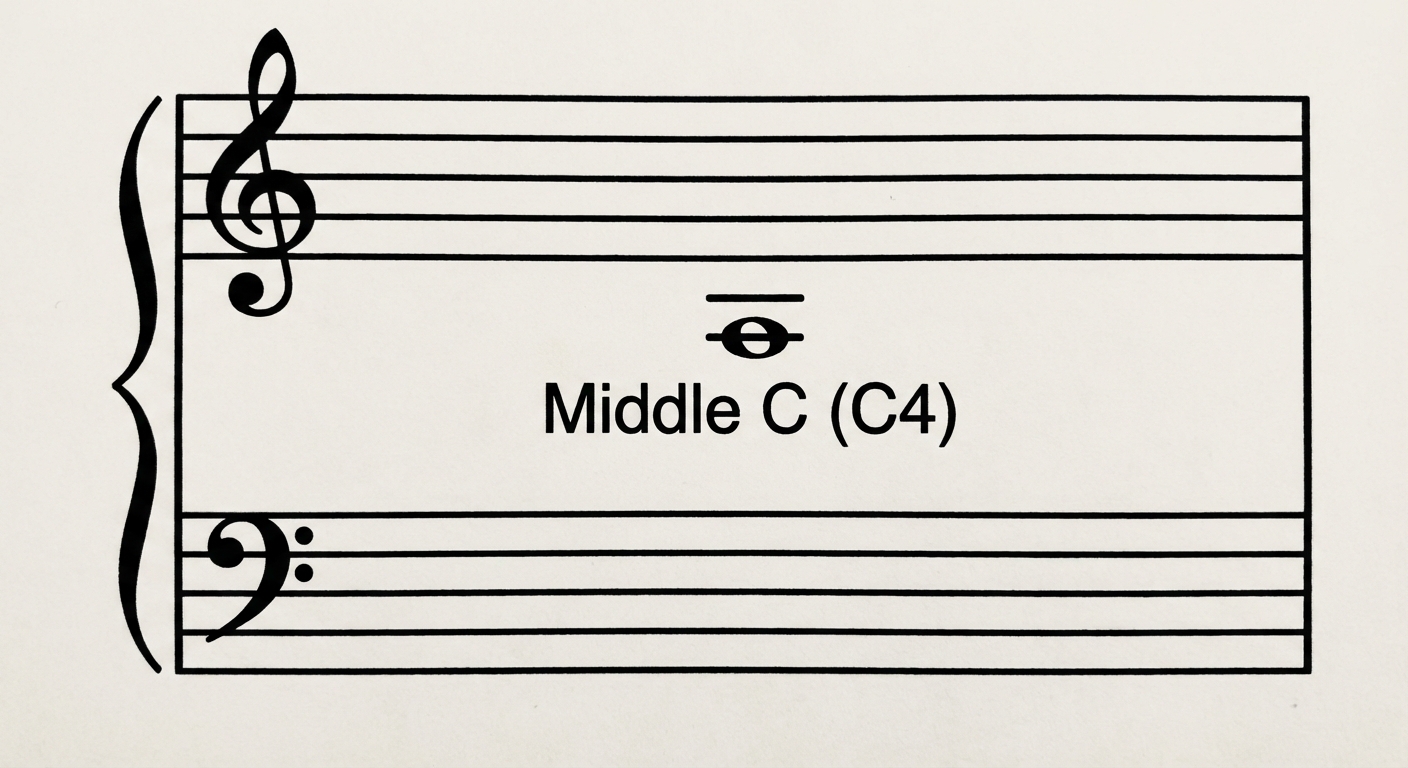
The Grand Staff
- Grand Staff: Combines two staves joined by a brace and a bar line. The top staff is typically Treble; the bottom is typically Bass.
- System: Multiple staves connected by bar lines (used for ensembles).
- Ledger Lines: Short horizontal lines added above or below the staff to extend its range.
Clef Types
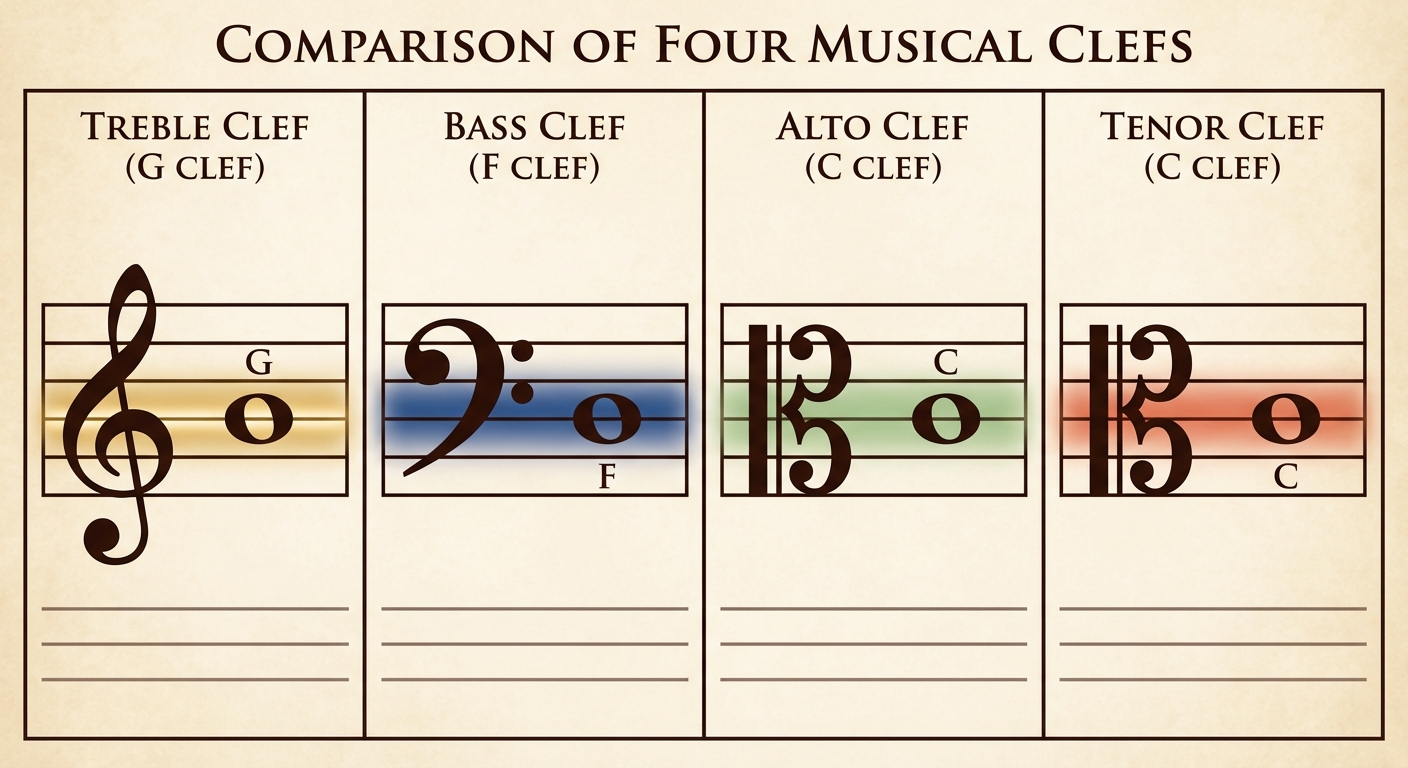
Clefs indicate which line represents a specific pitch, establishing the reference point for all other notes.
- G Clef (Treble Clef): Spirals around the second line from the bottom, identifying it as G4 (G above middle C). Used for soprano/alto voices, violin, flute, piano right hand.
- F Clef (Bass Clef): Two dots surround the fourth line from the bottom, identifying it as F3 (F below middle C). Used for tenor/bass voices, cello, tuba, piano left hand.
- C Clef (Movable): The center indentation points to Middle C (C4). It moves to accommodate different tessituras (ranges).
- Alto Clef: C clef centered on the 3rd line. Used primarily by the viola.
- Tenor Clef: C clef centered on the 4th line. Used by cello, bassoon, and trombone for high passages.
- Soprano/Mezzo-Soprano/Baritone Clefs: Obsolete C-clef positions rarely used in modern notation but historically significant.
- Neutral Clef: Used for unpitched percussion (snare drum, cymbals). It creates a rhythm map rather than a pitch map.
Accidentals and Enharmonics
Accidentals alter the pitch of a note. They are placed before the notehead usually on the same line or space.
- Sharp ($♯$): Raises pitch by one half step.
- Flat ($♭$): Lowers pitch by one half step.
- Natural ($♮$): Cancels a previous sharp or flat.
- Double Sharp (x): Raises pitch by two half steps (one whole step).
- Double Flat ($♭♭$): Lowers pitch by two half steps (one whole step).
Enharmonic Equivalence: Notes that sound the same but are spelled differently (e.g., F$♯$ and G$♭$, or C$♮$ and B$♯$).
2. Rhythm and Durational Values
Note and Rest Hierarchy
Rhythm is the organization of music in time. Durations are represented by notes (sound) and rests (silence).
| Note Name | Note Symbol | Rest Symbol | Relative Value |
|---|---|---|---|
| Whole | $\mathbf{w}$ | (rectangle hanging from line 4) | 4 beats (in 4/4) |
| Half | $\mathbf{h}$ | (rectangle sitting on line 3) | 2 beats |
| Quarter | $\mathbf{q}$ | (squiggle) | 1 beat |
| Eighth | $\mathbf{e}$ | (flag/beam) | 1/2 beat |
| Sixteenth | $\mathbf{x}$ | (2 flags/beams) | 1/4 beat |
Anatomy of a Note
- Note Head: The oval part. Open for whole/half notes; filled for quarter and smaller.
- Stem: Vertical line.
- Rule: If the note head is below the middle line (3rd line), stem goes UP (on the right). If on or above the middle line, stem goes DOWN (on the left).
- Flag: Curved stroke on the stem (always to the right). More flags = shorter duration.
- Beam: Thick horizontal line connecting stems of eighth or sixteenth notes to show rhythmic grouping (beats).
Extending Duration
- The Tie: A curved line connecting two notes of the same pitch. It combines their values into one continuous sound.
- Example: Quarter note tied to a quarter note = Duration of a half note.
- The Dot: Placed to the right of a notehead.
- Single Dot: Adds half the value of the original note.
- Formula: $Duration = Note + (0.5 \times Note)$
- Example: Dotted Half = Half + Quarter = 3 beats.
- Double Dot: Adds half the value of the first dot.
- Example: Double Dotted Quarter = Quarter + Eighth + Sixteenth.
- Single Dot: Adds half the value of the original note.
Common Mistakes: Ties vs. Slurs
Critical Distinction: A Tie connects notes of the same pitch (rhythm addition). A Slur connects notes of different pitches (articulation/legato). Do not confuse them.
3. Meter and Time Signatures
Meter is the grouping of beats into regular patterns called measures (separated by bar lines).
The Time Signature
The two numbers at the start of a piece.
- Top Number: Relates to the number of beats or pulses.
- Bottom Number: Relates to the note value representing the beat (or division).
Simple Meter
In Simple Meter, the beat is divisible by two.
- Top numbers: 2, 3, or 4.
- Top Number meaning: The number of beats per measure.
- Bottom Number meaning: The note value that gets the beat.
| Meter Type | Time Signature | Beats per Measure | Beat Unit |
|---|---|---|---|
| Simple Duple | $\frac{2}{4}$ (or $\frac{2}{2}$) | 2 | Quarter (or Half) |
| Simple Triple | $\frac{3}{4}$ (or $\frac{3}{8}$) | 3 | Quarter (or Eighth) |
| Simple Quadruple | $\frac{4}{4}$ (or $\mathbf{c}$) | 4 | Quarter |
- Common Time ($\mathbf{c}$): Shorthand for $\frac{4}{4}$.
- Cut Time / Alla Breve ($\mathbf{\cent}$): Shorthand for $\frac{2}{2}$.
Compound Meter
In Compound Meter, the beat is divisible by three. The beat unit is always a dotted note.
- Top numbers: 6, 9, or 12.
- Top Number meaning: The number of divisions (pulses) per measure.
- Bottom Number meaning: The note value of the division.
To find the beat:
- Divide the top number by 3 = Number of beats.
- Sum three of the bottom notes = The beat unit (a dotted note).
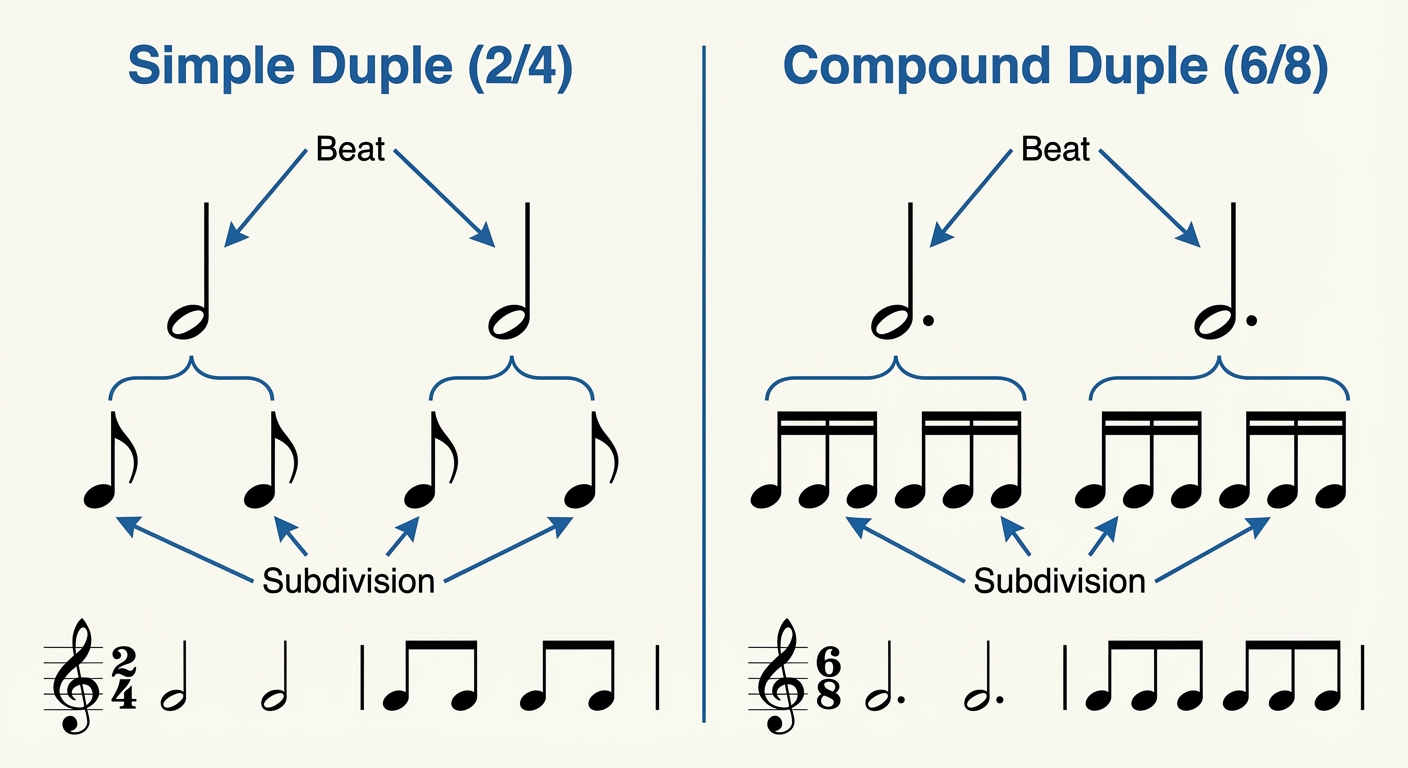
| Meter Type | Time Signature | Beats per Measure | Beat Unit | Subdivision |
|---|---|---|---|---|
| Compound Duple | $\frac{6}{8}$ | 2 | Dotted Quarter | 6 Eighths |
| Compound Triple | $\frac{9}{8}$ | 3 | Dotted Quarter | 9 Eighths |
| Compound Quadruple | $\frac{12}{8}$ | 4 | Dotted Quarter | 12 Eighths |
Asymmetrical (Odd) Meter
Meters with unequal beat lengths, usually combining simple and compound beats. The top number is often 5 or 7.
- 5/8: Often grouped as 3+2 or 2+3.
- 7/8: Often grouped as 2+2+3 or 3+2+2.
Rhythmic Devices / Metric Anomalies
- Syncopation: Stressing the weak beat or the off-beat.
- Hemiola: A shift in the rhythmic pulse from a division of 2 to a division of 3 (or vice-versa), e.g., feeling 3 half notes over two measures of 3/4 time.
- Anacrusis (Pickup): Notes preceding the first full measure (downbeat).
- Cross-rhythm (Polyrhythm): Two different rhythmic pulses occurring simultaneously (e.g., 2 against 3).
4. Scales, Keys, and Intervals
Half Steps and Whole Steps
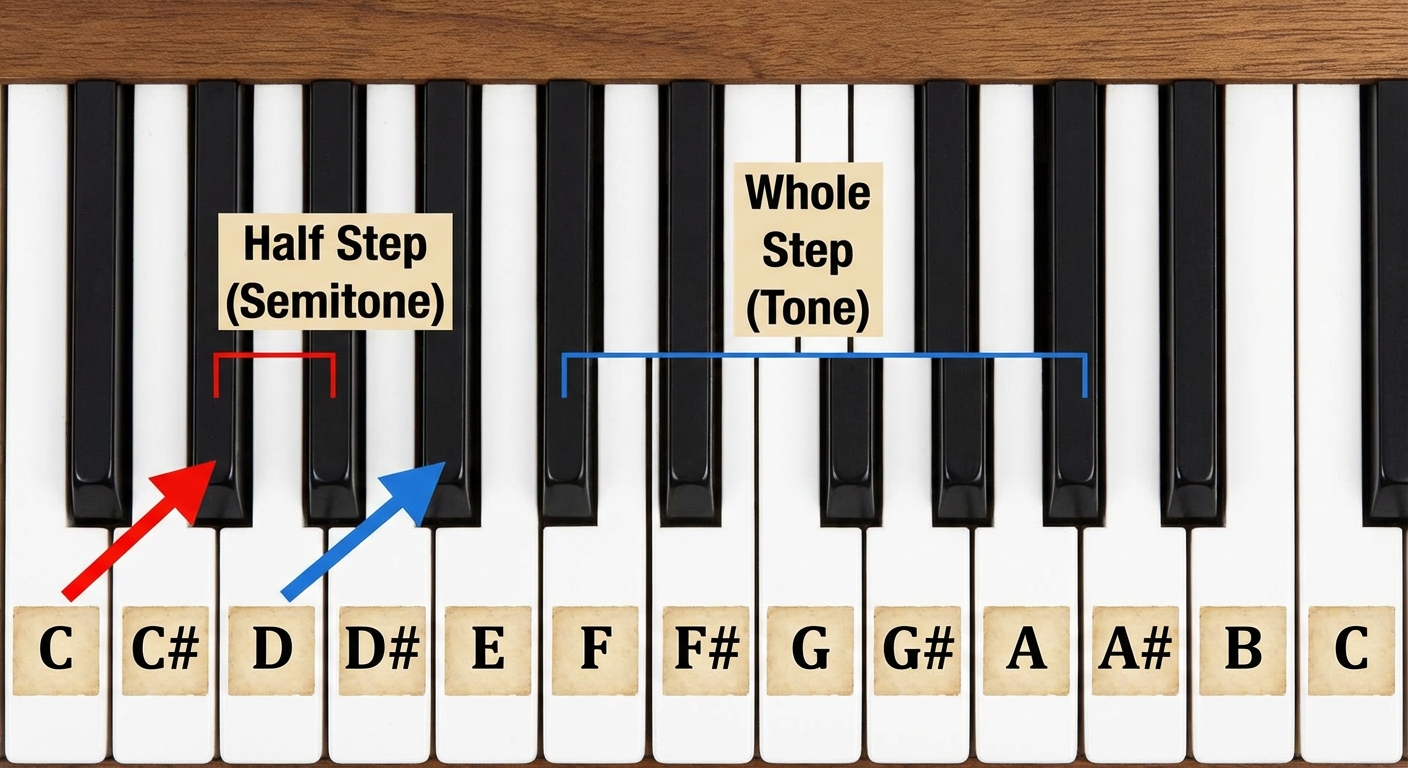
- Half Step (Semitone): The smallest distance between two notes in Western tonal music (e.g., C to C$♯$, E to F).
- Chromatic Half Step: Same letter name (C to C$♯$).
- Diatonic Half Step: Different letter names (C to D$♭$).
- Whole Step (Tone): Equivalent to two half steps (e.g., C to D, E to F$♯$).
The Major Scale
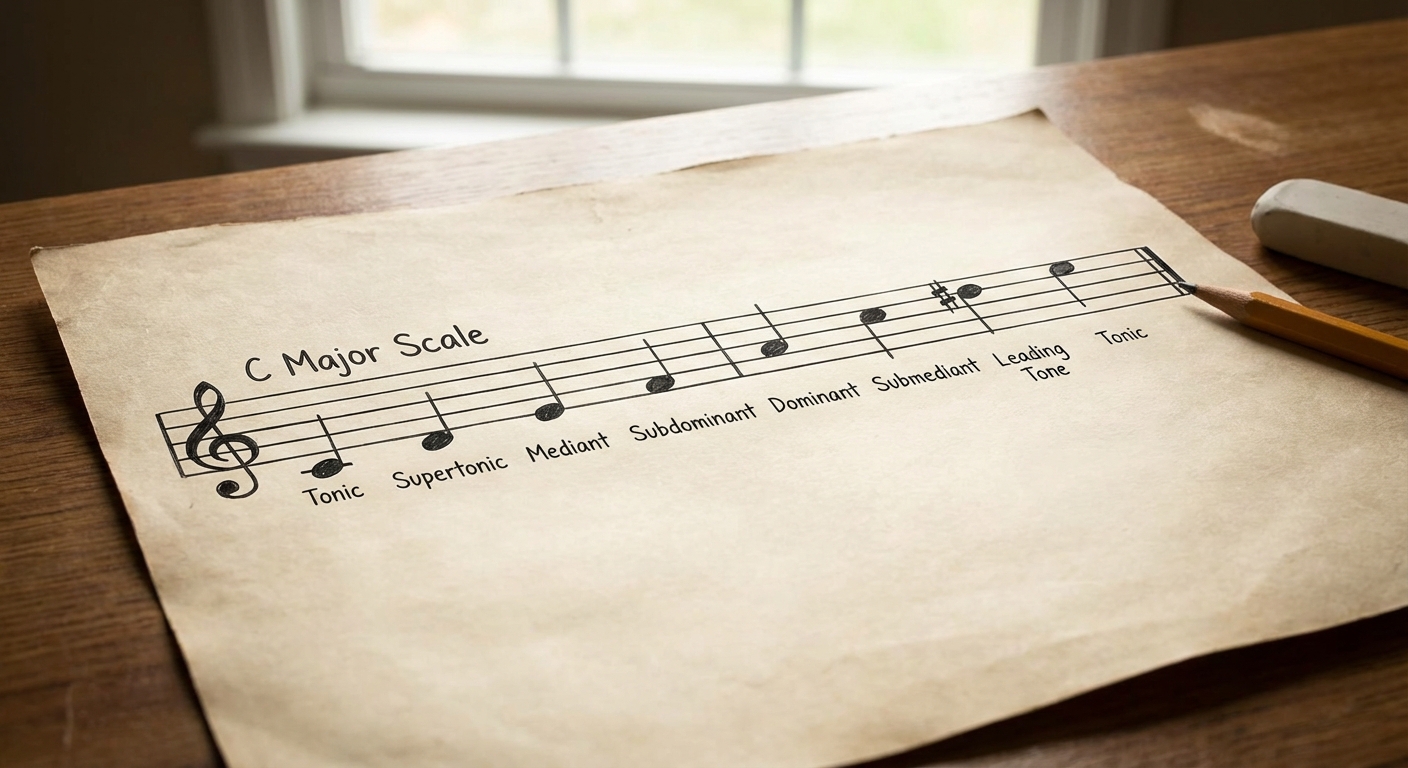
A specific sequence of whole tones (W) and half tones (H). This pattern is asymmetrical, which establishes the key center (Tonic).
Pattern:
(Visual Check: C Major on piano is all white keys because E-F and B-C are naturally half steps)
Scale Degrees
Every note in a scale has a functional name indicating its relationship to the Tonic.
| Degree | Name | Function |
|---|---|---|
| $\hat{1}$ | Tonic | The home note; stable. |
| $\hat{2}$ | Supertonic | One step above tonic. |
| $\hat{3}$ | Mediant | Middle way between Tonic and Dominant. |
| $\hat{4}$ | Subdominant | Lower dominant ($5^{th}$ below tonic). |
| $\hat{5}$ | Dominant | Second most important note; pulls to Tonic. |
| $\hat{6}$ | Submediant | Middle way between Tonic and Subdominant. |
| $\hat{7}$ | Leading Tone | One half step below Tonic; strong pull up to resolution. |
Key Signatures and The Circle of Fifths
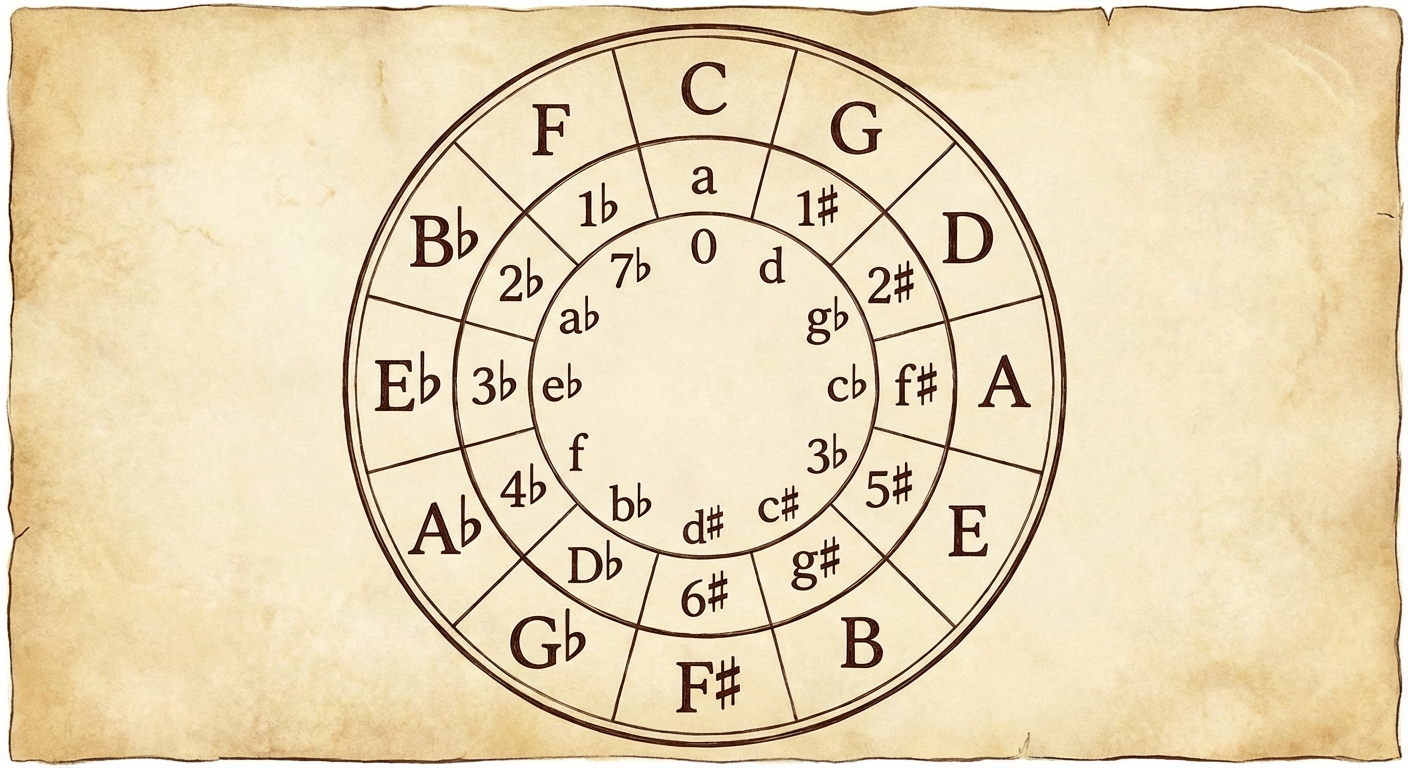
The Key Signature is the arrangement of sharps or flats at the beginning of the staff. It indicates which notes are consistently altered.
Order of Accidentals
If you memorize these orders, you can build any key signature.
- Order of Sharps: Fat Cats Go Down Alleys Eating Birds (F C G D A E B)
- Order of Flats: Be Ever And During Great Cause Father (B E A D G C F) (Notice it is the sharp order reversed)
Identification Rules
- Sharp Keys: Look at the last sharp on the right. The Key is one half-step UP from that sharp.
- Example: Last sharp is C$♯$ $\rightarrow$ Key is D Major.
- Flat Keys: Look at the second to last flat. That flat is the name of the Key.
- Example: Flats are B$♭$, E$♭$, A$♭$. Second to last is E$♭$. Key is E$♭$ Major.
- Exception: F Major has only one flat (B$♭$). Memorize this.
Intro to Intervals (Quantity and Quality)
While Unit 2 covers this in depth, specific terminology is introduced in Unit 1.
- Interval: Distance between two pitches.
- Harmonic: Played together.
- Melodic: Played sequentially.
- General Rules: intervals 1, 4, 5, 8 are Perfect. Intervals 2, 3, 6, 7 are Major (in a major scale context).
- Consonance: Stable, restful intervals (P1, P5, P8, M3, m3, M6, m6).
- Dissonance: Unstable, tense intervals requiring resolution (M2, m2, M7, m7, P4 in some contexts, Tritone).
5. Expressive Elements
Tempo (Speed)
Standard Italian terms are used to designate speed.
- Largo: Very, very slow (broad).
- Adagio: Slow.
- Andante: Walking pace.
- Moderato: Moderate.
- Allegro: Fast, cheerful.
- Presto: Very fast.
- Ritardando (rit.): Gradually slowing down.
- Accelerando (accel.): Gradually speeding up.
- A tempo: Return to original speed.
Dynamics (Volume)
- Pianissimo ($pp$): Very soft.
- Piano ($p$): Soft.
- Mezzo Piano ($mp$): Moderately soft.
- Mezzo Forte ($mf$): Moderately loud.
- Forte ($f$): Loud.
- Fortissimo ($ff$): Very loud.
- Crescendo (
- Decrescendo / Diminuendo (>): Gradually softer.
Articulation
- Staccato: Short, detached (dot above note).
- Legato: Smooth, connected (slur).
- Tenuto: Hold for full value, slightly stressed (line above note).
- Accent: Emphasize the note (marked >).
- Marcato: Stronger accent, "marked" (carrot top ^).
- Fermata: Hold note longer than indicated value (bird's eye symbol).
Common Mistakes to Avoid in Unit 1
- Confusing Meter: Thinking 6/8 is "simple" because 6 is an even number. Wrong. 6 is a multiple of 3. 6/8 is Compound Duple (2 beats, divided into triplets).
- Stem Direction: Forgetting that on the middle line (B in treble), the stem goes DOWN.
- Scale Degree Names: Mixing up Mediant (3rd) and Submediant (6th).
- Enharmonics: Forgetting that C$♭$ sounds like B Natural, or E$♯$ sounds like F Natural.
- Key Signatures: Misidentifying the key of F Major. It is a flat key, but the rule "second to last flat" doesn't work because there is only one. Memorize: F Major = 1 Flat.